
In the contemporary automotive industry, the shift towards new energy vehicles has intensified the demand for lightweight, high-speed, safe, comfortable, and energy-efficient solutions. To achieve these goals, advancements in materials and technologies are pivotal, with the use of lightweight materials being a critical strategy for reducing vehicle weight. Aluminum alloys, due to their low density, high strength comparable to premium steel, excellent plasticity, ease of processing, and superior electrical conductivity, thermal conductivity, and corrosion resistance, have become widely adopted in automotive manufacturing. They are now the second most used alloy after steel in the automotive sector. However, existing aluminum alloy body components often suffer from insufficient strength and stability, leading to local deformation that can compromise vehicle performance and lifespan. This issue is frequently linked to heat treatment defects arising from suboptimal processing, such as incomplete dissolution of phases or inadequate quenching, which result in residual stresses and microstructural inhomogeneities. Therefore, optimizing heat treatment processes is essential to mitigate these heat treatment defects and enhance the mechanical properties of aluminum castings.
Common manufacturing methods for aluminum alloy components include forging and casting, with casting alloys gaining prominence due to cost advantages and the ability to be strengthened through heat treatment. For instance, heat-treatable casting aluminum alloys can achieve enhanced performance via solution treatment and aging, making them suitable for automotive applications. Previous studies have explored various aspects: for example, research on A356 cast aluminum wheels investigated the influence of solution parameters on mechanical properties, while studies on 6005A cast aluminum highlighted the need for high quenching rates and short dwell times to meet performance requirements. Orthogonal experimental methods have also been employed to analyze factors affecting mechanical properties and derive optimal heat treatment routes. Despite these efforts, heat treatment defects like distortion, porosity, and reduced ductility remain prevalent, underscoring the necessity for refined processes. In this context, this article focuses on the heat treatment optimization for an automotive under-tray aluminum casting, aiming to improve mechanical performance and provide insights for manufacturers. By addressing typical heat treatment defects, such as those caused by improper cooling or insufficient aging, we can achieve better material consistency and reliability.
Aluminum alloys exhibit unique heat treatment characteristics due to their composition and lack of allotropic transformation. Unlike steels, which rely on phase changes for strengthening, aluminum alloys achieve enhancement through solution treatment and age hardening. This involves dissolving alloying elements and secondary phases into the matrix during solution treatment, followed by controlled precipitation of fine strengthening phases during aging. However, not all aluminum alloys are heat-treatable; for instance, alloys like ZL102 (Al-Si series), ZL302 (Al-Mg series), and ZL401 (Al-Zn series) offer excellent castability but cannot be strengthened via heat treatment due to their inherent properties. For heat-treatable alloys, the primary goals of heat treatment include: (1) strengthening the alloy by improving microstructure, thereby enhancing mechanical properties, machinability, and weldability; (2) relieving internal stresses induced during casting due to uneven cooling, which stabilizes the structure and dimensional accuracy; and (3) preventing volume changes from high-temperature phase transformations, eliminating segregation, and promoting homogenization. Failure to achieve these goals can lead to various heat treatment defects, such as cracking, warping, or reduced corrosion resistance, which compromise component integrity.
The heat treatment process is influenced by alloy composition, which directly affects mechanical properties and the susceptibility to heat treatment defects. For example, elements like silicon, magnesium, and manganese play key roles in precipitation hardening, but imbalances can cause issues like hot tearing or porosity. The general mechanism involves solution treatment at elevated temperatures to maximize solid solubility, followed by rapid cooling to retain a supersaturated solid solution. Aging then precipitates fine particles that impede dislocation motion, increasing strength. However, deviations in parameters—such as temperature, time, or cooling rate—can introduce heat treatment defects. Common issues include over-aging (leading to softness), under-aging (resulting in insufficient strength), or quench cracking due to thermal stresses. Thus, precise control is vital to minimize these heat treatment defects and achieve optimal performance.
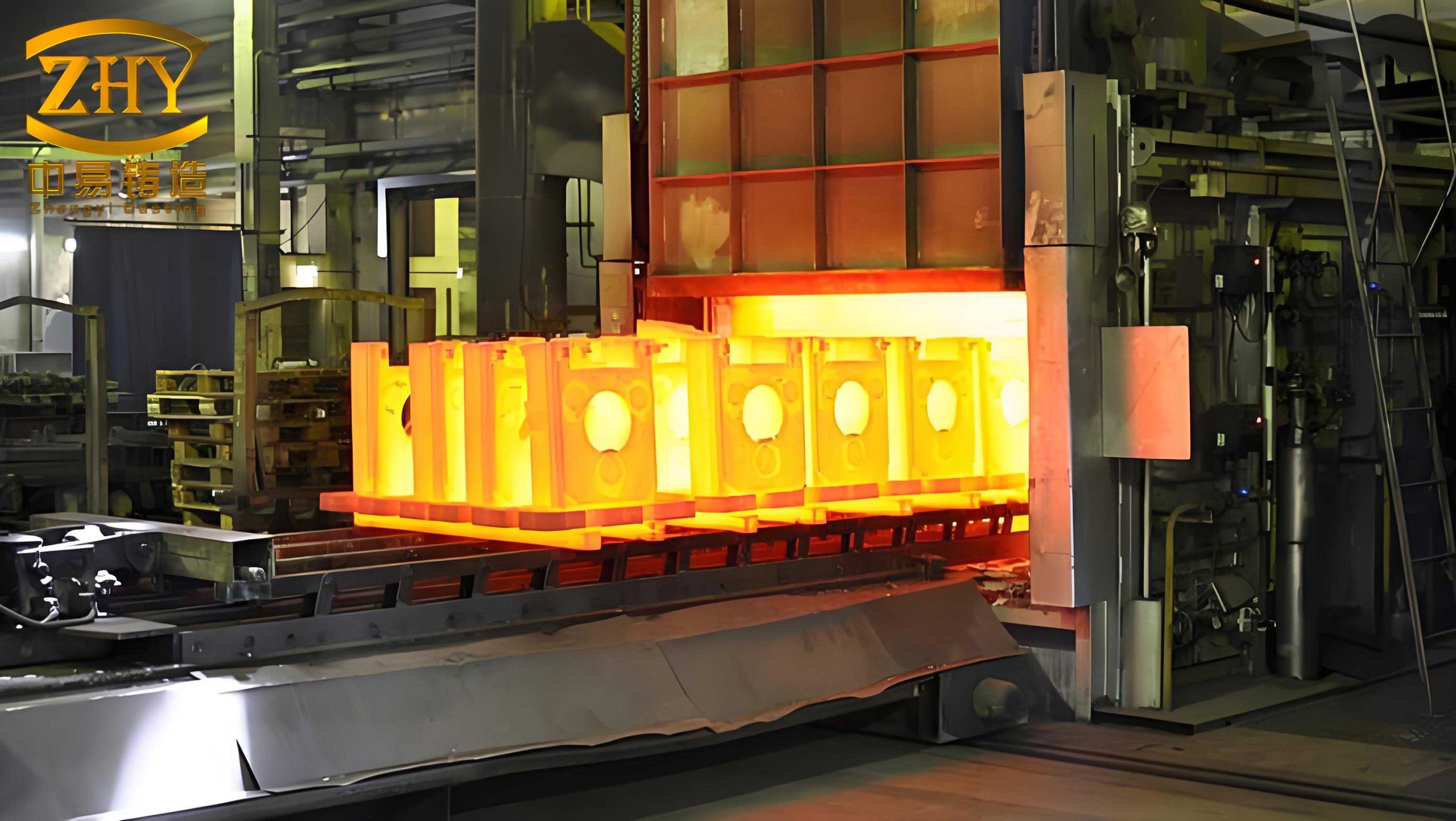
In this study, we utilized an Al-Si series alloy, specifically AlSi10MnMg, conforming to standard GB/T 20975.25-2008. The material composition was analyzed using inductively coupled plasma atomic emission spectroscopy on three samples, with results summarized in Table 1. This alloy was selected for its balance of castability and heat-treatability, though improper processing can exacerbate heat treatment defects like silicon segregation or magnesium oxide formation.
| Test Item | Sample 1# | Sample 2# | Sample 3# | Limit Requirements | Result |
|---|---|---|---|---|---|
| Si | 10.36% | 10.22% | 11.21% | 9.0-11.5% | Compliant |
| Mn | 0.462% | 0.467% | 0.480% | 0.40-0.80% | Compliant |
| Mg | 0.282% | 0.290% | 0.292% | 0.10-0.60% | Compliant |
| Fe | 0.205% | 0.204% | 0.218% | ≤0.25% | Compliant |
| Cu | 0.015% | 0.015% | 0.015% | ≤0.05% | Compliant |
| Zn | 0.014% | 0.014% | 0.015% | ≤0.07% | Compliant |
| Ti | 0.016% | 0.016% | 0.016% | ≤0.20% | Compliant |
| Al | 88.62% | 88.75% | 87.73% | Balance | Compliant |
The under-tray casting, produced via high-vacuum die-casting, exhibited several issues prior to heat treatment: tensile strength below 230 MPa, yield strength under 180 MPa, elongation less than 5%, and a gas leakage rate of 0.35 kPa/min during pressure testing, indicating significant deformation due to low strength. Additionally, threaded holes lacked sufficient strength, leading to stripping and loosening during assembly. These problems are classic examples of heat treatment defects stemming from inadequate strengthening and residual stresses. To address this, we designed an optimized heat treatment process aimed at reducing such heat treatment defects through controlled parameters.
The heat treatment protocol was established after repeated trials: solution treatment at 520°C for 2 hours to dissolve soluble phases, followed by forced air cooling for 2 hours to room temperature to achieve rapid quenching and retain a supersaturated solid solution. This was succeeded by artificial over-aging at 230°C for 2 to 5 hours to slightly reduce strength while improving plasticity and dimensional stability. The temperature profile can be described by a piecewise function, where the solution stage maintains a constant temperature, and the cooling phase approximates an exponential decay: $$ T(t) = T_{\text{room}} + (T_{\text{solution}} – T_{\text{room}}) \cdot e^{-kt} $$ for cooling, with \( k \) representing the cooling rate constant. This careful control helps mitigate heat treatment defects like quench distortion or incomplete precipitation.
Post-treatment, we evaluated the castings through mechanical testing, torque assessment, and leak testing. Three specimens were extracted from heat-treated castings and tested on a 300 kN electronic universal testing machine per ASTM B557-15. The results, shown in Table 2, demonstrate significant improvement: tensile strength exceeded 230 MPa, yield strength surpassed 180 MPa, and elongation rose above 5%. These enhancements indicate a reduction in heat treatment defects such as brittle failure or low ductility.
| Sample No. | Tensile Strength (≥230 MPa) | Yield Strength (≥180 MPa) | Elongation (≥5%) | Conclusion |
|---|---|---|---|---|
| 1# | 286 MPa | 217 MPa | 5.2% | Compliant |
| 2# | 256 MPa | 209 MPa | 6.3% | Compliant |
| 3# | 279 MPa | 235 MPa | 5.5% | Compliant |
Torque testing was conducted on three random samples, with six threaded holes per sample evaluated for installation torque. The requirement was a tightening torque ≥15 N·m, withstanding over 10 assembly cycles without failure, and no rotation or detachment of steel inserts when反向 torqued to 8 N·m. As summarized in Table 3, all samples met these criteria, confirming that heat treatment effectively bolstered thread strength and minimized heat treatment defects like micro-cracking or stress corrosion.
| Sample ID | Torque Requirement | Steel Insert 1 | Steel Insert 2 | Steel Insert 3 | Steel Insert 4 | Steel Insert 5 | Steel Insert 6 |
|---|---|---|---|---|---|---|---|
| 1# | Forward: 15 N·m | Achieved | Achieved | Achieved | Achieved | Achieved | Achieved |
| Reverse: 8 N·m | Achieved | Achieved | Achieved | Achieved | Achieved | Achieved | |
| 2# | Forward: 15 N·m | Achieved | Achieved | Achieved | Achieved | Achieved | Achieved |
| Reverse: 8 N·m | Achieved | Achieved | Achieved | Achieved | Achieved | Achieved | |
| 3# | Forward: 15 N·m | Achieved | Achieved | Achieved | Achieved | Achieved | Achieved |
| Reverse: 8 N·m | Achieved | Achieved | Achieved | Achieved | Achieved | Achieved |
Leak testing, performed on ten random samples, involved applying ≥20 kPa pressure for 1 minute and measuring leakage rate, with a pass criterion of ≤0.1 kPa/min. Results in Table 4 show all samples compliant, indicating minimal deformation and stable dimensions post-heat treatment. This success underscores the process’s efficacy in averting heat treatment defects related to residual stresses or micro-porosity.
| Sample No. | Specification | Leakage Rate (kPa/min) | Assessment |
|---|---|---|---|
| 1 | ≤0.1 kPa/min | 0.011 | OK |
| 2 | 0.009 | OK | |
| 3 | 0.023 | OK | |
| 4 | 0.033 | OK | |
| 5 | 0.018 | OK | |
| 6 | 0.027 | OK | |
| 7 | 0.043 | OK | |
| 8 | 0.026 | OK | |
| 9 | 0.022 | OK | |
| 10 | 0.038 | OK |
To further analyze the impact of heat treatment on defect reduction, we can model the strength improvement using a simplified precipitation hardening equation: $$ \Delta \sigma = \frac{Gb}{L} $$ where \( \Delta \sigma \) is the strength increase, \( G \) is the shear modulus, \( b \) is the Burgers vector, and \( L \) is the precipitate spacing. Optimized aging reduces \( L \), enhancing strength while avoiding over-aging defects. Additionally, residual stress relief can be quantified via the relationship: $$ \sigma_{\text{residual}} = E \cdot \alpha \cdot \Delta T $$ with \( E \) as Young’s modulus, \( \alpha \) as thermal expansion coefficient, and \( \Delta T \) as temperature gradient during cooling. Controlled cooling minimizes \( \Delta T \), thereby reducing heat treatment defects like warping.
In conclusion, the optimized heat treatment process—520°C solution treatment for 2 hours, forced air cooling for 2 hours to room temperature, and artificial over-aging at 230°C for 2–5 hours—significantly enhances the mechanical properties and dimensional stability of automotive under-tray aluminum castings. This approach effectively mitigates common heat treatment defects, such as low strength, residual stresses, and microstructural instability, leading to improved performance in torque retention and leak tightness. For future work, exploring dynamic aging cycles or integrating computational modeling could further refine processes and reduce heat treatment defects in complex geometries. Ultimately, addressing these heat treatment defects is crucial for advancing lightweight automotive components and supporting sustainable manufacturing goals.