
The pursuit of lightweight, high-strength components for critical structural applications, such as underwater equipment, has driven the extensive adoption of aluminum alloy cylinder castings. The reliability of these components is fundamentally governed by the dimensional accuracy of their internal cavities, internal soundness, and mechanical properties. In service environments, these cylinders endure complex loading scenarios including sustained hydrostatic pressure, corrosion, and vibration. The presence of dimensional deviations in the internal cavity or internal discontinuities such as shrinkage porosity and inclusions can severely compromise sealing performance, induce stress concentrations, and lead to premature structural failure, posing significant operational safety risks. While advanced foundry techniques like 3D printed sand cores combined with counter-pressure casting offer remarkable improvements in cavity definition and internal density, a persistent and critical challenge remains: the control of heat treatment defects, primarily dimensional distortion, in large, thin-walled structures with non-uniform wall thickness. These heat treatment defects manifest as warping, ovality deviations, and localized buckling, often exceeding permissible tolerances and necessitating costly corrective machining that undermines production efficiency and cost-effectiveness.
1. The Core Challenge: Unveiling the Genesis of Distortion
The archetypal cylinder structure—featuring end closures and a central barrel section—inherently possesses significant variations in wall thickness. While the barrel may have a nominal wall thickness of 12-15 mm, the junction areas at the end closures can accumulate thicknesses of 20-30 mm or more. This geometrical disparity sets the stage for a cascade of thermally-driven stresses throughout the manufacturing cycle, culminating in pronounced heat treatment defects.
The distortion mechanism is a multi-stage process rooted in thermal gradients and phase transformations:
Stage 1: Casting Solidification & Residual Stress Buildup. During solidification, thin sections cool and solidify rapidly, while thick sections remain in a semi-solid or liquid state for a longer duration. This differential contraction generates locked-in thermal stresses. The final stress state in the as-cast condition, $\sigma_{cast}$, can be conceptually related to the temperature difference $\Delta T_{solid}$ and the constraint factor $C_g$ of the geometry:
$$
\sigma_{cast} \propto E \cdot \alpha \cdot \Delta T_{solid} \cdot C_g
$$
where $E$ is Young’s modulus and $\alpha$ is the coefficient of thermal expansion. These initial residual stresses provide the baseline for subsequent thermal processing.
Stage 2: Solution Treatment & Stress Reconfiguration. During heating to the solution temperature (e.g., ~535°C for Al-Si-Mg alloys), the cast structure attempts to expand. Non-uniform heating rates can create new thermal gradients. More critically, the yield strength of the alloy drops dramatically at elevated temperatures. This allows the initial residual stresses to be partially relieved through creep and plastic flow, effectively “resetting” the stress state. However, if heating is too rapid, surface overheating can create a reverse stress gradient.
Stage 3: Quenching & The Peak Stress Generation. This is the most critical phase for inducing heat treatment defects. Upon rapid cooling (quenching), the surface layers contract immediately while the core remains hot and expanded. This creates immense tensile stress on the surface ($\sigma_s$) and compressive stress in the core ($\sigma_c$). The magnitude is directly governed by the cooling rate $q$ and the associated thermal gradient $\nabla T$:
$$
\sigma_s \approx – \sigma_c \propto \frac{E \alpha}{1-\nu} \cdot \int (\nabla T(q, t)) \, dt
$$
where $\nu$ is Poisson’s ratio. When these transient thermal stresses exceed the temperature-dependent yield strength of the material, permanent plastic deformation occurs. For a cylinder, this often manifests as bending (axial distortion) or ovalization (radial distortion).
Stage 4: Aging & Stress Stabilization. While artificial aging (T6 temper) primarily aims for precipitation hardening, it also subjects the part to another thermal cycle. This can lead to further stress relaxation or, if not controlled, can “lock in” the distorted shape by relieving the elastic portion of the stress field supporting the distortion.
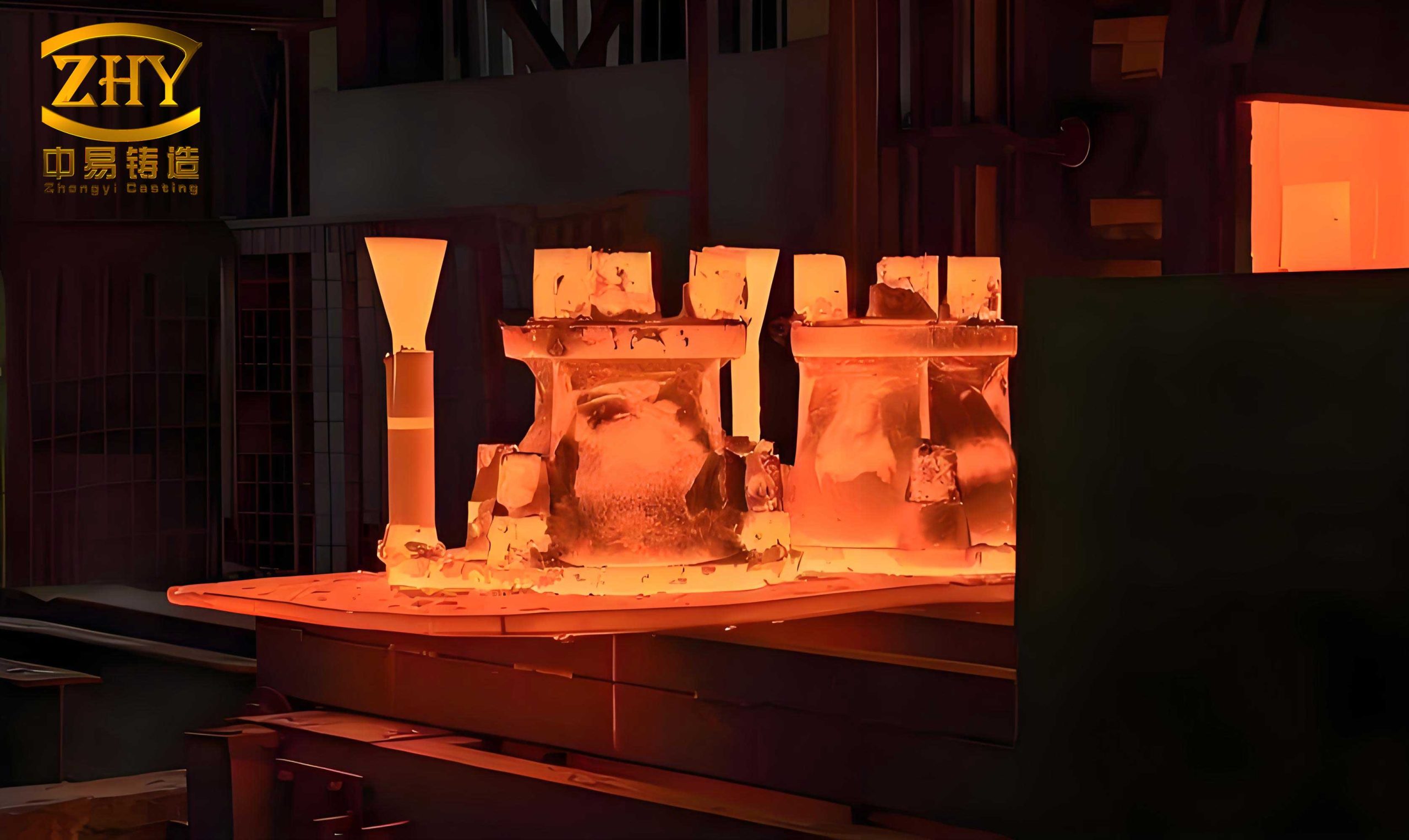
The traditional approach of solely modifying heat treatment parameters—slowing heating/cooling rates—has proven insufficient for large, thin-walled cylinders. It merely reduces the driving force ($\nabla T$) without addressing the fundamental structural susceptibility. This underscores the need for a holistic “Process-Structure”协同 optimization strategy to tackle these complex heat treatment defects.
2. A Synergistic Optimization Framework: Process and Structure
To systematically combat distortion, we propose and implement a dual-path optimization framework targeting both the thermal process inputs and the structural response of the casting itself.
2.1 Process Path Optimization: Mitigating the Thermal Driving Force
The objective here is to minimize the thermal gradients ($\nabla T$) throughout the heat treatment cycle, thereby reducing the source term for stress generation. The optimized parameters are contrasted with a conventional baseline in the table below.
| Process Parameter | Conventional Baseline | Optimized Protocol | Rationale & Impact on Heat Treatment Defects |
|---|---|---|---|
| Initial Charge Temperature | < 300°C | < 150°C | Reduces thermal shock and initial heating gradient, minimizing early plastic strain. |
| Heating Rate to Intermediate Hold | ~100°C/h (direct) | 80°C/h to 400°C | Slower rate allows temperature homogenization, reducing $\nabla T$ before high-temp soak. |
| Intermediate Soak | None | 2 hours at 400°C | Critical for equalizing temperature in thick/thin sections, mitigating stress from non-uniform expansion. |
| Heating Rate to Solution Temp | ~100°C/h | 60°C/h (400°C to 535°C) | Further control of gradient in the high-temp, low-yield-strength regime. |
| Solution Soak Time | 6 hours at 535°C | 8 hours at 535°C | Ensures complete dissolution of soluble phases and more uniform microstructure, promoting homogeneous properties. |
| Quench Medium Temperature | Water at 20-40°C | Water at 70°C | Single most effective change. Raisates quenchant temperature ($T_q$), dramatically lowering initial cooling rate $q$ and peak $\nabla T$, directly reducing quench stress magnitude. The cooling rate must remain above the critical quenching rate for the alloy to avoid deleterious precipitation. |
| Post-Quench Thermal Aging (Stress Relief) | Not specifically applied for stress relief | 3 hours at 150-200°C | Specifically targets the residual stress field after quenching. Applies a low-temperature thermal cycle to promote microplasticity and relax residual stresses without significantly affecting mechanical properties from aging. |
The thermal profile of this optimized process effectively “softens” the thermal shock, as illustrated by the following conceptual comparison of temperature vs. time gradients between surface ($T_s$) and core ($T_c$):
$$
\text{Conventional: } \max(|T_s(t) – T_c(t)|) \text{ is LARGE during heating and very LARGE during quenching.}
$$
$$
\text{Optimized: } \max(|T_s(t) – T_c(t)|) \text{ is MEDIUM during heating and MEDIUM-SMALL during quenching.}
$$
2.2 Structural Path Optimization: Enhancing Resistance to Distortion
Process optimization reduces the force causing distortion. Structural optimization increases the casting’s stiffness to resist that force. For a large cylinder, two primary distortion modes must be addressed: Axial Bending and Radial Ovalization/Collapse.
2.2.1 Axial Stiffener Design
Axial bending often occurs during quenching due to non-symmetric cooling or inherent stress imbalances. Stiffeners are integrated along the longitudinal axis of the cylinder barrel. Their design is not arbitrary; they are strategically converted from existing process features. The side walls of the cylinder, which often incorporate a vertical feeding channel (a “knife gate”) during casting, are designed so that after knock-off, the remaining ridge forms a natural longitudinal stiffener. The effectiveness of a stiffener in increasing bending resistance is proportional to its area moment of inertia, $I$. For a rectangular stiffener of width $b$ and height $h$, $I = \frac{bh^3}{12}$. The anti-bending stiffness $K_{bend}$ of the cylinder with ‘n’ such stiffeners is enhanced:
$$
K_{bend,stiffened} \approx K_{bend,plain} + n \cdot C \cdot E \cdot I
$$
where $C$ is a geometric coupling factor. By increasing $K_{bend}$, the axial deflection $\delta$ under a given thermal moment $M_{th}$ is reduced: $\delta \propto M_{th} / K_{bend}$.
2.2.2 Radial Stiffener (Tie-Bar) Design
Radial distortion is a primary heat treatment defect for large-diameter cylinders, especially in areas with internal ring ribs that create localized thick sections. To prevent ovalization or inward collapse of these rings during quenching, radial tie-bars are incorporated. These are internal connectors that link opposite sides of an internal cavity or ring, placed in areas not critical to final function. Typically, 4 to 6 tie-bars are spaced evenly around the circumference. They work by providing a direct tensile/compressive load path that counteracts the circumferential thermal stresses trying to change the ring’s shape. Their effect can be modeled as adding a radial spring constant $k_r$ that opposes the deformation force $F_{def}$ causing ovalization. The resulting radial displacement $u_r$ is reduced:
$$
u_r = \frac{F_{def}}{k_{cylinder} + k_{tie-bars}}
$$
The following table summarizes the structural optimization strategy and its targeted distortion mode.
| Structural Feature | Design Strategy | Targeted Distortion Mode | Mechanism of Action |
|---|---|---|---|
| Axial Stiffeners | Integration from leftover knife-gate geometry on side walls. Dimensions: ~25mm width, full wall height. | Axial Bending (Camber, Warping) | Increases the area moment of inertia ($I$) of the cross-section, enhancing bending stiffness ($EI$) to resist thermal moments. |
| Radial Tie-Bars | 4-6 bars evenly spaced within non-critical internal cavities/rings. Cross-section: ~10mm x 25mm. | Radial Ovalization, Ring Collapse | Provides a direct load path to equilibrate circumferential thermal stresses, constraining the ring geometry during non-uniform contraction. |
3. Experimental Validation & Quantitative Analysis of Results
The efficacy of the proposed synergistic framework was validated on a representative ZAlSi7MgY aluminum alloy cylinder casting (Ø550 mm x 770 mm, main wall thickness 12 mm). The casting was produced using 3D printed sand cores for precise internal cavities and counter-pressure casting for high density. Dimensional verification was performed using high-resolution 3D scanning, with data points collected over the entire internal cavity surface. The key metric for success was the statistical distribution of dimensional deviation from nominal, with technical requirements demanding: ≥80% of points within [-0.3 mm, +0.8 mm] and ≤20% of points within [+0.8 mm, +1.4 mm]. Points beyond +1.4 mm were unacceptable.
3.1 Baseline: Conventional Process, No Structural Aids
This represents the starting point, highlighting the severity of heat treatment defects.
- Result: Severe distortion observed. Only 59.79% of points were within the optimal tolerance band. A significant 35.85% fell into the [+0.8, +1.4 mm] band, and 4.35% exceeded +1.4 mm, indicating major local buckling or bending.
- Analysis: The uncontrolled thermal gradients and low structural stiffness led to widespread plastic deformation during quenching, confirming the inadequacy of standard practice for this geometry.
3.2 Case 1: Optimized Heat Treatment Process Only
Implementing only the thermal parameter adjustments from Section 2.1.
- Result: A measurable but insufficient improvement. Points within [-0.3, +0.8 mm] increased to 67.35%. Points in [+0.8, +1.4 mm] reduced to 29.05%. Out-of-tolerance points (>+1.4 mm) reduced to 3.5%.
- Analysis: The data confirms that reducing thermal gradients ($\nabla T$) effectively diminishes the driving force for distortion, lowering the incidence of severe heat treatment defects (points >+1.4 mm). However, the structure’s inherent compliance still allows significant deviation, failing to meet the 80% target. This underscores that process optimization alone is a necessary but not sufficient condition for precision.
3.3 Case 2: Optimized Process + Axial Stiffeners
Combining the slow-quench process with the integration of longitudinal stiffeners.
- Result: Major improvement in axial control. Points within [-0.3, +0.8 mm] rose significantly to 76.11%. Points in [+0.8, +1.4 mm] were reduced to 20.63%. Out-of-tolerance points were minimal at 3.25%.
- Analysis: The addition of axial stiffness ($K_{bend}$) directly counteracted bending moments, pulling more points into the target band. The percentage in the secondary band (+0.8 to +1.4 mm) hovered just above the 20% limit, suggesting that while axial bending was largely controlled, a different distortion mode—likely radial—was now the limiting factor.
3.4 Case 3: Full Synergistic Approach (Optimized Process + Axial + Radial Stiffeners + Thermal Aging)
Implementing the complete framework: optimized thermal cycle, axial stiffeners, radial tie-bars, and a final low-temperature thermal aging cycle for stress relief.
- Result: Target achieved conclusively. 93.34% of all measured points fell within the optimal [-0.3, +0.8 mm] band. Only 6.66% remained in the [+0.8, +1.4 mm] band. No points exceeded +1.4 mm.
- Analysis: This result validates the holistic “Process-Structure”协同 hypothesis. The radial tie-bars ($k_{tie-bars}$) successfully constrained ovalization and ring deformation, addressing the deficiency observed in Case 2. The final thermal aging step further stabilized the microstructure and relieved any minor residual stresses, ensuring dimensional stability. The synergistic effect is non-linear; the combination yields a result superior to the sum of individual improvements.
The progression of results is best captured in the following summary table, which quantifies the fight against heat treatment defects:
| Optimization Stage | Key Modifications | Dimensional Deviation Distribution | Meets Spec? |
|---|---|---|---|
| Baseline | Conventional HT, no stiffeners. | 59.79% in [-0.3, +0.8] mm 35.85% in [+0.8, +1.4] mm 4.35% > +1.4 mm |
No |
| Case 1 | Optimized HT Process only. | 67.35% in [-0.3, +0.8] mm 29.05% in [+0.8, +1.4] mm 3.50% > +1.4 mm |
No |
| Case 2 | Opt. HT + Axial Stiffeners. | 76.11% in [-0.3, +0.8] mm 20.63% in [+0.8, +1.4] mm 3.25% > +1.4 mm |
Marginally No (Secondary band >20%) |
| Case 3 (Final) | Opt. HT + Axial & Radial Stiffeners + Thermal Aging. | 93.34% in [-0.3, +0.8] mm 6.66% in [+0.8, +1.4] mm 0.00% > +1.4 mm |
Yes |
4. Discussion: Mechanisms and Synergistic Principles
The experimental results clearly demonstrate that controlling complex heat treatment defects in large castings requires moving beyond single-factor optimization. The success of the final approach can be dissected into core principles:
1. Sequential Stress Management: The strategy addresses stresses at every stage. The optimized process minimizes the generation of new thermal stresses. The stiffeners provide resistance to distortion from any remaining stresses. The final thermal aging relieves the residual elastic stresses that could otherwise cause gradual dimensional shift or be problematic during machining. This full-cycle management is key.
2. Stiffness vs. Strength: It is crucial to note that the goal of structural aids here is not to increase the part’s load-bearing strength in service, but to increase its geometric stiffness during the manufacturing process. The stiffeners act as sacrificial process aids. Their design prioritizes maximizing moment of inertia ($I$) with minimal added mass, and they are placed in locations that can be easily removed post-machining if not required for final function.
3. The Role of Advanced Foundry Techniques: The underlying quality enabled by 3D printed cores and counter-pressure casting is a prerequisite. These techniques ensure the initial dimensional accuracy and internal soundness of the casting. Attempting to control heat treatment defects on a casting already flawed by core shift or shrinkage would be futile. This work therefore sits at the intersection of advanced forming and advanced thermal processing.
4. Predictive Potential: The framework, once validated for a given alloy family and general geometry class, has strong predictive value. The effect of thermal parameters on gradient ($\nabla T$) can be simulated. The stiffening effect of ribs can be approximated with beam and shell theory. This allows for the pre-emptive design of heat treatment cycles and casting geometries to avoid distortion, transitioning from corrective to preventive quality control.
5. Conclusion
The control of heat treatment defects, specifically dimensional distortion, in large thin-walled aluminum alloy cylinder castings is a multi-factorial challenge that cannot be solved by process or design changes in isolation. This research establishes and validates a synergistic “Process-Structure” optimization framework as an effective solution. The key findings are:
- Process Optimization is Foundational: Deliberate control of heating rates, implementation of intermediate thermal holds, and most critically, the use of an elevated-temperature quench, are essential for reducing the thermal gradients that drive stress formation. This alone can reduce severe distortion but is insufficient for precision tolerances.
- Structural Augmentation is Critical for Precision: Strategically integrating axial stiffeners to resist bending and radial tie-bars to resist ovalization provides the necessary mechanical constraint to counteract the thermal forces that persist even in an optimized process. These features increase the effective stiffness of the casting during its most vulnerable state.
- Synergy Yields Qualification: The combination of an optimized thermal cycle, axial and radial stiffeners, and a final stress-relief aging treatment produced a cast cylinder with over 93% of its internal cavity dimensions within the tightest tolerance band, fully meeting stringent technical requirements. This represents a significant advancement over conventional or partially optimized methods.
- Holistic Lifecycle View: The successful strategy requires viewing the casting through its entire manufacturing lifecycle—from solidification stress inheritance to solution heat treatment and quenching dynamics—and intervening at multiple points to manage strain. This integrated approach provides a robust and transferable methodology for achieving precision in the casting of complex, large-scale aluminum components, directly enhancing their reliability in demanding applications by eliminating the root causes of one of the most pernicious heat treatment defects.