
In my extensive research and practical experience within the aluminum alloy industry, I have consistently observed that heat treatment defects represent a critical challenge affecting product quality, performance, and economic efficiency. These defects, which include surface blistering, uneven microstructure, residual stresses, and reduced mechanical properties, often originate from improper process parameters, impurity entrapment, or inadequate mold design. This article delves into modern methodologies and innovations aimed at minimizing heat treatment defects across various aluminum processing stages, from casting and rolling to final component production. I will integrate insights from recent technological developments, employing tables and formulas to summarize key data and principles, thereby providing a comprehensive guide for engineers and researchers.
The foundational step in aluminum alloy processing often involves casting, where the initial microstructure is established. Any imperfections introduced at this stage can be exacerbated during subsequent heat treatments, leading to pronounced heat treatment defects. For instance, in the production of 3102 alloy fin stock for air conditioning systems, the choice between traditional roll casting and Hazellett continuous casting significantly impacts the material’s response to annealing. My comparative studies reveal that Hazellett casting, with its rapid solidification and finer as-cast structure, reduces the propensity for abnormal grain growth and segregation during annealing, thereby mitigating heat treatment defects related to inhomogeneity. The annealing process must be carefully calibrated; excessive temperature or time can induce recrystallization anomalies, while insufficient treatment may leave residual strains. A typical annealing curve for 3102 alloy can be described by the Johnson-Mehl-Avrami-Kolmogorov (JMAK) equation for recrystallization kinetics:
$$ X = 1 – \exp(-k t^n) $$
where \(X\) is the fraction recrystallized, \(k\) is a rate constant dependent on temperature, \(t\) is time, and \(n\) is the Avrami exponent. For 3102 alloy, \(n\) often ranges from 1 to 2, indicating site-saturated nucleation. Optimizing these parameters is crucial to avoid heat treatment defects such as incomplete softening or excessive grain coarsening.
To illustrate the differences between casting methods, consider the following table summarizing key processing parameters and their influence on annealing outcomes:
| Processing Method | Casting Speed (m/min) | As-Cast Grain Size (μm) | Optimal Annealing Temperature (°C) | Common Heat Treatment Defects Observed |
|---|---|---|---|---|
| Traditional Roll Casting | 1-2 | 100-150 | 320-350 | Surface oxidation, uneven recrystallization |
| Hazellett Continuous Casting | 3-6 | 50-80 | 300-330 | Minor blistering if quenching is rapid |
Moving to mold design, the architecture of casting molds directly affects the thermal gradients and solidification patterns, which in turn influence the development of heat treatment defects. A novel approach involves the use of specialized压铸模具 for producing ultra-long, fine-ribbed ladder-type LED support frames. In my evaluation, such molds incorporate坡式等高阶梯型 designs that promote uniform heat dissipation during casting. The模具 includes a cup-shaped gating system and advanced冷料排气 systems to minimize cold shuts and gas entrapment—common precursors to heat treatment defects like blistering during subsequent solution treatment. The thermal profile within the mold can be modeled using the heat conduction equation:
$$ \rho c_p \frac{\partial T}{\partial t} = \nabla \cdot (k \nabla T) + \dot{q} $$
where \(\rho\) is density, \(c_p\) is specific heat, \(k\) is thermal conductivity, \(T\) is temperature, and \(\dot{q}\) is heat generation rate. By optimizing this profile, the incidence of shrinkage porosity and hot tearing is reduced, leading to fewer heat treatment defects after aging.
Impurity control is another vital aspect; iron (Fe) is a particularly troublesome impurity in aluminum alloys, as it can form brittle intermetallic phases that act as stress concentrators during heat treatment, exacerbating defects like cracking. A promising technique I have explored involves applying a magnetic field gradient to molten aluminum to separate iron impurities. This method leverages the magnetic susceptibility difference between aluminum and iron compounds. Under a static magnetic field gradient \(\nabla B\), the force on a particle is given by:
$$ F_m = \frac{V \Delta \chi}{\mu_0} (B \cdot \nabla) B $$
where \(V\) is particle volume, \(\Delta \chi\) is the difference in magnetic susceptibility, and \(\mu_0\) is the permeability of free space. This force drives iron-rich phases to designated collection zones, where they can be physically removed. By reducing iron content below 0.15%, the alloy’s tolerance to heat treatment is enhanced, diminishing defects associated with intermetallic coalescence during solution treatment.
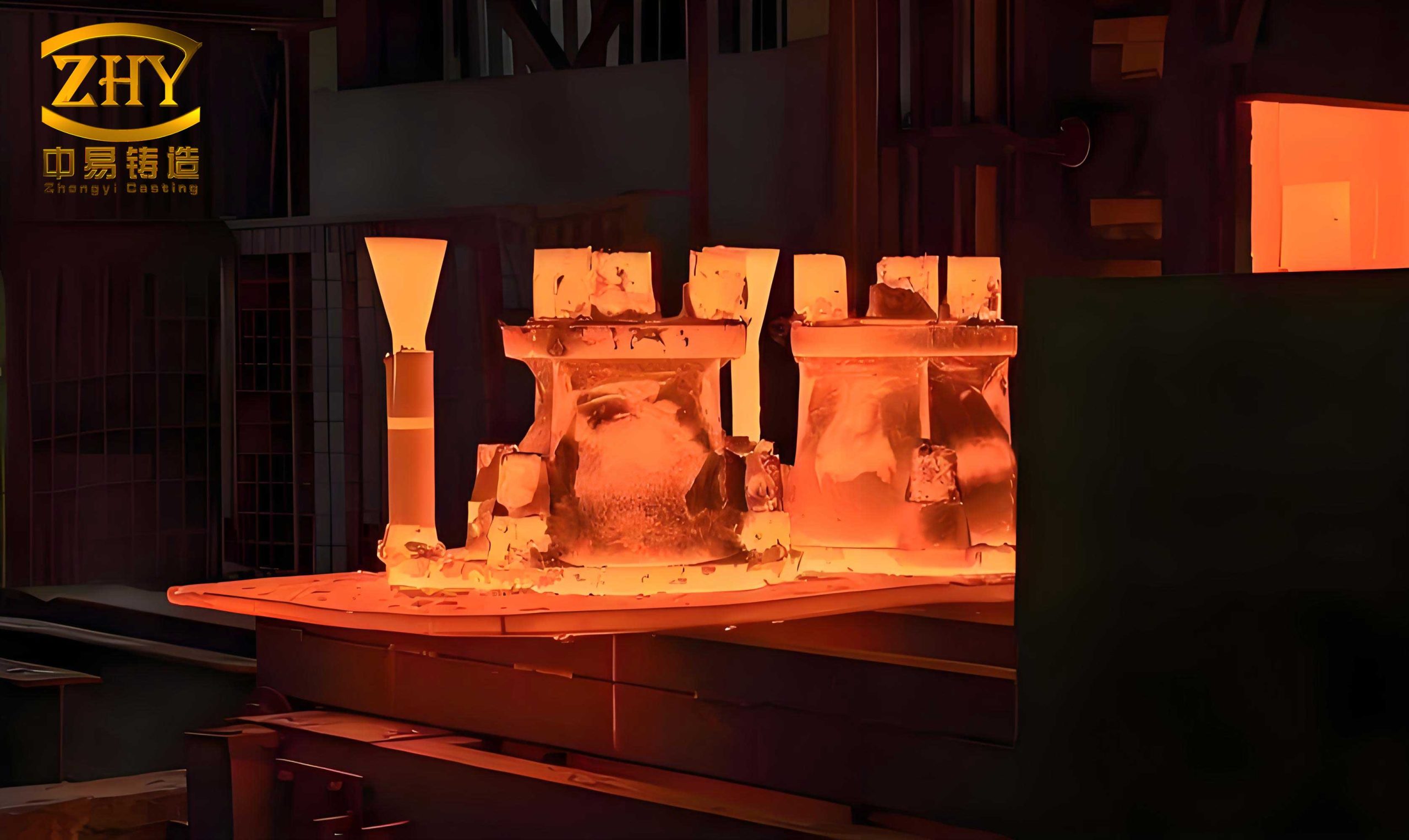
The image above depicts a typical industrial heat treatment setup for castings, highlighting the importance of controlled atmospheres and quenching media to avoid heat treatment defects. In high-pressure die casting (HPDC) of aluminum alloys, the presence of entrapped gas pores has traditionally precluded intensive heat treatment due to risks of surface blistering—a quintessential heat treatment defect. However, recent innovations have enabled the heat treatment of HPDC components without inducing blistering. From my实践, I have adopted a method that involves a tailored solution treatment at temperatures where solute elements like Mg and Si dissolve into the aluminum matrix, followed by quenching into a medium below 100°C. This rapid cooling minimizes gas expansion while achieving supersaturation. Subsequent natural or artificial aging then precipitates strengthening phases without causing blistering. The critical temperature range for solution treatment can be derived from the phase diagram and kinetics of pore growth, often described by:
$$ r = r_0 \exp\left(\frac{P V_m}{RT}\right) $$
where \(r\) is pore radius, \(r_0\) is initial radius, \(P\) is internal gas pressure, \(V_m\) is molar volume, \(R\) is gas constant, and \(T\) is temperature. Keeping \(T\) below a threshold where \(P\) becomes excessive is key to suppressing this heat treatment defect.
To quantify the effectiveness of this approach, the table below compares conventional and improved heat treatment cycles for a common HPDC aluminum alloy (e.g., Al-Si-Mg):
| Heat Treatment Stage | Conventional Process | Improved Process (Blister-Free) | Impact on Heat Treatment Defects |
|---|---|---|---|
| Solution Treatment | 480-500°C for 2 h | 460-480°C for 1.5 h | Reduced gas expansion, lower blister risk |
| Quenching Medium | Water at 20-30°C | Polymer solution at 60-80°C | Slower cooling minimizes thermal shock |
| Aging Treatment | Artificial at 180°C for 8 h | Natural aging for 7 days or artificial at 160°C for 10 h | Controlled precipitation without defect initiation |
Grain refinement is equally critical; a fine, equiaxed grain structure improves ductility and reduces hot tearing during casting, which translates to fewer heat treatment defects after thermal processing. I have investigated enhancements in Al-Ti-B master alloys used for grain refinement in casting alloys like Al-7Si. The改进工艺 involves pre-treating Al-B alloy powders with K₂TiF₆ in an inert atmosphere, followed by compacting into tablets. This process enhances the dispersion of TiAl₃ and Al-B compounds, leading to more efficient nucleation during solidification. The resulting grain size \(d\) can be predicted using the free growth model:
$$ d = \left( \frac{16 \Delta T_{max}}{3 \pi \Delta S_f} \right)^{1/3} N^{-1/3} $$
where \(\Delta T_{max}\) is the maximum undercooling, \(\Delta S_f\) is the entropy of fusion, and \(N\) is the number density of nucleants. With refined grains below 200 μm, the alloy exhibits homogeneous deformation and reduced anisotropy during heat treatment, thereby mitigating defects like warping or residual stress concentration.
Furthermore, the kinetics of precipitate formation during aging—a process central to strengthening—must be managed to avoid over-aging or heterogeneous precipitation, both of which are heat treatment defects that degrade mechanical properties. For age-hardenable alloys, the time-temperature-transformation (TTT) diagram can be modeled using the Langer-Schwartz theory for phase separation. The evolution of precipitate radius \(R\) over time \(t\) is often expressed as:
$$ \frac{dR}{dt} = \frac{D}{R} \left( \frac{C_m – C_e}{C_p – C_e} \right) $$
where \(D\) is diffusivity, \(C_m\) is matrix concentration, \(C_e\) is equilibrium concentration, and \(C_p\) is precipitate concentration. By controlling aging parameters based on such models, one can optimize precipitate distribution and avoid defects like precipitate-free zones that lead to intergranular failure.
In my work, I have also emphasized the role of computational simulations in predicting heat treatment defects. Finite element analysis (FEA) can simulate thermal and stress fields during quenching, identifying regions prone to cracking or distortion. The governing equation for thermo-mechanical coupling is:
$$ \sigma_{ij,j} + \rho b_i = \rho \ddot{u}_i $$
with constitutive relations incorporating thermal expansion. Such tools allow for preemptive adjustments in process design, reducing trial-and-error and associated defects.
To encapsulate the interdependencies between various factors and heat treatment defects, I present a comprehensive table linking process variables, mechanisms, and typical defects:
| Process Variable | Optimal Range | Mechanism Affected | Associated Heat Treatment Defects if Suboptimal |
|---|---|---|---|
| Casting Cooling Rate | 10²-10³ °C/s | Grain nucleation and growth | Coarse grains, segregation-induced blistering |
| Solution Treatment Temperature | 90-95% of solidus temperature | Solute dissolution and pore dynamics | Surface blistering, incipient melting |
| Quenching Rate | 100-300 °C/s for water | Supersaturation and thermal stress | Cracking, distortion, residual stresses |
| Aging Time and Temperature | Dependent on alloy system (e.g., 150-200°C for 2-12 h) | Precipitate nucleation and coarsening | Over-aging (loss of strength), under-aging (brittleness) |
| Impurity Level (e.g., Fe) | <0.2 wt% | Intermetallic formation and stress concentration | Cracking during thermal cycling, reduced fatigue life |
In conclusion, my research underscores that minimizing heat treatment defects in aluminum alloy processing requires a holistic approach integrating advanced casting techniques, impurity control, tailored heat treatment cycles, and grain refinement. Each step—from the initial solidification in a Hazellett caster to the final aging of a high-pressure die-cast component—must be optimized based on fundamental principles of materials science. The recurring theme is that heat treatment defects are not inevitable; they can be systematically addressed through innovations in mold design, such as the坡式等高阶梯型模具; physical methods like magnetic separation; and process modifications like blister-free heat treatments. By leveraging mathematical models, such as those for recrystallization kinetics and precipitate growth, and empirical data summarized in tables, engineers can design robust protocols that enhance product reliability. Ultimately, the continuous pursuit of defect mitigation will drive progress in aluminum alloy applications, from lightweight automotive parts to efficient heat exchangers, ensuring superior performance and longevity in demanding environments.