
In my extensive work with copper-based alloys, few materials present as compelling a case for meticulous process control as the widely used ZQAl9-4 aluminum-iron bronze. This alloy, nominally composed of Cu-9.5Al-4Fe, is renowned for its impressive combination of strength, corrosion resistance, and wear properties, making it a staple for critical components like bearings, gears, and bushings. However, its true potential remains locked within its microstructure, only fully unleashed through a deep understanding and precise application of heat treatment. More critically, the journey to optimal properties is fraught with potential pitfalls—various heat treatment defects that can severely compromise performance if not properly managed. This exploration details my systematic investigation into the heat treatment pathways for ZQAl9-4 castings, focusing on how to avoid common heat treatment defects to achieve a superior strength-toughness balance.
1. The Foundation: As-Cast State and Inherent Challenges
The starting point for any heat treatment regimen is the as-cast condition. The mechanical properties of the ZQAl9-4 alloy in its cast and stress-relieved states are summarized below. The data clearly indicates a baseline performance level that, while acceptable for many applications, leaves significant room for improvement.
| State | Sample ID | Tensile Strength, σb (MPa) | Elongation, δ10 (%) | Hardness (HB) |
|---|---|---|---|---|
| As-Cast | 1 | 573 | 35.8 | 132 |
| 2 | 579 | 39.4 | 125 | |
| 3 | 586 | 42.1 | 136 | |
| 4 | 567 | 42.8 | 134 | |
| 280°C Stress Relief (3h) | 1 | 710 | 32.1 | 177 |
| 2 | 700 | 34.5 | 176 | |
| 3 | 708 | 31.4 | 175 | |
| 4 | 728 | 32.1 | 178 |
Microstructurally, the as-cast alloy is characterized by a non-uniform mixture of the copper-rich α solid solution, the brittle (α+γ₂) eutectoid, and finely dispersed FeAl₃ intermetallic particles. The iron addition is crucial; it refines the grain structure by acting as nuclei for the α phase and, by slowing diffusion processes, suppresses the formation of the continuous eutectoid network during slow cooling. However, this cast structure is inherently inhomogeneous. One of the primary heat treatment defects we seek to mitigate originates from this state: the presence of a coarse or networked eutectoid phase, which acts as a brittle pathway for crack propagation, limiting both strength and ductility.
The phenomenon observed after the 280°C treatment is particularly noteworthy. Instead of softening, the alloy hardens—a classic example of low-temperature annealing hardening, common in many copper-base alloys. This effect can be related to the pinning of dislocations by solute atoms (like Al in Cu) or the formation of short-range order. While this boosts hardness, it is a subtle effect and not the primary strengthening mechanism we target. The relationship can be conceptually framed as an increase in yield strength due to impeded dislocation motion:
$$ \Delta \tau_{y} \propto \frac{G b}{L} $$
where $ \Delta \tau_{y} $ is the increase in shear yield stress, $ G $ is the shear modulus, $ b $ is the Burgers vector, and $ L $ is the average distance between pinning points (solute atoms or precipitates).
2. Exploring Annealing Pathways: Softening and the Risk of Over-softening
To improve machinability or ductility, annealing above the recrystallization temperature is employed. My experiments at 600°C and 700°C aimed to homogenize the structure and dissolve/coarsen the eutectoid. The results, however, highlight a different kind of heat treatment defect: excessive softening leading to a loss of strength.
| Condition | Sample ID | Tensile Strength, σb (MPa) | Elongation, δ10 (%) | Hardness (HB) |
|---|---|---|---|---|
| 600°C x 2h Anneal | 9 | 603 | 36.5 | 145 |
| 10 | 593 | 34.5 | 150 | |
| 11 | 583 | 38.5 | 146 | |
| 12 | 613 | 37.5 | 149 | |
| 700°C x 2h Anneal | 9 | 520 | 45.1 | 112 |
| 10 | 515 | 46.2 | 110 | |
| 11 | 515 | 48.4 | 119 | |
| 12 | 510 | 49.3 | 115 |
The 600°C treatment retained reasonable strength with good ductility. Interestingly, samples that were cold-worked prior to this anneal showed higher final hardness, indicating the interaction of work hardening and recovery/recrystallization. The 700°C treatment, however, caused a significant drop in strength and hardness—a clear heat treatment defect if high strength is the goal. This is due to complete recrystallization, grain growth, and the spheroidization of any remaining phases, maximizing ductility at the expense of strength. The driving force for grain growth is inversely proportional to the grain radius, leading to accelerated coarsening at higher temperatures:
$$ \frac{dr}{dt} = \frac{K}{r^n} $$
where $ r $ is the grain radius, $ t $ is time, $ K $ is a temperature-dependent constant, and $ n $ is the growth exponent. This uncontrolled growth is a classic microstructural heat treatment defect.
3. The Quest for Strength: Quenching and the Martensitic Transformation
The paradigm shift in strengthening ZQAl9-4 comes from exploiting a solid-state phase transformation, akin to steel. The high-temperature β phase (disordered BCC) can transform, upon rapid cooling, into a martensitic structure termed β’. This transformation is the key to unlocking high strength.
My initial trials at 850°C quenching were underwhelming, representing a suboptimal process that could be considered a heat treatment defect of under-performance.
| Condition | Sample ID | Tensile Strength, σb (MPa) | Elongation, δ10 (%) | Hardness (HB) |
|---|---|---|---|---|
| 850°C Quench (Water) | 17 | 637 | 33.5 | 145 |
| 18 | 628 | 32.6 | 146 | |
| 19 | 646 | 34.3 | 147 | |
| 20 | 632 | 34.1 | 148 | |
| + 260°C Aging | 17 | 652 | 32.4 | 164 |
| 18 | 670 | 31.5 | 165 | |
| 19 | 662 | 31.6 | 163 | |
| 20 | 650 | 31.3 | 162 |
The modest improvement suggests that at 850°C, the volume fraction of the β phase available for transformation is insufficient. The microstructure largely consists of α and retained β, with only a small amount of martensitic β’. This insufficiency is a direct consequence of an incorrect thermal profile—a fundamental heat treatment defect where the chosen temperature does not achieve the necessary single-phase (β) field for a complete transformation upon quenching.
The phase fraction of β, $ f_\beta $, at a given temperature can be approximated from the phase diagram and follows a rule of mixtures based on alloy composition. At 850°C, for ZQAl9-4, $ f_\beta $ is low, leading to limited martensite formation upon quenching:
$$ f_{\beta’} \approx f_\beta(T_{quench}) \cdot (1 – \exp(-k \cdot \dot{T})) $$
where $ \dot{T} $ is the cooling rate and $ k $ is a transformation kinetic constant.
4. Optimizing the Quench: The High-Temperature Window and its Perils
To maximize $ f_\beta $, the quench temperature must be raised significantly. My experiments at 920°C and 950°C yielded dramatic improvements, but also revealed the narrow window for success, beyond which severe heat treatment defects emerge.
| Condition | Sample ID | Tensile Strength, σb (MPa) | Elongation, δ10 (%) | Hardness (HB) |
|---|---|---|---|---|
| 920°C Quench (Brine) | 25 | 804 | 31 | 189 |
| 26 | 833 | 29 | 185 | |
| 27 | 857 | 30 | 188 | |
| 28 | 834 | 31 | 190 | |
| + 260°C Aging | 25 | 882 | 29 | 215 |
| 26 | 872 | 28 | 210 | |
| 27 | 892 | 30 | 209 | |
| 28 | 882 | 27 | 210 |
| Condition | Sample ID | Tensile Strength, σb (MPa) | Elongation, δ10 (%) | Hardness (HB) |
|---|---|---|---|---|
| 950°C Quench (Brine) | 25 | 877 | 14.3 | 197 |
| 26 | 863 | 14.8 | 199 | |
| 27 | 867 | 14.6 | 207 | |
| 28 | 873 | 13.5 | 206 | |
| + 260°C Aging | 25 | 905 | 14.3 | 209 |
| 26 | 897 | 15.6 | 211 | |
| 27 | 897 | 15.5 | 212 | |
| 28 | 888 | 14.8 | 213 |
The results are illuminating. The 920°C quench produces an excellent combination: strength nearly 60% higher than the as-cast state, doubled hardness, and retained ductility (~30%). The subsequent aging provides a further modest boost, primarily from the precipitation of fine, coherent zones within the metastable β’ matrix. This is the optimized condition.
The 950°C quench, while achieving peak hardness and strength, shows a catastrophic drop in elongation. This is the manifestation of a critical heat treatment defect: excessive grain growth and incipient burning. At this temperature, the β grains grow rapidly. Upon quenching, these large grains transform into large, interconnected plates of martensite. This coarse microstructure, while hard, provides easy paths for crack propagation, drastically reducing toughness. Furthermore, approaching the solidus temperature risks localized melting (burning) at grain boundaries, a catastrophic and irreversible heat treatment defect. The image below exemplifies the kind of microstructural damage that can arise from such extreme thermal excursions, including grain boundary oxidation, cracking, and phase instability that are all cardinal heat treatment defects.
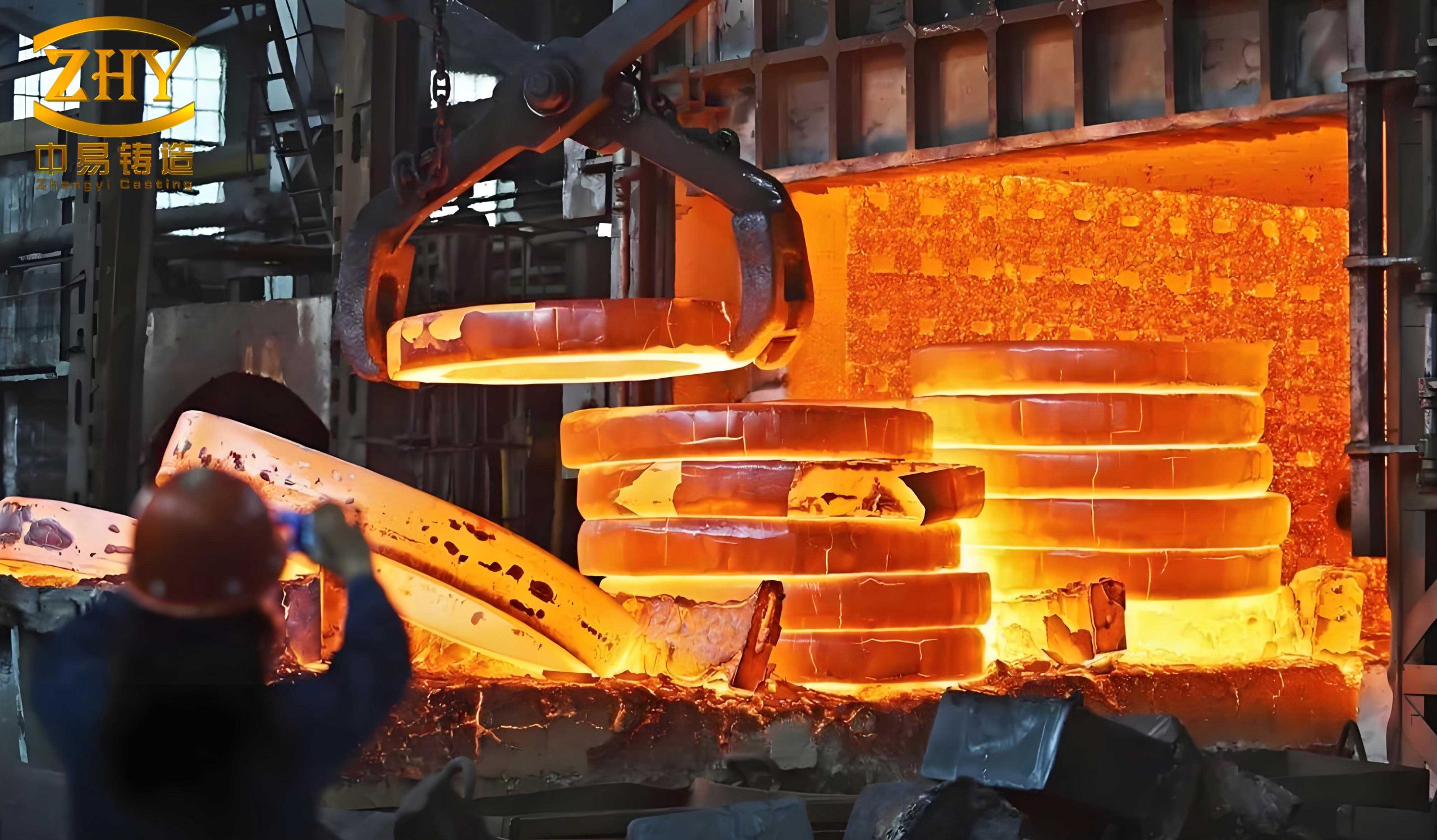
The degradation in toughness with increasing grain size can be described by the Hall-Petch relationship, which also applies to the prior-β grain size controlling the martensite packet size:
$$ \sigma_y = \sigma_0 + k_y \cdot d^{-1/2} $$
While strength ($ \sigma_y $) increases with finer grain size ($ d $), the stress concentration at the tip of a crack in a coarse-grained material is more severe, and the cleavage fracture stress often decreases, leading to lower ductility and toughness. Thus, an optimum grain size exists for a strength-toughness balance.
5. Synthesis: A Roadmap for Avoiding Heat Treatment Defects in ZQAl9-4
My investigation culminates in a clear roadmap for heat treating ZQAl9-4 castings, defined as much by what to avoid (heat treatment defects) as by what to achieve.
- Understand the Starting Point: Recognize the as-cast microstructure’s inhomogeneity. Any heat treatment must aim to homogenize or transform this structure. The presence of a continuous (α+γ₂) eutectoid network is a pre-existing condition that acts like a heat treatment defect if not addressed.
- Define the Objective:
- For Ductility/Machinability: Use annealing at 600-700°C. The heat treatment defect to avoid here is over-softening at the higher end of this range if some strength is still required.
- For Maximum Strength & Wear Resistance: Use high-temperature quenching. The primary heat treatment defect to avoid is insufficient quench temperature (e.g., 850°C), which fails to generate enough martensite.
- Master the Quenching Process:
- Temperature: The optimal window is 920-940°C. At 920°C, you get a fine, acicular β’ martensite within a refined prior-β grain structure. Exceeding 950°C introduces the heat treatment defects of excessive grain growth and reduced toughness.
- Cooling Rate: A rapid quench (brine > water) is essential to suppress the diffusional formation of the soft α phase and the brittle (α+γ₂) eutectoid during cooling. Slow cooling introduces a different set of heat treatment defects, namely an undesirable equilibrium microstructure.
- Aging: A low-temperature aging (260-300°C) can provide additional strength via precipitation hardening within the β’ matrix. However, over-aging must be avoided as it is a heat treatment defect that leads to coarsening of precipitates and softening.
- Leverage Secondary Effects: The low-temperature (280°C) hardening effect can be useful for enhancing wear resistance without a full quench-and-temper cycle. Pre-quench cold work can also enhance final properties after annealing or solution treatment by providing more nucleation sites for recrystallization or transformation.
The transformation of properties is profound. Through controlled heat treatment and vigilant avoidance of heat treatment defects, tensile strength can be elevated from ~570 MPa to over 900 MPa, and hardness from ~110 HB to over 210 HB, while maintaining useful ductility. This represents not just an improvement, but a fundamental change in the material’s capability, extending service life and enabling more demanding applications. The study underscores that in advanced alloys like ZQAl9-4, thermal processing is not a mere supplementary step but the critical determinant of performance, where the margin between exceptional properties and catastrophic heat treatment defects is often a matter of a few tens of degrees Celsius.