
The development and reliable production of high-chromium (approx. 12 wt.%) martensitic cast steels are critical for the power generation industry, particularly for components operating in ultra-supercritical (USC) and supercritical (SC) steam conditions. These materials, such as ZG1Cr10MoVNbN, SA-217-C12A, and their variants, are selected for critical castings including inner casings, valve bodies, and diaphragm rings due to their combination of high-temperature strength, corrosion resistance, and creep properties. The final service performance of these heavy-section castings is intrinsically linked to their heat treatment, which governs the transformation from the as-cast state to a homogeneous, tempered martensitic structure with optimal mechanical properties. A significant challenge in manufacturing is to achieve consistent properties batch-to-batch while minimizing the occurrence of heat treatment defects such as non-uniform microstructure, residual stresses, insufficient tempering, or undesirable phase formation. This study consolidates extensive process development work aimed at optimizing the full heat treatment cycle—comprising diffusion annealing, austenitization (quenching), and tempering—for several key 12% Cr grades. By analyzing the interplay between chemistry, transformation characteristics, and process parameters, this work establishes robust protocols to enhance yield and ensure the mechanical integrity of these high-value components, with a particular focus on identifying and mitigating sources of heat treatment defects.
The foundational step in designing an effective thermal processing route is understanding the material’s chemical composition and its phase transformation behavior. The four primary grades investigated have nuanced but important compositional differences, as summarized in Table 1. Elements like carbon, molybdenum, vanadium, niobium, and nitrogen are crucial for solid solution strengthening and precipitate formation (e.g., M23C6, MX carbonitrides), which stabilize the microstructure during long-term service.
| Grade Designation | C | Cr | Mo | V | Nb | N | Other |
|---|---|---|---|---|---|---|---|
| KT5917SO (USC) | 0.09-0.14 | 10.0-11.0 | 1.00-1.30 | 0.15-0.25 | 0.04-0.08 | 0.03-0.07 | W 0.20-0.30 |
| ZG1Cr10MoVNbN (SC) | 0.09-0.13 | 9.1-10.0 | 0.65-1.00 | 0.13-0.20 | 0.03-0.07 | 0.03-0.07 | Ni 0.4-0.7 |
| KT5316AS3 (SC) | 0.11-0.15 | 9.5-11.5 | 0.70-1.00 | 0.20-0.30 | 0.05-0.20 | 0.03-0.06 | – |
| SA-217-C12A (SC) | 0.08-0.12 | 8.0-9.5 | 0.85-1.05 | 0.18-0.25 | 0.06-0.10 | 0.03-0.07 | – |
Critical transformation temperatures (Ac1, Ac3, Ms, Mf) were experimentally determined for key grades using dilatometry. For instance, typical values for ZG1Cr10MoVNbN are Ac1 ≈ 850°C, Ac3 ≈ 950°C, Ms ≈ 320°C, and Mf ≈ 150°C. These points are vital for setting appropriate austenitization and quenching parameters to avoid incomplete transformation or excessive retained austenite—a potential heat treatment defect. The mechanical property targets, which drive the process optimization, are stringent and vary between grades, as shown in Table 2. Notably, grades like ZG1Cr10MoVNbN demand a high yield strength (≥550 MPa) coupled with excellent impact toughness (≥66 J), presenting a classic metallurgical challenge as these properties are often inversely related.
| Grade | Yield Strength Rp0.2 (MPa) | Tensile Strength Rm (MPa) | Elongation A (%) | Reduction of Area Z (%) | Impact Energy KV (J) | Max. Hardness (HB) |
|---|---|---|---|---|---|---|
| KT5917SO | 491 | 687 | 13 | 35 | Recorded | 260 |
| ZG1Cr10MoVNbN | 550 | 670 | 18 | 40 | 66 | – |
| KT5316AS3 | 516 | 689 | 15 | 35.6 | – | 260 |
| SA-217-C12A | 415 | 585-760 | 20 | 45 | – | – |
The core of the development involved systematic trials of the full heat treatment sequence. The primary variables studied were: 1) Diffusion annealing temperature (for homogenization), 2) Austenitizing (quenching) temperature, and 3) Tempering temperature and number of cycles. The experimental matrix is summarized in Table 3. The goal was to find the window that dissolves carbides for a fully austenitic state, ensures a complete martensitic transformation upon cooling, and then tempers it to achieve the optimal balance of strength and toughness while avoiding heat treatment defects like temper embrittlement or over-softening.
| Processing Stage | Temperature Range Studied (°C) | Key Metallurgical Objective |
|---|---|---|
| Diffusion Annealing | 1030 – 1100 | Homogenize micro-segregation from casting. |
| Austenitization & Quenching | 1000 – 1070 | Dissolve secondary phases, achieve full martensite. |
| First Tempering | 680 – 760 | Relieve stresses, precipitate carbides, improve toughness. |
| Second Tempering* | 680 – 750 | Further stress relief, stabilize microstructure. |
*Applied to grades with higher alloy content or stricter toughness requirements.
Based on the performance data from hundreds of test coupons and actual castings, an optimized standard practice was derived. For all four grades, a diffusion annealing step at 1050°C was found essential to mitigate chemical inhomogeneity from solidification, a root cause of inconsistent properties and a type of inherited heat treatment defect if not addressed. Subsequently, austenitizing at 1050°C followed by forced-air or oil quenching proved most effective in achieving a uniform martensitic structure. The key differentiation lies in the tempering strategy: grades ZG1Cr10MoVNbN, KT5316AS3, and KT5917SO require a double tempering at approximately 700°C, whereas SA-217-C12A consistently meets specifications with a single temper at 720°C. The double tempering is crucial for complex grades to ensure complete transformation of any retained austenite and to achieve a stable dislocation substructure, thereby avoiding the heat treatment defect of inadequate tempering response.
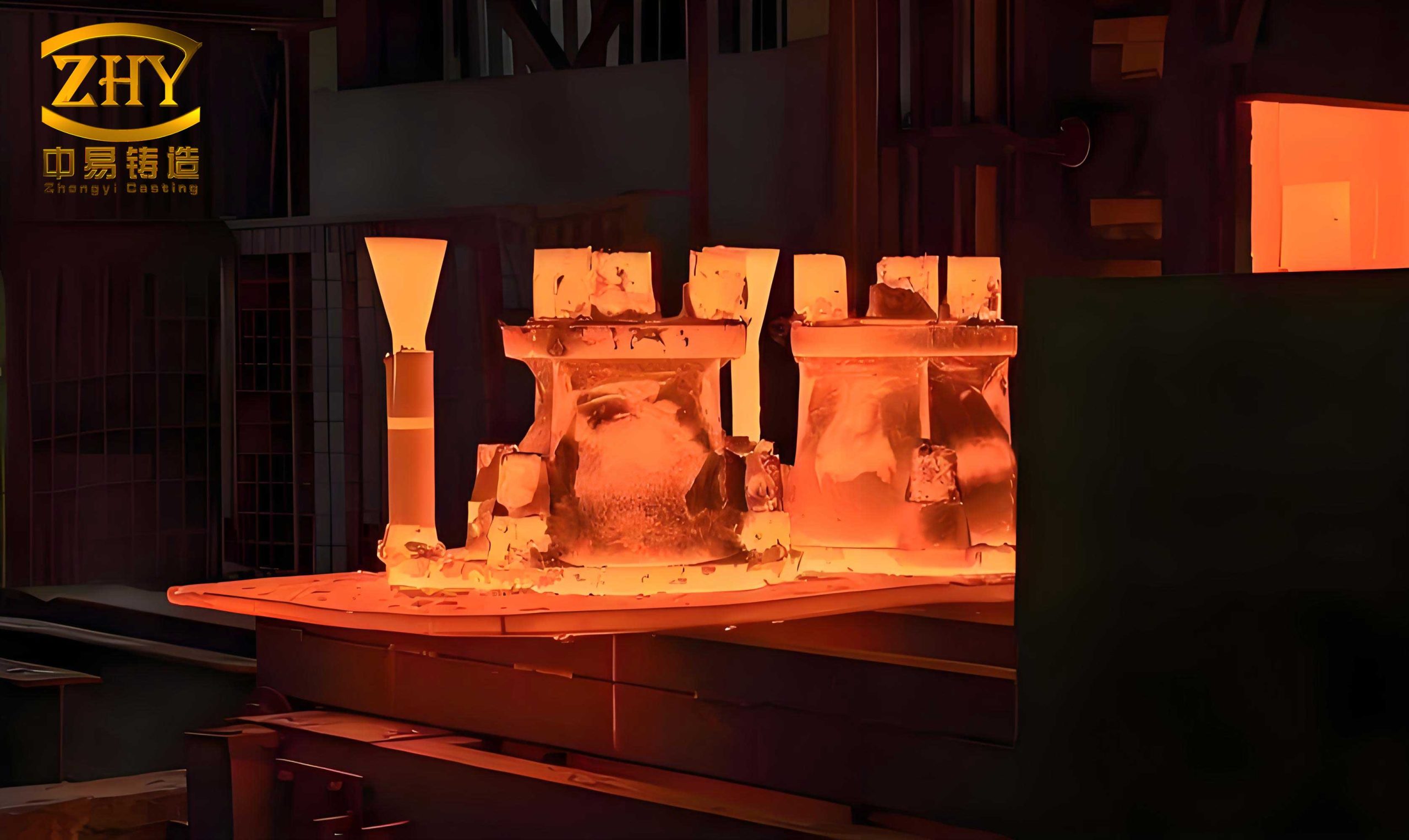
The effectiveness of the optimized process is best evaluated through statistical analysis of production data. To facilitate this, property results were categorized based on their “margin” over the minimum requirement (H = Measured Value – Minimum Requirement). This classification helps identify processes prone to producing borderline properties or excessive over-strength, which can be detrimental to toughness.
- Grade A (Marginal): 0 ≤ H ≤ Low Margin. Risk of falling below spec with minor variation.
- Grade B (Optimal): Good, safe margin. Properties are balanced.
- Grade C (Over-strength): H > High Margin. Often indicates lower toughness.
- Grade F (Fail): Does not meet minimum requirement.
A detailed breakdown of production outcomes reveals distinct behavioral patterns among the grades, as synthesized in Table 4. The most common heat treatment defects manifested as failures in yield strength (Rp0.2), elongation (A), and impact energy (KV).
| Material Grade | Primary Non-Conformity (Failure Mode) | Approx. Initial Pass Rate | Dominant Property Challenge |
|---|---|---|---|
| ZG1Cr10MoVNbN | Low Elongation (A) & Low Impact (KV) | ~65% | Balancing very high strength with ductility/toughness. |
| KT5316AS3 | Low Yield Strength (Rp0.2) & Low Hardness | ~71% | Achieving consistent strength response. |
| SA-217-C12A | Occasional High/Low Tensile Strength (Rm) | ~79% | Controlling strength within a relatively narrow band. |
| KT5917SO | Occasional High Hardness | ~83% | Achieving full tempering response. |
Delving deeper, the performance of ZG1Cr10MoVNbN is particularly instructive. Analysis shows that a majority of failures in elongation and impact energy were associated with property sets where the strength values were in the “Grade C” (over-strength) category. This is a classic signature of heat treatment defects related to insufficient tempering or non-optimal tempering temperature. The high strength is achieved, but at the expense of ductility and toughness. The relationship can be conceptually described by a toughness-strength trade-off, often approximated for tempered martensite by an inverse relationship. While not a direct law, the trend can be illustrated as:
$$ KV \propto \frac{1}{(\sigma_y)^n} $$
where \( KV \) is impact energy, \( \sigma_y \) is yield strength, and \( n \) is a material-specific exponent. Furthermore, variability was exacerbated by furnace loading conditions. High load density with insufficient spacing between castings led to non-uniform cooling rates during quenching, a direct process-induced heat treatment defect causing scatter in transformation kinetics and final microstructure. This resulted in a wide distribution of properties across different locations in a load, reducing first-pass yield.
In contrast, grades SA-217-C12A and KT5917SO exhibited a much higher concentration of properties in the “Grade B” optimal range (75% and 77% of all measured properties, respectively). Their chemistry and specified property ranges appear more forgiving within the established 1050°C quench + temper process. For SA-217-C12A, a single high temper at 720°C is sufficient to produce a fine, tempered lath martensitic structure with the required ductility and strength. For KT5917SO, the double temper at 700°C effectively manages the higher alloy content (including tungsten) to achieve the necessary microstructural stability and property balance. Most non-conformities for these grades were correctable with a simple adjustment of the final tempering temperature, indicating that the core microstructure after quenching was sound and the main heat treatment defect was merely an off-optimal final tempering parameter.
The tempering process itself is governed by diffusion-controlled precipitation and recovery phenomena. The softening effect of tempering can be empirically related to the tempering parameter \( P \), often expressed using the Hollomon-Jaffe equation:
$$ P = T (C + \log t) $$
where \( T \) is the absolute temperature (K), \( t \) is the time (hours), and \( C \) is a constant (~20 for many low-alloy steels, but higher for high-Cr steels). For a fixed time, the final hardness \( HV \) can be modeled as decreasing with increasing \( P \):
$$ HV \approx HV_0 – k \cdot P $$
Here, \( HV_0 \) is the as-quenched hardness and \( k \) is a material constant. This framework explains why a second temper at the same temperature can further reduce hardness and increase toughness: it effectively increases the cumulative \( t \) in the parameter, allowing for more complete carbide coarsening and dislocation annihilation. Not applying this second temper where needed is a recipe for the heat treatment defect of retained brittleness.
In conclusion, the rigorous development and statistical analysis of heat treatment protocols for 12% Cr (ultra) supercritical cast steels have led to a validated and optimized production methodology. The standardized practice of 1050°C diffusion annealing followed by 1050°C austenitization and quenching establishes a consistent, fully martensitic starting condition. The critical differentiation is in tempering: a double temper at ~700°C is mandatory for achieving the demanding property balance in grades like ZG1Cr10MoVNbN and KT5917SO, while a single temper at ~720°C suffices for SA-217-C12A. This tailored approach directly addresses the most prevalent heat treatment defects—namely, non-uniform properties from inadequate homogenization or cooling, and poor toughness from insufficient or sub-optimal tempering. A paramount practical finding is the significant influence of furnace loading geometry on quenching uniformity; ensuring adequate spacing between heavy castings is as crucial as temperature control to minimize scatter and rejections. The optimized process has demonstrably increased production yield and reliability, providing a robust framework for the manufacture of these high-integrity power plant components. Continued focus on the precise control of every thermal cycle step remains the key to suppressing heat treatment defects and guaranteeing performance in extreme service environments.