
As an industry observer deeply involved in the field of materials engineering, I have witnessed significant strides in heat treatment technologies that are pivotal for enhancing product performance, particularly in automotive and manufacturing sectors. Heat treatment processes are essential for achieving desired mechanical properties such as strength, toughness, and durability in metal components. However, one of the most critical challenges we face is the occurrence of heat treatment defects, which can compromise the integrity and functionality of parts. In this article, I will delve into recent developments in heat treatment systems, their role in mitigating heat treatment defects, and how advanced monitoring and control systems contribute to this endeavor. Throughout, I will emphasize the importance of addressing heat treatment defects through innovative approaches, supported by tables and formulas to summarize key concepts.
The collaboration between a leading industrial furnace provider and a major automotive manufacturer has resulted in the establishment of a new heat treatment test facility. This system is designed to develop lightweight materials and optimized heat treatment processes for structural components. It features a modular setup comprising a solution annealing and aging furnace, a fluidized bed furnace, and a quenching unit capable of air and water cooling. Such flexibility allows for extensive research into various heat treatment parameters, directly influencing the reduction of heat treatment defects like distortion, residual stresses, and inhomogeneous microstructures. By controlling cooling gradients precisely, this system aims to minimize defects that often arise during quenching, such as cracking or warping. The integration of advanced atmosphere control further helps in preventing surface defects like oxidation or decarburization, which are common heat treatment defects in high-temperature processes.
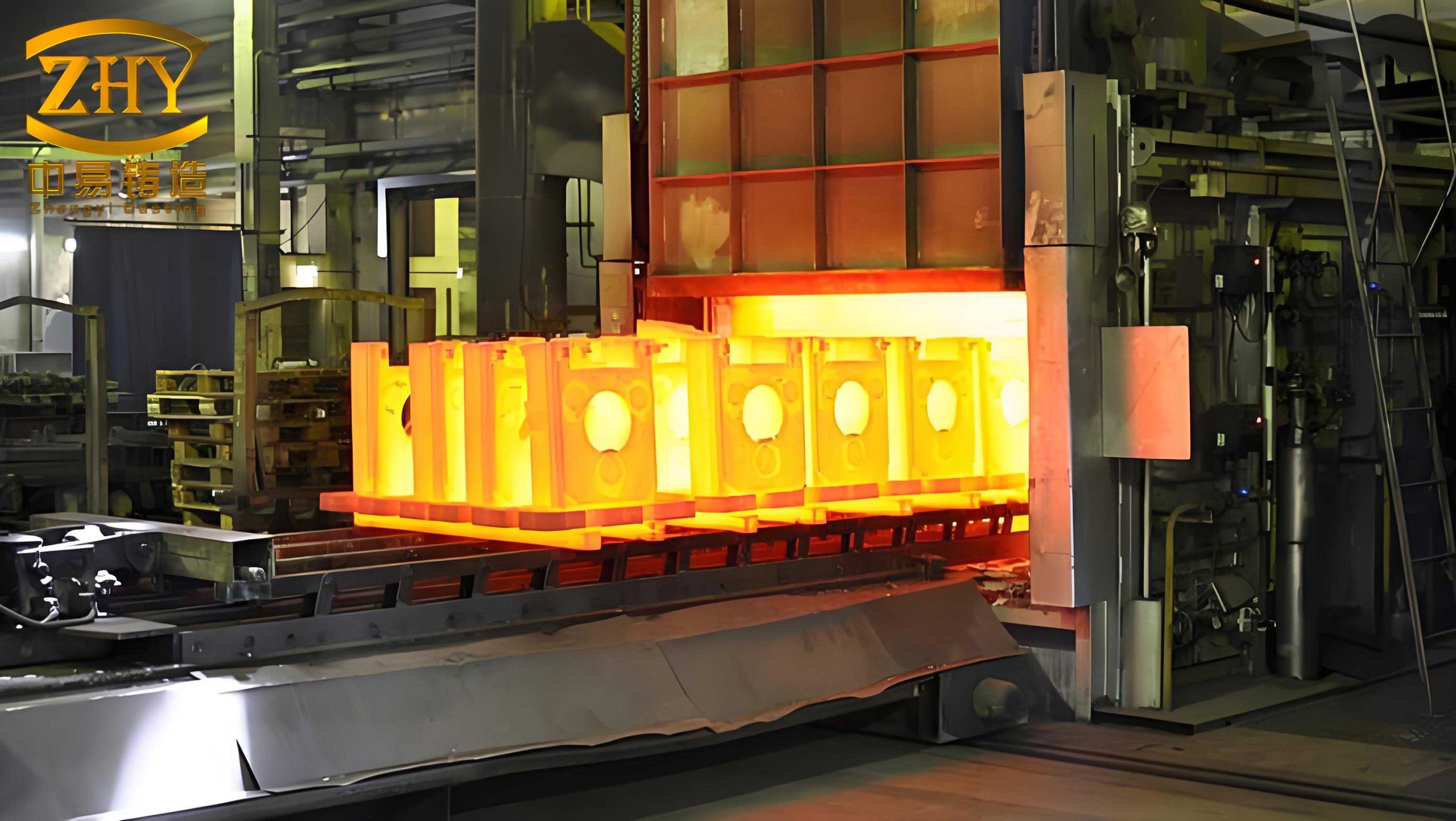
To better understand the types and causes of heat treatment defects, I have compiled a table summarizing common issues encountered in industrial practices. This table highlights how specific process variables can lead to defects, underscoring the need for precise control in modern heat treatment systems.
| Defect Type | Primary Causes | Impact on Component | Preventive Measures |
|---|---|---|---|
| Cracking | Rapid cooling, high residual stresses | Structural failure | Controlled quenching rates, stress relieving |
| Warping | Uneven heating or cooling | Dimensional inaccuracy | Uniform temperature distribution, fixturing |
| Soft spots | Inadequate austenitization | Reduced hardness | Proper soaking times, temperature monitoring |
| Oxidation | Exposure to air at high temperatures | Surface degradation | Use of protective atmospheres |
| Decarburization | Loss of carbon from surface | Reduced fatigue strength | Controlled carbon potential in furnaces |
In the context of heat treatment defects, mathematical models play a crucial role in predicting and mitigating these issues. For instance, the temperature evolution during heat treatment can be described using differential equations. Consider a simple model for heating and cooling cycles: the temperature \( T(t) \) as a function of time \( t \) can be expressed as:
$$ T(t) = T_{\text{ambient}} + (T_{\text{max}} – T_{\text{ambient}}) \cdot e^{-k t} $$
where \( T_{\text{max}} \) is the peak temperature, \( T_{\text{ambient}} \) is the ambient temperature, and \( k \) is a cooling constant dependent on the medium (e.g., air or water). Rapid cooling with high \( k \) values can lead to thermal stresses, contributing to heat treatment defects like cracking. By optimizing \( k \) through controlled quenching, we can reduce such defects.
Another critical aspect is the phase transformation kinetics during heat treatment, which directly influences microstructural defects. The Avrami equation is often used to describe the fraction of transformed phase \( X(t) \):
$$ X(t) = 1 – \exp(-k t^n) $$
where \( k \) and \( n \) are material-dependent constants. Incomplete transformations due to improper time-temperature profiles can result in soft spots or heterogeneous microstructures, which are prevalent heat treatment defects. Advanced systems with precise control over these parameters help ensure complete and uniform transformations, thereby minimizing defects.
Moving to foundry operations, the establishment of new cleaning facilities for castings highlights the post-heat treatment steps essential for defect removal. Castings often exhibit surface imperfections such as sand inclusions, burrs, or oxide scales, which can be exacerbated by heat treatment processes if not addressed. By implementing dedicated cleaning processes, these surface defects are eliminated, reducing the overall incidence of heat treatment defects that might propagate during service. The investment in such facilities underscores the industry’s focus on quality assurance, where heat treatment defects are systematically identified and rectified. For example, shot blasting or machining operations can remove decarburized layers, a common heat treatment defect, thereby restoring surface integrity.
To illustrate the effectiveness of different cleaning methods in mitigating heat treatment defects, I present a comparative table. This table evaluates various techniques based on their ability to address specific defects, emphasizing the holistic approach required in manufacturing.
| Cleaning Method | Targeted Defects | Efficiency | Cost Implications |
|---|---|---|---|
| Shot blasting | Surface oxides, scales | High | Moderate |
| Machining | Dimensional inaccuracies, burrs | Very high | High |
| Chemical cleaning | Decarburization, contamination | Medium | Low to moderate |
| Thermal descaling | Oxide layers from heat treatment | Medium to high | Moderate |
The integration of Industry 4.0 technologies, such as advanced network management systems, revolutionizes how we monitor and control heat treatment processes to prevent defects. A new network management system enables real-time configuration, management, and monitoring of industrial communication networks, which is vital for maintaining consistent heat treatment parameters. By ensuring reliable data transmission from sensors to control units, this system helps in early detection of anomalies that could lead to heat treatment defects. For instance, fluctuations in furnace temperature or atmosphere composition can be instantly flagged, allowing for corrective actions before defects occur. The system’s ability to manage large networks with numerous devices ensures that every component in the heat treatment line operates within specified tolerances, reducing the risk of defects like uneven heating or cooling.
From a first-person perspective, I see these advancements as transformative. The modular heat treatment system allows for tailored processes that address specific material requirements, thereby mitigating heat treatment defects through customized cooling and heating cycles. Similarly, the focus on post-treatment cleaning ensures that any residual defects from heat treatment are removed, enhancing overall product quality. Moreover, the adoption of smart network systems provides a proactive approach to defect prevention by enabling continuous monitoring and rapid response.
To further analyze the relationship between process variables and heat treatment defects, I have developed a formula for calculating thermal stress \( \sigma_{\text{thermal}} \) during quenching, which is a major contributor to cracking defects:
$$ \sigma_{\text{thermal}} = E \cdot \alpha \cdot \Delta T $$
where \( E \) is the Young’s modulus, \( \alpha \) is the coefficient of thermal expansion, and \( \Delta T \) is the temperature difference between the surface and core of the component. High \( \Delta T \) values, often resulting from rapid quenching, increase stress and the likelihood of heat treatment defects. By optimizing quenching media and rates, we can control \( \Delta T \) and reduce stress, as demonstrated in the new heat treatment systems.
Another important consideration is the role of atmosphere control in preventing surface-related heat treatment defects. The equilibrium carbon potential \( C_p \) in a furnace atmosphere can be modeled using the following expression, which helps in avoiding decarburization:
$$ C_p = K \cdot \sqrt{\frac{P_{\text{CO}}^2}{P_{\text{CO}_2}}} $$
where \( K \) is a temperature-dependent constant, and \( P_{\text{CO}} \) and \( P_{\text{CO}_2} \) are partial pressures of carbon monoxide and carbon dioxide, respectively. Maintaining \( C_p \) close to the steel’s carbon content prevents carbon loss, a key heat treatment defect. Advanced furnaces with precise atmosphere control leverage such models to minimize defects.
In summary, the fight against heat treatment defects is multifaceted, involving innovative furnace designs, rigorous post-treatment processes, and digital monitoring solutions. As I reflect on these developments, it is clear that the industry is moving towards a defect-aware paradigm where every step—from heat treatment to final inspection—is optimized to eliminate flaws. The tables and formulas presented here underscore the technical depth required to address heat treatment defects, and I anticipate further innovations that will continue to push the boundaries of quality and efficiency.
To encapsulate the key parameters influencing heat treatment defects, I provide a comprehensive table below. This table synthesizes process factors, their effects on defects, and mitigation strategies, serving as a quick reference for practitioners.
| Process Factor | Effect on Heat Treatment Defects | Optimal Range | Mitigation Technique |
|---|---|---|---|
| Heating rate | Too high can cause thermal shock and cracking | 10-100°C/min depending on material | Gradual heating, preheating stages |
| Quenching medium | Affects cooling rate and stress development | Oil, water, or polymer solutions | Selection based on hardenability |
| Soaking time | Insufficient time leads to incomplete phase transformation | Determined by section thickness | Extended soaking for homogeneity |
| Atmosphere composition | Prevents oxidation and decarburization | Controlled nitrogen, hydrogen, or vacuum | Real-time gas analysis |
| Temperature uniformity | Variations cause warping and soft spots | ±5°C within furnace | Advanced heating elements and fans |
Finally, the continuous improvement in heat treatment technology is driven by the need to reduce heat treatment defects, which remain a significant cost and quality concern in manufacturing. Through collaborative efforts, such as those seen in recent test facilities, and the adoption of digital tools, we are better equipped to predict, detect, and prevent these defects. As I look ahead, I believe that integrating artificial intelligence and machine learning with heat treatment processes will further enhance our ability to mitigate heat treatment defects, leading to more reliable and high-performance components across industries.