
In the realm of wind energy components, the production of high-integrity castings is paramount due to the demanding reliability standards over extended service lifetimes. As a researcher focused on casting alloys and composite materials, I have extensively studied the occurrence of heat treatment defects in critical ductile iron parts, such as planetary frames. These defects, particularly cracks arising during thermal processing, pose significant challenges to manufacturing yield and component performance. This article delves into a comprehensive investigation of the root causes and mitigation strategies for such heat treatment defects, emphasizing the role of stress concentration. Through detailed process analysis and experimental validation, I present effective methods to substantially reduce scrap rates, thereby enhancing economic viability.
The planetary frame casting, a core component in wind turbine gearboxes, is typically manufactured from ductile iron grade QT700-2. This material requires a normalizing and tempering heat treatment to achieve the desired mechanical properties, but this very process often introduces heat treatment defects if not meticulously controlled. The casting, weighing approximately 1,300 kg with complex geometry and varying wall thicknesses (from 35 mm to 110 mm), is inherently prone to developing residual stresses during both solidification and subsequent heating and cooling cycles. The initial production phase revealed a distressing scrap rate of 8-10% due to cracking during heat treatment, which directly impacted project economics and highlighted the critical need to address these heat treatment defects.
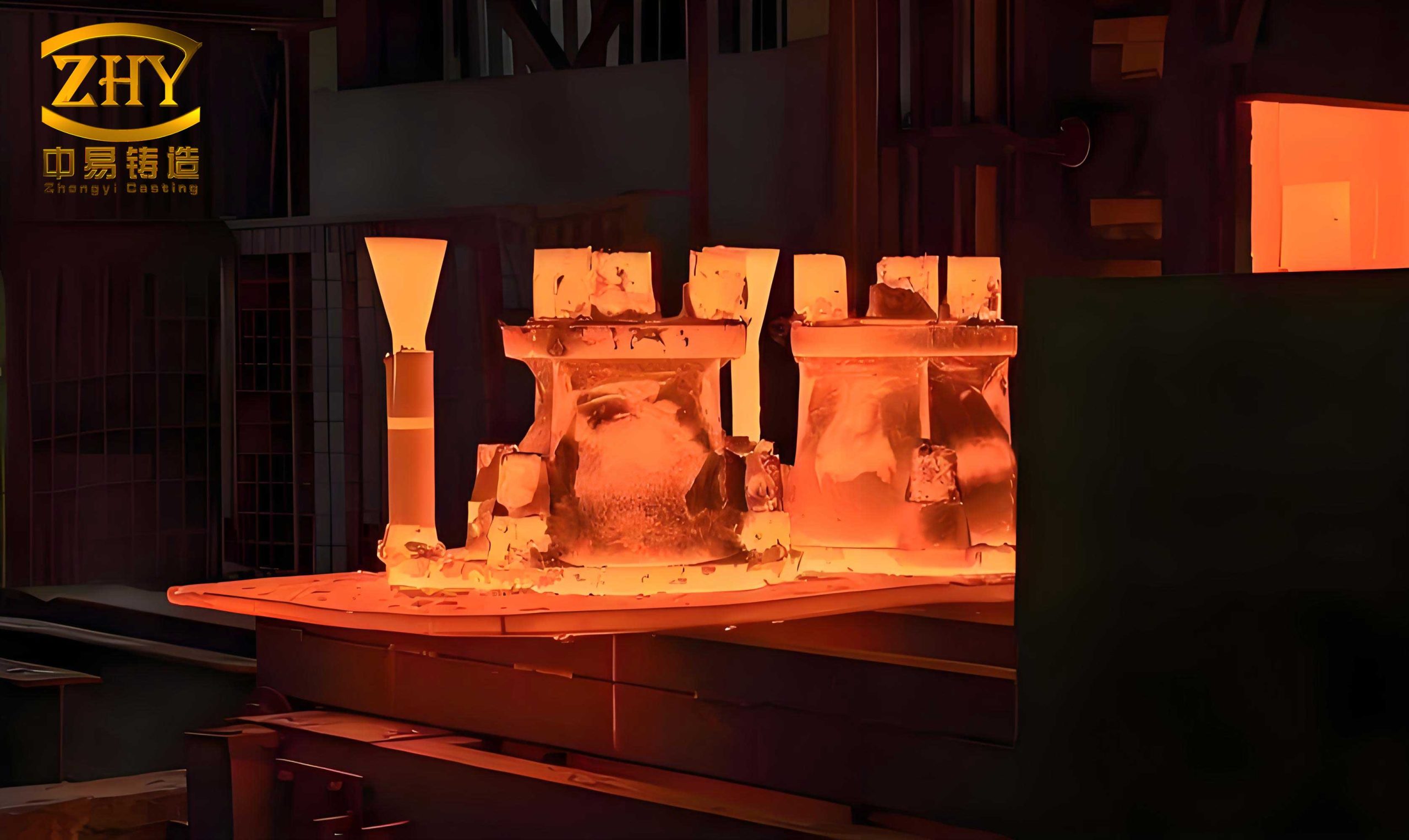
The casting process itself was designed with care. A furan resin sand mold was used with a hand molding and core-making process. The gating system was bottom-poured and semi-closed, incorporating filters to ensure smooth filling. Given the thick sections, the feeding strategy utilized a combination of padding, exothermic risers, and chills to manage solidification. The chemical composition was tightly controlled, as summarized in Table 1, to ensure the base material met the grade requirements before heat treatment.
| Element | Target Range | Function & Rationale |
|---|---|---|
| Carbon (C) | 3.75 – 3.85 | Promotes graphite formation, affects fluidity and shrinkage. |
| Silicon (Si) | 2.0 – 2.3 | Strong graphitizer, influences matrix ferrite/pearlite ratio. |
| Manganese (Mn) | 0.4 – 0.6 | Strengthens matrix, stabilizes pearlite. |
| Copper (Cu) | 0.35 – 0.45 | Pearlite promoter, enhances strength and hardenability. |
| Phosphorus (P) | ≤ 0.05 | Impurity, kept low to avoid phosphide eutectic and brittleness. |
| Sulfur (S) | ≤ 0.03 | Impurity, detrimental to graphite nodularization. |
| Magnesium (Mg) | 0.04 – 0.06 | Nodularizing agent for spheroidal graphite. |
| Rare Earth (RE) | 0.025 – 0.04 | Aids nodularization, counteracts deleterious trace elements. |
Melting was conducted in a medium-frequency induction furnace, with charge materials including high-purity pig iron, scrap steel, and returns. Inoculation and nodularization were performed in the transfer ladle using a yttrium-based rare earth master alloy and a composite inoculant containing bismuth. The pouring temperature was maintained between 1,360°C and 1,380°C. After shakeout at temperatures between 300°C and 600°C, the castings proceeded to heat treatment, which is where the primary heat treatment defects manifested.
The original heat treatment cycle comprised a normalizing stage followed by tempering. The specified parameters are outlined in Table 2. The normalizing involved heating to 890°C, holding for 4 hours, followed by forced air cooling (fan cooling) for 2 hours and subsequent air cooling. Tempering was done at 620°C for 3 hours. The furnace loading configuration placed 12 castings per batch on a large hearth.
| Stage | Temperature Range/Point | Heating/Cooling Rate | Hold Time | Cooling Method |
|---|---|---|---|---|
| Normalizing Heating | Ambient to 300°C | Free (Maximum power) | None | N/A |
| 300°C to 600°C | ≤ 150°C/h | None | N/A | |
| 600°C to 890°C | ≤ 100°C/h | None | N/A | |
| Normalizing Soak | 890°C | N/A | 4 hours | N/A |
| Normalizing Cooling | 890°C to ~50°C | Forced air (2h), then air | N/A | Fan + Air |
| Tempering | Ambient to 620°C | 100°C/h | 3 hours | Air |
| Tempering Cooling | 620°C to Ambient | Furnace cool/Air cool | N/A | Air |
Despite achieving the target mechanical properties of QT700-2, this cycle resulted in a significant number of heat treatment defects, specifically cracks. These cracks typically originated at the re-entrant corners of the triangular openings on either the large or small end faces of the planetary frame, sometimes propagating through the section. The consistent location at stress concentration points pointed toward a fundamental issue related to internal stresses. The analysis of these heat treatment defects led to the conclusion that stress concentration was the predominant cause. The sources of this stress concentration are multifactorial: the inherent geometrical stress risers in the design, non-uniform wall thickness leading to differential thermal expansion and contraction, potential residual casting stresses from early shakeout, and most critically, the thermal gradients induced during the heat treatment cycle itself.
To understand the thermo-mechanical behavior, one can consider the basic principles of thermal stress generation. When a component is heated or cooled, temperature differences between the surface and the interior, or between thick and thin sections, create strain incompatibilities. The resulting thermal stress ($\sigma_{th}$) can be approximated by:
$$ \sigma_{th} = E \cdot \alpha \cdot \Delta T \cdot \kappa $$
where $E$ is Young’s modulus, $\alpha$ is the coefficient of thermal expansion, $\Delta T$ is the temperature difference driving the gradient, and $\kappa$ is a constraint factor (often near 1 for full constraint). During rapid heating, the surface layers expand more quickly than the core, placing the surface in compression and the core in tension. If the tensile stresses in the core exceed the material’s high-temperature strength, or if residual stresses are additive, cracking—a severe heat treatment defect—can initiate. Similarly, during rapid cooling from the normalizing temperature, the surface contracts faster than the core, generating surface tensile stresses that can open cracks at notches.
The original process had a “free heating” stage from ambient to 300°C, where the furnace power was maximized. This likely created steep initial thermal gradients. Furthermore, the schedule lacked any stress-relief soak during the heating phase. The combination of these factors allowed stress concentration to build up to critical levels, particularly at the geometrical discontinuities of the triangular holes, leading to the observed heat treatment defects.
The mitigation strategy focused directly on controlling these thermal gradients to alleviate stress concentration. Two key modifications to the heating phase of the normalizing cycle were implemented and tested. The first modification was to impose a strict heating rate limit from the very start of the cycle. The second, more effective modification added an intermediate stabilization soak. The revised thermal schedule is detailed in Table 3 and depicted conceptually in the formula for temperature over time, $T(t)$, during heating.
For the heating phase, the temperature profile can be modeled in segments. Let $T_0$ be the initial ambient temperature, $T_1 = 300°C$, $T_2 = 600°C$, and $T_3 = 890°C$. Let $r_1$, $r_2$, and $r_3$ be the heating rates for the respective segments. In the revised process:
$r_1 \leq 100°C/h$ from $T_0$ to $T_1$, a hold at $T_2$ for time $\tau_{hold}$, and $r_3 \leq 100°C/h$ from $T_2$ to $T_3$. The time-temperature function becomes:
$$ T(t) = \begin{cases}
T_0 + r_1 t, & \text{for } 0 \leq t \leq t_1, \text{ where } t_1 = (T_1 – T_0)/r_1 \\
T_1 + r_2 (t – t_1), & \text{for } t_1 < t \leq t_2, \text{ where } t_2 = t_1 + (T_2 – T_1)/r_2 \\
T_2, & \text{for } t_2 < t \leq t_2 + \tau_{hold} \\
T_2 + r_3 (t – t_2 – \tau_{hold}), & \text{for } t_2 + \tau_{hold} < t \leq t_3
\end{cases} $$
with $r_2 \leq 100°C/h$ and $r_3 \leq 100°C/h$.
| Stage | Temperature Range/Point | Heating/Cooling Rate | Hold Time | Purpose & Effect |
|---|---|---|---|---|
| Normalizing Heating | Ambient to 300°C | ≤ 100°C/h (Controlled) | None | Minimize initial thermal gradient, reduce stress concentration. |
| 300°C to 600°C | ≤ 100°C/h | None | Continued gentle heating. | |
| 600°C | N/A | 1 hour | Stress homogenization and relief. Key to eliminating heat treatment defects. | |
| 600°C to 890°C | ≤ 100°C/h | None | Final heating to austenitizing temperature. | |
| Normalizing Soak | 890°C | N/A | 4 hours | Austenitization and composition homogenization. |
| Normalizing Cooling | 890°C to ~50°C | Forced air (2h), then air | N/A | Unchanged, but now performed on a more stress-relieved part. |
| Tempering | Ambient to 620°C | 100°C/h | 3 hours | Relief of transformation stresses, improvement of toughness. |
The implementation of the first modification (controlled heating from ambient) alone reduced the incidence of heat treatment defects, bringing the crack-related scrap rate down to below 3%. This confirmed that the initial rapid heating was a major contributor to stress concentration. However, the more robust solution involved the addition of the 1-hour soak at 600°C. This intermediate hold allows sufficient time for temperature equilibration across the complex casting geometry and facilitates the relief of locked-in residual stresses through creep mechanisms at elevated temperature. The effectiveness of this soak can be rationalized by considering the thermal diffusion time. The characteristic time for heat conduction across a thickness $L$ is proportional to $L^2/\alpha$, where $\alpha$ is the thermal diffusivity. For a thick section of ductile iron, this time constant is significant, and a hold period ensures near-uniform temperature, minimizing $\Delta T$ in the stress equation. With this revised cycle, the scrap rate due to heat treatment defects plummeted to a remarkable 0.3%, even for castings shaken out at higher temperatures (around 700-800°C), which previously carried even greater residual stress risk.
The quantitative impact of these heat treatment defects on production economics was substantial. Over a multi-year production run involving approximately 3,500 planetary frame castings, the initial scrap rate of 8-10% represented a potential loss of 270 to 340 castings. With a conservative valuation per casting, the financial loss attributable to these heat treatment defects was significant. The process optimization, by reducing the defect rate to 0.3%, effectively salvaged the vast majority of these units, resulting in cost savings and additional profit estimated in the range of several million currency units. This starkly illustrates the critical importance of precise thermal cycle control in preventing costly heat treatment defects in heavy-section ductile iron castings.
In conclusion, the investigation into the heat treatment defects of planetary frame castings unequivocally identified stress concentration as the root cause of cracking during normalizing and tempering. These heat treatment defects were systematically eliminated not by altering the casting design or material, but by meticulously modifying the heating segment of the thermal cycle. Enforcing a slow, controlled heating rate from room temperature and introducing a strategic stabilization soak at an intermediate temperature (600°C) proved to be highly effective strategies. These measures allowed for more uniform heating, promoted stress relaxation, and thereby alleviated the stress concentrations that led to failure. The successful resolution of these persistent heat treatment defects underscores a fundamental principle in heat treating complex castings: the thermal history must be managed with as much care as the chemical composition to ensure dimensional integrity and mechanical performance. This case study provides a replicable framework for addressing similar heat treatment defects in other large, geometrically complex ferrous castings where thermal stresses pose a recurring challenge.