
This study investigates the development of a stable production process for a grade of spheroidal graphite cast iron, targeting the mechanical properties specified for QT550-7. The primary objective was to achieve the required combination of tensile strength and elongation in the as-cast condition, thereby eliminating the need for subsequent heat treatment and reducing production time and cost. The approach centers on the manipulation of matrix structure through alloying, specifically by examining the synergistic effects of copper and manganese additions on the microstructure and consequent mechanical and machining properties of the iron.
Experimental Methodology
The melting process employed a cupola-electric furnace duplexing system. Initial melting and desulfurization were conducted in a cupola using pig iron and returns, with the metal subsequently tapped and cast into ingots. These ingots were then remelted in a 50 kg medium-frequency induction furnace. The base iron chemistry prior to treatment was targeted at approximately (wt%): 3.70 C, 1.00 Si, 0.20 Mn, ≤0.02 S, ≤0.05 P.
Treatments were performed at a temperature of 1600°C. Nodularization was achieved using the sandwich method in a ladle with a well, employing a MgRE (5% Mg, 2% Rare Earth) alloy at an addition rate of 1.5% of the treated iron weight. Post-inoculation was carried out using 75% ferrosilicon at an addition rate of 1.0%. The final chemistry was adjusted by adding pure copper and ferromanganese to the ladle to create different compositional sets.
From the treated iron, the following samples were cast: spectroscopic samples for chemical analysis, step-blocks with sections of 15 mm, 30 mm, 50 mm, and 70 mm thickness to assess hardenability and section sensitivity, and standard 25-mm Y-blocks. Tensile test specimens were machined from the Y-blocks. The fractured ends of these tensile specimens were then used for Brinell hardness testing and metallographic examination to determine graphite morphology, nodule count, and matrix phase fractions (particularly pearlite content).
Results and Discussion: Chemical Composition and Microstructure
Three distinct compositional variants were produced by varying the Cu and Mn additions. The final chemical compositions, as verified by optical emission spectroscopy, are presented in Table 1.
| Heat ID | C | Si | Mn | Cu | Mgres | REres |
|---|---|---|---|---|---|---|
| B1 | 3.68 | 2.60 | 0.53 | 0.25 | 0.027 | 0.025 |
| C2 | 3.70 | 2.50 | 0.39 | 0.53 | 0.035 | 0.025 |
| D2 | 3.74 | 2.48 | 0.73 | 0.17 | 0.026 | 0.028 |
The carbon equivalent (CE) for all heats was maintained within a narrow range conducive to sound casting of spheroidal graphite cast iron, calculated as:
$$ CE = C + \frac{Si + P}{3} $$
All compositions successfully met the preliminary targets for C, Si, and the critical low levels of S and P. The key variables were the Mn and Cu contents, which directly influence the matrix formation.
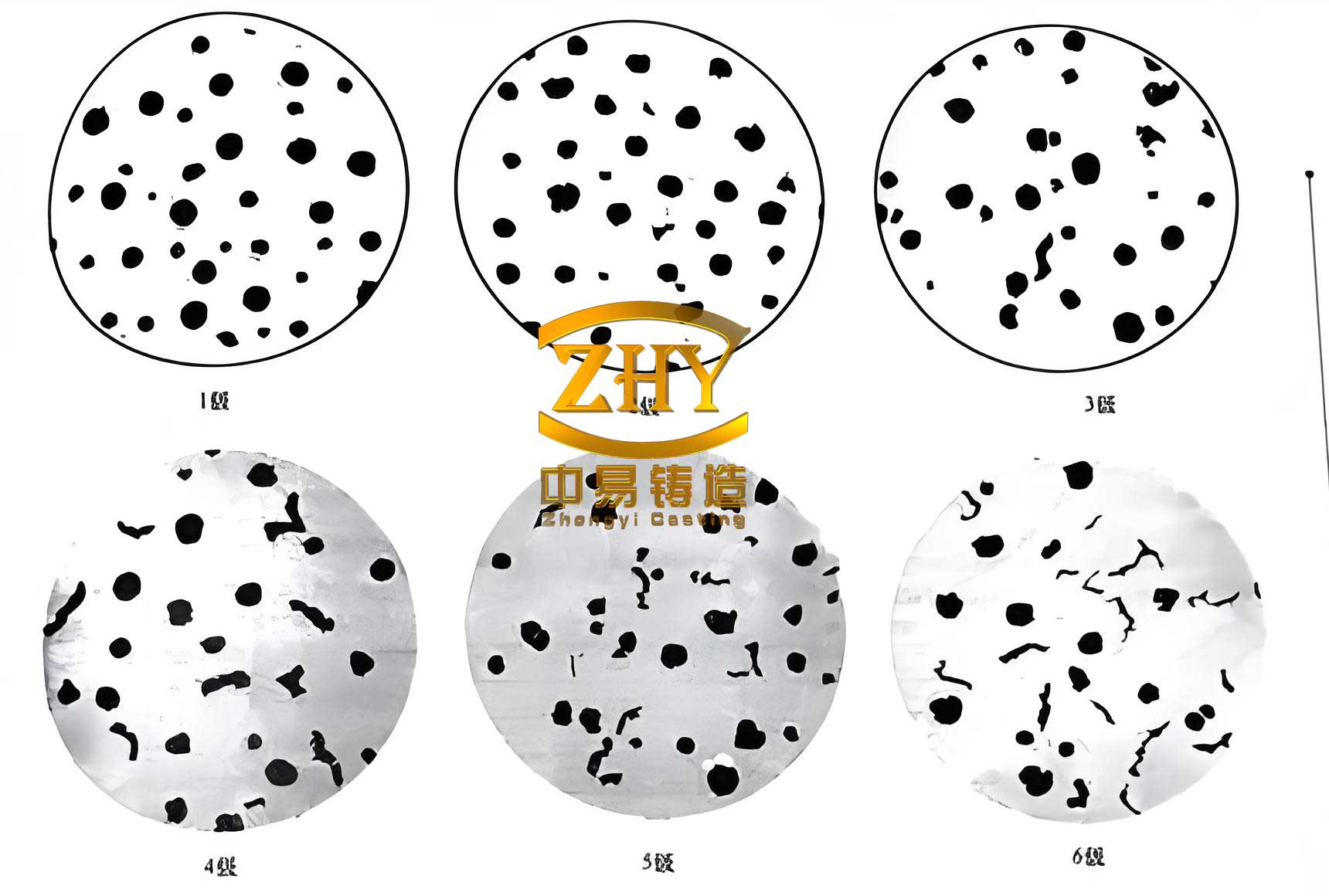
The mechanical properties and microstructural characteristics obtained from the Y-block samples are summarized in Table 2. All samples exhibited good nodularization, with a rating of 3 (per relevant standards) and a nodule size rating of 6 or 7. The graphite morphology is a defining feature of high-quality spheroidal graphite cast iron. The matrix, however, varied significantly with composition.
| Heat ID | σb (MPa) | δ5 (%) | Hardness (HB) | Nodule Rating | Nodule Size | Nodule Count (/mm²) | Pearlite (%) |
|---|---|---|---|---|---|---|---|
| B1 | 587 | 8.86 | 198 | 3 | 6 | 100 | 35-45 |
| C2 | 585 | 12.73 | 204 | 3 | 6 | 130 | ~55 |
| D2 | 602 | 7.50 | 235 | 3 | 6 | 100 | ~60 |
The data reveals a clear trend. Heat C2, with a high Cu (0.53%) and low Mn (0.39%) combination, achieved the highest elongation (12.73%) alongside a moderate tensile strength and the lowest hardness. Its microstructure consisted of approximately 55% pearlite in a ferritic matrix, with the finest graphite distribution (130 nodules/mm²). The enhanced nodule count is partly attributed to the graphitizing effect of Cu, which can influence solidification. Conversely, Heat D2, with low Cu (0.17%) and high Mn (0.73%), exhibited the highest tensile strength (602 MPa) and hardness (235 HB), but the lowest elongation (7.5%). Its microstructure contained the highest pearlite fraction (~60%). Heat B1, with a balanced mid-range of both elements, showed intermediate properties.
The underlying metallurgical principles explain these results. Manganese is a pearlite promoter and a solid solution strengthener in both ferrite and cementite. Its effectiveness in increasing pearlite fraction and hardness is described by a relationship such as:
$$ P_f \approx k_{Mn} \cdot [Mn] + P_{0} $$
where $P_f$ is the pearlite fraction, $[Mn]$ is the manganese content, $k_{Mn}$ is a potency coefficient, and $P_{0}$ is the base pearlite fraction. However, Mn has a tendency to segregate to cell boundaries and can stabilize carbides, especially in faster cooling sections, which detrimentally impacts toughness and ductility. Copper, on the other hand, is a stronger and more efficient pearlite promoter than Mn but does not form stable carbides and has less severe segregation tendencies. It refines the pearlite lamellae and contributes to solid solution strengthening without drastically reducing ductility. Its effect can be conceptualized as providing a better combination of strength and ductility, often expressed through a quality index $Q$:
$$ Q = \sigma_b + k \cdot \delta $$
where a higher $Q$ value indicates a better balance. The high-Cu alloy (C2) maximizes this index for the spheroidal graphite cast iron grades studied.
Machinability Assessment: Hardness Distribution and Micro-Hardness
Machinability is critically linked to hardness and its uniformity throughout a casting. The presence of hard phases or severe microstructural heterogeneity leads to poor tool life and surface finish. The step-block tests were conducted to evaluate section sensitivity. The hardness values across different section thicknesses are listed in Table 3.
| Heat ID | 15 mm | 30 mm | 50 mm | 70 mm | Max Hardness Spread |
|---|---|---|---|---|---|
| B1 | 219 | 209 | 198 | 225 | 27 |
| C2 | 250 | 233 | 216 | 219 | 34 |
| D2 | 262 | 241 | 232 | 237 | 31 |
The results show that all compositional variants exhibited relatively low hardness spreads (27-34 HB), which is a positive indicator of uniform machinability across varying section sizes. This uniformity is a key benefit of well-inoculated spheroidal graphite cast iron. However, the absolute hardness levels and their variation with cooling rate are telling. For the high-Mn heat D2, the hardness in the fastest-cooling 15 mm section (262 HB) is significantly higher than that of heat B1 (219 HB), a difference of 43 HB. In the slowest-cooling 70 mm section, this difference reduces to only 12 HB. This demonstrates that the hardness-increasing effect of Mn becomes more pronounced with increasing cooling rate, likely due to its role in suppressing ferrite formation and potentially promoting fine carbides. In contrast, the high-Cu heat C2 shows a less severe gradient, and its peak hardness is lower than that of the high-Mn heat.
To probe for the presence of localized hard spots that could hinder machining, micro-hardness traverses were performed on sample C2. The values ranged from a minimum of 210 HV to a maximum of 323 HV, with an average of approximately 255.5 HV. The maximum value of 323 HV corresponds to a pearlitic colony or a small aggregate, while the minimum corresponds to ferritic regions. The absence of values exceeding, for instance, 400-500 HV indicates no formation of brittle, uncuttable carbides (like massive cementite). This micro-hardness profile is comparable to that of known well-machining commercial spheroidal graphite cast iron components, confirming that the developed high-Cu, low-Mn variant does not contain deleterious hard phases that would impair machinability.
Industrial-Scale Production Validation
Based on the laboratory findings, a production trial was conducted for a single-tire wheel hub casting (weight: 27 kg, wall thickness: 10/25 mm, specified grade: QT550-7). The processing parameters were scaled up using a 425 kg treatment ladle. The charge was melted and treated following the duplex process. The alloying strategy adopted the more stable and machinable approach: a lower Mn range (0.5-0.6%) coupled with a moderate Cu addition (0.2-0.3%). The final chemistry of the production heat is shown below (wt%): C: 3.77, Si: 2.41, Mn: 0.51, P: 0.032, S: 0.013, Mgres: 0.037, Cu: 0.23.
Four wheel hubs were cast on a DISA molding line alongside controlling Y-blocks. The Y-blocks showed consistent properties: tensile strength 573-582 MPa, elongation 8.2-12.9%, hardness 195-206 HB, with a microstructure of 45% pearlite and excellent nodularity. The cast hubs were sectioned, and hardness was measured at six points from the top to the bottom of the casting. The results showed a maximum hardness of 237 HB, a minimum of 205 HB, and a maximum spread of 32 HB. The microstructure at all checked locations was primarily ferritic-pearlitic with pearlite content between 45-55%, and nodularity was maintained at ratings of 3-4. No undesirable carbides were observed. The mechanical properties on the castings met the QT550-7 specification, and the hardness uniformity confirmed good expected machinability.
Conclusions
This investigation successfully delineated a robust production methodology for as-cast QT550-7 spheroidal graphite cast iron and established the critical influence of Cu and Mn alloying strategies. The following conclusions are drawn:
- Viable Composition Window: A stable as-cast QT550-7 can be produced with the following chemical composition (wt%): 3.7-3.8 C, 2.4-2.6 Si, ≤0.03 P, ≤0.02 S, 0.5-0.6 Mn, 0.25-0.35 Cu, with careful control of residual magnesium and rare earths.
- Alloying Element Synergy: The Cu/Mn ratio is a decisive factor. A combination of high Mn and low Cu effectively increases pearlite fraction, tensile strength, and bulk hardness but at the cost of reduced ductility and a greater sensitivity of hardness to casting section size (cooling rate). This variant may be suitable for applications like automotive chassis or hubs where higher hardness and wear resistance are prioritized, and cost is a significant factor (using less Cu).
- Optimized Balance for Machinability: A combination of high Cu and low Mn yields a superior balance of properties: lower and more uniform hardness, higher elongation, and finer microstructural constituents. This variant ensures excellent and predictable machinability, making it ideal for safety-critical components like crankshafts that require high fatigue strength and toughness under dynamic loads.
- Process Stability: The cupola-electric furnace duplex melting process, combined with effective nodularizing and inoculating practices, provides sufficient foundation for the consistent production of high-quality spheroidal graphite cast iron. The chosen alloying strategy based on Cu addition enhances process stability by minimizing the risk of carbide formation associated with high Mn levels, especially in varying section thicknesses.
In summary, the production of as-cast QT550-7 spheroidal graphite cast iron is not merely a matter of achieving a chemical specification but involves a strategic selection of alloying elements to tailor the microstructure for the intended mechanical performance and manufacturability requirements. The findings provide a clear guideline for selecting the appropriate Cu/Mn balance based on the specific service and machining demands of the cast component.