
In the development of modern diesel engines, advancements such as high-pressure common rail, turbocharging, and direct injection have driven the need for more durable and efficient components. Among these, cylinder liners play a critical role in the engine assembly, forming the cylinder unit with pistons and rings to convert combustion pressure into mechanical work. The operational environment for cylinder liners is exceptionally harsh, involving high temperatures, pressures, and friction, which directly impact engine performance, reliability, fuel economy, emissions, and noise levels. Traditionally, materials like pearlitic gray cast iron, alloyed cast iron, and compacted graphite iron have been used, but they often suffer from failures like scuffing, cavitation, and premature wear. In contrast, austempered ductile iron (ADI), a type of spheroidal graphite cast iron, offers superior strength, toughness, wear resistance, and corrosion resistance, making it a promising candidate for cylinder liners. However, challenges such as poor machinability and high production costs due to conventional austempering temperatures have limited its widespread adoption. This study investigates the effects of subcritical quenching (a lower-temperature austempering process) and conventional isothermal quenching on the microstructure and properties of spheroidal graphite cast iron cylinder liners, aiming to optimize performance while enhancing manufacturability and cost-efficiency.
The spheroidal graphite cast iron used in this study was produced via water-cooled metal mold centrifugal casting, a method that ensures uniform microstructure and minimal defects. The chemical composition of the spheroidal graphite cast iron is detailed in Table 1, highlighting key alloying elements like copper and niobium that influence phase formation and properties. Copper, in particular, enhances hardenability and promotes the formation of copper-rich phases, while niobium contributes to carbide precipitation for improved wear resistance.
| C | Si | Cu | Nb | B | Mn | S | P | Mg | Ce | Fe |
|---|---|---|---|---|---|---|---|---|---|---|
| 3.0-3.9 | 2.4-3.0 | 2.0-2.5 | 0.06-0.10 | 0.01-0.03 | <0.4 | <0.02 | <0.1 | 0.03-0.06 | 0.02-0.04 | Bal. |
The as-cast spheroidal graphite cast iron cylinder liners exhibited a microstructure comprising approximately 85% pearlite, 15% ferrite, and minor amounts of carbides and copper-rich phases, with a hardness of at least 240 HB. Graphite nodularity was rated at grade 2 with a nodule size of grade 7, ensuring good mechanical integrity. To modify the properties, two quenching processes were applied: subcritical quenching (Process 1) and conventional isothermal quenching (Process 2). The heat treatment parameters are summarized in Table 2. In Process 1, austenitization was conducted at 810°C for 25 minutes in a high-temperature salt bath composed of 70% BaCl and 30% NaCl, followed by rapid quenching into a low-temperature salt bath (45% NaNO2 and 55% KNO3) at 335°C for 80 minutes. This subcritical temperature lies within the three-phase region of graphite, austenite, and ferrite, allowing for partial retention of ferrite. In Process 2, austenitization was performed at 920°C for 25 minutes, within the two-phase region of graphite and austenite, followed by identical isothermal quenching. After treatment, samples were air-cooled and cleaned to remove residual salts.
| Parameter | Process 1 (Subcritical Quenching) | Process 2 (Conventional Isothermal Quenching) |
|---|---|---|
| Austenitization | 810°C × 25 min | 920°C × 25 min |
| Isothermal Quenching | 335°C × 80 min | 335°C × 80 min |
Microstructural analysis was conducted using optical microscopy with a 4% nitric acid alcohol etchant, and phase fractions were quantified via image analysis. Mechanical properties, including tensile strength (Rm), elongation (A), and hardness (HB), were evaluated according to GB228.1-2010 and ASTM standards. Dynamic elastic modulus (E) was measured using a resonant frequency method, while thermal conductivity and linear expansion coefficient were determined via laser flash and dilatometry techniques, respectively. Friction and wear tests were performed on a tribometer under lubricated conditions with a constant load of 100 N and varying speeds, simulating engine operating conditions. Machinability was assessed by counting the number of cylinder liners processed under fixed cutting parameters until tool wear became significant, using CBN tools on a CNC machining center.
The microstructure of the spheroidal graphite cast iron after quenching revealed significant differences between the two processes. In Process 1 (subcritical quenching), the matrix consisted of lower bainite, copper-rich retained austenite, blocky ferrite, and a small amount of niobium-containing carbides. The presence of ferrite is attributed to the austenitization temperature being within the three-phase region, where ferrite does not fully transform. This structure resulted in a hardness of at least 300 HB. In Process 2 (conventional isothermal quenching), the matrix comprised lower bainite, copper-rich retained austenite, and minor niobium carbides, with no retained ferrite due to complete austenitization, yielding a higher hardness of at least 350 HB. The copper-rich phases form because copper has a solubility of about 3.5% in austenite and only 0.3% in ferrite at room temperature, leading to precipitation during quenching. These microstructural variations directly influence the mechanical and tribological properties of the spheroidal graphite cast iron.
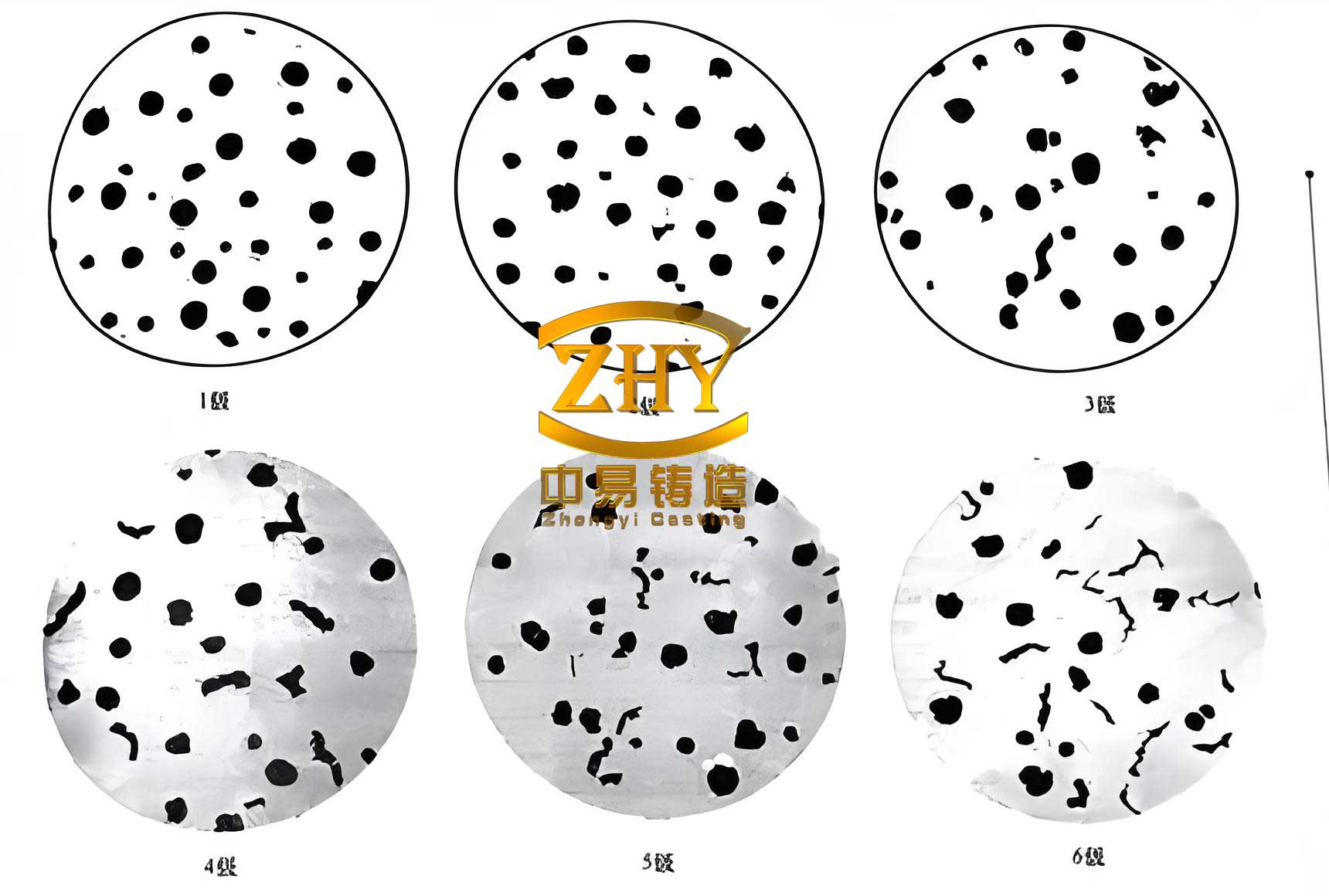
The mechanical properties of the spheroidal graphite cast iron cylinder liners are summarized in Table 3. Compared to Process 2, Process 1 showed a reduction in tensile strength and hardness, while the elastic modulus remained nearly unchanged, and elongation increased. This behavior can be explained by the presence of soft ferrite in the subcritical quenched spheroidal graphite cast iron, which enhances ductility but reduces strength. The relationship between hardness and phase composition can be approximated by a rule-of-mixtures formula: $$ HB = V_{B} \cdot HB_{B} + V_{F} \cdot HB_{F} + V_{A} \cdot HB_{A} + V_{C} \cdot HB_{C} $$ where \( V \) represents the volume fraction and subscripts denote bainite (B), ferrite (F), austenite (A), and carbides (C). For Process 1, the higher \( V_{F} \) lowers overall hardness, whereas in Process 2, the absence of ferrite leads to higher hardness dominated by bainite and austenite.
| Process | Tensile Strength, Rm (MPa) | Elastic Modulus, E (GPa) | Elongation, A (%) | Hardness (HB) |
|---|---|---|---|---|
| Process 1 (Subcritical) | 900 | 170 | 8 | ≥300 |
| Process 2 (Conventional) | 1050 | 175 | 6 | ≥350 |
Thermal properties, including linear expansion coefficient and thermal conductivity, were evaluated over a temperature range from 50°C to 400°C. As shown in Table 4, both processes exhibited similar linear expansion coefficients and thermal conductivities, indicating that these properties are primarily governed by the graphite morphology rather than the matrix structure in spheroidal graphite cast iron. The linear expansion coefficient for both spheroidal graphite cast iron samples was higher than that of typical gray cast iron (around 12 μm/(m·°C)), which is beneficial for thermal stability in engine applications. Notably, above 400°C, the expansion coefficient decreased sharply, possibly due to precipitation of nano-sized copper-rich phases from the austenite, altering the lattice parameters. The thermal conductivity of spheroidal graphite cast iron was lower than that of gray cast iron (41.5–52.5 W/(m·K)), but Process 1 showed slightly higher values at lower temperatures, likely due to retained copper-rich phases from the casting process. Above 400°C, Process 2 displayed higher conductivity, attributed to enhanced phase precipitation.
| Temperature (°C) | Linear Expansion Coefficient (μm/(m·°C)) – Process 1 | Linear Expansion Coefficient (μm/(m·°C)) – Process 2 | Thermal Conductivity (W/(m·K)) – Process 1 | Thermal Conductivity (W/(m·K)) – Process 2 |
|---|---|---|---|---|
| 50 | 13.5 | 13.6 | 17.27 | 16.49 |
| 100 | 14.2 | 14.3 | 18.31 | 17.43 |
| 150 | 15.0 | 15.1 | 18.11 | 17.34 |
| 200 | 15.8 | 15.9 | 19.06 | 18.60 |
| 250 | 16.5 | 16.6 | 19.74 | 19.02 |
| 300 | 17.2 | 17.3 | 20.36 | 20.27 |
| 350 | 17.8 | 17.9 | 21.26 | 21.22 |
| 400 | 18.0 | 18.1 | 22.89 | 22.95 |
The friction and wear performance of spheroidal graphite cast iron cylinder liners was tested under lubricated conditions with SAE30 oil and a chrome-plated piston ring. The friction coefficient decreased with increasing rotational speed for both processes, as summarized in Table 5. This trend aligns with the Stribeck curve, where higher speeds promote hydrodynamic lubrication. However, Process 1 consistently exhibited lower friction coefficients than Process 2 across all speeds, with the difference narrowing at higher speeds. The enhanced tribological behavior in subcritical quenched spheroidal graphite cast iron is likely due to the presence of copper-rich phases, which act as solid lubricants and reduce shear stress at the interface. The wear rate can be modeled using the Archard equation: $$ W = k \cdot \frac{F \cdot v}{H} $$ where \( W \) is wear volume, \( k \) is a wear coefficient, \( F \) is load, \( v \) is sliding velocity, and \( H \) is hardness. For Process 1, the lower hardness is compensated by the lubricating effect of copper-rich phases, resulting in reduced friction.
| Rotational Speed (rpm) | Friction Coefficient – Process 1 | Friction Coefficient – Process 2 |
|---|---|---|
| 25 | 0.1277 | 0.1332 |
| 50 | 0.1252 | 0.1292 |
| 75 | 0.1240 | 0.1262 |
| 100 | 0.1233 | 0.1241 |
| 150 | 0.1219 | 0.1224 |
| 250 | 0.1206 | 0.1212 |
| 375 | 0.1196 | 0.1204 |
Machinability is a critical factor for industrial applications of spheroidal graphite cast iron. Under identical cutting conditions (150 m/min speed, 600 rpm spindle speed, 0.2 mm feed, 0.5–1.1 mm depth of cut), the subcritical quenched spheroidal graphite cast iron cylinder liners demonstrated significantly improved machinability. The number of liners processed before tool wear became excessive was over five times higher for Process 1 compared to Process 2. This improvement stems from the lower hardness and presence of ferrite in the subcritical quenched spheroidal graphite cast iron, which reduces cutting forces and tool abrasion. Additionally, the copper-rich phases may enhance chip breaking and lubricate the cutting zone, further extending tool life. The relationship between machinability and material properties can be expressed as: $$ M \propto \frac{1}{HB \cdot \sigma_{y}} $$ where \( M \) is machinability index, \( HB \) is hardness, and \( \sigma_{y} \) is yield strength. For Process 1, the lower \( HB \) and \( \sigma_{y} \) contribute to higher \( M \), facilitating easier machining.
In summary, this study highlights the profound impact of quenching processes on the microstructure and properties of spheroidal graphite cast iron cylinder liners. Subcritical quenching, conducted at 810°C, results in a microstructure of lower bainite, copper-rich retained austenite, blocky ferrite, and minor carbides, with a hardness of at least 300 HB. In contrast, conventional isothermal quenching at 920°C produces a matrix of lower bainite, copper-rich retained austenite, and carbides, achieving a higher hardness of at least 350 HB. The subcritical quenched spheroidal graphite cast iron exhibits reduced tensile strength and hardness but increased elongation, while elastic modulus, linear expansion coefficient, and thermal conductivity remain largely unchanged compared to conventional quenching. Friction coefficients decrease with speed for both processes, but subcritical quenching yields lower values due to copper-rich phase lubrication. Most notably, machinability is dramatically enhanced in subcritical quenched spheroidal graphite cast iron, with processing capacity exceeding five times that of conventional quenched liners under the same conditions. These findings suggest that subcritical quenching offers a viable route to optimize the performance and manufacturability of spheroidal graphite cast iron cylinder liners for high-demand engine applications, balancing mechanical properties with production efficiency. Future work could explore the effects of varying alloy compositions or quenching parameters to further tailor the properties of this versatile material.