
The manufacture of large, critical components for industrial machinery presents unique challenges in foundry engineering. This discourse details the comprehensive process development, simulation-led validation, and successful production of a massive spheroidal graphite cast iron disc, a core component for a high-speed mechanical press. The primary objective was to achieve a defect-free casting with uniform microstructure and consistent mechanical properties, crucial for ensuring the press’s operational stability and longevity by preventing deformation under cyclic loads.
Component Analysis and Foundry Challenges
The disc casting is a monumental component with a finished mass of approximately 38,000 kg. Its dimensions are substantial, with an outer diameter of 4,800 mm, a total height of 1,700 mm, and a maximum casting dimension exceeding 5,800 mm. The nominal wall thickness is 220 mm, with localized hot spots, particularly at the roots of bearing housing bosses. The specified material is spheroidal graphite cast iron grade QT500-7, requiring a tensile strength >420 MPa, yield strength >320 MPa, and elongation >5% from separately cast test bars.
The casting geometry introduces significant difficulties. The large, open cavity area and the presence of a pattern of threaded holes on the bottom face demand exceptional dimensional stability and soundness in these regions. Any subsurface shrinkage or porosity in the bolt hole areas could lead to failure during assembly or service. The fundamental challenge lies in managing the solidification characteristics of such a heavy-section spheroidal graphite cast iron casting to prevent defects like shrinkage porosity, graphite flotation, and degenerated graphite structures (e.g., chunk graphite), which are prevalent in thick castings due to extended solidification times.
Foundry Process Design Philosophy
The overarching philosophy was to combine robust gating and risering principles with advanced metallurgical control and targeted cooling to promote directional solidification and enhance graphite nucleation.
Chemical Composition Design
Careful balancing of the chemical composition is fundamental to producing sound, heavy-section spheroidal graphite cast iron. The target ranges were established based on the need for graphitization potential, controlled matrix structure, and minimization of deleterious elements.
| Element Group | Element | Target Range (wt.%) | Rationale |
|---|---|---|---|
| Base Elements | Carbon (C) | 3.5 – 3.7 (Base) | Provides high carbon equivalent (CE) for good castability and graphitization potential. CE = C% + 0.33*(Si%). Target CE: 4.0 – 4.2. |
| Silicon (Si) | 1.4 – 1.5 (Base) | ||
| Manganese (Mn) | 0.35 – 0.45 | Strengthens the pearlitic matrix; kept moderate to avoid excessive segregation. | |
| Phosphorus (P) | ≤ 0.02 | Minimized to reduce embrittlement and formation of steadite. | |
| Controlled Elements | Sulfur (S) | ≤ 0.010 | Critical for successful treatment. Low base S allows for lower residual Mg, reducing shrinkage tendency. |
| Copper (Cu) | 0.5 – 0.8 | Promotes pearlite formation, increases strength and hardness uniformly. | |
| Treatment Additions | Residual Magnesium (Mgres) | 0.035 – 0.055 | Essential for graphite spheroidization. Tight control is vital. |
| Trace Additions | Antimony (Sb) | 0.005 – 0.01 | Acts as a pearlite stabilizer and can help prevent graphite degeneration in heavy sections. |
The carbon equivalent (CE) is a critical parameter calculated as:
$$ CE = \%C + \frac{1}{3}\%Si $$
Aiming for a CE between 4.0% and 4.2% ensures adequate fluidity and a strong graphitizing tendency to counter the chilling effect and long solidification time.
Molding and Gating System Design
A three-part molding strategy using furan resin sand was employed. The parting line was set to position the critical bottom face with the bolt holes in the drag (bottom mold), ensuring better compaction and surface finish for this important area.
Gating System: A bottom-gating, semi-open system was designed to ensure calm, non-turbulent filling. Multiple downsprues were connected to a large, ring-shaped runner running along the periphery of the disc’s bottom in the drag. Several ingates were positioned to introduce metal evenly across the bottom surface. This design minimizes oxide formation and slag entrainment. The system was sized for a pouring weight of ~40,000 kg with a choke area ratio of approximately:
$$ \Sigma A_{\text{sprue}} : \Sigma A_{\text{runner}} : \Sigma A_{\text{ingate}} = 1 : 1.2 : 0.8 $$
The fill time was calculated based on the nominal filling velocity and total metal volume.
Chill Application: Given the thick sections and impracticality of using massive feeders (risers) in certain locations, strategic use of cast iron chills was paramount. Chills were placed at identified thermal centers, such as the bearing boss junctions. The function of the chills is two-fold: to locally increase the cooling rate, thus refining the microstructure and preventing late-stage graphite degeneration, and to promote directional solidification towards other hotter regions or the gating system itself. The effectiveness of a chill can be related to its modulus (volume/surface area) relative to the casting section modulus.
Melting, Treatment, and Pouring Methodology
Metallurgical control during treatment and pouring is arguably the most critical aspect for heavy-section spheroidal graphite cast iron.
Spheroidizing Treatment: A yttrium-bearing heavy rare earth spheroidizing alloy was selected. Yttrium provides a “late-spheroidizing” effect with a higher boiling point than magnesium, offering better resistance to graphitizing fade during long solidification. The treatment was performed using the sandwich method in a preheated ladle.
| Material | Key Components (wt.%) | Addition Rate (wt.%) | Purpose |
|---|---|---|---|
| Yttrium-based Spheroidizer | Mg: 6-7, RE (incl. Y): 1.5-2.5, Si: ~45 | 1.0 – 1.2 | Initiates and sustains graphite spheroidization; rare earths counteract trace element interference. |
| Barium-containing Inoculant (Ladle) | Si: 70-75, Ba: 1-2 | 0.5 – 0.6 | Primary inoculation for high nucleation potency; Ba provides fade resistance. |
| Rare Earth Inoculant (In-stream) | Si: 55-65, RE: 1-2 | 0.1 – 0.2 | Late inoculation during pouring to create instant nucleation sites in the mold. |
The required magnesium addition (Madd) can be estimated considering base sulfur and target residual:
$$ M_{\text{add}} (\%) \approx 0.76 \times (\%S_{\text{base}}) + \%Mg_{\text{target}} + \text{Loss Factor} $$
Pouring Practice: The melt was superheated to 1500-1550°C for cleansing and then allowed to cool. The treatment was carried out at 1430-1460°C. A deliberately low pouring temperature of 1300-1330°C was chosen to:
- Reduce total liquid contraction volume.
- Shorten the overall solidification time, mitigating graphite degeneration.
- Minimize mold wall erosion and veining.
This required precise coordination and rapid transfer to avoid excessive temperature drop before pouring completion.
Numerical Simulation and Process Optimization
Advanced casting simulation software was employed to virtually prototype the process, predict potential defects, and optimize the design before committing to expensive tooling and melt.
Filling Analysis: The simulation confirmed a calm fill pattern with the bottom-gating design. Velocity vectors showed no significant turbulent impingement on mold walls. The analysis predicted the timing for the arrival of metal at different sections, helping verify that no isolated liquid pools formed prematurely which could lead to cold shuts.
Solidification and Porosity Prediction: This was the most critical simulation output. The software solves the heat transfer equation, considering the release of latent heat during the austenite-graphite eutectic reaction:
$$ \rho C_p \frac{\partial T}{\partial t} = \nabla \cdot (k \nabla T) + \rho L \frac{\partial f_s}{\partial t} $$
where $\rho$ is density, $C_p$ is specific heat, $k$ is thermal conductivity, $T$ is temperature, $t$ is time, $L$ is latent heat, and $f_s$ is solid fraction. The Niyama criterion, a function of thermal gradient (G) and cooling rate (R), was used as an indicator for shrinkage porosity risk:
$$ Niyama = \frac{G}{\sqrt{\dot{T}}} \quad \text{or} \quad \frac{G}{\sqrt{R}} $$
Areas with a Niyama value below a critical threshold were flagged as potential shrinkage zones. The simulation clearly highlighted the thermal centers at the boss junctions. The initial design showed a moderate risk in these areas. The virtual model was then used to iteratively optimize the size, placement, and number of chills. The final simulation result showed a significant reduction in the predicted shrinkage volume, confirming that the chills effectively redirected the thermal gradients to promote sound solidification.
Production Validation and Quality Assessment
The finalized process was executed in production. The casting was poured successfully, and extensive testing was conducted on representative samples.
Chemical and Mechanical Properties
The final chemical composition of the casting met all specified targets. The mechanical properties, measured on attached test blocks, significantly exceeded the minimum requirements for QT500-7.
| Property | Specification (QT500-7) | Actual Result (Attached Block) |
|---|---|---|
| Tensile Strength (MPa) | > 420 | 535 |
| Yield Strength (MPa) | > 320 | 365 (0.2% offset) |
| Elongation (%) | > 5 | 5.5 |
| Hardness (HBW) | 170 – 230 | 192 |
Microstructural Evaluation
Metallographic examination is the ultimate verification for spheroidal graphite cast iron quality. Samples were taken from the thickest sections of the casting and the attached blocks.
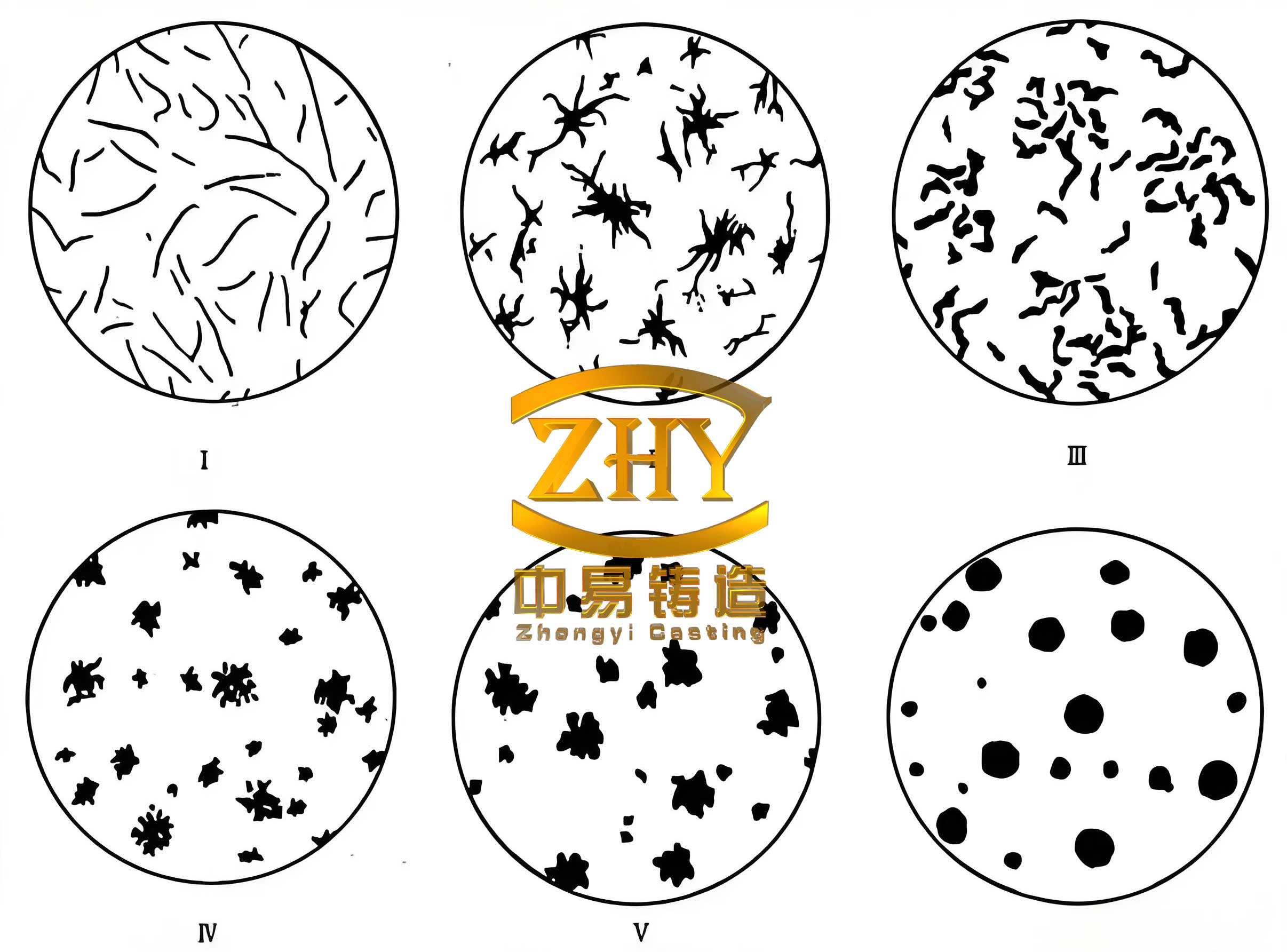
Graphite Structure: The microstructure exhibited a well-formed, predominantly nodular graphite morphology. Graphite nodule count was high, and nodularity, a key metric for the shape factor of graphite particles, was excellent. Quantitative image analysis confirmed a nodularity level exceeding 95%, with the vast majority of graphite particles being Type I (spheroidal) and Type II (nodular) according to relevant standards. Crucially, no evidence of chunk graphite or significant graphite flotation was observed, indicating successful control over solidification and fading.
Matrix Structure: The matrix consisted of a fine pearlite-ferrite mixture, with the pearlite fraction being dominant as intended by the copper and antimony additions. This matrix structure is responsible for the achieved high strength and moderate ductility.
Non-destructive testing (NDT) via ultrasonic examination was performed over the entire casting volume, particularly focusing on the high-stress areas and bolt hole regions. The results indicated a homogeneous, dense structure with no reportable indications of shrinkage or slag inclusions. Subsequent machining of the first-off casting validated the soundness, with all bolt holes and bearing seats machining cleanly without exposing any sub-surface defects.
Summary of Key Findings and Conclusions
The successful production of this massive, high-integrity press disc casting validates a holistic engineering approach combining fundamental metallurgy, innovative process design, and predictive simulation. The following conclusions can be drawn:
- Chemical Composition Control is Foundational: For heavy-section spheroidal graphite cast iron, a balanced composition with a carbon equivalent of 4.0-4.2%, low sulfur and phosphorus, controlled residual magnesium (0.035-0.055%), and strategic use of alloying elements (Cu) and stabilizers (Sb) is essential to achieve the desired microstructure and properties while minimizing defect susceptibility.
- The Gating and Feeding Strategy Must Ensure Thermal Management: A bottom-filled, multi-ingate system is highly effective for large, flat castings to ensure a non-turbulent fill. The strategic placement of chills is often more practical and effective than large risers for promoting localized directional solidification and refining microstructure in isolated hot spots of thick-section spheroidal graphite cast iron castings. The combined effect reduces isolated liquid pools and shrinkage porosity.
- Treatment and Pouring Parameters are Critical: The use of a fade-resistant yttrium-based spheroidizer coupled with intensive, multi-stage inoculation (ladle plus in-stream) is paramount to maintain a high graphite nodule count and prevent degeneration during prolonged solidification. A lower than conventional pouring temperature (1300-1330°C) is a viable strategy to reduce total contraction and solidification time, but requires precise process coordination.
- Simulation is an Indispensable Tool for First-Pass Success: Numerical simulation allowed for the virtual testing and optimization of the gating and chilling design. The ability to predict thermal gradients and shrinkage risk using criteria like the Niyama function enabled data-driven adjustments before production, saving significant time and cost associated with trial-and-error methods.
- Verification Confirms Process Efficacy: The final casting’s mechanical properties, excellent graphite nodularity (>95%), and defect-free status upon machining and NDT provide conclusive evidence that the integrated process design is capable of reliably producing high-quality, heavy-section spheroidal graphite cast iron components for demanding applications. This methodology provides a robust framework for the engineering of other large-scale, critical castings.