
In the production of high-performance components such as automotive turbocharger housings, Si-Mo heat-resistant spheroidal graphite cast iron is favored for its exceptional resistance to thermal fatigue, thermal shock, and good elevated temperature strength, with service capabilities reaching 700–800 °C. The intricate geometry and varying wall thicknesses of these castings, coupled with stringent customer quality standards, demand meticulous control over the entire manufacturing process. This includes tight regulation of chemical composition, melting parameters, spheroidization and inoculation practices, and pouring temperatures, often employing low-magnesium spheroidizers and specialized inoculants like silicon-barium. Despite these rigorous controls, production batches are frequently plagued by a defect known as fragmentary graphite, leading to significant scrap rates. The formation mechanisms and countermeasures for this defect are not uniformly understood in the industry. This analysis, based on extensive production experience, investigates the root causes from the perspectives of molten iron activity, chemical composition, spheroidization and inoculation, and the cooling conditions at heavy casting sections. The implementation of targeted improvements derived from this study has successfully mitigated the fragmentary graphite defect in Si-Mo heat-resistant spheroidal graphite cast iron.
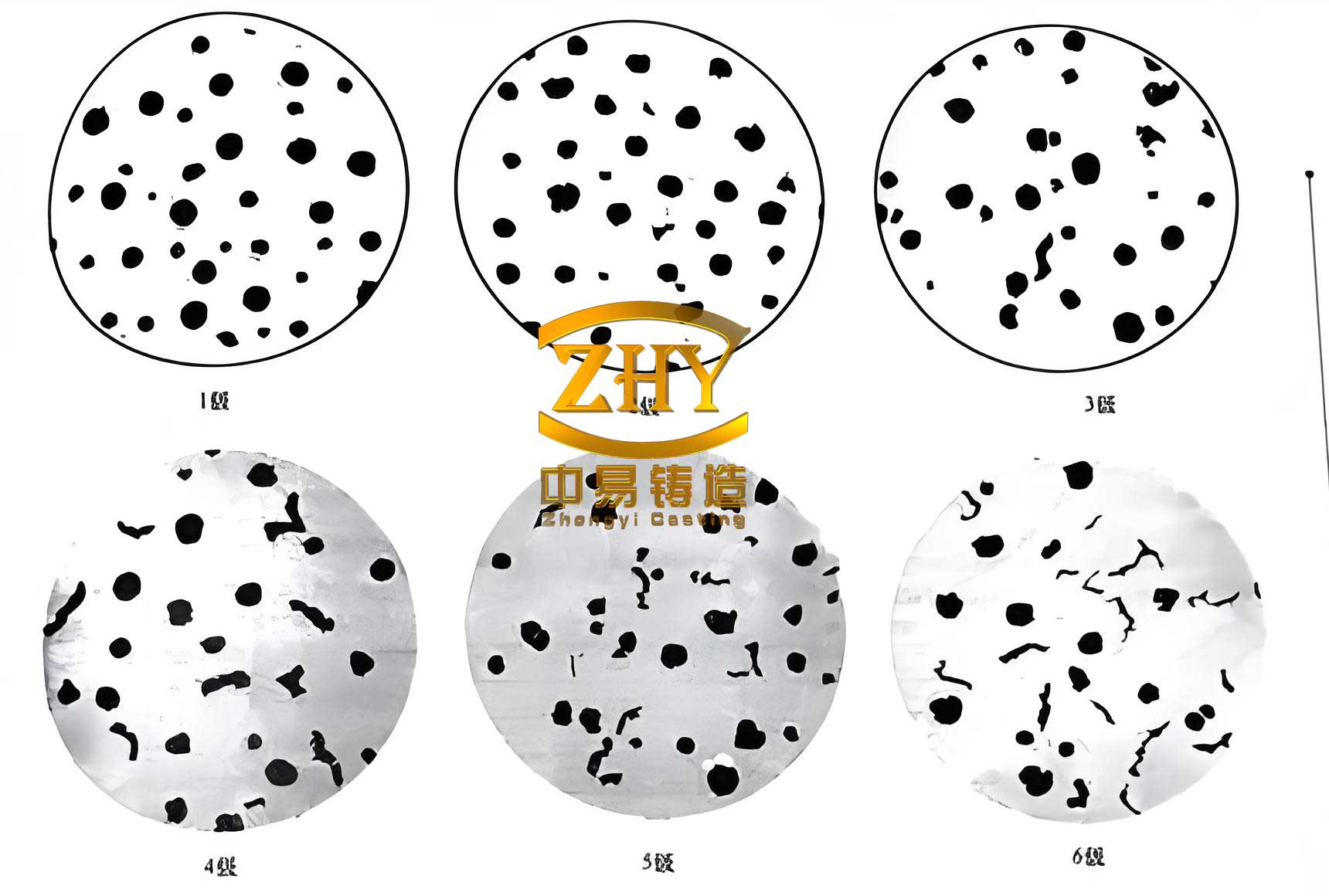
The foundation of the material lies in its specific chemistry. The high silicon content (3.75–4.9%) is crucial for promoting a high ferrite matrix ratio and increasing the austenite transformation temperature, which enhances microstructural stability under thermal cycling. Silicon also contributes directly to oxidation resistance. Molybdenum (0.5–0.7%) is added to significantly improve high-temperature tensile strength, creep resistance, and thermal fatigue properties. However, molybdenum can promote the precipitation of carbides at grain boundaries, potentially reducing elongation. Therefore, limiting elements like manganese, phosphorus, and sulfur is also critical for maintaining ductility. A typical chemical composition range is shown in the general guidelines below, though optimal ranges for preventing defects may be narrower.
The melting and processing of this grade of spheroidal graphite cast iron often involves adjustments to counteract its inherent characteristics. To minimize shrinkage porosity tendencies and ensure fluidity, carbon content is often pushed toward the upper limit. Furthermore, melting and pouring temperatures are typically elevated by approximately 40°C compared to standard grades; common practice involves melting at 1500–1530°C and pouring at 1410–1430°C. High-purity charge materials like carbon steel and low-impurity pig iron are selected, with alloys such as FeMo55 and FeSi75 added. The process commonly utilizes medium-frequency induction furnaces and the sandwich or tundish cover method for spheroidizing treatment.
The fragmentary graphite defect manifests primarily in thermal centers of the casting, such as heavy sections, hotspots, and areas near risers. In this specific spheroidal graphite cast iron, the susceptibility appears heightened. Metallographic examination reveals a morphology reminiscent of Type D graphite in gray iron: an aggregation of fine, seemingly disconnected graphite particles within the matrix. However, these particles are often interconnected within a single eutectic cell. They can appear as intercellular distributions or form clusters surrounded by well-formed spheroidal graphite. The short inter-particle distance facilitates rapid carbon diffusion, promoting ferrite formation between the fragments, while molybdenum carbides and pearlite tend to reside in grain boundary areas away from these clusters. Critically, two observations strongly link this defect to austenite dendrite formation: first, fragmentary graphite is predominantly found in regions with well-developed austenite dendrites; second, the graphite fragments are frequently aligned along these dendrites, creating a localized, segregated structure interspersed with a few spheroidal graphite nodules.
A systematic investigation of multiple production batches with fragmentary graphite issues identified several key influencing factors. The findings are summarized in the following table, which correlates process parameters with the propensity for defect formation.
| Influencing Factor | Condition Promoting Fragmentary Graphite | Proposed Mechanism |
|---|---|---|
| Molten Iron Activity | Excessive superheating (>1620°C) and prolonged holding. | Dissolution or deactivation of potential graphite nucleation sites, reducing overall nucleation potency. |
| Base Iron Sulfur Content | Very low S levels (0.005–0.007%). | Insufficient sulfur reduces the formation of heterogeneous nucleation substrates (e.g., (Mg,Ca,Mn)S complexes) critical for graphite spheroid formation. |
| Carbon Equivalent (CE) and Si | High CE (>4.7%) primarily from high Si (>4.6%). | High graphitizing potential may lead to graphite flotation and segregation during solidification, fostering irregular growth in interdendritic regions. |
| Spheroidizer Choice | Use of high-rare earth (RE) spheroidizers. | Low-melting point Fe-RE eutectics (e.g., Fe-Ce at ~1060°C) may cause local remelting of the austenite shell surrounding graphite, creating open channels for carbon diffusion and fragmented growth. |
| Local Cooling Rate | Slow cooling in heavy sections/thermal centers. | Long solidification time reduces undercooling, leading to a weak coupled growth between austenite and graphite, allowing for branching and fragmented graphite development in persistent liquid pockets. |
The role of chemistry is paramount. The carbon equivalent (CE), a key parameter for cast irons, is calculated as:
$$ CE = \%C + \frac{1}{3}\%Si $$
Maintaining CE within a controlled range, typically 4.5–4.6%, is crucial. Excessive silicon, while beneficial for heat resistance, dramatically increases the driving force for graphite precipitation and can destabilize the spheroidal growth front. Furthermore, the influence of trace elements cannot be overstated. Elements like lead, tin, titanium, and, as noted, certain levels of rare earths can profoundly interfere with the graphitization process in heavy sections of this sensitive spheroidal graphite cast iron. The detrimental effect of high rare earths is thought to be related to their impact on the solid-liquid interface stability during eutectic solidification. The localized undercooling, $\Delta T_{local}$, caused by rare earth segregation can be a driver for irregular growth.
The problem of low sulfur content highlights a fundamental aspect of metallurgy for spheroidal graphite cast iron: nucleation requires suitable substrates. While high purity is desirable, a minimum sulfur level (0.011–0.016% was found effective) is necessary to form oxy-sulfide particles that act as nuclei for graphite spheroids. An insufficient number of nuclei, $N$, directly increases the growth size of each eutectic cell and the diffusion distance for carbon, creating conditions favorable for fragmentary graphite. The relationship can be conceptually linked to the solidification time, $t_f$, in a thermal center:
$$ t_f \propto \frac{V^2}{A \cdot \kappa} $$
where $V$ is volume, $A$ is surface area, and $\kappa$ is thermal diffusivity. A long $t_f$ in a poorly nucleated melt is a recipe for defect formation.
Based on the root cause analysis, a multi-faceted strategy was developed to suppress fragmentary graphite in Si-Mo heat-resistant spheroidal graphite cast iron.
1. Optimizing Molten Iron Activity and Composition: Charge makeup should include a sufficient proportion of high-quality pig iron to provide inherent nucleation sites, while limiting recycled returns. Prolonged holding at high temperatures must be avoided. Intentional sulfur adjustment via FeS addition to achieve a base sulfur level of 0.011–0.016% proved highly effective in enhancing nucleation density and graphite spheroidicity. Pre-conditioning the base iron with high-grade silicon carbide (SiC) can also improve nucleation potential and iron activity.
2. Precise Chemical Control: Aim for a carbon equivalent at the lower end of the specification, around 4.5–4.6%, keeping silicon content near the lower limit (e.g., ~3.8% for medium-Si grades). In stubborn cases, the deliberate addition of minute amounts of elements like antimony (Sb, ~0.003%) or tin (Sn) can be effective. These elements segregate at the advancing graphite/austenite interface, impeding carbon diffusion and thereby suppressing the branched growth of fragmentary graphite. The effect can be modeled as an increase in the interfacial energy barrier for graphite growth. However, this must be applied cautiously as they strongly promote pearlite and can increase shrinkage sensitivity. The formula for estimating the final matrix structure must account for this. Crucially, the use of low-rare earth (RE ≤ 0.8%) or rare earth-free spheroidizing alloys is strongly recommended for this grade of spheroidal graphite cast iron, especially when chromium is also present.
3. Advanced Inoculation Strategy: Inoculation is the most powerful tool for combating fragmentary graphite. While barium-containing inoculants are common, they may not suffice in extreme thermal centers. Testing revealed that inoculants containing zirconium (Zr), such as silicon-strontium-zirconium or sulfur-oxygen-zirconium types, are remarkably effective in suppressing the defect in Si-Mo spheroidal graphite cast iron. Zirconium is believed to form very stable nitrides/carbides (e.g., ZrN, ZrC) that provide potent, persistent nucleation sites even in slowly cooling regions. Inoculants containing bismuth (Bi) or rare earths should be avoided for this application, as their beneficial effects fade in heavy sections. The practice of multiple inoculation, particularly with a late stream inoculation during pouring, is essential. The inoculant size for stream inoculation must be carefully controlled (0.2–0.7 mm) to prevent slag defects in the relatively viscous Si-Mo spheroidal graphite cast iron melt. The effectiveness of different inoculants can be compared as follows:
| Inoculant Type | Effect on Graphite in Thermal Centers | Remarks |
|---|---|---|
| Silicon-Barium (Ba) | Moderate improvement; may not eliminate defect. | Standard choice, good for general nodule count. |
| Silicon-Bismuth (Bi) / RE | Poor; fragmentary graphite often persists. | Effective for thin walls but fades in slow-cooling areas. |
| Silicon-Strontium-Zirconium (Sr,Zr) | Excellent; significant suppression of fragmentary graphite. | Provides stable nuclei for spheroidal graphite cast iron in heavy sections. |
4. Enhancing Local Cooling: Any measure that increases the local cooling rate in thermal centers is beneficial. This includes redesigning gating systems to avoid concentrated metal flow and resultant hot spots, and the strategic use of internal or external chills, chromium ore sand in molds, or attached cooling fins to extract heat from critical areas. The goal is to reduce the local solidification time, $t_f$, thereby promoting a finer eutectic structure and shifting solidification dynamics away from the regime conducive to fragmentary graphite formation.
In conclusion, the occurrence of fragmentary graphite in Si-Mo heat-resistant spheroidal graphite cast iron is a multifactorial challenge rooted in the material’s specific chemistry and the solidification conditions of complex castings. A holistic approach addressing molten metal preparation, stringent chemical control, sophisticated spheroidization and inoculation practices, and enhanced cooling design is required for consistent defect-free production. Key takeaways are: maintaining optimal iron activity with controlled sulfur; keeping carbon equivalent and silicon on the lower side; selecting low-RE spheroidizers and Zr-containing inoculants; and implementing late stream inoculation. Finally, maximizing cooling in thick sections remains a universally effective principle. Through the systematic application of these countermeasures, the problematic fragmentary graphite defect in high-performance Si-Mo spheroidal graphite cast iron can be reliably eliminated, ensuring the material meets its demanding service requirements.