
As a researcher in the field of advanced metallic materials, I have long been fascinated by the potential of spheroidal graphite cast iron, particularly when subjected to specialized heat treatments. Spheroidal graphite cast iron, commonly known as ductile iron, serves as a foundational material in numerous engineering applications due to its excellent castability and mechanical properties. However, the advent of austempering processes has unlocked even greater potential, leading to the development of Austempered Ductile Iron (ADI). This material, characterized by a unique ausferritic microstructure, offers an exceptional combination of high strength, good toughness, and superior wear resistance. In this extensive study, I delve into the effects of an intercritical austempering process—specifically, austenitizing within the ferrite-austenite-graphite three-phase region followed by isothermal quenching—on the microstructure and mechanical properties of spheroidal graphite cast iron. The objective is to systematically understand how partial austenitization temperatures influence the final phase constitution and performance, thereby contributing to the broader knowledge base for optimizing this remarkable material.
The fundamental allure of spheroidal graphite cast iron lies in its microstructure, where graphite exists in spherical nodules embedded within a metallic matrix. This structure is typically achieved through the addition of magnesium or cerium during melting. The matrix can be varied through heat treatment to produce different combinations of ferrite, pearlite, or, via austempering, ausferrite. Austempered Ductile Iron is produced by heating spheroidal graphite cast iron to a fully austenitic state, holding, and then rapidly quenching to and holding at a temperature in the bainitic transformation range (usually between 250°C and 400°C). This results in a matrix of acicular ferrite and carbon-enriched retained austenite, known as ausferrite. However, a variant known as dual-phase ADI or intercritically austempered spheroidal graphite cast iron is produced by heating the material into the intercritical (α+γ+G) region, where ferrite, austenite, and graphite coexist, prior to the isothermal quench. This process retains some proeutectoid ferrite in a fragmented form alongside the ausferrite, potentially offering a beneficial balance of properties, including improved machinability. The phase diagram for the Fe-C-Si system is crucial here, as silicon significantly shifts the eutectoid transformation to a temperature range. The lower and upper boundaries of this three-phase region are denoted as $$A_{c1}$$ and $$A_{c3}$$ respectively. The transformation kinetics during intercritical austenitization can be described by models considering diffusion-controlled growth. For instance, the volume fraction of austenite ($$V_\gamma$$) formed at a temperature T and time t can be approximated by the Johnson-Mehl-Avrami-Kolmogorov (JMAK) equation:
$$ V_\gamma = 1 – \exp(-k t^n) $$
where k is a rate constant dependent on temperature and alloy composition, and n is the Avrami exponent. This study focuses on varying the intercritical austenitizing temperature while keeping other parameters constant to isolate its effect.
| Element | C | Si | Mn | P | S | Mg | Cu | Mo | RE |
|---|---|---|---|---|---|---|---|---|---|
| Content | 3.55 | 2.53 | 0.17 | 0.03 | 0.02 | 0.041 | 0.55 | 0.33 | 0.035 |
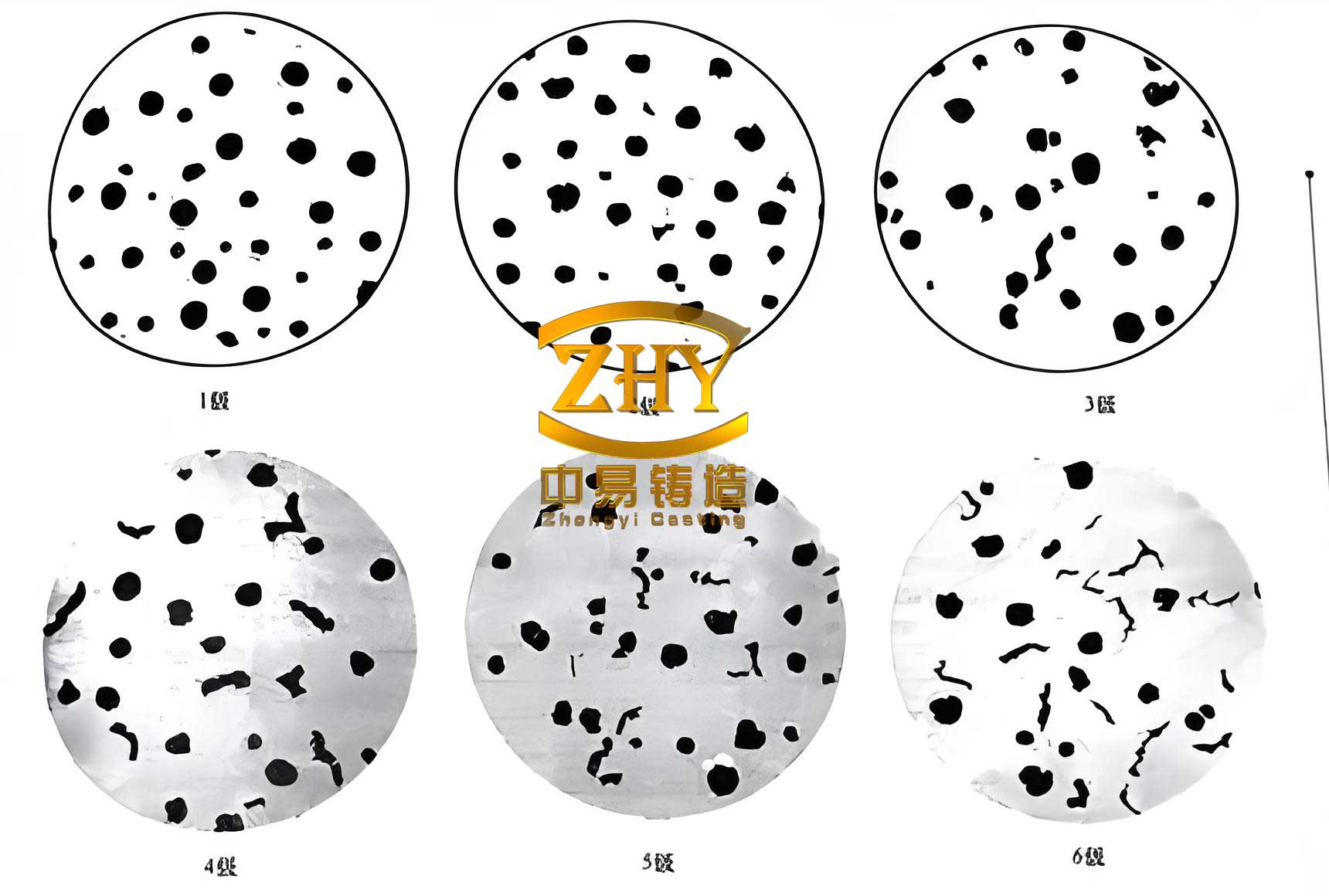
The spheroidal graphite cast iron for this investigation was meticulously prepared. Melting was conducted in a medium-frequency induction furnace using high-purity charge materials including pig iron, steel scrap, and necessary additives like ferrosilicon and carburizer. The critical step of spheroidization was achieved using a FeSiMg6Re2 alloy added via the sandwich method in a ladle, ensuring a high nodule count and spheroidization efficiency. Post-inoculation was performed to refine the graphite structure. The melt was then poured into Y-block sand molds to produce castings of 25 mm thickness, from which standard tensile and impact test specimens were machined. The as-cast microstructure of this spheroidal graphite cast iron exhibited a typical “bull’s-eye” structure with nodular graphite surrounded by a mixture of ferrite and pearlite, with a graphite nodularity exceeding 95%. This serves as the baseline for all subsequent heat treatments.
The core of the experimental design revolves around the intercritical austempering heat treatment. Prior to defining the main matrix, preliminary tests were conducted to determine the three-phase region boundaries for this specific composition of spheroidal graphite cast iron. Samples were austenitized at various temperatures, held for 60 minutes, and air-cooled. Microstructural analysis revealed the onset of austenite formation. Based on this, the intercritical austenitizing temperature range was confidently set between 820°C and 880°C. The full heat treatment schedule involved austenitizing at the specified temperature for 60 minutes to ensure homogenization, followed by rapid transfer to a salt bath maintained at a constant isothermal quenching temperature of 370°C, where they were held for 120 minutes to allow the bainitic transformation to proceed to completion, before final air cooling to room temperature. The complete matrix of treatments is summarized below.
| Sample Set | Austenitizing Temperature (°C) | Austenitizing Time (min) | Isothermal Quenching Temperature (°C) | Isothermal Quenching Time (min) |
|---|---|---|---|---|
| A | 820 | 60 | 370 | 120 |
| B | 840 | 60 | 370 | 120 |
| C | 860 | 60 | 370 | 120 |
| D | 880 | 60 | 370 | 120 |
Microstructural characterization was performed using optical microscopy on samples polished and etched with 4% nital. Mechanical testing included tensile tests to determine ultimate tensile strength (UTS) and elongation, Brinell hardness measurements, and Charpy V-notch impact tests at room temperature. All reported values are averages from multiple tests to ensure statistical reliability. The relationship between microstructure and properties was further analyzed through scanning electron microscopy of fracture surfaces.
The influence of the intercritical austenitizing temperature on the final microstructure of the austempered spheroidal graphite cast iron was profound and systematic. For the sample treated at 820°C, the microstructure consisted of a significant amount of blocky, proeutectoid ferrite (retained from the initial partial austenitization) embedded within a matrix of ausferrite (acicular ferrite laths with intervening films of stabilized, high-carbon austenite) and the ever-present spheroidal graphite nodules. This is classic dual-phase ADI. As the austenitizing temperature increased to 840°C and then 860°C, the volume fraction of this retained, fragmented ferrite decreased progressively, while the proportion of the ausferritic matrix increased correspondingly. This is a direct consequence of the phase rule applied to the Fe-C-Si system; a higher temperature within the (α+γ+G) field shifts the equilibrium towards a greater fraction of austenite at the expense of ferrite. The austenite formed at these temperatures, upon isothermal quenching, transforms into ausferrite. At the highest austenitizing temperature of 880°C, the microstructure was nearly fully ausferritic with minimal to no visible blocky ferrite, indicating that the treatment temperature was at or very near the $$A_{c3}$$ boundary for this spheroidal graphite cast iron composition. Essentially, the material approached a fully austenitized condition prior to quenching. The transition can be quantified by considering the lever rule in the two-phase region. If we denote the carbon content of the alloy as $$C_0$$, the fraction of austenite ($$f_\gamma$$) at a temperature T within the intercritical range can be estimated from the phase diagram boundaries $$C_{\alpha}$$ and $$C_{\gamma}$$:
$$ f_\gamma \approx \frac{C_0 – C_{\alpha}(T)}{C_{\gamma}(T) – C_{\alpha}(T)} $$
where $$C_{\alpha}(T)$$ and $$C_{\gamma}(T)$$ are the carbon concentrations in ferrite and austenite at equilibrium at temperature T, respectively. This fraction directly dictates the amount of ausferrite formed after isothermal transformation.
The mechanical properties of the austempered spheroidal graphite cast iron exhibited clear and consistent trends correlated with the microstructural evolution driven by the austenitizing temperature. The data is comprehensively presented in the following table.
| Austenitizing Temp. (°C) | Ultimate Tensile Strength (MPa) | Elongation (%) | Impact Absorbed Energy (J) | Brinell Hardness (HB) |
|---|---|---|---|---|
| 820 | 647 | 13.5 | 115.1 | 157 |
| 840 | 800 | 9.0 | 99.7 | 229 |
| 860 | 1001 | 7.5 | 91.6 | 285 |
| 880 | 1115 | 5.5 | 84.3 | 323 |
The ultimate tensile strength and hardness demonstrated a monotonic increase with rising austenitizing temperature. This can be attributed to the increasing volume fraction of the strong, hard ausferritic phase at the expense of the softer, more ductile proeutectoid ferrite. The strength of the ausferrite itself is a function of the fineness of the acicular ferrite and the stability of the retained austenite. The relationship between strength ($$\sigma$$) and microstructure can be modeled using a rule of mixtures for a composite material:
$$ \sigma = f_{\alpha_{block}} \cdot \sigma_{\alpha} + f_{ausferrite} \cdot \sigma_{ausf} $$
where $$f_{\alpha_{block}}$$ and $$f_{ausferrite}$$ are the volume fractions of blocky ferrite and ausferrite, respectively, and $$\sigma_{\alpha}$$ and $$\sigma_{ausf}$$ are their respective strengths. Since $$f_{ausferrite}$$ increases with temperature and $$\sigma_{ausf} > \sigma_{\alpha}$$, the overall strength rises. Hardness follows a similar trend, as it is closely related to strength. Conversely, both elongation (ductility) and impact absorbed energy (toughness) decreased systematically as the austenitizing temperature increased. The retained blocky ferrite in samples treated at lower temperatures provides a continuous, ductile phase that can accommodate plastic deformation and blunt crack propagation, thereby enhancing both ductility and toughness. As this phase diminishes, the deformation becomes more concentrated in the ausferrite, which, despite its good combination of properties, generally offers lower ductility than pure ferrite. The impact energy ($$U$$) can be thought of as an integral of the stress-strain curve, and its reduction aligns with the decrease in uniform elongation. Furthermore, the stability of the retained austenite in the ausferrite plays a role; under impact or high strain rates, it may transform to martensite (transformation-induced plasticity), but the overall trend here is dominated by the phase fractions.
Fractographic analysis provided vivid corroboration of the mechanical test data. The fracture surfaces of impact specimens from the 820°C treatment showed a predominantly dimpled, ductile rupture morphology with numerous deep equiaxed dimples, indicative of high energy absorption via microvoid coalescence. This is characteristic of the significant plastic deformation enabled by the blocky ferrite in this spheroidal graphite cast iron. As the austenitizing temperature increased to 840°C and 860°C, the dimpled area became less dominant, with increasing areas of a more faceted or quasi-cleavage appearance associated with the fracture of the acicular ferrite plates in the ausferrite. At 880°C, the fracture surface was largely characterized by this quasi-cleavage mode with shallower dimples, consistent with the lower impact energy measured. This evolution directly mirrors the reduction in the volume fraction of the ductile ferrite phase.
The discussion naturally extends to the underlying metallurgical mechanisms. The process of intercritical austenitization in spheroidal graphite cast iron is governed by carbon diffusion. At the lower temperatures (e.g., 820°C), the driving force for austenite nucleation is high at the ferrite/graphite interfaces, but the kinetics of carbon diffusion are relatively slow. This results in a lower volume of austenite, which is also potentially less homogeneous in carbon content. Upon isothermal quenching, this austenite transforms to ausferrite. The remaining ferrite is chemically unaltered during this stage. At higher intercritical temperatures, diffusion is accelerated (following an Arrhenius relationship, $$D = D_0 \exp(-Q/RT)$$, where D is diffusivity, Q activation energy, R gas constant, T temperature), leading to a larger, more carbon-homogenized austenite volume. Consequently, after isothermal holding, a larger fraction of ausferrite forms. The hardness and strength of ausferrite itself are influenced by the isothermal transformation temperature (held constant here at 370°C), which controls the scale of the bainitic ferrite subunits. The stability of the retained austenite, crucial for ductility and toughness, is primarily a function of its carbon content, which is enriched during the bainitic transformation. This carbon enrichment ($$C_{\gamma}$$) can be estimated from the paraequilibrium condition between ferrite and austenite, often linked to the isothermal holding temperature ($$T_{iso}$$) by an empirical relationship. The interplay between the hard ausferrite and soft ferrite defines the composite mechanical behavior. For designers working with spheroidal graphite cast iron, this study provides a clear pathway: selecting an intercritical austenitizing temperature allows for tailoring the final property profile. If higher strength and wear resistance are required for a component made of spheroidal graphite cast iron, a temperature nearer the $$A_{c3}$$ point is advisable. If improved machinability, ductility, and impact resistance are prioritized, a lower intercritical temperature would be more suitable, preserving a network of softer ferrite.
In conclusion, this investigation into the intercritical austempering of spheroidal graphite cast iron has yielded definitive insights. By systematically varying the austenitizing temperature within the three-phase region (820-880°C) while maintaining a constant isothermal quenching protocol (370°C for 120 minutes), a clear correlation between processing, microstructure, and properties was established. The volume fraction of ausferrite increases monotonically with austenitizing temperature, while the amount of retained blocky ferrite decreases, vanishing near 880°C. This microstructural shift drives a corresponding increase in tensile strength and hardness, and a decrease in elongation and impact toughness. The ability to engineer the phase balance through intercritical austenitization offers a powerful tool for property optimization in austempered spheroidal graphite cast iron components. Future work could explore the effects of varying the isothermal quenching temperature or time from these intercritical states, or investigate the wear and fatigue performance of these dual-phase structures. The fundamental principles elucidated here reinforce the status of spheroidal graphite cast iron as an immensely versatile material platform, capable of meeting diverse and demanding engineering challenges through sophisticated thermal processing.