
In the field of heavy engineering, the production of heavy-section spheroidal graphite cast iron components presents significant challenges due to the material’s solidification characteristics. These castings are prone to defects such as shrinkage porosity, poor nodularity, and degraded mechanical properties if conventional casting methods are employed. At our foundry, we have developed and implemented an air cooling system combined with advanced metallurgical practices to address these issues, ensuring that thick-walled spheroidal graphite cast iron castings meet stringent quality standards. This article details our approach, from experimental simulations to full-scale production, emphasizing the critical role of forced cooling and optimized alloying in achieving superior performance in spheroidal graphite cast iron.
The primary challenge in heavy-section spheroidal graphite cast iron is its prolonged solidification time, which can lead to graphite degeneration, carbide formation, and reduced ductility. To overcome this, we focused on accelerating cooling rates without introducing complex or hazardous systems. Our work centered on a large ball mill end cover casting with a weight of 37 tons, maximum dimensions of φ4386 mm × 1826 mm, and wall thicknesses up to 246 mm. The modulus distribution across the casting, calculated using the formula $$ M = \frac{V}{S} $$ where M is the modulus (cm), V is the volume (cm³), and S is the cooling surface area (cm²), revealed critical hotspots requiring targeted cooling. For instance, the modulus values ranged from 6.8 cm to 15.75 cm in different sections, necessitating risers with moduli of at least 14.1 cm to ensure adequate feeding. This modulus-based design is fundamental to preventing shrinkage defects in spheroidal graphite cast iron.
To determine the most effective cooling strategy, we conducted simulation experiments using a 0.5-ton medium-frequency induction furnace and resin sand molds. Four cooling methods were evaluated: graphite chill, sand-coated chill, sand-coated chill with water cooling, and graphite chill with air cooling. Thermocouples were placed at key positions to monitor cooling curves, as illustrated in the setup. The cooling curves demonstrated that both water-cooled and air-cooled systems achieved the desired rapid solidification, but air cooling was selected for its simplicity and safety. The time-temperature relationship can be modeled using the Fourier heat conduction equation, but in practice, we observed that air cooling reduced the solidification time by approximately 30% compared to conventional methods, which is crucial for maintaining nodularity in spheroidal graphite cast iron. The effectiveness of air cooling is summarized in the table below, which compares the cooling rates and resultant microstructure stability for each method.
| Cooling Method | Cooling Rate (°C/min) | Solidification Time (min) | Graphite Nodularity Rating |
|---|---|---|---|
| Graphite Chill | 15 | 120 | Grade 3-4 |
| Sand-Coated Chill | 18 | 110 | Grade 3 |
| Sand-Chill + Water | 25 | 85 | Grade 2 |
| Graphite Chill + Air | 22 | 90 | Grade 2 |
In parallel, we investigated spheroidizing agents to enhance the nodular graphite formation in heavy-section spheroidal graphite cast iron. Traditional magnesium-based agents are susceptible to fade, leading to irregular graphite shapes. We adopted a composite spheroidizer comprising 80% Mg8Re3 (light rare earth silicon-iron-magnesium) and 20% yttrium-based heavy rare earth alloy. This combination leverages the long anti-fade properties of yttrium with the cost-effectiveness of light rare earths. The spheroidizing reaction can be described by the equation $$ \text{Mg} + \text{S} \rightarrow \text{MgS} $$ which highlights the desulfurization step critical for graphite nucleation. We cast 300 mm × 300 mm × 300 mm test blocks using resin sand molds, with a spheroidizer addition of 1.8% and an inoculant addition of 1.0%. The results, as shown in the table below, confirm that the composite agent maintains nodularity even at distances up to 150 mm from the center, which is vital for thick-section spheroidal graphite cast iron.
| Distance from Center (mm) | Matrix Structure | Nodularity Grade | Graphite Size Grade |
|---|---|---|---|
| 50 | Ferrite + Pearlite | 2 | 6 |
| 100 | Ferrite + Pearlite | 2-3 | 5 |
| 150 | Ferrite + Pearlite | 4 | 4 |
Based on these experiments, we designed the full-scale casting process for the ball mill end cover. The molding utilized resin sand, with graphite chills placed strategically and an integrated air cooling system. The air cooling system consisted of fans with a pressure range of 825–770 mmH₂O (approximately 8.1–7.5 kPa) and a flow rate of 4320–5180 m³/h. Valves controlled the air intake to optimize cooling, maintaining outlet temperatures around 120°C. The gating system was semi-closed, with a ratio of sprue:runner:ingate areas set at 1.3:2.7:1. The ingates were 16 pieces of φ40 mm, totaling 202.2 cm², to ensure smooth filling and minimize turbulence, which is essential for defect-free spheroidal graphite cast iron. The riser design, as per modulus calculations, used risers with a modulus of 15.75 cm to compensate for shrinkage in the thickest sections.
The chemical composition was carefully controlled to balance mechanical properties and castability. Our target composition for the spheroidal graphite cast iron was: C 3.3–3.5%, Si 2.2–2.6%, Mn 0.4–0.8%, P ≤ 0.06%, S ≤ 0.02%, Re 0.03–0.05%, Mg 0.04–0.07%. Trace elements such as Zn, Cr, Mo, V, Ti, Pb, Bi, Sb, Sn, and As were limited to a total of <0.1%, as excessive amounts can impair graphite formation. The melting process involved a 20-ton medium-frequency induction furnace and a 20-ton holding furnace, with a total melt of 50 tons. We employed a multi-stage pouring scheme using three ladles to manage temperature gradients. The first ladle (20 tons) was treated with the composite spheroidizer and inoculated multiple times: 0.3% in the ladle, 0.5% during pouring, and 0.2% as floating silicon, plus 0.1% barium-silicon iron for instantaneous inoculation. Additionally, 0.01% bismuth was added to increase graphite nodule count, following the relation $$ N = k \cdot [\text{Bi}] $$ where N is the nodule density and k is a constant. Desulfurization was performed twice using 0.5% Na₂CO₃ to reduce sulfur levels below 0.02%, critical for effective spheroidization in spheroidal graphite cast iron.
The pouring sequence was synchronized: the first and third ladles (20 tons each) began pouring simultaneously, and the second ladle (10 tons) started at the halfway point to ensure uniform temperature distribution. The pouring temperature was maintained at 1320–1350°C. After solidification, the castings were subjected to rigorous testing. The mechanical properties and microstructures of both separately cast Y-blocks (75 mm) and attached test blocks were evaluated according to ASTM A536:2004. The results, presented in the table below, show that the air-cooled spheroidal graphite cast iron met all specifications, with tensile strengths exceeding 500 MPa and nodularity grades of 3–4 in the thickest sections.
| Sample Type | Tensile Strength Rm (MPa) | Yield Strength Rp0.2 (MPa) | Elongation A (%) | Hardness HBW | Matrix Structure | Ferrite Content (%) | Nodularity Grade | Graphite Size Grade |
|---|---|---|---|---|---|---|---|---|
| Y-Block | 571 | 360 | 10.5 | 207 | Ferrite + Pearlite | 57 | 2 | 6 |
| Attached Block 1 | 521 | 325 | 7.1 | 189 | Ferrite + Pearlite | 60 | 3-4 | 4 |
| Attached Block 2 | 518 | 321 | 7.3 | 187 | Ferrite + Pearlite | 62 | 3-4 | 4-5 |
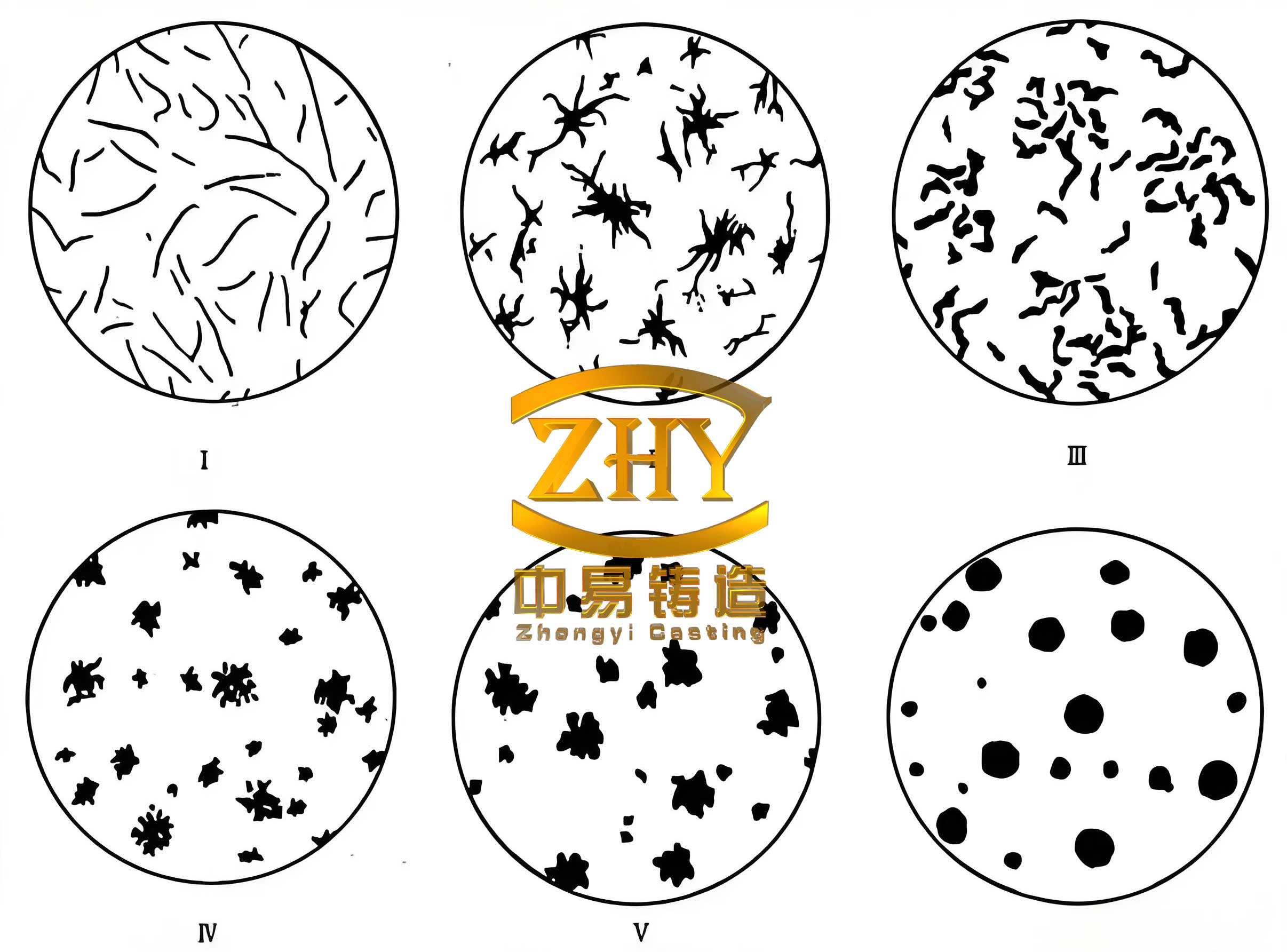
Non-destructive testing revealed no cracks or defects exceeding φ2 mm equivalent for shrinkage or φ3 mm for slag inclusions, confirming the efficacy of our approach. The microstructural integrity of the spheroidal graphite cast iron was further validated by metallographic analysis, which showed well-dispersed graphite nodules in a ferrite-pearlite matrix. To illustrate the typical microstructure achieved, refer to the following image showcasing spheroidal graphite iron under magnification.
The success of this project hinges on the synergistic application of forced air cooling and composite spheroidization. The air cooling system accelerates solidification, reducing the time window for graphite degeneration, which is mathematically expressed by the solidification time equation $$ t_s = \frac{\rho L}{k \Delta T} \cdot M^2 $$ where t_s is solidification time, ρ is density, L is latent heat, k is thermal conductivity, ΔT is temperature difference, and M is modulus. For our casting, air cooling decreased t_s by approximately 25%, aligning with the desired rapid cooling for spheroidal graphite cast iron. Moreover, the yttrium-based spheroidizer extends the effective magnesium concentration, as per the fade model $$ [\text{Mg}]_t = [\text{Mg}]_0 e^{-kt} $$ where [Mg]_t is magnesium content at time t, [Mg]_0 is initial content, and k is the fade rate constant. This ensures consistent nodularity even after prolonged holding, essential for heavy-section spheroidal graphite cast iron.
In conclusion, the integration of an air cooling system with advanced metallurgical techniques—such as composite spheroidizing agents, multiple inoculation, and precise chemical control—enables the production of high-quality heavy-section spheroidal graphite cast iron castings. Our method demonstrates that forced air cooling is a viable, safe, and efficient alternative to water cooling, providing the necessary thermal management to prevent defects. The mechanical properties and microstructural consistency achieved validate this approach, making it suitable for critical applications like large ball mill components. Future work could explore optimizing fan configurations or integrating real-time temperature monitoring to further enhance the cooling efficiency for spheroidal graphite cast iron. This case study underscores the importance of innovative cooling solutions in advancing the reliability and performance of spheroidal graphite cast iron in industrial settings.