
In my investigation of a failed automotive left steering knuckle manufactured from spheroidal graphite cast iron, specifically grade QT450-10, I encountered a critical fracture incident that occurred after approximately 1,834 kilometers of vehicle operation at low speeds. This failure, which led to sudden loss of steering during a turn, prompted a comprehensive analysis to determine the root cause. As an analyst, I will detail the entire process, from the initial macroscopic examination to advanced microstructural and compositional analyses, emphasizing the properties and failure mechanisms of spheroidal graphite cast iron. The objective is to provide a thorough understanding of how such failures can arise in this widely used material.
Spheroidal graphite cast iron, also known as ductile iron, is renowned for its combination of strength, ductility, and castability, making it ideal for automotive components like steering knuckles that endure cyclic loads. The material derives its name from the spherical graphite nodules embedded in a metallic matrix, typically ferritic or pearlitic. These nodules act as crack arresters, enhancing toughness compared to flake graphite cast iron. The grade QT450-10 indicates a tensile strength of 450 MPa and 10% elongation, with a ferritic matrix predominating. However, the presence of inclusions or microstructural anomalies can severely compromise these properties, leading to premature failure. In this case, the fracture occurred unexpectedly, suggesting underlying defects that warranted a multi-faceted investigation.
The production process for the spheroidal graphite cast iron left steering knuckle involved several stages: raw material selection, casting to form the毛坯, machining, inspection, cleaning, and packaging. The casting process likely included melting, nodularization treatment with magnesium and rare earth elements, inoculation, and pouring into molds. Proper control of these steps is crucial to ensure the formation of well-distributed graphite spheroids and a sound matrix. Deviations can introduce defects such as inclusions, porosity, or irregular graphite structures, which may act as stress concentrators. Given the safety-critical nature of steering components, any failure demands a rigorous analysis to prevent recurrence.
My analysis began with a macroscopic examination of the fracture surface. The断口 exhibited a dull, grayish appearance with slight corrosion, indicating exposure to environmental elements post-failure. The surface was rough, with a polyhedral grain-like pattern. Notably, in the region adjacent to the upper表层, I observed radiating tear ridges extending downward, accompanied by faint fatigue arc bands. These features are characteristic of a bending-induced brittle fatigue fracture. The absence of necking or shear lips near the fracture edges further confirmed the brittle nature. The fatigue origin was identified at the upper表层区域, where stress concentrations likely initiated crack propagation. This macroscopic assessment set the stage for deeper microstructural and chemical evaluations.
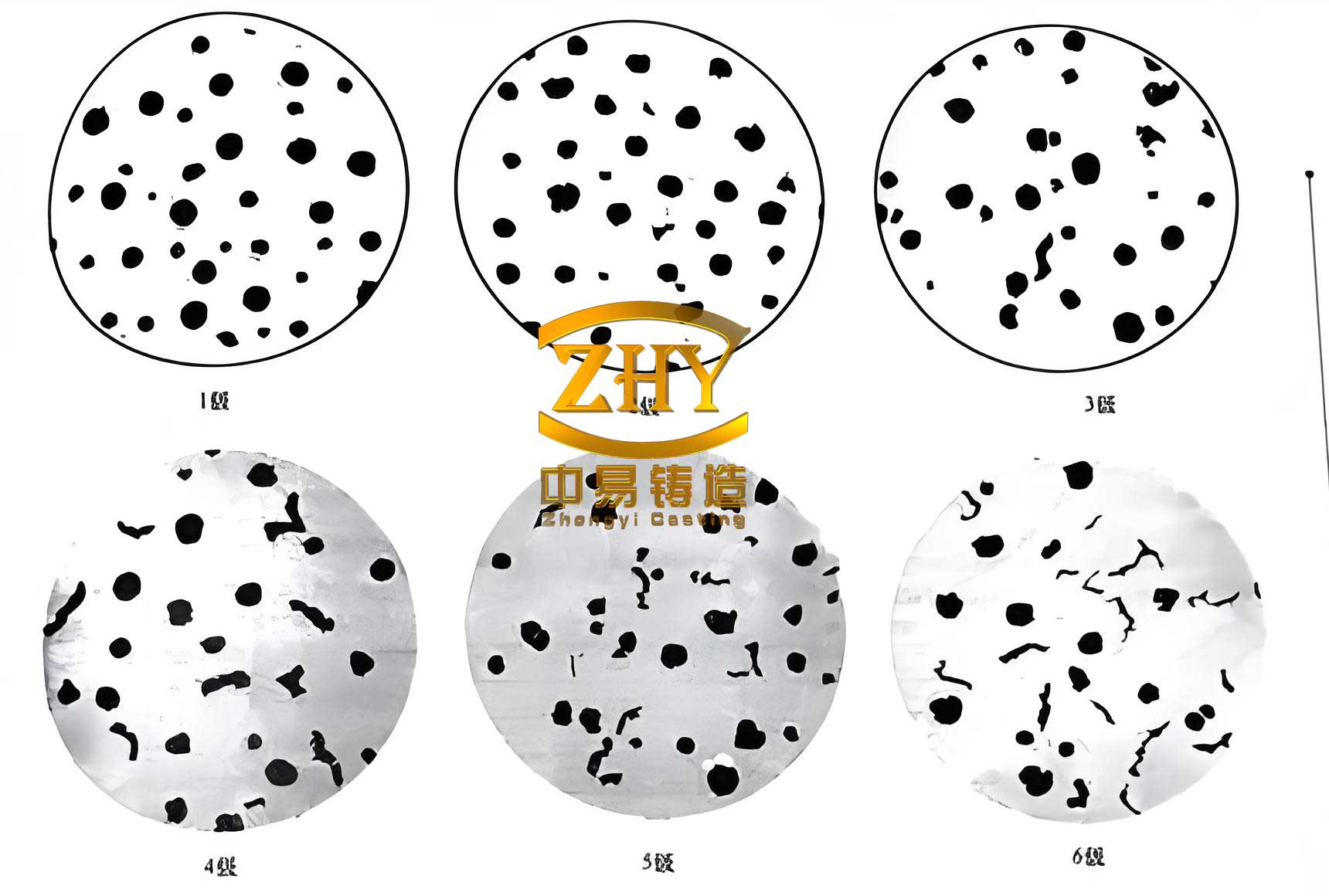
To quantify the material composition, I performed chemical analysis using spectrometry. The results, compared against standard specifications for spheroidal graphite cast iron QT450-10, are summarized in the table below. All elements fell within acceptable ranges, ruling out gross compositional deviations as the primary cause. However, minor variations in residual magnesium and rare earth elements can influence graphite morphology and inclusion formation, which necessitated further scrutiny.
| Element | Measured Value | Standard Range for QT450-10 |
|---|---|---|
| C | 3.54 | 3.5–4.0 |
| Si | 2.34 | 2.0–2.7 |
| Mn | 0.40 | ≤0.6 |
| P | 0.035 | ≤0.07 |
| S | 0.005 | ≤0.02 |
| Mgres | 0.037 | 0.03–0.06 |
| REres | 0.026 | 0.02–0.04 |
Next, I conducted metallographic examination on samples extracted from the fracture region. After preparation and etching, I observed the microstructure under optical microscopy. In most areas, the spheroidal graphite cast iron exhibited a graphite nodularity exceeding 85%, with graphite size rated at level 5 according to GB/T 9441-2009. The matrix consisted of approximately 20%片状 pearlite in a ferritic background, and no cementite was detected. This structure aligns with the requirements for QT450-10. However, in the vicinity of the fracture surface, specifically within 0.8 to 1.5 mm from the upper表层, I identified anomalous regions featuring irregular band-like clusters. These clusters appeared as dark,团絮状 entities under the microscope, distinct from the normal matrix. Similar anomalies were found in the sub-surface layers, indicating a localized defect zone.
The presence of these anomalies prompted a detailed scanning electron microscopy (SEM) analysis. At higher magnifications, the表层 and sub-surface regions revealed irregular条带团絮状物质 that contrasted sharply with the surrounding spheroidal graphite cast iron matrix. These clusters measured approximately 0.3–0.4 mm in length and occupied about 20% of the anomalous area. More critically, microcracks were observed emanating from these clusters, extending 0.1–0.2 mm into the depth. The fracture surface in the crack initiation zone displayed intergranular features with some quasi-cleavage facets and tear ridges, accompanied by secondary cracking. This morphology is indicative of an intergranular + quasi-cleavage brittle fracture mechanism. The absence of protective coating penetration confirmed that the crack initiated during service, propagating under cyclic loads until final rupture.
To characterize the chemical nature of these clusters, I employed energy-dispersive X-ray spectroscopy (EDS) on both the anomalous regions and normal matrix areas. The results are presented in the following tables. The团絮状物质 showed significantly higher concentrations of oxygen, silicon, and carbon compared to the normal spheroidal graphite cast iron matrix, pointing to oxide-based inclusions. Such inclusions, often formed during melting or pouring, can act as potent stress raisers and crack initiation sites.
| Element | Weight % | Atomic % |
|---|---|---|
| CK | 13.65 | 23.49 |
| OK | 42.92 | 55.43 |
| SiK | 8.55 | 6.29 |
| FeK | 28.38 | 10.50 |
| Others (Na, Mg, Al, S, Cl, K, Ca) | 6.50 | 4.29 |
| Element | Weight % | Atomic % |
|---|---|---|
| CK | 3.84 | 13.67 |
| OK | 7.10 | 19.01 |
| SiK | 0.54 | 0.82 |
| FeK | 85.53 | 65.57 |
| Others (Cl, Tb) | 2.99 | 0.93 |
The mechanical properties of the spheroidal graphite cast iron were assessed via Brinell hardness testing. The results, shown below, fell within the specified range for QT450-10, indicating that bulk hardness was not a contributing factor. However, localized softening or embrittlement due to inclusions could still reduce fatigue resistance.
| Measurement | Value | Technical Requirement |
|---|---|---|
| 1 | 171 | 159–235 |
| 2 | 161 | |
| 3 | 170 |
To understand the fracture mechanics, I considered the fatigue crack growth behavior in spheroidal graphite cast iron. The Paris law describes crack propagation under cyclic loading: $$ \frac{da}{dN} = C (\Delta K)^m $$ where \( da/dN \) is the crack growth rate per cycle, \( \Delta K \) is the stress intensity factor range, and \( C \) and \( m \) are material constants. For spheroidal graphite cast iron, these constants depend on microstructure and defect content. The presence of oxide inclusions likely elevated \( C \) or reduced the threshold \( \Delta K_{th} \), accelerating crack initiation. The stress intensity factor for a surface crack can be approximated by: $$ K_I = \sigma \sqrt{\pi a} \, Y $$ where \( \sigma \) is applied stress, \( a \) is crack depth, and \( Y \) is a geometry factor. In this case, the团絮状物质 acted as initial flaws, effectively increasing \( a \) and lowering the fatigue limit.
The thermodynamic aspects of inclusion formation in spheroidal graphite cast iron are also relevant. During solidification, oxides may form due to reactions between residual elements and oxygen. The Gibbs free energy change for oxide formation, such as SiO₂, is given by: $$ \Delta G = \Delta H – T \Delta S $$ where \( \Delta H \) is enthalpy change, \( T \) is temperature, and \( \Delta S \) is entropy change. Negative \( \Delta G \) favors oxide formation. In practice, improper deoxidation or slag entrapment during casting can introduce these inclusions. For spheroidal graphite cast iron, ensuring low oxygen activity through effective melt treatment is crucial to minimize such defects.
Furthermore, the role of graphite nodules in spheroidal graphite cast iron cannot be overstated. The nodules blunt cracks and dissipate energy, but their effectiveness is compromised if clusters of inclusions are present. The modulus of elasticity \( E \) for spheroidal graphite cast iron is typically around 170 GPa, but local variations due to inclusions can create stress concentrations. The stress concentration factor \( K_t \) for an elliptical inclusion can be expressed as: $$ K_t = 1 + 2\sqrt{\frac{a}{\rho}} $$ where \( a \) is inclusion length and \( \rho \) is tip radius. For irregular团絮状物质 with sharp edges, \( \rho \) is small, leading to high \( K_t \) values that promote crack initiation.
In discussing the fatigue life of spheroidal graphite cast iron components, the total life \( N_f \) can be divided into initiation \( N_i \) and propagation \( N_p \) phases: $$ N_f = N_i + N_p $$ For high-quality spheroidal graphite cast iron, \( N_i \) dominates, but with pre-existing defects like oxide clusters, \( N_i \) is drastically reduced, shifting failure to early cycles. The applied stress range \( \Delta \sigma \) in service, estimated from vehicle dynamics, might have been relatively low, but the stress concentration at inclusions raised local stresses above the endurance limit.
My findings align with known failure modes in spheroidal graphite cast iron. The oxide inclusions, rich in silicon and oxygen, likely originated from slag or reaction products during the nodularization process. These inclusions weakened the interfacial bonding between the matrix and graphite, facilitating intergranular crack propagation. The quasi-cleavage aspects suggest that under cyclic loading, microvoids coalesced around inclusions, leading to brittle fracture. This underscores the importance of stringent quality control in producing spheroidal graphite cast iron, particularly for safety-critical parts.
To mitigate such failures, recommendations include enhancing melt purification to reduce oxide inclusions, optimizing inoculation practices to ensure uniform graphite distribution, and implementing non-destructive testing like ultrasonic inspection to detect subsurface flaws. Additionally, finite element analysis during design can identify high-stress regions where material integrity is paramount. For spheroidal graphite cast iron, maintaining a clean melt and controlled solidification is key to achieving the desired mechanical properties.
In conclusion, the fracture of the spheroidal graphite cast iron left steering knuckle resulted from oxide inclusion clusters near the surface, which acted as stress concentrators and crack initiation sites under bending fatigue. The material’s bulk composition and hardness met specifications, but localized defects compromised its integrity. This case highlights the critical need for defect minimization in spheroidal graphite cast iron manufacturing to ensure reliability in automotive applications. Future work could involve statistical analysis of inclusion distributions and their impact on fatigue performance, further refining the processing of spheroidal graphite cast iron for enhanced durability.