
With the continuous advancement of technology, the automotive industry has increasingly stringent requirements for cast iron components, particularly in terms of lightweight design and enhanced mechanical properties. In this context, the development of high-strength, high-ductility spheroidal graphite cast iron has become a critical focus. My team and I have been engaged in research aimed at optimizing the process technology for as-cast spheroidal graphite cast iron, specifically targeting material grades such as QT700-10. Through systematic adjustments in chemical composition, cooling conditions, and inoculation treatments, we have successfully improved the microstructure and mechanical properties of spheroidal graphite cast iron, achieving a balance between strength and elongation while reducing the tendency for micro-slag formation. This article delves into the detailed process techniques, analytical discussions, and key findings from our development journey, emphasizing the importance of microstructure control in spheroidal graphite cast iron.
The core objective of our work was to develop a spheroidal graphite cast iron with a mixed matrix structure, primarily pearlitic, that meets the demanding standards of automotive applications. We set progressive targets for material grades: QT900-5, QT700-8, and QT700-10, all sampled from castings with a wall thickness of 15 mm. The melting process utilized medium-frequency induction furnaces, with green sand molding on horizontal lines. The chemical compositions for each stage were carefully designed, as summarized in Table 1. For QT900-5 and QT700-8, pure scrap steel was used, whereas QT700-10 employed a blend of scrap steel and pig iron (Q10) in a ratio of 1:4, with alloy elements added separately. Key elements like carbon, silicon, manganese, and trace alloys such as copper and tin were controlled to influence the matrix formation in spheroidal graphite cast iron.
| Test Bar | Material Grade | C | Si | Mn | P | S | Mg | Cu | Sn | Ni |
|---|---|---|---|---|---|---|---|---|---|---|
| #1 | QT900-5 | 3.58 | 2.51 | 0.21 | 0.02 | 0.01 | 0.039 | 0.72 | 0.01 | >1 |
| #2 | QT700-8 | 3.48 | 2.71 | 0.19 | 0.02 | 0.008 | 0.049 | 0.57 | 0.01 | 0.325 |
| #3 | QT700-10 | 3.49 | 2.80 | 0.25 | 0.02 | 0.007 | 0.043 | 0.53 | 0.01 | – |
The nodularizing and inoculation processes were pivotal in determining the final properties of the spheroidal graphite cast iron. We adopted a three-step treatment method: nodularizer was placed in the ladle, covered with inoculant, and then topped with 0.5% silicon steel sheets. The ladle was preheated, and iron was tapped within 5 minutes of loading the nodularizer. The entire process from treatment to the final pouring was controlled within 8 minutes. The nodularizers used included ZM-N6013 and ZM-N6003, both low-rare-earth, medium-magnesium types. Inoculants were selected based on their specific functions: ZM-IPE for enhancing strength, ZM-IFE for improving nucleation uniformity, ZM-IFA for increasing graphite nodule count, and ZM-IFC for boosting elongation. Table 2 outlines the treatment parameters for each stage.
| Test Bar | Nodularizer Type | Nodularizer Addition (%) | In-Ladle Inoculant Type | In-Ladle Inoculant Addition (%) | Stream Inoculant Type | Stream Inoculant Addition (%) | Pouring Temperature (°C) | Pouring Time (min) |
|---|---|---|---|---|---|---|---|---|
| #1 | Mg5.5RE1.8 | 1.20 | ZM-IPE | 0.20 | ZM-IFA | 0.10 | 1380-1420 | ≤8 |
| #2 | ZM-N6013 | 1.05 | ZM-IFE | 0.20 | ZM-IFC | 0.10 | 1400-1440 | ≤8 |
| #3 | ZM-N6003 | 1.05 | ZM-IFE | 0.20 | ZM-IFC | 0.10 | – | ≤8 |
The mechanical properties and microstructures of representative test bars, labeled #1, #2, and #3, are summarized in Table 3. These results highlight the progression in achieving higher elongation while maintaining strength in spheroidal graphite cast iron. For instance, #3 exhibited a ferrite volume fraction of 30-45%, with tensile strength over 700 MPa and elongation exceeding 10%, meeting the QT700-10 target.
| Test Bar | Material Grade | Ferrite Volume Fraction (%) | Tensile Strength (MPa) | Elongation (%) | Brinell Hardness (HB) |
|---|---|---|---|---|---|
| #1 | QT900-5 | <5 | 932 | 5.0 | 334 |
| #2 | QT700-8 | 15-30 | 756 | 8.6 | 233 |
| #3 | QT700-10 | 30-45 | 722 | 10.2 | 251 |
In spheroidal graphite cast iron, the distribution of ferrite and the structure of pearlite are critical factors influencing mechanical properties. The ferrite volume fraction directly correlates with ductility, as described by the empirical relationship: $$ \delta = \delta_0 + k_f \cdot f_f $$ where $\delta$ is the elongation, $\delta_0$ is the base elongation, $k_f$ is a material constant, and $f_f$ is the ferrite volume fraction. For #1, with ferrite below 5%, elongation was limited to around 5%, whereas #3, with 30-45% ferrite, achieved over 10% elongation. The ferrite in #3 formed a typical “bull’s-eye” structure around graphite nodules, enhancing toughness by providing a ductile phase that impedes crack propagation. This microstructure optimization is essential for high-performance spheroidal graphite cast iron.
Pearlite, a lamellar mixture of ferrite and cementite, contributes significantly to strength. The strength of pearlitic spheroidal graphite cast iron can be approximated by: $$ \sigma_b = \sigma_p \cdot f_p + \sigma_f \cdot f_f $$ where $\sigma_b$ is the tensile strength, $\sigma_p$ and $\sigma_f$ are the strengths of pearlite and ferrite, respectively, and $f_p$ and $f_f$ are their volume fractions. In #2, with over 98% pearlite, strength exceeded 700 MPa, but elongation reached 8.3% due to refined pearlite lamellae. Scanning electron microscopy revealed that pearlite with finer interlamellar spacing (e.g., 0.2 µm) and alignment parallel to the tensile axis promoted micro-ductile fracture, characterized by dimples and tear ridges. Conversely, coarse pearlite or unfavorable orientation led to brittle cleavage fractures. This underscores the importance of controlling pearlite morphology in spheroidal graphite cast iron for balanced properties.
Micro-defects, particularly micro-slags, pose a significant challenge to the consistency of spheroidal graphite cast iron. These defects act as stress concentrators, reducing elongation and strength. We observed that test bars from the same heat could exhibit varying elongation due to slag inclusions. For example, two bars, 3-1 and 3-2, had similar compositions but elongations of 5.5% and 10.2%, respectively. Fractography showed that 3-1 contained larger slag particles at the edge, leading to extensive brittle fracture, while 3-2 had smaller, internally located slags. The fracture mode transitioned from intergranular (along grain boundaries) to transgranular (through grains), with the latter being more ductile. This highlights the detrimental impact of micro-slags on spheroidal graphite cast iron performance.
To mitigate micro-slag formation, we optimized the inoculants. Conventional silicon-barium inoculants have a high melting point (above 1300°C) and non-uniform phase distribution, slowing dissolution and increasing slag tendency. In contrast, our proprietary inoculant ZM-IFC features finer grains and a lower melting point (below 1300°C), as confirmed by differential scanning calorimetry (DSC). The DSC data, summarized in Table 4, show that ZM-IFC requires less energy for melting (285.8 J/g) compared to conventional inoculants (352.8 J/g), promoting faster dissolution and reducing slag propensity. This improvement enhances the stability of spheroidal graphite cast iron properties.
| Inoculant Type | Particle Size (mm) | First Phase Melting Point (°C) | Second Phase Melting Point (°C) | Enthalpy of Melting (J/g) | Energy Consumption (kWh/t) |
|---|---|---|---|---|---|
| Conventional Si-Ba | 0.2-0.7 | 1210.3 | 1328.3 | 352.8 | 98.0 |
| ZM-IFC | 0.2-0.7 | 1207.8 | – | 285.8 | 79.4 |
Intergranular precipitates, such as those containing nickel or molybdenum, can also affect ductility in spheroidal graphite cast iron. While these elements are added to enhance hardenability and strength, they may segregate at grain boundaries during solidification. We observed precipitates in some samples, which slightly reduced elongation. However, their impact is less severe compared to micro-slags or coarse microstructures. By adjusting cooling rates and alloy content, these precipitates can be minimized or dispersed, further improving the toughness of spheroidal graphite cast iron.
The role of graphite nodularity cannot be overstated in spheroidal graphite cast iron. The nodularity, defined as the percentage of graphite particles with spheroidal shape, influences both strength and ductility. A higher nodularity reduces stress concentrations and improves mechanical properties. We measured nodularity using image analysis, with grades 1-2 (excellent) for all developed materials. The graphite nodule count, typically 5-6 on the ASTM scale, was optimized through inoculation. The relationship between nodule count and properties can be expressed as: $$ \sigma_b \propto \frac{1}{\sqrt{d}} $$ where $d$ is the average graphite nodule diameter, indicating that finer nodules enhance strength in spheroidal graphite cast iron.
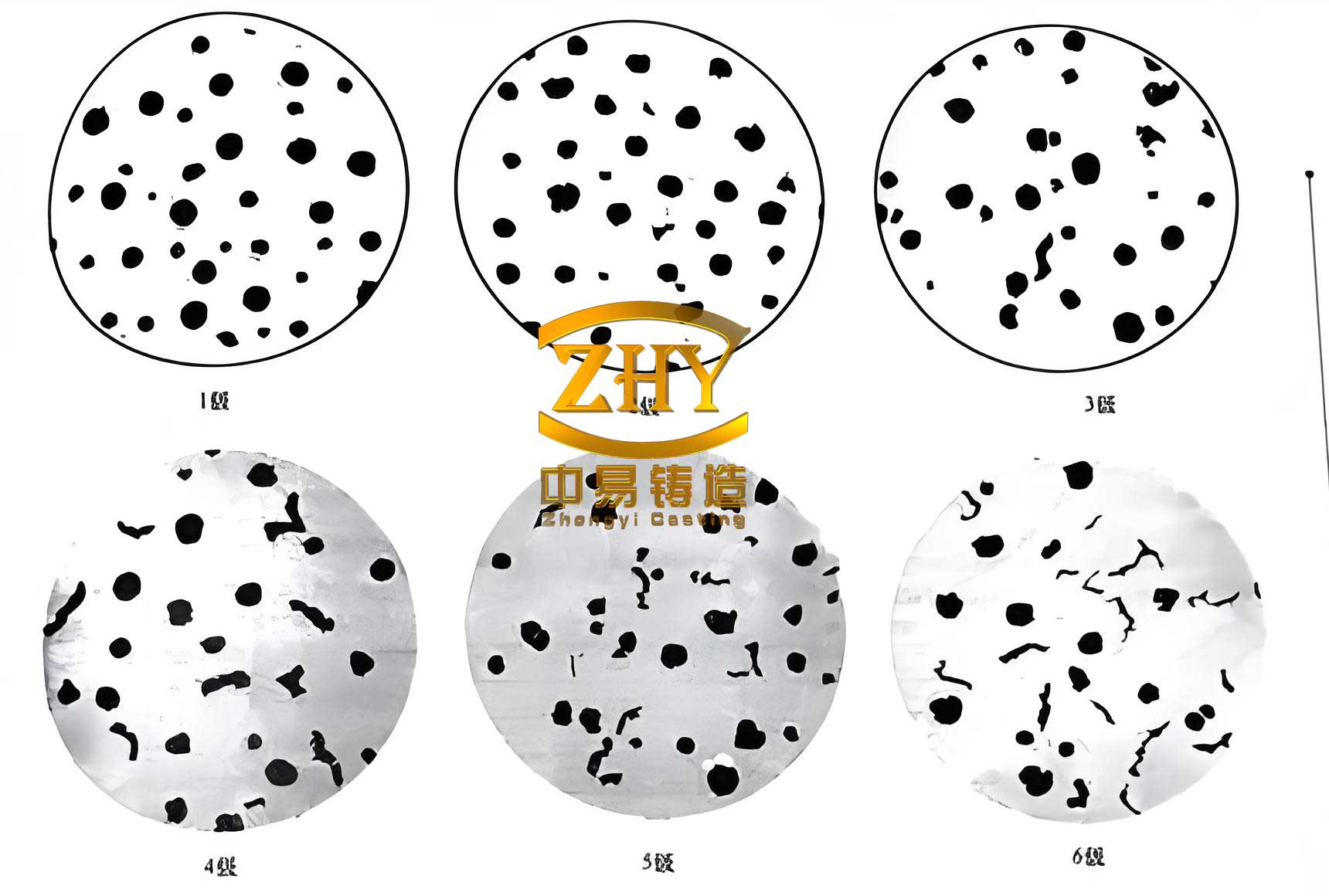
Cooling conditions play a vital role in microstructure development. Faster cooling promotes finer pearlite and higher nodule count, but may increase shrinkage defects. We balanced cooling by controlling mold materials and pouring temperatures. For spheroidal graphite cast iron, the solidification time $t_s$ can be estimated using Chvorinov’s rule: $$ t_s = k \left( \frac{V}{A} \right)^n $$ where $V$ is volume, $A$ is surface area, and $k$ and $n$ are constants. By optimizing the $V/A$ ratio for castings, we achieved uniform cooling, resulting in consistent microstructures across sections.
In summary, the development of high-strength, high-ductility spheroidal graphite cast iron involves a multifaceted approach. Key lessons include: (1) Microstructure control, particularly ferrite distribution and pearlite refinement, is paramount for balancing strength and elongation. (2) Micro-defects, especially slags, significantly affect property stability; selecting appropriate nodularizers and inoculants can reduce their formation. (3) Continuous process optimization, from melting to pouring, is essential for reproducible results in spheroidal graphite cast iron production.
Future work will focus on further enhancing the properties of spheroidal graphite cast iron through advanced alloy design and real-time process monitoring. We aim to develop grades with even higher elongation (e.g., QT700-12) while maintaining strength, catering to evolving automotive lightweighting demands. The insights gained from this study underscore the importance of integrated metallurgical strategies in advancing spheroidal graphite cast iron technology.
To elaborate on the theoretical aspects, the mechanical properties of spheroidal graphite cast iron can be modeled using composite theory. The material is considered a composite of graphite nodules embedded in a metallic matrix. The effective modulus $E_{\text{eff}}$ can be approximated by: $$ E_{\text{eff}} = E_m \left( 1 – f_g \right) + E_g f_g $$ where $E_m$ and $E_g$ are the moduli of the matrix and graphite, and $f_g$ is the graphite volume fraction. However, since graphite is much softer, the matrix dominates behavior. For strength, the Hall-Petch relationship applies to the ferritic phase: $$ \sigma_y = \sigma_0 + k_y d^{-1/2} $$ where $\sigma_y$ is yield strength, $\sigma_0$ is friction stress, $k_y$ is a constant, and $d$ is grain size. In pearlitic spheroidal graphite cast iron, the interlamellar spacing $\lambda$ influences strength: $$ \sigma_b = \sigma_0 + k_\lambda \lambda^{-1/2} $$ where $k_\lambda$ is a material constant. These equations guide the microstructural tuning for optimal performance.
In practice, achieving the desired microstructure in spheroidal graphite cast iron requires precise control of inoculation. Inoculants provide nucleation sites for graphite, affecting nodule count and distribution. The nucleation potency $P$ of an inoculant particle can be described by: $$ P = \frac{\Delta G_{\text{het}}}{\Delta G_{\text{hom}}} $$ where $\Delta G_{\text{het}}$ and $\Delta G_{\text{hom}}$ are the heterogeneous and homogeneous nucleation energies, respectively. Higher potency leads to more efficient nucleation. Our inoculants, like ZM-IFE, are designed with high-potency particles, ensuring uniform graphite formation in spheroidal graphite cast iron.
The impact of alloy elements on spheroidal graphite cast iron is complex. Copper and tin promote pearlite formation, while nickel aids in refining microstructure without excessive brittleness. The combined effect can be quantified using carbon equivalents, such as: $$ \text{CE} = \text{C} + \frac{\text{Si} + \text{P}}{3} $$ For spheroidal graphite cast iron, a CE around 4.2-4.5 is typical to avoid graphite flotation while ensuring good fluidity. Additionally, the pearlite-promoting factor $P_f$ can be defined as: $$ P_f = 3\text{Cu} + 5\text{Sn} + 10\text{Sb} – 2\text{Ni} $$ Higher $P_f$ values increase pearlite content, enhancing strength but potentially reducing ductility. Our compositions were tailored to balance these factors.
Defect analysis in spheroidal graphite cast iron often involves non-destructive testing and microscopy. We used scanning electron microscopy with energy-dispersive X-ray spectroscopy to identify slag compositions. Common slags include oxides of magnesium, calcium, and barium, originating from nodularizers or inoculants. By minimizing the residence time of these additives in the melt, we reduced slag formation. The kinetics of slag formation can be described by: $$ \frac{dC}{dt} = -k C^n $$ where $C$ is the concentration of slag-forming elements, $k$ is a rate constant, and $n$ is the reaction order. Faster processing, as in our 8-minute window, limits slag growth.
Furthermore, the thermal history during solidification affects shrinkage and porosity in spheroidal graphite cast iron. We employed simulation software to predict hot spots and optimized riser design. The Niyama criterion, given by: $$ G / \sqrt{T} > \text{critical value} $$ where $G$ is temperature gradient and $T$ is cooling rate, was used to assess porosity risk. By ensuring adequate feeding, we minimized internal defects, contributing to consistent mechanical properties in spheroidal graphite cast iron.
In conclusion, the journey to improve as-cast high-strength spheroidal graphite cast iron involves a deep understanding of metallurgical principles and practical process controls. Through iterative adjustments in chemistry, inoculation, and cooling, we achieved significant advancements in material performance. The success of this work demonstrates the potential of spheroidal graphite cast iron for demanding applications, paving the way for further innovations in the field.