
In the industrial landscape, steel and cast iron remain the most widely utilized materials, with spheroidal graphite cast iron holding a pivotal position due to its exceptional mechanical properties, corrosion resistance, and machinability. The demand for high-strength, high-hardness, and high-toughness spheroidal graphite cast iron has surged, particularly for heavy-section components like gear rings, transmission gears, and crankshafts, where wear resistance is critical. Traditional approaches, such as austempered ductile iron (ADI), often involve complex heat treatments and costly alloying, prompting exploration into conventional normalizing and tempering processes to achieve superior performance. This study focuses on developing QT900-2 grade spheroidal graphite cast iron for heavy sections, investigating the effects of antimony (Sb) and heat treatment on microstructure and properties, aiming to provide a cost-effective alternative for industrial applications.
The fundamental challenge in producing heavy-section spheroidal graphite cast iron lies in mitigating graphite degeneration and achieving uniform fine pearlite structures throughout thick cross-sections. Alloying elements like copper (Cu), tin (Sn), and antimony (Sb) are known to promote pearlite formation and refinement, but Sb can adversely affect graphite spheroidization. This research delves into optimizing the balance between RE (rare earth) additions and Sb content to neutralize anti-spheroidization effects while enhancing matrix refinement. Through systematic experimentation, we evaluate how varying Sb levels and heat treatment parameters influence graphite morphology, matrix structure, and mechanical properties, ultimately targeting QT900-2 specifications for sections up to 70 mm thickness and beyond.
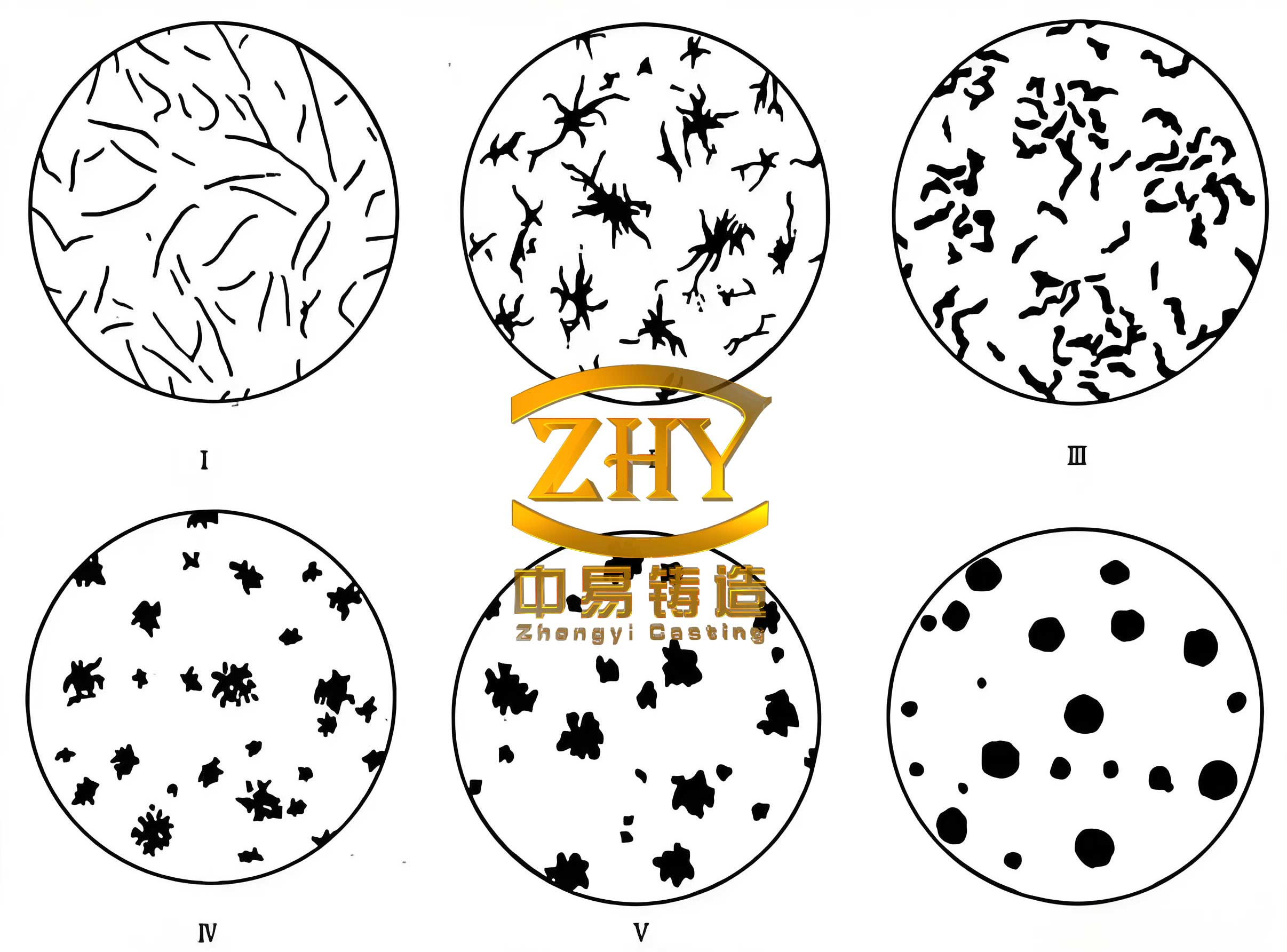
The production of spheroidal graphite cast iron for heavy sections requires meticulous control over composition and processing. In this study, we employed a charge ratio of 60% pig iron, 35% returns, and 5% scrap steel, adjusted with petroleum coke for carbon enrichment and 75% ferrosilicon for silicon addition. Alloying elements included electrolytic copper, tin ingots, and metallic antimony. The base chemical composition was targeted within specific ranges to ensure optimal graphitization and matrix stability, as outlined in Table 1. The key alloying elements—Cu, Sn, and Sb—were varied to assess their synergistic effects on pearlite refinement, with Sb content adjusted in 0.01% increments while maintaining constant Cu and Sn levels.
| Element | Target Range |
|---|---|
| C | 3.4–3.6 |
| Si | 1.9–2.1 |
| Mn | 0.4–0.6 |
| P | <0.03 |
| S | 0.006–0.012 |
| Mg | 0.035–0.055 |
| Cu | 1.0 (fixed for Sb variation trials) |
| Sn | 0.15 (fixed for Sb variation trials) |
| Sb | Varied: 0, 0.015, 0.025, 0.035 |
Melting was conducted in a 3-ton medium-frequency induction furnace, with carburizer added early in the charge and FeSi introduced in the final batch. Alloying elements were incorporated after base composition adjustments. The molten iron was tapped at approximately 1500°C and treated at 1450°C using a sandwich method with yttrium-based heavy RE-containing Si-Mg alloy as the nodulizer, covered by 0.8% Ba-Si inoculant and 0.2% steel chips. Post-treatment, slag was removed, and 0.15% 75SiFe was used for stream inoculation during pouring at around 1320°C. The nodulizer and inoculant specifications are detailed in Table 2.
| Material | Si (wt.%) | Mg (wt.%) | RE (wt.%) | Other (wt.%) | Particle Size (mm) |
|---|---|---|---|---|---|
| Si-Mg Alloy | 44.80 | 6.66 | – | Ca: trace, Al: 0.218 | 10–30 |
| Yttrium-based Heavy RE | 43.04 | 7.10 | 3.68 | Al: 0.652 | 10–30 |
| Ba-Si Inoculant | 67.36 | – | – | Ba: 5.96, Ca: 1.03, Al: 1.01 | 1–6 |
| 75SiFe | 75.18 | – | – | Al: 1.18 | 0.3–0.7 |
Heat treatment involved normalizing followed by tempering, with air cooling at 10–15°C/min monitored by thermocouples. We tested two normalizing temperatures (940°C and 910°C) and two tempering temperatures (460°C and 560°C), each held for 3 h and 4 h, respectively. Specimens included resin-sand molded blocks measuring 500 mm × 500 mm × 700 mm, attached with 70-mm-thick standard test blocks. Chemical analysis used a GS1000II direct-reading spectrometer, hardness was measured with a portable Brinell tester on the large blocks, and tensile properties were evaluated on φ14 mm bars machined from the 70-mm sections. Microstructural examination was performed using an OLYMPUS microscope.
The influence of Sb on graphite morphology is profound, as Sb acts as an anti-spheroidizing element. However, RE additions can counteract this effect. In our trials, without Sb and RE, graphite nodules were well-formed but sparse. With 0.025% Sb and only Si-Mg nodulizer, nodule count increased but irregular graphite appeared. Adding 0.1% yttrium-based heavy RE alongside 0.025% Sb yielded optimal results: graphite nodules were numerous and spherical, with a doubling in nodule count. Excessive RE (0.2%) deteriorated graphite morphology, highlighting the need for precise RE-Sb balance. This synergy can be expressed through a conceptual equation for effective nodule count \(N_e\):
$$N_e = k_1 \cdot [\text{RE}] – k_2 \cdot [\text{Sb}] + k_3 \cdot [\text{Mg}]$$
where \(k_1\), \(k_2\), and \(k_3\) are constants dependent on cooling conditions and base composition. For heavy-section spheroidal graphite cast iron, maintaining \(N_e > 100 \text{ nodules/mm}^2\) is crucial for mechanical integrity.
Sb’s impact on the matrix structure is equally significant. Without Sb, the as-cast matrix exhibited coarse, uneven pearlite with large interlamellar spacing. At 0.015% Sb, pearlite refined and became more uniform. With 0.025% Sb, further refinement occurred, enhancing homogeneity. At 0.035% Sb, however, pearlite was barely discernible, and carbides precipitated, detrimental to toughness. This refinement effect can be modeled using the pearlite interlamellar spacing \(\lambda\) relation:
$$\lambda = \lambda_0 \cdot \exp(-m \cdot [\text{Sb}])$$
where \(\lambda_0\) is the spacing without Sb, and \(m\) is a refinement coefficient. Excessive Sb leads to carbide formation, which can be predicted by the carbide precipitation tendency \(P_c\):
$$P_c = [\text{Sb}]^2 \cdot \frac{1}{[\text{RE}] + [\text{Si}]}$$
indicating that higher Sb and lower RE/Si increase carbide risk. These relationships underscore the delicate alloy design for spheroidal graphite cast iron.
Heat treatment drastically alters the matrix. For samples with 1.0% Cu, 0.15% Sn, and 0.025% Sb, normalizing at 910°C and tempering at 560°C produced a coarser pearlitic structure compared to 940°C normalizing and 460°C tempering, which yielded fine, uniform tempered martensite or lower bainite-like structures. The hardness and strength improvements correlate with the refined matrix, as summarized in Table 3. The optimal process—940°C normalizing (3 h) + 460°C tempering (4 h)—achieved QT900-2 properties: tensile strength over 900 MPa, yield strength around 730 MPa, elongation about 1.2%, and Brinell hardness 311–328 HB with minimal deviation (17 HB). This uniformity is vital for heavy-section spheroidal graphite cast iron components subject to variable loading.
| Heat Treatment Process | Tensile Strength (MPa) | Yield Strength (MPa) | Elongation (%) | Brinell Hardness (HB) |
|---|---|---|---|---|
| As-cast | 609.5 | 450.5 | 2.93 | 214–239 |
| 910°C Normalizing + 560°C Tempering | 787.3 | 660.6 | 1.43 | 263–275 |
| 910°C Normalizing + 460°C Tempering | 845.6 | 688.6 | 1.33 | 271–288 |
| 940°C Normalizing + 560°C Tempering | 878.3 | 697.4 | 1.38 | 292–295 |
| 940°C Normalizing + 460°C Tempering | 932.6 | 728.6 | 1.16 | 311–328 |
The synergy between alloying and heat treatment can be quantified using a performance index \(PI\) for spheroidal graphite cast iron:
$$PI = \sigma_t \cdot \left(1 + \frac{\epsilon}{10}\right) \cdot \frac{HB}{300}$$
where \(\sigma_t\) is tensile strength, \(\epsilon\) is elongation, and \(HB\) is Brinell hardness. For the optimal condition, \(PI \approx 3.5\), compared to 1.8 for as-cast, demonstrating the efficacy of the combined approach. Additionally, the hardness uniformity across the 500 mm × 500 mm × 700 mm block, with a deviation of only 17 HB, indicates minimal section sensitivity—a key achievement for heavy-section spheroidal graphite cast iron.
Further analysis reveals that Sb’s pearlite-refining action stems from its segregation at austenite grain boundaries, inhibiting ferrite growth and promoting finer pearlite colonies. However, beyond 0.025% Sb, the segregation becomes excessive, leading to carbide nucleation and graphite distortion. The role of RE in neutralizing Sb involves forming stable compounds like RE-Sb complexes, reducing free Sb available for anti-spheroidization. This interaction can be described by a stability constant \(K_s\):
$$K_s = \frac{[\text{RE-Sb}]}{[\text{RE}] \cdot [\text{Sb}]}$$
where higher \(K_s\) values indicate better neutralization. In practice, a ratio \([\text{RE}]/[\text{Sb}] \approx 4\) yielded optimal graphite and matrix for this spheroidal graphite cast iron.
The heat treatment dynamics involve austenitization kinetics, where higher normalizing temperatures (940°C) ensure complete dissolution of carbides and homogeneous austenite, described by the austenitization fraction \(f_a\):
$$f_a = 1 – \exp\left(-k \cdot t^n\right)$$
with \(k\) as a rate constant dependent on temperature via the Arrhenius equation, \(t\) as time, and \(n\) as an exponent. At 940°C, \(f_a\) approaches 1 within 3 h, facilitating subsequent transformation to fine pearlite or bainite upon cooling. Tempering at 460°C relieves stresses while maintaining high hardness through secondary carbide precipitation, whereas 560°C leads to over-tempering and strength loss.
To generalize these findings for industrial production of spheroidal graphite cast iron, we propose a process window defined by key parameters, as summarized in Table 4. This table integrates composition, heat treatment, and expected properties for QT900-2 grade heavy-section spheroidal graphite cast iron.
| Parameter | Optimal Range | Effect on Properties |
|---|---|---|
| C Content (wt.%) | 3.4–3.6 | Ensures graphitization, reduces chilling |
| Si Content (wt.%) | 1.9–2.1 | Enhances ferrite strength, counteracts carbides |
| Sb Content (wt.%) | 0.020–0.030 | Refines pearlite, minimal graphite distortion |
| RE Addition (wt.%) | 0.08–0.12 | Neutralizes Sb, improves nodule count |
| Normalizing Temperature | 930–950°C | Promotes austenite homogeneity |
| Normalizing Time | 2–4 h | Ensures complete phase transformation |
| Tempering Temperature | 450–480°C | Balances hardness and toughness |
| Cooling Rate | 10–20°C/min | Avoids pearlite coarsening, minimizes stresses |
In terms of mechanical performance, the achieved properties align with the QT900-2 standard, which typically requires tensile strength ≥900 MPa, yield strength ≥600 MPa, and elongation ≥2% for standard specimens. For heavy-section spheroidal graphite cast iron, elongation may reduce due to internal stresses, but the values here (around 1.2%) are acceptable for many applications like heavy-duty gears. The hardness consistency across large sections is particularly noteworthy, as it implies minimal variation in wear resistance—a critical factor for spheroidal graphite cast iron components in motion.
The economic implications are significant. By avoiding expensive alloys like nickel or molybdenum and complex ADI processes, this approach reduces production costs while meeting high-performance demands. The use of Sb and RE is cost-effective, and the conventional normalizing-tempering cycle is easier to implement in foundries. For spheroidal graphite cast iron producers, this method offers a scalable solution for thick-walled castings up to 700 mm in dimension.
Future work could explore digital modeling of microstructure evolution in spheroidal graphite cast iron during solidification and heat treatment, incorporating finite element analysis to predict property gradients. Additionally, fatigue and impact testing on full-scale components would validate long-term reliability. The principles established here—balancing Sb and RE, optimizing heat treatment—can be extended to other high-strength grades of spheroidal graphite cast iron, fostering innovation in the cast iron industry.
In conclusion, this study demonstrates that through precise alloy design and heat treatment, QT900-2 grade spheroidal graphite cast iron can be produced for heavy sections with excellent mechanical properties and uniformity. The key findings are: (1) RE additions around 0.1% effectively neutralize Sb’s anti-spheroidization effect, enhancing graphite nodule count and morphology in spheroidal graphite cast iron; (2) Sb content of 0.025% optimally refines pearlite without causing excessive carbides; and (3) a heat treatment of 940°C normalizing for 3 h followed by 460°C tempering for 4 h yields tensile strength over 930 MPa, hardness above 311 HB, and low hardness deviation in large sections. These results pave the way for broader application of high-strength spheroidal graphite cast iron in demanding industrial sectors, offering a blend of performance, cost-efficiency, and manufacturability.