
The escalating demand for corrosion resistance in industrial valves, particularly within chemical processing, wastewater management, and seawater-cooled power generation systems, has driven the search for advanced materials. While duplex stainless steels offer excellent corrosion performance, their adoption is hampered by prohibitively high costs (approximately $7,000–$11,000 per ton), extended production lead times, and challenging maintenance routines. The substantial annual maintenance costs incurred by industries due to valve corrosion underscore the urgent need for an alternative material that balances superior corrosion resistance with cost-effectiveness, good machinability, and streamlined production.
In this context, our research focuses on spheroidal graphite cast iron. Since its development in the mid-20th century, spheroidal graphite cast iron has revolutionized cast iron technology by incorporating spherical graphite nodules through spheroidizing and inoculating treatments. This transformation grants it mechanical properties comparable to carbon steel, often described as “the properties of steel with the essence of iron.” It is an engineering material renowned for its favorable combination of strength, ductility, and castability. As the world’s largest producer, accounting for nearly one-third of global output, China possesses a strong foundation for advancing this material. Modern spheroidal graphite cast iron is increasingly engineered for extreme service conditions involving heavy loads, low temperatures, fatigue, abrasion, and corrosion. Particularly for marine and aggressive chemical environments, developing corrosion-resistant grades of spheroidal graphite cast iron has become a significant research focus, offering a compelling alternative due to relative ease of melting, lower cost, and reduced environmental impact compared to high-alloy steels.
The corrosion of cast iron primarily occurs via chemical and electrochemical mechanisms. The electrochemical corrosion theory suggests that a homogeneous, single-phase microstructure generally exhibits better corrosion resistance. However, achieving a perfectly singular phase in industrial castings is impractical. Therefore, the strategy centers on microstructural homogenization to enhance corrosion resistance. We pursued three principal pathways to improve the corrosion resistance of spheroidal graphite cast iron:
1. Alloying: Modifying the electrochemical potential of constituent phases to reduce the electromotive force of galvanic cells.
2. Promoting Passivation: Facilitating the formation of a high-resistance corrosion product layer, especially a stable passive film, on the material surface.
3. Microstructural Optimization: Refining graphite nodule morphology, size, distribution, and the matrix structure to minimize the number and activity of galvanic couples.
Product Specifications and Chemical Composition Design
The subject of this development was a large-diameter butterfly valve assembly for a major chemical enterprise. The key components were the valve body and the disc, with masses of 6.9 and 7.8 metric tons, respectively. The castings featured substantial sections, with main wall thicknesses exceeding 60 mm and maximum thicknesses over 100 mm. The valve body reached a diameter of 3400 mm, and the disc measured 2900 mm in diameter.
Technical Requirements:
The material was specified as alloyed spheroidal graphite cast iron with stringent performance criteria. Castings were to be free from cracks, cold shuts, shrinkage porosity, or any defects detrimental to service performance. Metallurgical requirements included a carbide content ≤1%, a graphite nodularity ≥90%, and a uniform corrosion rate ≤0.25 mm/year when fully immersed in a 3.5% NaCl aqueous solution. Furthermore, the fully assembled valve had to withstand a hydrostatic pressure test of 2.4 MPa for 30 minutes without leakage.
Composition Design Philosophy:
The chemical composition was meticulously designed to meet the mechanical and corrosion-resistant properties simultaneously. The role of each element was analyzed as follows:
- Carbon (C): A critical element for graphite formation and fluidity. Excessively low carbon hinders graphitization and reduces fluidity, while excessively high carbon promotes graphite flotation. The target was set within a range that ensures adequate graphite formation without flotation.
- Silicon (Si): A potent graphitizer. Every 0.1% increase in Si raises the carbon equivalent (CE) by approximately 0.03%. Silicon dissolves in ferrite, causing lattice distortion and significantly promoting the formation of a ferrite matrix, which enhances ductility. However, excessive silicon increases brittleness and can adversely affect graphite morphology.
- Manganese (Mn): A pearlite stabilizer and strengthener. It tends to segregate at grain boundaries, impairing toughness and ductility. Therefore, its content was strictly minimized.
- Phosphorus (P) and Sulfur (S): Detrimental impurities. Phosphorus forms brittle phosphide eutectics at grain boundaries, drastically reducing mechanical properties. Sulfur consumes the spheroidizing agent (Mg), leading to spheroidizing decay, slag inclusions, and pinhole defects. Both elements were controlled to very low levels.
- Nickel (Ni): The primary alloying element for corrosion resistance. Nickel has low affinity for carbon, thus它 does not readily form carbides. It refines the pearlite structure and promotes its formation. In spheroidal graphite cast iron, nickel enhances corrosion resistance in both reducing and oxidizing environments by helping to form a dense, protective surface film and by elevating the electrochemical potential of the matrix.
- Chromium (Cr): A potent carbide former and film stabilizer. Although it can form carbides, its addition in controlled amounts significantly improves corrosion resistance by increasing the matrix potential and stabilizing protective oxide films. The interaction between Ni and Cr is crucial for developing a stable passive layer.
- Magnesium (Mg) and Rare Earths (RE): Essential for the spheroidization of graphite. Their residuals must be carefully controlled to ensure high nodularity without promoting excessive carbides.
Based on this analysis, the target chemical composition was established as shown in Table 1.
| Element | Target Range | Primary Function |
|---|---|---|
| C | 3.4 – 3.8 | Graphite formation, fluidity |
| Si | 2.2 – 2.8 | Graphitizer, ferrite promoter |
| Mn | ≤ 0.3 | Minimized to preserve toughness |
| P | ≤ 0.04 | Minimized impurity |
| S | ≤ 0.025 | Minimized impurity |
| Ni | 2.0 – 4.0 | Corrosion resistance, matrix refinement |
| Cr | 0.2 – 0.5 | Corrosion resistance, passive film stability |
| Mgres | 0.03 – 0.06 | Graphite spheroidization |
| REres | 0.02 – 0.04 | Graphite spheroidization, desulfurization |
The carbon equivalent (CE) is a vital parameter for predicting microstructure and casting behavior, calculated as:
$$ CE = \%C + \frac{\%Si + \%P}{3} $$
For our composition, with C=3.6%, Si=2.5%, P=0.03%, the CE is approximately 4.43, indicating good graphitization potential and castability.
Melting, Spheroidizing, and Inoculation Practice
The melt was prepared in a medium-frequency induction furnace. Charge materials comprised high-purity Q10 pig iron (C: 4.2-4.5%, Si: 1.2-1.5%), selected low-sulfur steel scrap, low-nitrogen graphite-based recarburizer, high-purity electrolytic nickel plate (Ni≥99.9%), nickel-iron alloy, and high-carbon ferrochromium. The charging sequence was pig iron → steel scrap → recarburizer → alloying additions → returns. After complete melting at 1400-1430°C, a sample was taken for spectroscopic analysis to fine-tune the composition. The molten metal was then superheated to 1500-1530°C and held for 5-10 minutes to ensure homogeneity and facilitate impurity removal.
The spheroidizing treatment was conducted using the sandwich method in a preheated ladon (300-500°C). A light-rare-earth-containing, medium-magnesium ferrosilicon-based spheroidizer (1.3-1.6% of tapped metal weight) was placed in the well of the ladon. A primary inoculant, often a Si-Ba-Ca type, was added alongside (total inoculant addition: 1.0-1.3%). When the metal temperature dropped to 1450-1480°C, it was tapped into the ladon, initiating the vigorous spheroidizing reaction. During tapping, additional portions of inoculant were added to enhance the inoculation effect.
Post-reaction slag was thoroughly removed. To counteract inoculation fading, a final stream inoculation was performed during casting at 1350-1380°C using fine-grained (0.2-0.5 mm) Si-Ba-Ca inoculant at a rate of 0.13-0.14%. This step is crucial for refining the eutectic cells and promoting a uniform distribution of fine, spherical graphite nodules in the final spheroidal graphite cast iron casting.
Heat Treatment and Mechanical Property Validation
After cleaning, the heavy-section castings underwent a subcritical annealing heat treatment to obtain a predominantly ferritic matrix, which is essential for optimal ductility and corrosion resistance. The cycle involved heating to 720 ± 10°C, holding for 10-12 hours, followed by furnace cooling. This process graphitizes any metastable carbides (e.g., cementite) that may have formed during solidification.
Mechanical properties were evaluated using separately cast test bars (or attached test blocks) subjected to the same heat treatment. The results, detailed in Table 2, demonstrate that the developed NiCr alloyed spheroidal graphite cast iron significantly exceeds the minimum requirements, exhibiting an excellent combination of high strength and remarkable ductility.
| Property | Required Value | Achieved Value | Standard |
|---|---|---|---|
| Yield Strength (Rp0.2) | ≥ 310 MPa | 420 MPa | ASTM A536 |
| Tensile Strength (Rm) | ≥ 450 MPa | 560 MPa | ASTM A536 |
| Elongation (A) | ≥ 3 % | 16 % | ASTM A536 |
| Hardness | 160 – 260 HB | 208 HB | ASTM E10 |
The microstructure, paramount for properties, was examined metallographically. The graphite was well-spheroidized with a nodularity grade exceeding 90% (Grade II). The matrix consisted of over 85% ferrite, with the balance being finely dispersed pearlite. The carbide content was verified to be below the 1% specification limit. A representative microstructure of high-quality spheroidal graphite cast iron is characterized by these spherical graphite nodules embedded in a ferritic matrix.
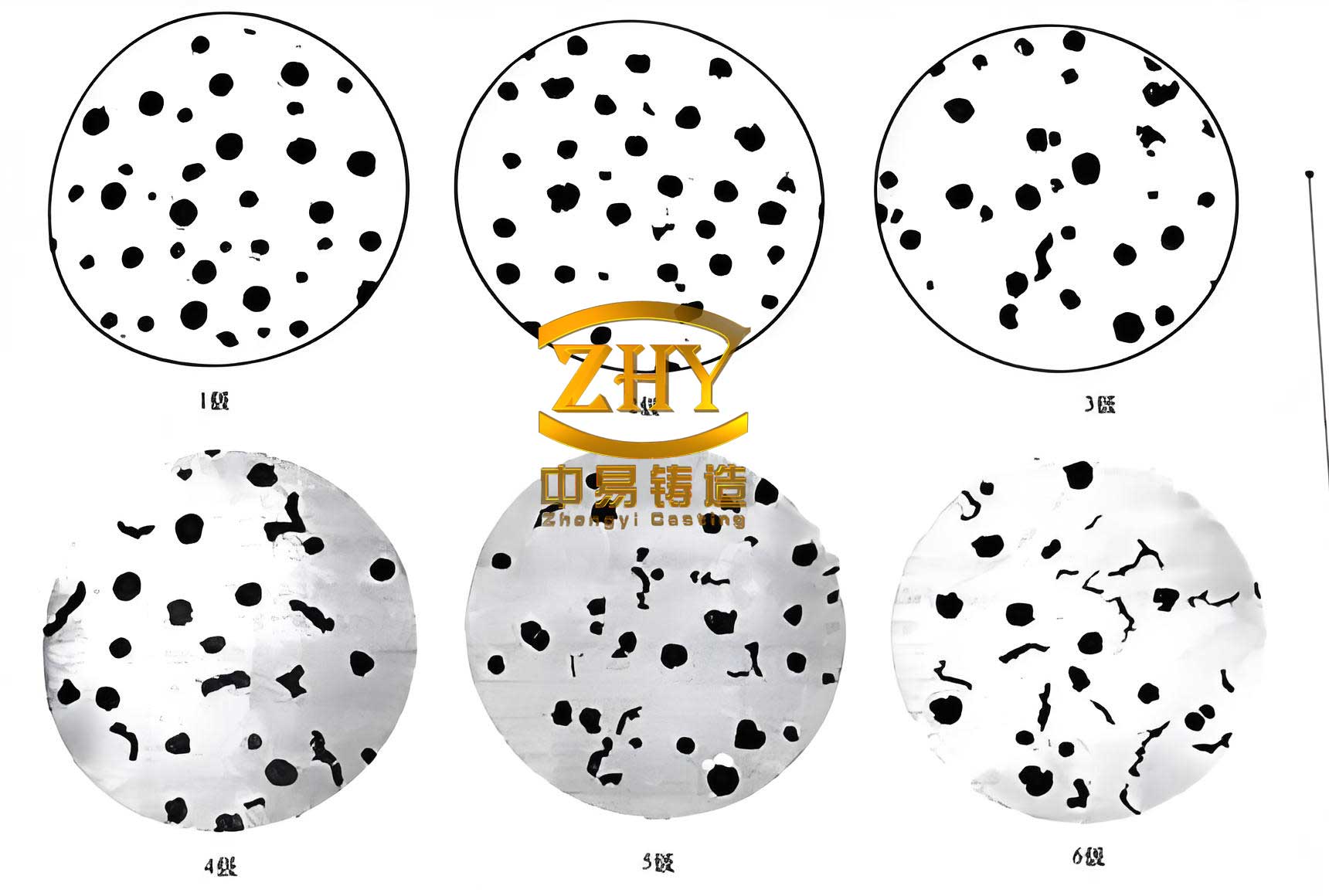
The successful hydrostatic pressure test of the fully machined and assembled valve at 2.4 MPa for 30 minutes without leakage provided definitive proof of the casting’s soundness and the material’s structural integrity.
Corrosion Performance Evaluation and Analysis
Corrosion resistance, the key performance indicator, was rigorously assessed via full immersion testing according to ASTM G31. Coupons were machined from attached test blocks. After degreasing, cleaning, and drying, their initial weights were precisely recorded. They were then fully immersed in a quiescent 3.5 wt.% NaCl solution at ambient temperature for periods of 72 and 168 hours. Post-exposure, the specimens were cleaned of corrosion products (using specific inhibitors to remove scale without attacking the base metal), dried, and re-weighed.
The corrosion rate \( CR \) in millimeters per year (mm/a) was calculated using the standard formula:
$$ CR = \frac{K \times W}{A \times T \times D} $$
where:
\( K \) = constant (8.76 × 10⁴ for mm/a),
\( W \) = mass loss (g),
\( A \) = exposed surface area (cm²),
\( T \) = exposure time (h),
\( D \) = material density (g/cm³).
The test results for two independent batches (QT1, QT2) are summarized in Table 3.
| Batch | Sample ID | Exposure Time (h) | Initial Mass (g) | Final Mass (g) | Corrosion Rate (mm/a) |
|---|---|---|---|---|---|
| QT1 | 1 | 72 | 35.6566 | 35.6458 | 0.066 |
| 2 | 72 | 35.3440 | 35.3327 | 0.069 | |
| 3 | 72 | 35.4596 | 35.4489 | 0.066 | |
| 4 | 168 | 34.6551 | 34.6286 | 0.069 | |
| 5 | 168 | 35.8876 | 35.8618 | 0.067 | |
| 6 | 168 | 32.7184 | 32.6949 | 0.062 | |
| QT2 | 1 | 72 | 34.5422 | 34.5319 | 0.064 |
| 2 | 72 | 35.2375 | 35.2296 | 0.065 | |
| 3 | 72 | 35.1325 | 35.1219 | 0.065 | |
| 4 | 168 | 34.7622 | 34.7385 | 0.063 | |
| 5 | 168 | 35.0206 | 34.9967 | 0.063 | |
| 6 | 168 | 34.1457 | 34.1221 | 0.062 |
Statistical Analysis and Discussion:
- Average Corrosion Rate: The overall average corrosion rate across all samples is approximately 0.065 mm/a, which is only 26% of the specified maximum limit of 0.25 mm/a. This represents a fourfold improvement in corrosion resistance over the requirement.
- Time Dependency: The average corrosion rate for the 72-hour tests (0.066 mm/a) is statistically indistinguishable from that of the 168-hour tests (0.065 mm/a). This lack of significant time dependence within this period suggests the rapid formation of a stable, protective surface film (likely a mixed Ni/Cr-enriched oxide/hydroxide layer) that effectively stifles further corrosion, a key characteristic of a passivating material.
- Batch Consistency: The variation between the QT1 and QT2 batches is minimal (less than 5% difference in average rate), demonstrating excellent reproducibility and process control in producing this NiCr alloyed spheroidal graphite cast iron.
The underlying corrosion mechanism involves the synergistic effect of Ni and Cr. Nickel increases the inherent corrosion potential of the ferritic matrix. Chromium, even at these modest levels, is crucial for forming a dense, adherent, and self-repairing passive film (primarily Cr₂O₃) on the surface. In chloride-containing environments, this film provides a barrier against ion penetration. The homogeneous, nearly fully ferritic matrix minimizes micro-galvanic coupling between different phases (e.g., between pearlite/ferrite or graphite/ferrite), which is a common corrosion accelerator in heterogeneous microstructures. The spherical shape of the graphite further reduces the stress concentration and crevice effects associated with flake graphite, contributing to the overall corrosion performance.
Conclusions and Outlook
The successful development and application of this high-performance NiCr alloyed spheroidal graphite cast iron for large butterfly valves mark a significant technological advancement. The material delivers an exceptional property profile: tensile strength >550 MPa, elongation around 16%, and a corrosion rate in 3.5% NaCl solution as low as 0.065 mm/a. This combination meets and far exceeds the demanding requirements for aggressive service environments like seawater cooling and chemical processing.
The key to this achievement lies in the integrated approach of:
1. Precise chemical composition design focusing on Ni and Cr for film formation and matrix potential elevation.
2. Strict control of detrimental elements (P, S, Mn).
3. Optimized spheroidizing and multi-stage inoculation practices to ensure high nodularity and a fine, uniform microstructure.
4. A subcritical annealing heat treatment to secure a soft, ductile, and electrochemically homogeneous ferritic matrix.
This NiCr spheroidal graphite cast iron offers a compelling, cost-effective alternative to duplex stainless steels for many corrosive applications, balancing performance, manufacturability, and lifecycle cost. The research provides valuable data and processing guidelines for the foundry industry. Future work may explore further optimization of the Ni/Cr ratio for specific corrosive media, the effect of minor additions like Mo or Cu, and the long-term behavior under erosion-corrosion or elevated temperature conditions. As global industries strive for sustainability and cost reduction, advanced, corrosion-resistant grades of spheroidal graphite cast iron are poised to play an increasingly vital role in critical infrastructure.