
In the construction and mining industries, excavators operate under harsh conditions, with components like sleeves subjected to significant wear and tear. Traditional materials, such as 45 steel, often fail prematurely due to inadequate wear resistance, leading to frequent maintenance and downtime. To address this, I explored the use of spheroidal graphite iron, specifically through centrifugal casting combined with austempering, to produce sleeves with superior durability. Spheroidal graphite iron, also known as austempered ductile iron (ADI), offers a unique microstructure that enhances mechanical properties and wear resistance. In this comprehensive study, I detail the process, analyze the results, and discuss the implications for industrial applications, emphasizing the role of spheroidal graphite iron in revolutionizing component longevity.
The wear of excavator sleeves typically results from abrasive and adhesive mechanisms under high loads and variable lubrication conditions. Conventional 45 steel sleeves, despite heat treatment, exhibit high friction coefficients and mass loss, especially in dry environments. This not only compromises efficiency but also increases operational costs. Spheroidal graphite iron, with its inherent self-lubricating properties due to graphite nodules, presents a promising alternative. The centrifugal casting method ensures a dense, uniform structure, while austempering transforms the matrix into a fine bainitic microstructure. This combination yields high strength, toughness, and exceptional wear resistance. My investigation aims to quantify these benefits through rigorous testing and analysis, providing a foundation for adopting spheroidal graphite iron in heavy machinery.
From a materials science perspective, spheroidal graphite iron derives its properties from its unique composition and processing. The iron-carbon system, with added elements like silicon, manganese, and copper, facilitates graphite spheroidization during solidification. The centrifugal force during casting aligns the graphite nodules and reduces porosity, enhancing integrity. Subsequent austempering involves austenitizing followed by isothermal quenching, which promotes the formation of acicular ferrite (bainite) and retained austenite. This microstructure is key to the material’s performance, as the bainite provides hardness, while the retained austenite offers ductility and work-hardening capability. The graphite nodules act as solid lubricants, reducing friction and wear. I will delve into these aspects, supported by data and theoretical models, to illustrate why spheroidal graphite iron outperforms traditional steels.
Materials and Processing Methodology
The base material for this study was spheroidal graphite iron, with a chemical composition designed to optimize austemperability. The composition was controlled to ensure high carbon equivalent for graphite formation, while alloying elements like copper were added to enhance hardenability and refine the microstructure. Table 1 summarizes the nominal composition, which was verified using spectral analysis.
| Element | C | Si | Mn | Cu | S | P | Fe |
|---|---|---|---|---|---|---|---|
| Content | 3.5 | 1.9 | 0.9 | 0.5 | <0.04 | <0.04 | Balance |
The centrifugal casting process was employed to manufacture the sleeves. A medium-frequency induction furnace melted the charge to 1540–1560°C, after which the molten iron was transferred to a preheated ladle for inoculation and nodularization. Inoculant (Si-25Fe) and nodularizer (rare earth magnesium) were added to promote graphite spheroidization. The ladle was then poured into a rotating mold at 1000 rpm, with a pouring temperature of 1400–1420°C. The centrifugal force ensured uniform distribution of the graphite nodules and minimized defects. After casting, the sleeves were cooled with water spray to prevent grain growth, then ejected for further processing. This method is particularly effective for spheroidal graphite iron, as it enhances density and homogeneity.
Austempering was conducted to achieve the desired microstructure. The sleeves were reheated to 900°C in a furnace for 1.5 hours for complete austenitization, then quenched into oil at 100°C. Once the temperature dropped to 230–280°C, they were transferred to an isothermal bath at 260°C for 100 minutes, followed by air cooling. This treatment resulted in a matrix of lower bainite, retained austenite, and spheroidal graphite, with minimal martensite. The parameters were optimized based on time-temperature-transformation (TTT) diagrams for spheroidal graphite iron, ensuring a balance of hardness and toughness. The hardness can be related to the microstructure through empirical models, such as:
$$ H = H_0 + k_B \cdot V_B + k_A \cdot V_A $$
where \( H \) is the hardness, \( H_0 \) is a base hardness, \( k_B \) and \( k_A \) are constants for bainite and austenite, respectively, and \( V_B \) and \( V_A \) are their volume fractions. For spheroidal graphite iron, the graphite volume also influences wear, but its primary role is lubrication.
For comparison, sleeves made of 45 steel were prepared via conventional forging and quenching, with a hardness of approximately 50 HRC. Both materials underwent identical wear testing to ensure fair evaluation. The focus, however, remains on spheroidal graphite iron due to its superior potential.
Microstructural Characterization and Mechanical Properties
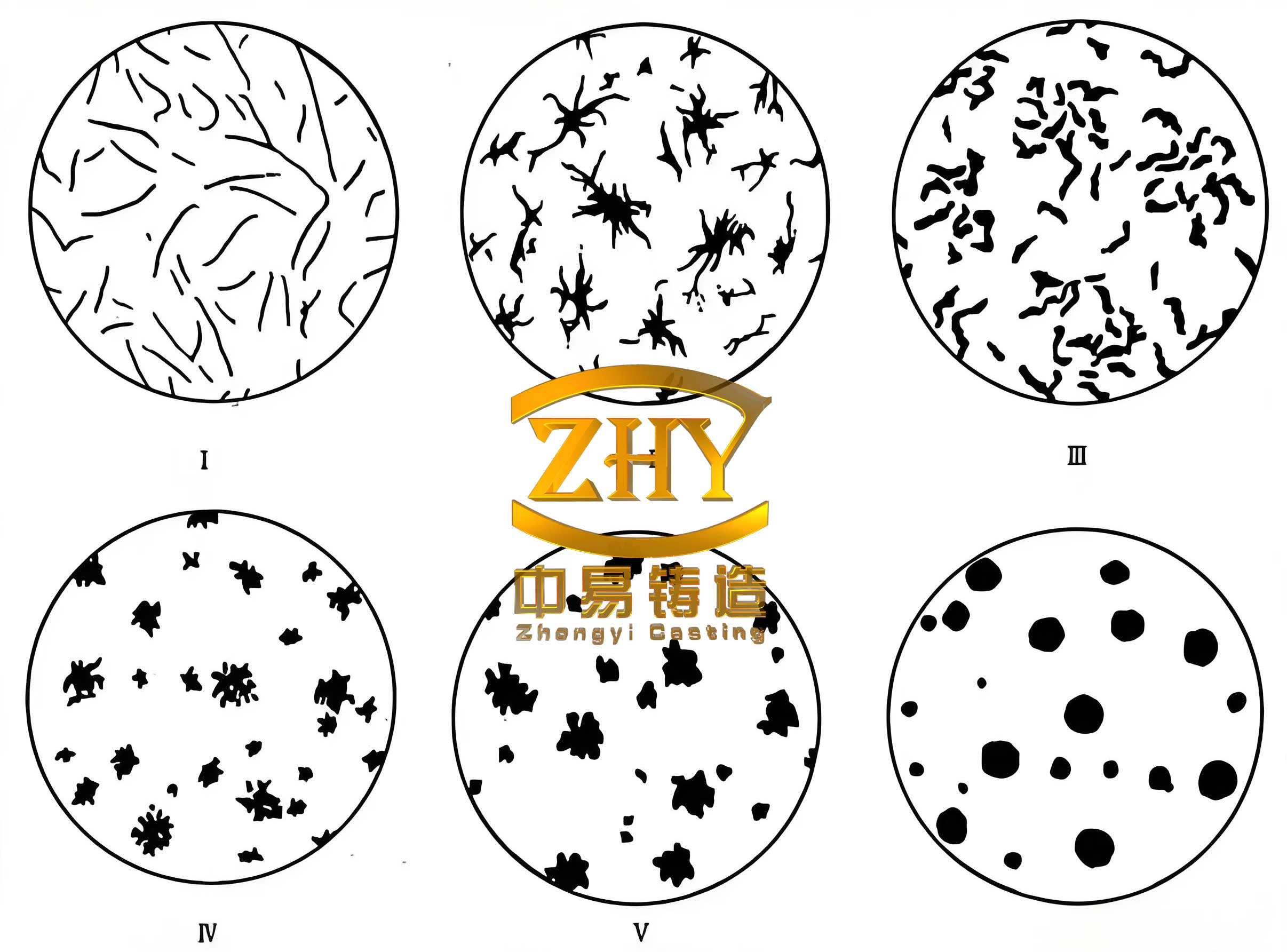
The microstructure of the austempered spheroidal graphite iron was examined using optical and scanning electron microscopy. The sample revealed a fine, homogeneous distribution of graphite nodules within a matrix of needle-like bainite and interlath retained austenite. The graphite nodules were spherical and well-dispersed, with an average diameter of 20–30 μm, as expected for high-quality spheroidal graphite iron. The bainitic ferrite platelets were ultrafine, contributing to high strength, while the retained austenite, estimated at 20–30% volume fraction, provided ductility and strain-induced transformation capability. This microstructure is pivotal for wear resistance, as the hard bainite resists abrasion, and the austenite accommodates deformation without cracking.
The mechanical properties were assessed through tensile testing and hardness measurements. Six samples from different sleeves were tested to ensure reproducibility. The results, presented in Table 2, show that spheroidal graphite iron achieved an average tensile strength of 1099 MPa, with a reduction of area of 0.5%, and a hardness of 52.8 HRC. These values exceed those of typical 45 steel, which has a tensile strength around 600 MPa after quenching. The high strength of spheroidal graphite iron is attributed to the bainitic matrix, while the limited ductility is due to the high hardness and graphite content. However, for sleeve applications, wear resistance is more critical than ductility.
| Sample | Tensile Strength (MPa) | Reduction of Area (%) | Hardness (HRC) |
|---|---|---|---|
| 1 | 1150 | 0.61 | 52 |
| 2 | 1068 | 0.44 | 54 |
| 3 | 1123 | 0.58 | 57 |
| 4 | 1053 | 0.38 | 49 |
| 5 | 1169 | 0.55 | 55 |
| 6 | 1034 | 0.47 | 50 |
| Average | 1099 | 0.50 | 52.8 |
The relationship between hardness and wear resistance can be described using the Archard wear equation, which is fundamental in tribology:
$$ V = \frac{K \cdot L \cdot s}{H} $$
where \( V \) is the wear volume, \( K \) is the wear coefficient, \( L \) is the load, \( s \) is the sliding distance, and \( H \) is the hardness. For spheroidal graphite iron, the presence of graphite reduces \( K \) by providing lubrication, thereby decreasing wear even at high hardness. Additionally, the retained austenite can transform to martensite under stress, increasing surface hardness during service—a phenomenon known as transformation-induced plasticity (TRIP). This dynamic hardening further enhances wear resistance, making spheroidal graphite iron ideal for fluctuating loads.
Wear Performance Under Dry and Lubricated Conditions
Wear tests were conducted using a ball-on-disk tribometer under both dry friction and oil-lubricated conditions. The upper specimen was a GCr15 steel ball (10 mm diameter), and the lower specimens were disks of austempered spheroidal graphite iron and 45 steel. The load was set at 30 N, sliding speed at 10 mm/s, stroke length at 10 mm, and test duration at 1800 s. These parameters simulate the intermittent motion and high pressure experienced by excavator sleeves. The friction coefficient was recorded in real-time, and mass loss was measured post-test using a precision balance with 0.1 mg accuracy.
Under dry friction, the spheroidal graphite iron exhibited a steady-state friction coefficient of approximately 0.38, compared to 0.58 for 45 steel. This reduction of about 34% is significant and stems from the self-lubricating effect of graphite nodules. As sliding occurs, graphite particles detach and form a tribofilm between surfaces, reducing direct metal-to-metal contact. The wear mass loss for spheroidal graphite iron was 3.59% of the initial mass, whereas 45 steel lost 21.8%, indicating that spheroidal graphite iron is roughly six times more wear-resistant. This aligns with the Archard equation, where the combination of high hardness and low wear coefficient minimizes volume loss.
Under oil lubrication, the performance gap widened further. Spheroidal graphite iron showed a friction coefficient of 0.12, only one-fourth that of 45 steel (0.48). The wear mass loss dropped to 0.82% for spheroidal graphite iron, compared to 8.95% for 45 steel—an order of magnitude improvement. The oil acts synergistically with the graphite: the porous structure around graphite nodules traps lubricant, maintaining a hydrodynamic film even under high loads. This dual lubrication mechanism is unique to spheroidal graphite iron and is quantified by the Stribeck curve, which relates friction to the lubrication regime. For spheroidal graphite iron, the curve shifts toward lower friction due to solid lubrication, as expressed by:
$$ \mu = \mu_0 + \alpha \cdot e^{-\beta \cdot \lambda} $$
where \( \mu \) is the friction coefficient, \( \mu_0 \) is the boundary friction coefficient, \( \alpha \) and \( \beta \) are material constants, and \( \lambda \) is the film thickness ratio. For spheroidal graphite iron, \( \mu_0 \) is lower due to graphite, enhancing performance in mixed and boundary lubrication regimes common in sleeves.
Table 3 summarizes the wear test results, highlighting the superiority of spheroidal graphite iron across both conditions. The data reinforces that spheroidal graphite iron is not only harder but also more effective at reducing friction and wear, especially when lubricated.
| Condition | Material | Test Duration (h) | Load (N) | Initial Mass (mg) | Final Mass (mg) | Mass Loss (%) | Avg. Friction Coefficient |
|---|---|---|---|---|---|---|---|
| Dry Friction | Spheroidal Graphite Iron | 0.5 | 30 | 3235 | 3119 | 3.59 | 0.38 |
| Dry Friction | 45 Steel | 0.5 | 30 | 3218 | 2516 | 21.8 | 0.58 |
| Oil Lubrication | Spheroidal Graphite Iron | 0.5 | 30 | 3223 | 3141 | 0.82 | 0.12 |
| Oil Lubrication | 45 Steel | 0.5 | 30 | 3241 | 2951 | 8.95 | 0.48 |
Discussion on Wear Mechanisms and Material Advantages
The exceptional wear resistance of spheroidal graphite iron can be attributed to multiple factors. First, the bainitic matrix provides a high hardness base, resisting plastic deformation and abrasive wear. The fine needle-like structure impedes crack propagation, as the interfaces act as barriers. Second, the retained austenite undergoes strain-induced transformation to martensite during sliding, creating a hardened surface layer that adapts to wear conditions. This is described by the Olson-Cohen model for transformation kinetics:
$$ f = 1 – \exp(-\beta \cdot \varepsilon^n) $$
where \( f \) is the volume fraction of martensite, \( \varepsilon \) is the strain, and \( \beta \) and \( n \) are constants. For spheroidal graphite iron, this transformation occurs progressively, maintaining a tough core and hard surface.
Third, the spheroidal graphite nodules play a crucial role. They act as reservoirs for lubricants and, when exposed, smeared graphite forms a protective layer that reduces adhesion and friction. The wear debris from graphite is soft and non-abrasive, unlike the hard oxides often generated from steels. This self-lubricating property is inherent to spheroidal graphite iron and is enhanced by centrifugal casting, which ensures uniform graphite distribution. The effect can be modeled using a composite wear theory, where the wear rate \( W \) is given by:
$$ W = W_m \cdot (1 – V_g) + W_g \cdot V_g $$
where \( W_m \) and \( W_g \) are the wear rates of the matrix and graphite, respectively, and \( V_g \) is the graphite volume fraction. Since \( W_g \) is low due to lubrication, increasing \( V_g \) reduces overall wear, up to an optimal point around 10–15% for spheroidal graphite iron.
Compared to 45 steel, spheroidal graphite iron exhibits lower friction coefficients and wear rates because steel lacks solid lubricants and has a martensitic matrix that is prone to brittle fracture and adhesive wear. Under lubrication, steel relies solely on the oil film, which can break down under high pressure, leading to boundary lubrication and increased wear. In contrast, spheroidal graphite iron maintains a hybrid lubrication regime, with graphite supplementing the oil film. This makes it particularly suitable for excavator sleeves, where lubrication is often intermittent due to dust and water ingress.
Furthermore, the centrifugal casting process imparts a fine, pore-free structure to spheroidal graphite iron, reducing stress concentrations and enhancing fatigue resistance. Fatigue wear is critical in cyclic loading applications, and the combination of high strength and toughness in spheroidal graphite iron extends service life. The fatigue limit can be estimated using the Goodman relation:
$$ \sigma_a = \sigma_e \left(1 – \frac{\sigma_m}{\sigma_u}\right) $$
where \( \sigma_a \) is the allowable stress amplitude, \( \sigma_e \) is the endurance limit, \( \sigma_m \) is the mean stress, and \( \sigma_u \) is the tensile strength. For spheroidal graphite iron, \( \sigma_e \) is high due to the fine microstructure, and \( \sigma_u \) exceeds 1000 MPa, allowing for higher operating stresses without failure.
Economic and Environmental Implications
Adopting spheroidal graphite iron for excavator sleeves offers significant economic benefits. The extended service life reduces replacement frequency, lowering maintenance costs and downtime. In typical mining operations, sleeve replacement can halt equipment for hours; using spheroidal graphite iron could extend intervals from months to years, improving productivity. Additionally, the centrifugal casting process is efficient for mass production, with minimal material waste compared to machining from billets. The raw material cost for spheroidal graphite iron is comparable to alloy steels, but the superior performance justifies any premium.
Environmentally, spheroidal graphite iron contributes to sustainability. The longer lifespan means fewer components are manufactured and discarded, reducing resource consumption and waste. The self-lubricating properties may allow for reduced lubricant usage, minimizing oil pollution. Moreover, spheroidal graphite iron is recyclable, as cast iron scrap can be remelted with minimal degradation. This aligns with circular economy principles, making spheroidal graphite iron a green material choice for heavy industry.
From a design perspective, spheroidal graphite iron enables lighter components due to its high specific strength. This can lead to weight savings in excavators, improving fuel efficiency and maneuverability. The material’s damping capacity, afforded by graphite, also reduces noise and vibration, enhancing operator comfort. These factors collectively make spheroidal graphite iron a versatile solution not just for sleeves, but for other wear-prone parts like gears, bearings, and crusher liners.
Future Directions and Research Opportunities
While this study demonstrates the advantages of spheroidal graphite iron, further research can optimize its properties. For instance, varying the austempering temperature and time could tailor the bainite morphology for specific applications. Lower temperatures (e.g., 200°C) might produce finer bainite for higher wear resistance, albeit with reduced toughness. Modeling this using phase transformation kinetics, such as the Johnson-Mehl-Avrami-Kolmogorov (JMAK) equation, could predict microstructure evolution:
$$ X = 1 – \exp(-k t^n) $$
where \( X \) is the transformed fraction, \( k \) is a rate constant, \( t \) is time, and \( n \) is an exponent. For spheroidal graphite iron, this helps in designing heat treatment cycles.
Additionally, alloying with elements like nickel or molybdenum could enhance hardenability and corrosion resistance, expanding use in marine or chemical environments. Composite approaches, such as incorporating carbides or ceramics into the spheroidal graphite iron matrix, might push wear resistance further. Tribological modeling using finite element analysis (FEA) could simulate wear patterns and optimize sleeve geometry. These advancements would solidify spheroidal graphite iron as a premier material for demanding applications.
In conclusion, spheroidal graphite iron, processed via centrifugal casting and austempering, offers a compelling combination of high strength, excellent wear resistance, and self-lubrication. My findings show that it outperforms traditional 45 steel by a wide margin, particularly under lubricated conditions, making it ideal for excavator sleeves and similar components. The microstructure, rich in bainite and graphite, provides both hardness and lubrication, while the manufacturing process ensures quality and consistency. As industries seek durable and efficient materials, spheroidal graphite iron stands out as a robust choice, promising longer service life and lower operational costs. Continued innovation in processing and alloy design will only broaden its applicability, reinforcing its role in advancing machinery performance.