
In recent years, the rapid development of rail transportation has demanded materials capable of withstanding extreme conditions, particularly in cold regions where temperatures can drop below -40°C. For critical components like gearboxes in electric locomotives, there is an increasing need for spheroidal graphite iron that combines high strength, high toughness, and excellent low-temperature impact properties. Traditional spheroidal graphite iron grades, such as QT500-7, often fall short in meeting these stringent requirements, especially in terms of elongation and low-temperature impact energy. To address this, I embarked on a research project to develop advanced spheroidal graphite iron materials, specifically QT500-7LT and QT600-7LT, which exhibit superior performance at ultra-low temperatures while maintaining high strength and ductility. This article details my experimental approach, findings, and insights into optimizing the composition and processing of spheroidal graphite iron for such applications.
Spheroidal graphite iron, also known as ductile iron, is renowned for its unique microstructure where graphite exists as spheroids within a metallic matrix, providing a favorable balance of strength and ductility. However, achieving enhanced low-temperature toughness in spheroidal graphite iron without compromising strength is challenging due to the inherent brittleness that can arise at sub-zero temperatures. The key lies in carefully controlling alloying elements, impurity levels, and solidification processes. In this study, I focused on the effects of nickel, copper, molybdenum, and sulfur, along with improved spheroidization and inoculation techniques, to tailor the properties of spheroidal graphite iron. Through systematic experimentation, I aimed to establish a reliable methodology for producing high-performance spheroidal graphite iron suitable for demanding railway applications.
Experimental Methodology
To investigate the development of ultra-low temperature spheroidal graphite iron, I designed a series of experiments centered on material composition and processing parameters. The foundational materials included Q10 pig iron, high-purity pig iron, steel scrap, and various ferroalloys. The chemical compositions of these charge materials are summarized in Table 1, which provides a clear overview of the elemental inputs used in the melting process.
| Material | C | Si | Mn | P | S | V | Ti |
|---|---|---|---|---|---|---|---|
| Q10 Pig Iron | 4.39 | 0.54 | 0.06 | 0.022 | 0.013 | 0.01 | 0.03 |
| High-Purity Pig Iron | 4.21 | 0.09 | 0.04 | 0.031 | 0.005 | 0.01 | 0.01 |
| Steel Scrap | 0.16 | 0.17 | 0.61 | 0.015 | 0.009 | – | – |
For spheroidization and inoculation, I employed specific agents whose compositions are listed in Table 2. These agents play a critical role in promoting the formation of spheroidal graphite and refining the microstructure of spheroidal graphite iron.
| Agent | Si | Mg | RE | Ca | Ba | Al | MgO |
|---|---|---|---|---|---|---|---|
| Spheroidizer | 44-47 | 4.5-5.5 | 0.6-1.0 | 0.8-1.2 | 1.8-2.5 | 1.0 | 0.4 |
| Inoculant | 65-75 | – | – | 1-1.2 | – | 0.6-1.0 | – |
The melting was conducted using a 100 kg medium-frequency induction furnace, with temperatures maintained between 1,500°C and 1,550°C. The tapping temperature was set at 1,500-1,520°C, and the pouring temperature ranged from 1,380°C to 1,420°C. Spheroidization was achieved via the sandwich method, while inoculation involved both base covering and secondary addition during tapping. Additionally, a stream inoculation device with a 4 mm diameter orifice was used during pouring to enhance graphite nucleation. Y-block specimens, as illustrated in the following dimensions, were cast for subsequent testing: the Y-block had a geometry conducive to uniform solidification and representative property evaluation.
For characterization, I employed standard metallographic techniques according to ISO 945, using an A1m type optical microscope for microstructural analysis. Mechanical properties were assessed with a HB-3000 Brinell hardness tester and a JNB-300B pendulum impact tester for low-temperature impact energy at -40°C. The impact tests were conducted on V-notched specimens to simulate stress concentration conditions, which is crucial for evaluating the toughness of spheroidal graphite iron in service.
Influence of Alloying Elements on Spheroidal Graphite Iron
The selection of alloying elements is pivotal in tailoring the properties of spheroidal graphite iron. I explored three primary schemes: single nickel addition, nickel-molybdenum combination, and nickel-copper combination. Each approach was evaluated based on its ability to enhance strength, elongation, and low-temperature impact energy in spheroidal graphite iron.
Single Nickel Addition
Initially, I focused on QT500-7 spheroidal graphite iron with nickel additions ranging from 0.9% to 1.9%. The objective was to assess how nickel alone affects the mechanical and low-temperature properties of spheroidal graphite iron. The results, summarized in Figure 1, indicate that nickel improves low-temperature impact energy and elongation, but higher amounts are required to achieve tensile strength above 500 MPa. For instance, at 1.9% Ni, the average -40°C impact energy reached 7.7 J, with individual values exceeding 6 J, and elongation was above 12%. However, the tensile strength only surpassed 500 MPa at this higher nickel content.
The role of nickel in spheroidal graphite iron can be described through its influence on the eutectic temperature interval and solid solution strengthening. Nickel widens the gap between the stable Fe-G and metastable Fe-Fe3C eutectic temperatures, promoting graphite formation during solidification and refining graphite spheres. This contributes to enhanced toughness. The solid solution strengthening effect can be modeled using a simplified equation for yield strength contribution: $$ \Delta \sigma_{Ni} = k_{Ni} \cdot C_{Ni} $$ where $k_{Ni}$ is a strengthening coefficient and $C_{Ni}$ is the nickel concentration. However, for spheroidal graphite iron, the effect is moderate at low levels, necessitating higher additions for significant strength improvement, which increases cost.
| Ni Content (wt%) | Graphite Morphology (ISO 945) | Matrix Structure | Tensile Strength (MPa) | Elongation (%) | -40°C Impact Energy (J) |
|---|---|---|---|---|---|
| 0.9 | 85% VI 5/6 + 15% V 5/6 | Ferrite + <10% Pearlite | 480 | 12.5 | 6.7 |
| 1.3 | 85% VI 5/6 + 15% V 5/6 | Ferrite + 10-20% Pearlite | 490 | 13.0 | 7.0 |
| 1.6 | 85% VI 5/6 + 15% V 5/6 | Ferrite + 15-25% Pearlite | 495 | 12.8 | 7.3 |
| 1.9 | 85% VI 5/6 + 15% V 5/6 | Ferrite + 25-35% Pearlite | 510 | 12.2 | 7.7 |
Nickel-Molybdenum Combination
Next, I investigated the nickel-molybdenum combination, with molybdenum fixed at 0.17% and nickel varied from 0.6% to 1.0%. Molybdenum is known to lower the ductile-to-brittle transition temperature in spheroidal graphite iron, but its effect on strength is limited at low concentrations. The results, shown in Figure 2, revealed that while low-temperature impact energy met the requirement of ≥4 J, tensile strength remained below 500 MPa for nickel contents up to 1.0%. For example, at 0.8% Ni, the average impact energy was 5.3 J, but tensile strength was only 480 MPa.
The interaction between nickel and molybdenum in spheroidal graphite iron can be complex. Molybdenum tends to promote pearlite formation, which can increase strength but reduce ductility and toughness if excessive. The combined effect on low-temperature toughness can be approximated by: $$ A_{KV}(-40^\circ C) = A_0 – \beta_1 C_{Mo} + \beta_2 C_{Ni} $$ where $A_0$ is a baseline impact energy, and $\beta_1$ and $\beta_2$ are coefficients. However, given the limited strength gain and higher cost of molybdenum, this scheme was deemed less favorable for producing cost-effective spheroidal graphite iron with balanced properties.
| Ni Content (wt%) | Graphite Morphology (ISO 945) | Matrix Structure | Tensile Strength (MPa) | Elongation (%) | -40°C Impact Energy (J) |
|---|---|---|---|---|---|
| 0.6 | 85% VI 5/6 + 15% V 5/6 | Ferrite + 5-10% Pearlite | 470 | 14.0 | 5.3 |
| 0.7 | 85% VI 5/6 + 15% V 5/6 | Ferrite + 10-20% Pearlite | 475 | 13.5 | 4.7 |
| 0.8 | 80% VI 5/6 + 20% V 5/6 | Ferrite + 15-25% Pearlite | 480 | 13.0 | 4.3 |
| 0.9 | 80% VI 5/6 + 20% V 5/6 | Ferrite + 25-35% Pearlite | 485 | 12.5 | 4.0 |
| 1.0 | 80% VI 5/6 + 20% V 5/6 | Ferrite + 25-35% Pearlite | 490 | 12.0 | 3.8 |
Nickel-Copper Combination
Given the limitations of the previous schemes, I turned to the nickel-copper combination, which proved more effective for both QT500-7LT and QT600-7LT spheroidal graphite iron. Copper is a cost-effective alloying element that enhances strength through solid solution hardening and pearlite promotion, while nickel aids in toughness and low-temperature performance. I conducted experiments with varying nickel (0.8-2.0%) and copper (0.1-0.5%) contents, as summarized in Tables 5 and 6.
For QT500-7LT spheroidal graphite iron, optimal properties were achieved with nickel at 0.8-2.0% and copper at 0.1-0.2%. This composition yielded tensile strength above 500 MPa, elongation over 8%, and -40°C impact energy averaging ≥4 J. For QT600-7LT spheroidal graphite iron, higher nickel (1.0-2.0%) and copper (0.2-0.5%) were required to reach tensile strengths exceeding 600 MPa while maintaining adequate toughness. The synergy between nickel and copper can be expressed via a composite strengthening model: $$ \sigma_y = \sigma_0 + k_{Ni}C_{Ni} + k_{Cu}C_{Cu} + k_{d}d^{-1/2} $$ where $\sigma_0$ is the base strength, $k_{Ni}$ and $k_{Cu}$ are coefficients, $C_{Ni}$ and $C_{Cu}$ are concentrations, and $k_{d}d^{-1/2}$ represents the Hall-Petch contribution from matrix grain refinement. This combination effectively balances the properties of spheroidal graphite iron for ultra-low temperature applications.
| Cu Content (wt%) | Graphite Morphology (ISO 945) | Matrix Structure | Tensile Strength (MPa) | Elongation (%) | -40°C Impact Energy (J) |
|---|---|---|---|---|---|
| 0.12 | 80% VI 6/7 + 20% V 6 | Ferrite + 5-15% Pearlite | 520 | 11.0 | 6.5 |
| 0.15 | 85% VI 6/7 + 15% V 6 | Ferrite + 10-20% Pearlite | 540 | 10.5 | 6.8 |
| 0.18 | 85% VI 6/7 + 15% V 6 | Ferrite + 15-25% Pearlite | 560 | 9.8 | 7.0 |
| 0.20 | 80% VI 6/7 + 20% V 6 | Ferrite + 20-30% Pearlite | 580 | 9.0 | 7.2 |
| 0.22 | 85% VI 6/7 + 15% V 6/7 | Ferrite + 30-40% Pearlite | 600 | 8.5 | 7.5 |
| Ni Content (wt%) | Graphite Morphology (ISO 945) | Matrix Structure | Tensile Strength (MPa) | Elongation (%) | -40°C Impact Energy (J) |
|---|---|---|---|---|---|
| 1.0 | 80% VI 6/7 + 20% V 6 | Pearlite + 5-30% Ferrite | 620 | 8.0 | 4.3 |
| 1.3 | 85% VI 6/7 + 15% V 6 | Pearlite + 10-35% Ferrite | 640 | 7.8 | 5.0 |
| 1.6 | 80% VI 6/7 + 20% V 6 | Pearlite + 15-30% Ferrite | 660 | 7.5 | 5.5 |
| 1.9 | 85% VI 6/7 + 15% V 6 | Pearlite + 20-40% Ferrite | 680 | 7.2 | 6.0 |
| 2.0 | 85% VI 6/7 + 15% V 6/7 | Pearlite + 25-45% Ferrite | 700 | 7.0 | 6.5 |
Impact of Sulfur Content on Spheroidal Graphite Iron
Sulfur is a notorious impurity in spheroidal graphite iron, as it can interfere with graphite spheroidization and degrade mechanical properties. To quantify its effect, I compared two charge material sets: one with high-purity pig iron (low sulfur) and another with Q10 pig iron (higher sulfur). The results, depicted in Figure 3, clearly show that lower sulfur content (0.004-0.008%) leads to superior tensile strength, elongation, and low-temperature impact energy in spheroidal graphite iron. For instance, with sulfur below 0.008%, tensile strength exceeded 550 MPa, whereas at sulfur levels above 0.012%, strength dropped below 500 MPa.
The detrimental role of sulfur in spheroidal graphite iron can be explained by its tendency to form sulfides that act as nucleation sites for undesirable graphite shapes or inclusions. The relationship between sulfur content and tensile strength can be modeled as: $$ \sigma_{TS} = \sigma_{max} – \alpha S $$ where $\sigma_{max}$ is the maximum achievable strength, $\alpha$ is a degradation coefficient, and $S$ is the sulfur concentration. Maintaining low sulfur is therefore crucial for producing high-quality spheroidal graphite iron with consistent properties.
Optimization of Spheroidization and Inoculation in Spheroidal Graphite Iron
The process of spheroidization and inoculation is vital for controlling graphite morphology and matrix structure in spheroidal graphite iron. I evaluated two approaches: conventional inoculation and composite inoculation. The composite method involved a combination of base and stream inoculation with refined agents, leading to improved graphite spheroidization and increased ferrite content. As shown in Table 7, composite inoculation enhanced the low-temperature impact energy of QT600-7LT spheroidal graphite iron by 9.3% to 25% compared to conventional methods.
The mechanism behind this improvement lies in the enhanced nucleation of graphite spheres and finer matrix grains. The effectiveness of inoculation can be related to the inoculant potency and cooling rate, which influence the number of graphite nuclei. A simplified kinetic model for graphite nucleation in spheroidal graphite iron is: $$ N = N_0 \exp\left(-\frac{Q}{RT}\right) \cdot f(I) $$ where $N$ is the number of spheroids, $N_0$ is a pre-exponential factor, $Q$ is activation energy, $R$ is the gas constant, $T$ is temperature, and $f(I)$ is a function of inoculant addition. Composite inoculation maximizes $f(I)$, resulting in a finer and more uniform distribution of spheroidal graphite, which benefits toughness.
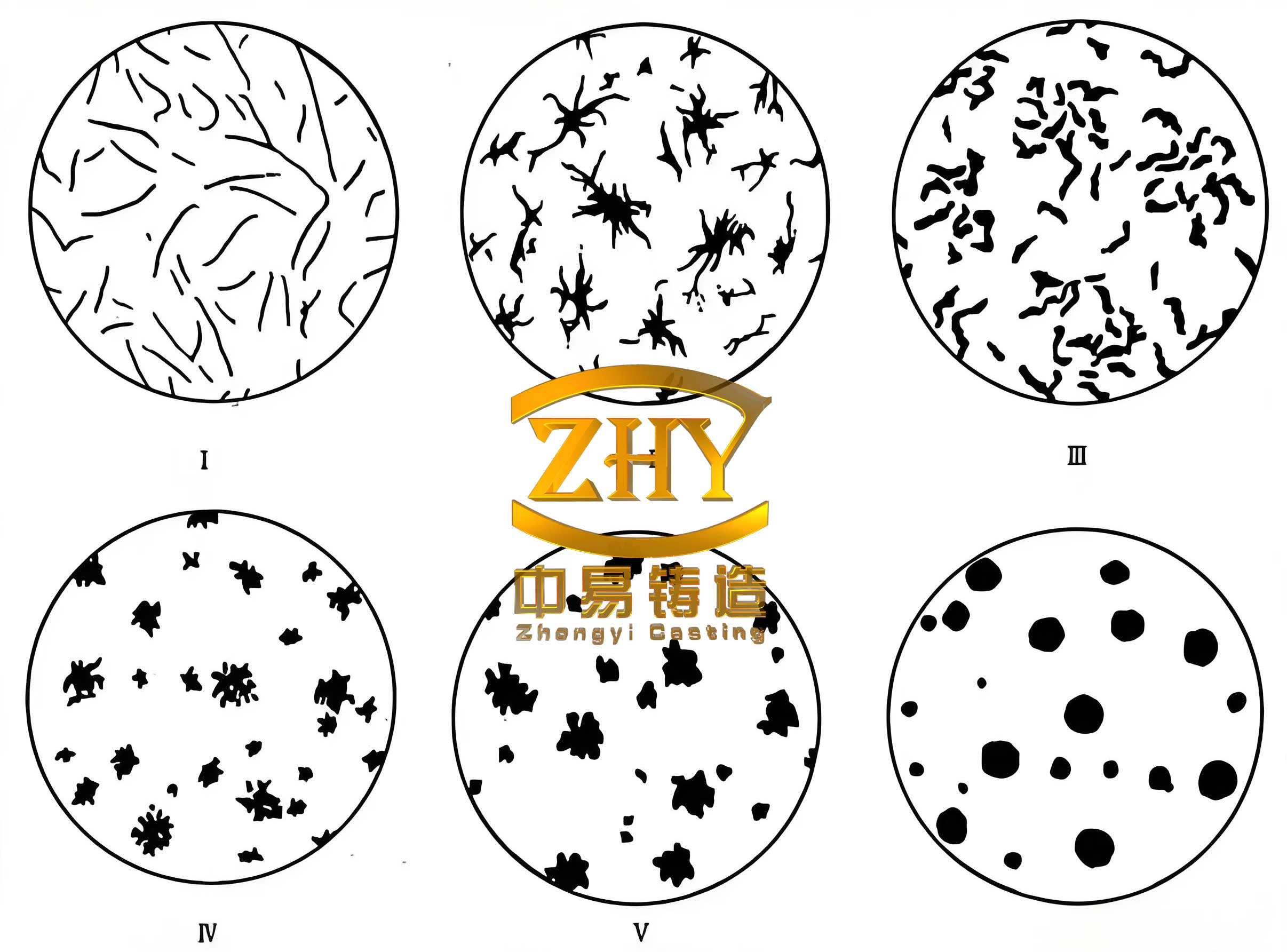
The microstructure of spheroidal graphite iron, as shown in the image above, typically consists of well-formed graphite spheroids embedded in a ferritic or pearlitic matrix. Optimizing this microstructure through proper inoculation is key to achieving the desired balance of strength and toughness in spheroidal graphite iron.
| Inoculation Method | Graphite Morphology (ISO 945) | Matrix Structure | Tensile Strength (MPa) | Elongation (%) | -40°C Impact Energy (J) – Single/Avg |
|---|---|---|---|---|---|
| Conventional | 80% VI 6/7 + 20% V 6 | Pearlite + 5-30% Ferrite | 650 | 7.5 | 4.0 / 4.3 |
| Composite | 85% VI 6/7 + 15% V 6 | Pearlite + 10-35% Ferrite | 655 | 8.0 | 5.0 / 5.0 |
| Conventional | 80% VI 6/7 + 20% V 6 | Pearlite + 5-30% Ferrite | 645 | 7.3 | 4.3 / 4.3 |
| Composite | 85% VI 6/7 + 15% V 6 | Pearlite + 10-35% Ferrite | 660 | 7.8 | 4.7 / 4.7 |
| Conventional | 80% VI 6/7 + 20% V 6 | Pearlite + 5-30% Ferrite | 640 | 7.0 | 4.0 / 4.0 |
| Composite | 85% VI 6/7 + 15% V 6 | Pearlite + 10-35% Ferrite | 650 | 7.5 | 5.0 / 5.0 |
Discussion and Theoretical Insights
The development of ultra-low temperature spheroidal graphite iron hinges on a deep understanding of metallurgical principles. The low-temperature toughness of spheroidal graphite iron is often governed by the ductile-to-brittle transition temperature (DBTT), which can be lowered by reducing pearlite content, refining graphite spheres, and minimizing impurities. The DBTT can be estimated using an empirical relation: $$ DBTT = T_0 + \gamma_1 P + \gamma_2 S – \gamma_3 Ni $$ where $T_0$ is a base temperature, $P$ is pearlite fraction, $S$ is sulfur content, and $\gamma_i$ are coefficients. By optimizing nickel and copper additions, I effectively reduced the DBTT of spheroidal graphite iron, enabling better performance at -40°C.
Furthermore, the strength of spheroidal graphite iron is influenced by matrix hardening and graphite morphology. The overall tensile strength can be expressed as a composite of matrix strength and graphite contribution: $$ \sigma_{TS} = V_m \sigma_m + V_g \sigma_g $$ where $V_m$ and $V_g$ are volume fractions of matrix and graphite, $\sigma_m$ is matrix strength, and $\sigma_g$ is the effective strength of graphite spheres (typically low). Enhancing $\sigma_m$ through solid solution hardening with nickel and copper, while maintaining a high $V_m$ via ferrite promotion, is crucial for high-strength spheroidal graphite iron.
In terms of impact energy, the Charpy impact value at low temperatures correlates with the energy absorbed during fracture, which involves crack initiation and propagation. For spheroidal graphite iron, the impact energy can be modeled as: $$ A_{KV} = K_{IC}^2 / E \cdot g(d, \rho) $$ where $K_{IC}$ is fracture toughness, $E$ is Young’s modulus, and $g$ is a function of graphite sphere diameter $d$ and spacing $\rho$. Finer graphite and higher ferrite content increase $K_{IC}$, thereby boosting $A_{KV}$. This aligns with my findings that composite inoculation and nickel-copper alloying improve low-temperature impact energy in spheroidal graphite iron.
Conclusion
Through this comprehensive study, I have demonstrated that ultra-low temperature spheroidal graphite iron with high strength and toughness can be successfully developed by tailoring alloy compositions and processing techniques. The nickel-copper combination, with nickel controlled at 0.8-2.0% and copper at 0.1-0.5%, proves to be the most effective for achieving the desired properties in QT500-7LT and QT600-7LT spheroidal graphite iron. Additionally, maintaining low sulfur content (0.004-0.008%) is essential for consistent mechanical performance. The adoption of composite spheroidization and inoculation further enhances the low-temperature impact energy by refining graphite morphology and promoting ferrite formation.
These findings provide a robust framework for manufacturing advanced spheroidal graphite iron components for railway applications, ensuring reliability in harsh environments. Future work could explore the integration of other microalloying elements or advanced heat treatments to push the boundaries of spheroidal graphite iron performance. Ultimately, the versatility and adaptability of spheroidal graphite iron make it a cornerstone material for modern engineering challenges, and continuous innovation in its processing will unlock new potentials across industries.