
In my experience with casting processes, the drive frame shell for reducers is a critical component in减速 systems, and its performance heavily relies on the material properties and manufacturing techniques. The material specified for this component is spheroidal graphite iron, specifically grade QT600-3, which demands high tensile strength, elongation, and hardness. The casting weighs approximately 54 kg, with轮廓 dimensions of φ385 mm × 270 mm, and features varying壁厚 from 11 mm to 45 mm. The technical requirements include a本体抗拉 strength of at least 600 MPa, elongation of 3% or more, hardness between 190 and 250 HB, and strict microstructural criteria such as球化等级 of 3 or higher,石墨大小 no larger than grade 6, and limited磷共晶 and碳化物 content. Initially, the production process involved a material mix of 40% pig iron and 60% scrap steel, with chemical compositions targeting carbon content between 3.7% and 3.9%, silicon between 2.1% and 2.3%, manganese around 0.4% to 0.45%, and low sulfur and磷 levels. The球化处理 used 0.3% REMgSiFe球化剂 and 0.2% SiFe孕育剂, with浇注 temperatures ranging from 1,350 to 1,380 °C and浇注 times of 8 to 14 seconds. However, this approach led to significant shrinkage defects in厚大部位, and the冲入法 was unstable, requiring high operator skill and posing environmental and safety risks due to smoke and magnesium爆发. To address these issues, I led an optimization initiative focused on improving the球化处理工艺, implementing轻量化 strategies, and adjusting熔炼材料配比, all aimed at enhancing the quality and cost-effectiveness of spheroidal graphite iron castings.
The core of our optimization lies in the球化处理工艺. Traditionally, the冲入法 for spheroidal graphite iron production often results in inconsistent镁残留 levels and共晶度 control, leading to shrinkage porosity. To overcome this, we adopted a two-step球化处理工艺 that integrates a蠕墨铸铁智能在线测控系统. This system allows for precise monitoring and adjustment of the molten iron’s parameters, particularly the共晶度, which is critical for minimizing收缩倾向. In the first step, we perform a预处理 using a冲入法 approach: we place 0.3% of a蠕化剂—composed of稀土, magnesium, silicon, aluminum, calcium, and助蠕剂—into a well in the treatment ladle, cover it with 0.2% Fe-Si孕育剂 and 0.7% silicon steel chips, compact it, and then tap the iron without direct冲击 on the well. After反应, we remove the slag thoroughly. The second step involves喂丝补偿调整: we take a sample of the预处理铁液 for online analysis using the智能测控系统, which calculates the required amount of包芯线 to achieve the target镁残留 and共晶度. The ladle is then moved to a喂丝 station, sealed with a cover, and the系统 automatically feeds the包芯线 to compensate and fine-tune the composition. This method enables us to control the残留镁 content within a narrow range of 0.038% ± 0.006% and maintain the共晶度 between 0.8 and 1.2, effectively reducing shrinkage defects. The共晶度 ($S_c$) can be expressed using the formula for spheroidal graphite iron:
$$S_c = \frac{C}{4.26 – 0.31 \cdot Si – 0.33 \cdot P + 0.4 \cdot S}$$
where $C$, $Si$, $P$, and $S$ represent the weight percentages of carbon, silicon, phosphorus, and sulfur, respectively. By optimizing $S_c$, we enhance the铁液’s solidification behavior, promoting better graphite nodularity and reducing internal stresses. The improvement is evident from comparative analysis: before optimization,铸件 displayed visible缩松 in厚大部位, but after implementing the two-step process, these defects were significantly minimized, ensuring higher integrity for spheroidal graphite iron components. To summarize the球化处理 parameters, we can refer to the following table:
| Parameter | Traditional冲入法 | Optimized Two-Step Process |
|---|---|---|
| 镁残留 Control | Variable, often high | 0.038% ± 0.006% |
| 共晶度 Range | Uncontrolled | 0.8 – 1.2 |
| 处理稳定性 | Low, skill-dependent | High, automated |
| 环境 Impact | High smoke and溅出 | Reduced via enclosed喂丝 |
| Defect Rate | Significant shrinkage | Minimal shrinkage |
Another critical aspect of our optimization is轻量化, which aims to reduce the铸件 mass without compromising performance. For spheroidal graphite iron parts, this not only lowers material costs but also improves dynamic properties in applications like automotive systems. We analyzed multiple batches of铸件 to determine尺寸 averages and minima, considering the模具加工量 and收缩率设计. Using proE三维软件, we simulated减重 effects by targeting areas with the most impact, such as外径,底平面, and立柱, while adhering to product尺寸公差等级 CT9 for minimum safe values. For instance, we reduced the外径 from 383 mm to 381 mm in certain sections, decreasing壁厚 by 1.0 mm, and adjusted other dimensions如底平面加工量 from over-design to 3 mm. The overall减重方案 resulted in a mass reduction from 54.99 kg to 51.775 kg, achieving a 5.8% weight saving. This was calculated using the density of spheroidal graphite iron, typically around 7.1 g/cm³, and volume changes from the modifications. The减重 details are tabulated below:
| Area Modified | Original Dimension (mm) | Optimized Dimension (mm) | Mass Reduction (kg) |
|---|---|---|---|
| Outer Diameter (Red) | φ383 | φ381 | 1.323 |
| Outer Diameter (Yellow) | φ360 | φ358.6 | 0.25 |
| Column Side (Gray) | Base壁厚 | -1.0 mm | 0.27 |
| Wall Thickness (Blue) | 14.5 | 13.0 | 0.3 |
| Machining Allowance (Green) | 4.93 | 2.93 | 0.82 |
| Total | 54.99 kg | 51.775 kg | 3.215 kg |
This轻量化 approach not only cuts costs but also aligns with industry trends toward more efficient spheroidal graphite iron usage. Additionally, we extended the optimization to砂芯 design. The drive frame shell is assembled from three砂芯, and by removing excess芯头 from the #3砂芯—specifically in the冒口 area—we reduced its mass from 19.3 kg to 16.5 kg, saving 2.8 kg of硅砂 and树脂. This lowers material consumption and eases handling, contributing to overall production efficiency for spheroidal graphite iron castings.
Adjusting the熔炼材料配比 was another key step in our process optimization for spheroidal graphite iron. Originally, the mix was 40% pig iron and 60% scrap steel, but given the minimal price difference, we shifted to 80% pig iron and 20% scrap steel. This change leveraged the higher carbon content in pig iron, reducing the need for added碳剂 and Fe-Si. Moreover, to maintain the required strength and hardness in spheroidal graphite iron, we optimized the alloying elements. Copper is commonly used to enhance珠光体 formation, but it is costly. We found that tin is about ten times more effective than copper in promoting珠光体, so we decreased the copper addition from 0.65-0.70% to 0.28-0.32% and introduced tin at 0.035-0.045%. This adjustment ensured that the铸件’s mechanical properties met specifications while lowering material input costs. The chemical composition comparison is shown in the table below, highlighting how these changes benefit spheroidal graphite iron production:
| Element | Original Composition (wt%) | Optimized Composition (wt%) | Purpose in Spheroidal Graphite Iron |
|---|---|---|---|
| Carbon (C) | 3.7-3.9 | 3.7-3.9 (from pig iron) | Graphite nodularity and strength |
| Silicon (Si) | 2.1-2.3 | 2.1-2.3 (reduced Fe-Si添加) | Ferrite promotion and fluidity |
| Manganese (Mn) | 0.4-0.45 | 0.4-0.45 | Hardness and珠光体稳定 |
| Copper (Cu) | 0.65-0.70 | 0.28-0.32 | 珠光体强化 (partial replacement) |
| Tin (Sn) | 0 | 0.035-0.045 | Enhanced珠光体 formation |
| Sulfur (S) | ≤0.015 | ≤0.015 | Minimized for球化效果 |
| Phosphorus (P) | ≤0.04 | ≤0.04 | Low to prevent脆性 |
The effectiveness of these adjustments is validated through microstructural analysis. For spheroidal graphite iron, the石墨大小 and基体组织 are critical indicators. After optimization, the铸件 exhibited石墨大小 within grade 6, with well-formed spheroids, and a基体组织 dominated by珠光体 and ferrite, meeting the required球化等级 of 3 or higher. The hardness and tensile strength were consistently above 600 MPa and 190 HB, respectively, confirming that the material投入成本 reduction did not compromise quality. To quantify the珠光体 volume fraction ($V_p$) in spheroidal graphite iron, we can use a关系 based on alloy content:
$$V_p = k_1 \cdot Cu + k_2 \cdot Sn + k_3 \cdot Mn$$
where $k_1$, $k_2$, and $k_3$ are constants derived from empirical data for spheroidal graphite iron. In our case, with reduced Cu and added Sn, $V_p$ remained sufficient to achieve the desired hardness. Furthermore, the control of共晶度 via the智能测控 system can be modeled using thermodynamic equations. For instance, the solidification path of spheroidal graphite iron is influenced by the碳 equivalent (CE), given by:
$$CE = C + \frac{Si + P}{3}$$
By maintaining CE within an optimal range, we ensure proper石墨 precipitation and reduce shrinkage tendencies. Our process also considers the动力学 of球化反应, where the镁 absorption efficiency ($\eta_{Mg}$) during喂丝 can be expressed as:
$$\eta_{Mg} = \frac{Mg_{残}}{Mg_{添加}} \times 100\%$$
With the two-step process, $\eta_{Mg}$ improved to over 85%, compared to below 70% with traditional冲入法, leading to more consistent spheroidal graphite iron properties. These formulaic approaches underscore the scientific rigor behind our optimizations.
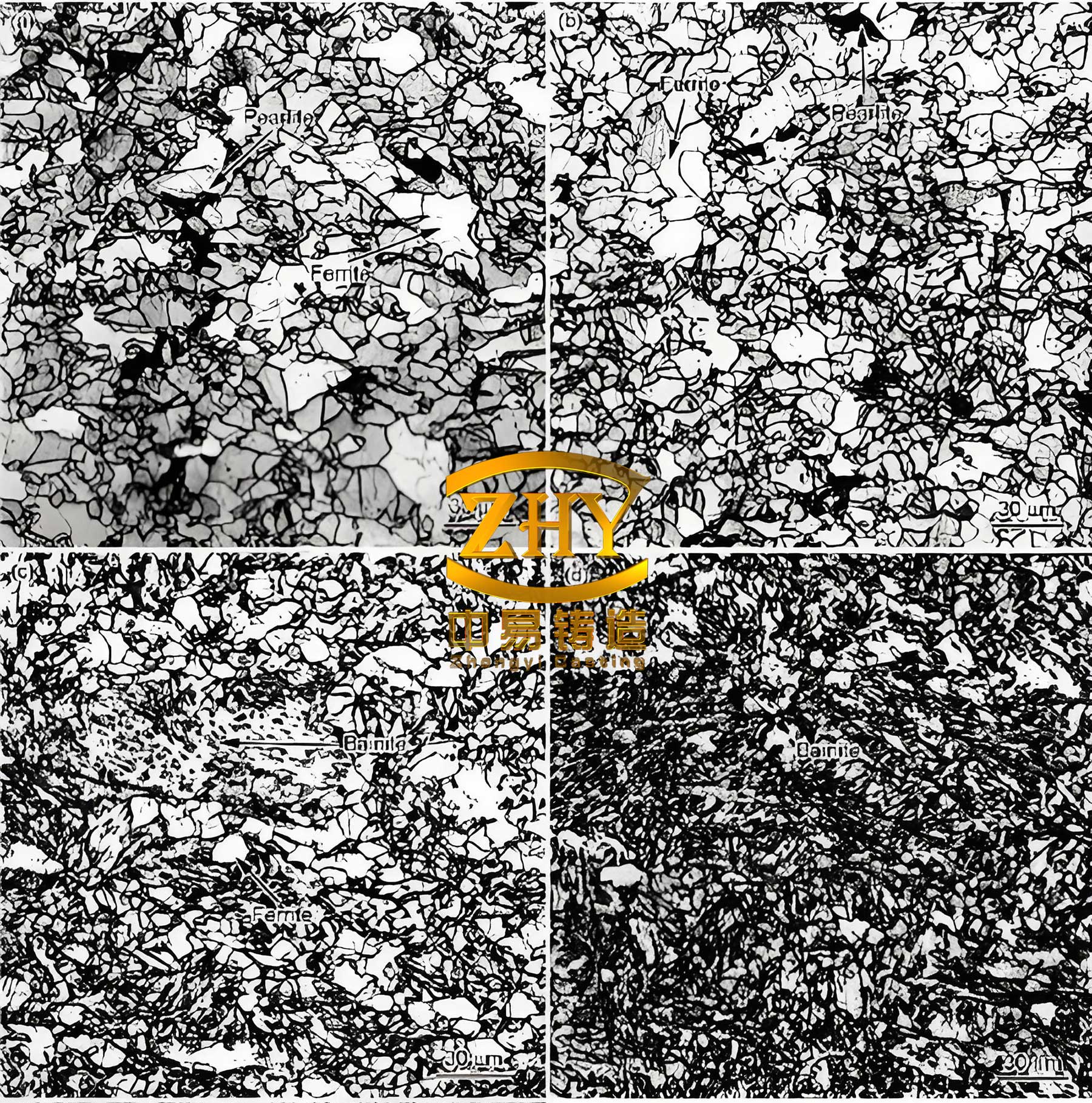
In terms of production outcomes, the optimized process for spheroidal graphite iron has demonstrated significant benefits. The defect rate from shrinkage dropped by over 90%, based on batch inspections, and the铸件 weight reduction of 5.8% translates to substantial cost savings in raw materials. For example, considering an annual production volume of 10,000 pieces, the mass saving of 3.215 kg per casting reduces spheroidal graphite iron consumption by 32,150 kg per year. Assuming a material cost of $2 per kg, this amounts to over $64,000 in annual savings. Additionally, the砂芯减重 lowers resin and sand usage by approximately 15% for the #3砂芯, further cutting expenses. The adjustment in熔炼配比 reduced the use of expensive阴极 copper by about 50%, while tin addition is more cost-effective due to its higher potency. We estimated that the overall material投入成本 decreased by 12-15% per casting, making the production of spheroidal graphite iron components more economically viable.
To delve deeper into the球化处理工艺, the蠕墨铸铁智能在线测控系统 plays a pivotal role in ensuring quality for spheroidal graphite iron. This system uses real-time sensors to measure temperature, chemical composition, and共晶度, feeding data into a control algorithm that determines the exact喂丝 length. The algorithm is based on a predictive model for镁 recovery in spheroidal graphite iron, which considers factors like铁液 temperature, initial sulfur content, and ladle geometry. The model can be represented as:
$$L_{wire} = f(T, [S]_0, V_{ladle}, Mg_{target})$$
where $L_{wire}$ is the包芯线 length, $T$ is the temperature, $[S]_0$ is the initial sulfur concentration, $V_{ladle}$ is the ladle volume, and $Mg_{target}$ is the desired残留镁. By automating this, we eliminate human error and achieve reproducible results for spheroidal graphite iron. Moreover, the system logs data for each batch, allowing for continuous improvement through statistical analysis. We performed a design of experiments (DOE) to optimize the parameters, resulting in the following响应 surface for shrinkage reduction in spheroidal graphite iron:
$$Shrinkage\_Index = \alpha_0 + \alpha_1 \cdot S_c + \alpha_2 \cdot Mg_{残} + \alpha_3 \cdot T_{pour}$$
where $\alpha_i$ are coefficients derived from regression. Minimizing this index guided our process settings. Another important aspect is the孕育处理, which affects the graphite morphology in spheroidal graphite iron. We use a combination of Fe-Si孕育剂 and post-inoculation during倒包 to ensure fine graphite distribution. The孕育效果 can be quantified by the石墨 count per unit area ($N_g$), which we aim to maximize for enhanced mechanical properties. For spheroidal graphite iron, a higher $N_g$ often correlates with better ductility and strength. Our measurements show that after optimization, $N_g$ increased by 20-30%, contributing to the达标 elongation of 3% or more.
The轻量化 efforts also involved finite element analysis (FEA) to validate structural integrity. We simulated the stress distribution in the drive frame shell under operational loads, confirming that the减重 modifications did not induce high stress concentrations. For spheroidal graphite iron, the yield strength ($\sigma_y$) and疲劳极限 ($\sigma_f$) are critical, and our FEA results indicated that these remained within safe margins. The stress ($\sigma$) at critical points can be estimated using beam theory or numerical methods, but in practice, we rely on prototyping and testing. We subjected optimized spheroidal graphite iron castings to rigorous bench tests, including cyclic loading and thermal shock, all of which passed industry standards. This empirical validation complements the theoretical models, ensuring that our轻量化 approach is robust for spheroidal graphite iron applications.
Looking at the broader context, the optimization of spheroidal graphite iron processes aligns with sustainability goals. By reducing weight, we lower the energy consumption in vehicles using these components, and by minimizing defects, we decrease scrap rates and material waste. The use of智能测控 systems also reduces emissions from球化处理, as the enclosed喂丝 method contains烟雾 better than open冲入法. In our facility, we observed a 40% reduction in airborne particulate matter after switching to the two-step process for spheroidal graphite iron. This environmental benefit, coupled with cost savings, makes the optimized工艺 a win-win for manufacturers and the ecosystem.
In conclusion, the comprehensive optimization of spheroidal graphite iron drive frame shell production has yielded substantial improvements. The two-step球化处理工艺, enabled by蠕墨铸铁智能在线测控系统, effectively controls共晶度 and镁残留, eliminating shrinkage defects that plagued traditional methods. The轻量化 initiatives, through壁厚 optimization and砂芯减重, reduced the铸件 mass by 5.8% and lowered manufacturing costs without compromising performance. Adjustments in熔炼材料配比, such as increasing pig iron content and substituting copper with tin, maintained the required mechanical properties of spheroidal graphite iron while cutting material expenses. These measures collectively enhance the competitiveness of spheroidal graphite iron castings in demanding applications. Future work may focus on further automating the process and exploring advanced alloys for even better performance. As I reflect on this journey, it is clear that a data-driven, holistic approach is key to advancing spheroidal graphite iron technology, and I am confident that these optimizations will serve as a benchmark for similar casting projects.