
As a researcher focused on advanced materials for engine components, I have extensively studied the impact of heat treatment processes on spheroidal graphite iron, commonly used in cylinder liners. With the rapid development of diesel engine technologies such as high-pressure common rail, turbocharging, and direct injection, alongside stringent emission standards like China V and VI, there is an increasing demand for high-performance engine parts. The cylinder liner, a critical component that works under severe conditions alongside pistons and piston rings, directly influences engine power, reliability, fuel economy, emissions, and noise. Traditional materials like pearlitic gray cast iron, spheroidal graphite iron, compacted graphite iron, and alloyed cast iron often face failures such as cylinder cracking, cavitation erosion, and premature wear, limiting engine lifespan. In contrast, austempered ductile iron (ADI), a form of spheroidal graphite iron, offers superior strength, toughness, wear resistance, and corrosion resistance, making it ideal for cylinder liners. However, ADI’s poor machinability and high production costs due to conventional austempering temperatures have hindered its widespread adoption. To address these issues, I investigated subcritical quenching (a lower-temperature process) versus conventional isothermal quenching, aiming to optimize the microstructure and properties of spheroidal graphite iron cylinder liners while enhancing machinability and reducing energy consumption. This study delves into the microstructural evolution, mechanical and physical properties, friction-wear behavior, and machining performance, providing insights for developing cost-effective, high-performance cylinder liners.
In my research, I prepared spheroidal graphite iron cylinder liner blanks using a water-cooled metal mold centrifugal casting method. The chemical composition of the spheroidal graphite iron was carefully controlled, as summarized in Table 1. This composition includes key alloying elements like copper and niobium, which influence phase formation and properties during heat treatment. The as-cast microstructure, as observed under optical microscopy, consisted of graphite spheroids (grade 7 size, with a nodularity ≥90% and grade 2 spheroidization), embedded in a matrix of approximately 85% pearlite, 15% ferrite, along with minor carbides and copper-rich phases. The hardness of the as-cast spheroidal graphite iron was ≥240 HB, providing a baseline for comparison.
| C | Si | Cu | Nb | B | Mn | S | P | Mg | Residual Ce | Balance Fe |
|---|---|---|---|---|---|---|---|---|---|---|
| 3.0-3.9 | 2.4-3.0 | 2.0-2.5 | 0.06-0.10 | 0.01-0.03 | <0.4 | <0.02 | <0.1 | 0.03-0.06 | 0.02-0.04 | Remainder |
I subjected the semi-finished cylinder liners to two distinct isothermal quenching processes, as detailed in Table 2. For subcritical quenching (Process 1), the austenitization was performed at 810°C for 25 minutes in a high-temperature salt bath composed of 70% BaCl and 30% NaCl, followed by rapid quenching into a low-temperature salt bath (45% NaNO2 + 55% KNO3) at 335°C for 80 minutes. This temperature is in the α + γ + graphite three-phase region, allowing for partial retention of ferrite. In contrast, conventional isothermal quenching (Process 2) involved austenitization at 920°C for 25 minutes in the same high-temperature salt, followed by identical isothermal treatment at 335°C for 80 minutes; this higher temperature places the material in the γ + graphite two-phase region, leading to full austenitization. After quenching, samples were air-cooled to room temperature and cleaned to remove residual salt. The microstructures were examined using a Leica DM2500M optical microscope after etching with a 4% nitric acid alcohol solution, and phase content was analyzed with a MAS-3 image analysis system. Hardness was measured with a Time TH608 automatic Brinell hardness tester. Tensile properties, including tensile strength (Rm) and elongation (A), were tested according to GB228.1-2010 standard on an electronic universal testing machine, while dynamic elastic modulus (E) was determined per ASTM E 1876-01 using a Grindo Sonic MK51 instrument. Thermal conductivity and linear expansion coefficient were evaluated via GB/T22588-2008 and GB/T4339-2008 standards, respectively. Friction-wear tests were conducted on a UMT-3 tribometer under lubricated conditions with SAE30 oil, following ASTM G181-04, using chrome-plated piston rings against cylinder liner samples. Machining performance was assessed on a CNC machining center with CBN tools under fixed parameters.
| Parameter | Process 1 (Subcritical Quenching) | Process 2 (Conventional Isothermal Quenching) |
|---|---|---|
| Austenitization | 810°C × 25 min | 920°C × 25 min |
| Isothermal Quenching | 335°C × 80 min | 335°C × 80 min |
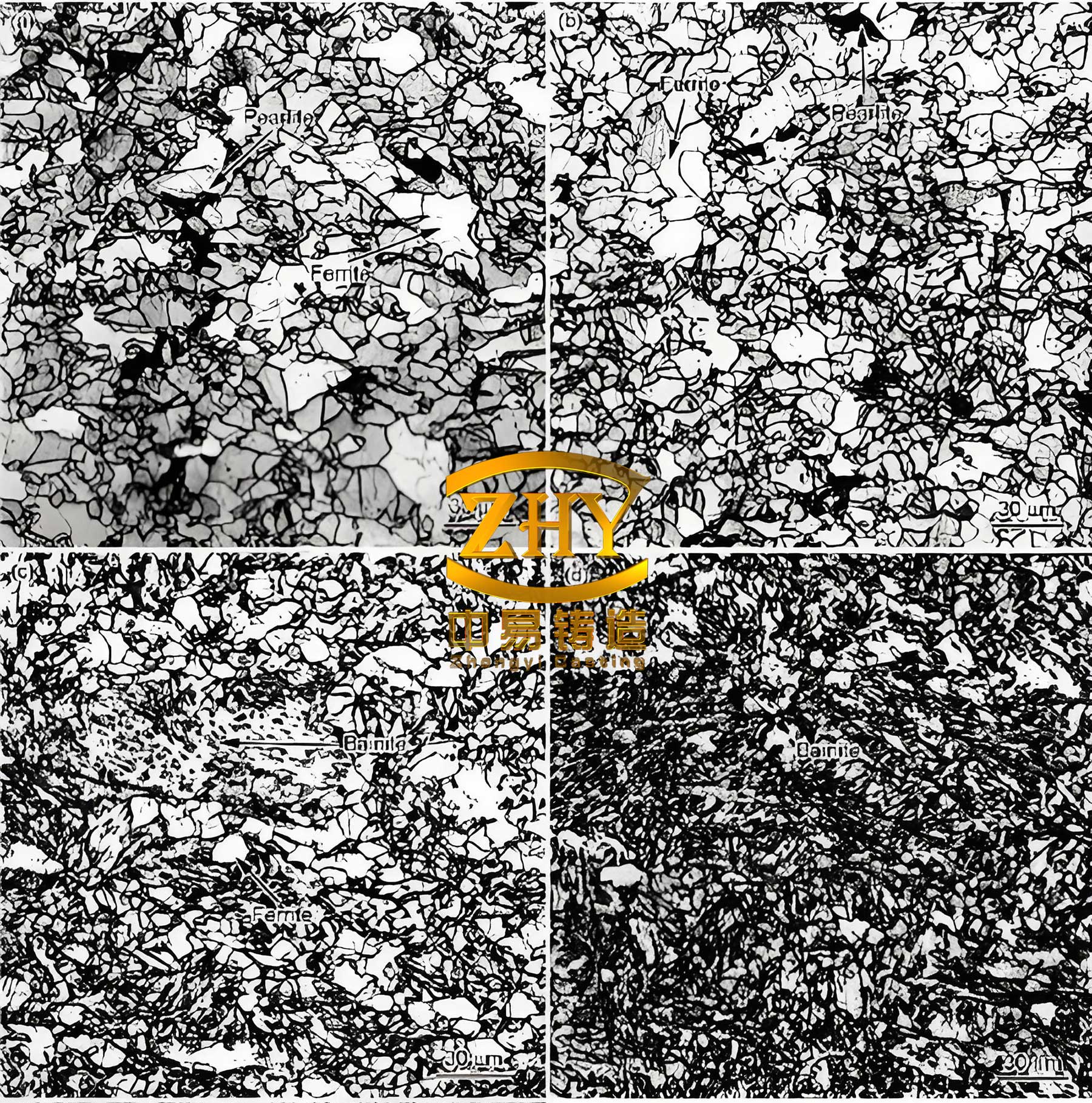
The microstructural analysis revealed significant differences between the two quenching processes. After subcritical quenching, the spheroidal graphite iron exhibited a matrix consisting of lower bainite, copper-rich residual austenite, blocky ferrite, and a small amount of niobium-containing carbides. The presence of ferrite is attributed to the austenitization in the three-phase region, where ferrite does not fully transform. In contrast, conventional isothermal quenching produced a microstructure of lower bainite, copper-rich residual austenite, and minor niobium-containing carbides, with no retained ferrite due to complete austenitization. Copper solubility in austenite is about 3.5%, but only 0.3% in ferrite at room temperature, leading to the formation of copper-enriched phases during quenching. The hardness values were ≥300 HB for subcritical quenched spheroidal graphite iron and ≥350 HB for conventional isothermal quenched spheroidal graphite iron, reflecting the hardening effect of bainite and the softening influence of ferrite. To quantify the microstructural contributions, I considered a simplified model where hardness (H) relates to volume fractions of phases: $$ H = k_b V_b + k_f V_f + k_a V_a + k_c V_c $$ where \( V_b \), \( V_f \), \( V_a \), and \( V_c \) are the volume fractions of bainite, ferrite, austenite, and carbides, respectively, and \( k \) terms are constants dependent on phase properties. For spheroidal graphite iron, the graphite morphology also plays a role, but the matrix phases dominate hardness variations.
The mechanical properties of the spheroidal graphite iron cylinder liners are summarized in Table 3. Subcritical quenching resulted in a tensile strength of 900 MPa, elastic modulus of 170 GPa, and elongation of 8%, whereas conventional isothermal quenching yielded higher tensile strength (1050 MPa) and elastic modulus (175 GPa) but lower elongation (6%). The reduction in strength and hardness for subcritical quenched spheroidal graphite iron is directly linked to the retained ferrite, which has lower strength compared to bainite. The elastic modulus remained largely unchanged, indicating that the overall stiffness of spheroidal graphite iron is less sensitive to matrix phases and more influenced by graphite spheroids. The increase in elongation with subcritical quenching is beneficial for toughness, as ferrite provides ductility. These trends can be expressed using a rule-of-mixtures approach: $$ R_m = \sigma_b V_b + \sigma_f V_f + \sigma_a V_a $$ where \( \sigma \) represents the strength contribution of each phase. For spheroidal graphite iron, the presence of ferrite lowers \( R_m \) but enhances ductility, as reflected in the elongation values.
| Process | Tensile Strength, Rm (MPa) | Elastic Modulus, E (GPa) | Elongation, A (%) |
|---|---|---|---|
| Process 1 (Subcritical Quenching) | 900 | 170 | 8 |
| Process 2 (Conventional Isothermal Quenching) | 1050 | 175 | 6 |
Physical properties, including linear expansion coefficient and thermal conductivity, were evaluated across a temperature range. As shown in Figure 1, the linear expansion coefficient of spheroidal graphite iron cylinder liners after both quenching processes was significantly higher than that of ordinary gray cast iron (approximately 12 μm/(m·°C)). The values for subcritical and conventional isothermal quenched spheroidal graphite iron were nearly identical, suggesting that this property is primarily dictated by graphite morphology rather than matrix structure. However, above 400°C, the linear expansion coefficient decreased, with a sharp drop beyond 450°C, possibly due to precipitation of nano-sized copper-rich phases from the austenite, which alters thermal expansion behavior. This phenomenon can be modeled using the equation: $$ \alpha(T) = \alpha_0 + \Delta \alpha \cdot f(T) $$ where \( \alpha(T) \) is the temperature-dependent expansion coefficient, \( \alpha_0 \) is a baseline value, and \( f(T) \) accounts for phase transformations in spheroidal graphite iron.
Thermal conductivity data are presented in Table 4. The spheroidal graphite iron cylinder liners exhibited lower thermal conductivity compared to typical gray cast iron (41.5–52.5 W/(m·K)), which is expected due to the spherical graphite dispersing heat less efficiently. Both quenching processes resulted in similar thermal conductivity values across temperatures, reinforcing that graphite morphology is the dominant factor. However, subcritical quenched spheroidal graphite iron showed slightly higher conductivity at lower temperatures, likely due to retained copper-rich phases from the as-cast state, while at temperatures above 400°C, conventional quenched spheroidal graphite iron had higher conductivity, possibly from precipitated nano-copper phases enhancing heat transfer. The thermal conductivity \( k \) can be approximated by: $$ k = k_g \phi_g + k_m \phi_m $$ where \( k_g \) and \( k_m \) are the conductivities of graphite and matrix, respectively, and \( \phi \) represents volume fractions. For spheroidal graphite iron, the matrix composition shifts slightly with quenching, but graphite remains key.
| Process | 50°C | 100°C | 150°C | 200°C | 250°C | 300°C | 350°C | 400°C |
|---|---|---|---|---|---|---|---|---|
| Process 1 (Subcritical Quenching) | 17.27 | 18.31 | 18.11 | 19.06 | 19.74 | 20.36 | 21.26 | 22.89 |
| Process 2 (Conventional Isothermal Quenching) | 16.49 | 17.43 | 17.34 | 18.60 | 19.02 | 20.27 | 21.22 | 22.95 |
Friction-wear performance under lubricated conditions revealed interesting trends, as summarized in Table 5. For both types of spheroidal graphite iron cylinder liners, the friction coefficient decreased with increasing rotational speed at a constant load of 100 N, consistent with Stribeck curve behavior where higher speeds promote hydrodynamic lubrication. However, subcritical quenched spheroidal graphite iron consistently exhibited lower friction coefficients compared to conventional isothermal quenched spheroidal graphite iron across all speeds, with the difference narrowing at higher speeds. This improvement is attributed to the presence of copper-rich phases in the subcritical quenched spheroidal graphite iron, which act as solid lubricants and anti-wear agents, reducing friction. Additionally, during friction, nano-sized copper-rich phases may precipitate, further enhancing tribological properties. The friction coefficient \( \mu \) can be described by a modified Archard equation: $$ \mu = \frac{F_f}{F_n} = C \cdot \frac{H}{v} $$ where \( F_f \) is friction force, \( F_n \) is normal load, \( H \) is hardness, \( v \) is speed, and \( C \) is a constant incorporating material properties like phase composition in spheroidal graphite iron. The lower hardness of subcritical quenched spheroidal graphite iron contributes to reduced friction, but the copper-rich phases play a critical role.
| Speed (rpm) | 25 | 50 | 75 | 100 | 150 | 250 | 375 |
|---|---|---|---|---|---|---|---|
| Process 1 (Subcritical Quenching) | 0.1277 | 0.1252 | 0.1240 | 0.1233 | 0.1219 | 0.1206 | 0.1196 |
| Process 2 (Conventional Isothermal Quenching) | 0.1332 | 0.1292 | 0.1262 | 0.1241 | 0.1224 | 0.1212 | 0.1204 |
Machining performance was a key focus, as poor machinability often limits the application of spheroidal graphite iron in cylinder liners. Under identical cutting conditions (CBN tools, 150 m/min cutting speed, 600 rpm spindle speed, 0.2 mm feed, 0.5–1.1 mm depth of cut), subcritical quenched spheroidal graphite iron cylinder liners demonstrated remarkable improvement. The number of cylinder liners that could be machined before tool wear became significant was over five times greater than for conventional isothermal quenched spheroidal graphite iron. This enhancement stems from the lower hardness and presence of ferrite in subcritical quenched spheroidal graphite iron, which reduces tool stress and wear. Additionally, copper-rich phases may aid in chip breaking and provide lubricating effects during dry cutting. The tool life \( T \) can be modeled using Taylor’s tool life equation: $$ T = \frac{C}{v^a f^b d^c} $$ where \( v \), \( f \), and \( d \) are cutting speed, feed, and depth, respectively, and \( C \), \( a \), \( b \), \( c \) are constants dependent on workpiece material. For spheroidal graphite iron, the constants vary with microstructure; subcritical quenching yields higher \( C \) values due to better machinability.
In discussing these results, I emphasize the trade-offs between properties. Subcritical quenching of spheroidal graphite iron offers a balanced combination of moderate strength, high ductility, good friction-wear performance, and excellent machinability, making it suitable for cylinder liners where manufacturing efficiency and wear resistance are prioritized. Conventional isothermal quenching of spheroidal graphite iron provides higher strength and hardness, beneficial for heavy-duty applications, but at the cost of reduced machinability and higher energy input. The microstructural mechanisms involve phase transformations: during subcritical quenching, the incomplete austenitization preserves ferrite, while conventional quenching leads to full bainitic transformation. Copper alloying in spheroidal graphite iron enhances hardenability and promotes copper-rich phase formation, which influences residual austenite stability and tribological behavior. The role of niobium carbides in refining microstructure and improving wear resistance should also be noted, though they are present in small amounts.
To further quantify these effects, I derived empirical relationships. For instance, the elongation (A) can be correlated with ferrite volume fraction \( V_f \) in spheroidal graphite iron: $$ A = A_0 + \lambda V_f $$ where \( A_0 \) is the elongation of fully bainitic spheroidal graphite iron and \( \lambda \) is a proportionality constant. Similarly, the friction coefficient reduction with speed follows a power law: $$ \mu = \mu_0 v^{-\beta} $$ where \( \mu_0 \) and \( \beta \) are material-specific parameters, with \( \beta \) higher for subcritical quenched spheroidal graphite iron due to copper-rich phases. These formulas help in tailoring spheroidal graphite iron properties for specific engine requirements.
In conclusion, my study demonstrates that quenching processes profoundly affect the microstructure and properties of spheroidal graphite iron cylinder liners. Subcritical quenching yields a microstructure of lower bainite, copper-rich residual austenite, blocky ferrite, and minor carbides in spheroidal graphite iron, with hardness ≥300 HB, while conventional isothermal quenching produces lower bainite, copper-rich residual austenite, and carbides in spheroidal graphite iron, with hardness ≥350 HB. Compared to conventional isothermal quenching, subcritical quenched spheroidal graphite iron exhibits lower tensile strength and hardness, similar elastic modulus, linear expansion coefficient, and thermal conductivity, increased elongation, reduced friction coefficient under lubrication, and vastly improved machinability—over five times more cylinder liners can be machined under same conditions. These findings highlight subcritical quenching as a viable, energy-efficient alternative for producing high-performance spheroidal graphite iron cylinder liners, balancing mechanical properties with manufacturing feasibility. Future work could explore optimizing copper and niobium contents in spheroidal graphite iron or combining subcritical quenching with surface treatments to further enhance durability. This research contributes to advancing spheroidal graphite iron applications in modern engines, supporting the development of cleaner, more efficient transportation technologies.