
In this investigation, I examine the influence of silicon content on the microstructure and the mechanical properties, both at room and elevated temperatures, of a heat-resistant spheroidal graphite iron. The objective is to understand the trade-offs involved in alloying with silicon to achieve improved high-temperature performance while maintaining adequate structural integrity. Silicon is a potent alloying element known for its ability to promote ferrite formation and provide solid solution strengthening, yet its high concentration is often associated with graphite degeneration and embrittlement. This study systematically varies the silicon content while keeping the carbon equivalent and other alloying elements constant to isolate its specific effects.
The spheroidal graphite iron alloys were prepared in a medium-frequency induction furnace. The base charge consisted of Q10 pig iron and high-quality low-carbon scrap steel. Alloying elements were introduced via ferromolybdenum, ferrochromium, 75% ferrosilicon, copper, and nickel blocks. The chemical compositions of the five designed alloys are detailed in Table 1, with carbon equivalent fixed at 4.3 and varying silicon from 2.8% to 4.8% (by mass fraction).
| Sample | C | Si | Mo | Cr | Ni | Cu | Mg |
|---|---|---|---|---|---|---|---|
| A | 3.4 | 2.8 | 0.6 | 0.6 | 0.8 | 0.4 | <0.04 |
| B | 3.2 | 3.3 | 0.6 | 0.6 | 0.8 | 0.4 | <0.04 |
| C | 3.1 | 3.8 | 0.6 | 0.6 | 0.8 | 0.4 | <0.04 |
| D | 2.9 | 4.3 | 0.6 | 0.6 | 0.8 | 0.4 | <0.04 |
| E | 2.7 | 4.8 | 0.6 | 0.6 | 0.8 | 0.4 | <0.04 |
The melt was superheated to 1500-1550°C before treatment. A two-stage inoculation process was employed to ensure effective graphite nucleation and to counteract fading. The primary inoculation involved placing 1.2% 75FeSi and 0.1% silicon carbide in the ladle bottom along with 1.5% rare earth-magnesium spheroidizing agent (6-1 type). The treatment was carried out via the sandwich method. A late stream inoculation with 0.2% Si-Ba inoculant (0.5-1 mm grain size) was performed just before pouring. The final pouring temperature was controlled between 1400-1450°C into Y-block sand molds with a wall thickness of 25 mm.
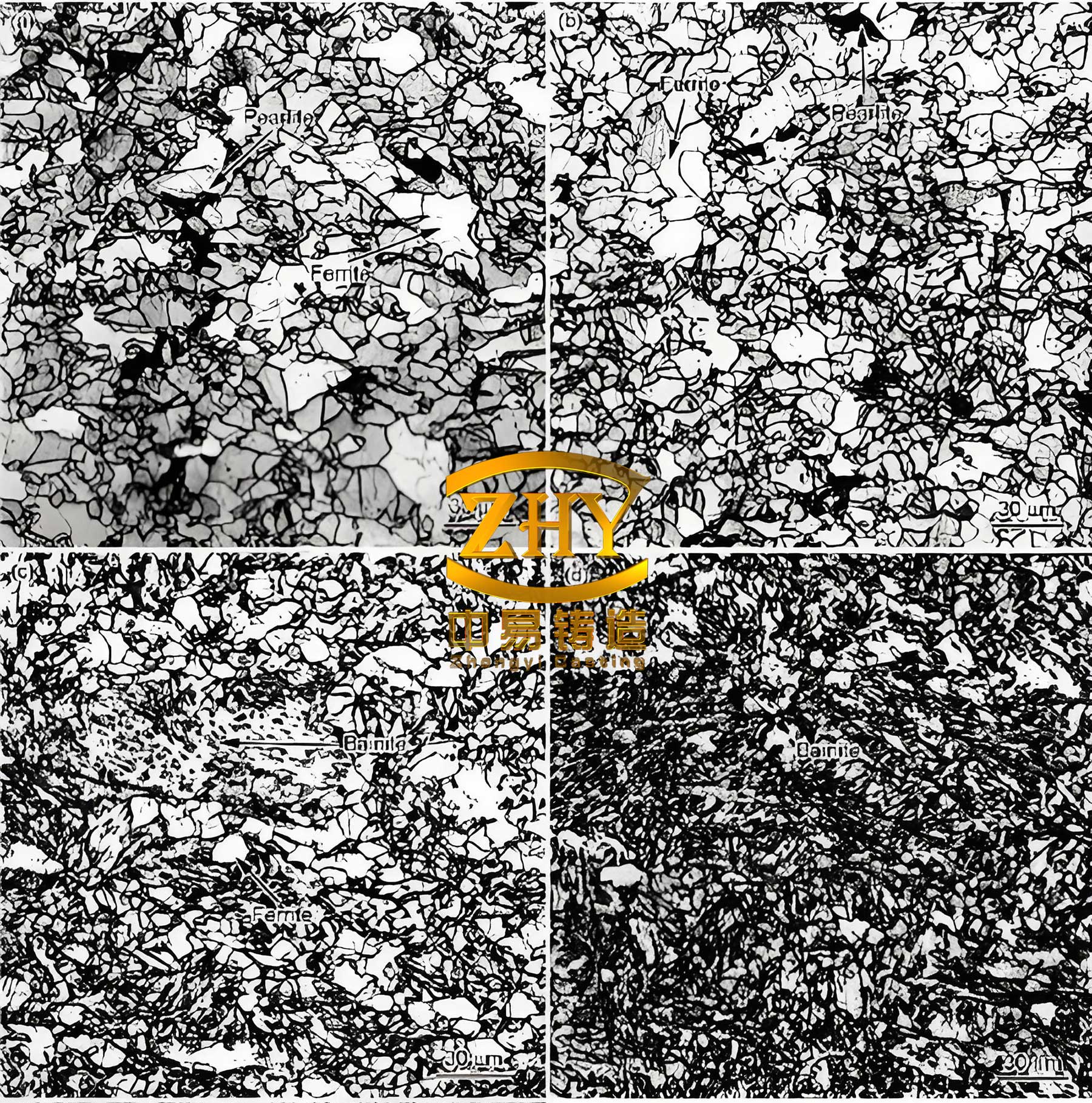
Specimens for microstructural analysis were sectioned from the Y-blocks, ground, polished, and etched with 4% nital. Microstructural characterization was performed using optical microscopy and scanning electron microscopy (SEM). Room-temperature and high-temperature (500°C) tensile tests were conducted according to GB/T 228.1 and GB/T 4338 standards, respectively, using an electronic universal testing machine (MTS E45.305). The gauge length was 30 mm with a diameter of 6 mm, and a constant crosshead speed of 1 mm/min was applied. For high-temperature tests, specimens were held at 500°C for 30 minutes prior to loading. Fractographic analysis was performed on the fractured tensile specimens using SEM.
Microstructural Evolution with Silicon Content
The microstructure of spheroidal graphite iron fundamentally consists of a metallic matrix reinforced—or rather, interrupted—by graphite spheroids. The morphology, size, and distribution of these graphite nodules are critical, as they act as inherent stress concentrators. In this study, I observed a clear deterioration in graphite nodularity with increasing silicon content. At 2.8% Si, the graphite was predominantly well-formed spheroids, evenly distributed. As silicon increased to 3.8%, the number of irregular, degenerate graphite forms (often referred to as chunky or fragmented graphite) increased significantly. This trend continued at higher silicon levels, severely compromising the ideal spherical shape. A quantitative assessment of the graphite characteristics is summarized in Table 2.
| Si Content (%) | Nodularity Grade | Nodularity (%) | Nodule Size Grade |
|---|---|---|---|
| 2.8 | 1 | 91.14 | 6 |
| 3.3 | 2 | 86.09 | 6 |
| 3.8 | 3 | 75.78 | 6 |
| 4.3 | 4 | 68.84 | 6 |
| 4.8 | 5 | 57.26 | 7 |
The mechanism behind this degeneration is complex. Silicon, which partitions strongly to the austenite and ferrite phases and is virtually insoluble in graphite, alters the solidification dynamics. It raises both the eutectic and eutectoid transformation temperatures. While this enhances carbon diffusion, promoting graphite growth, the high silicon content also seems to destabilize the spheroidal growth front, favoring irregular growth modes that lead to chunky graphite. Notably, the nodule size remained relatively unchanged until the highest silicon level, suggesting that the opposing effects of reduced carbon content (limiting growth) and enhanced diffusion (promoting growth) largely balanced each other initially.
The matrix structure of all alloys in the as-cast condition was a mixture of ferrite and pearlite. Silicon is a powerful ferritizer, and its effect was unmistakable. With increasing silicon content, the proportion of pearlite decreased substantially. Image analysis revealed the quantitative change, as shown in Table 3. This occurs because silicon reduces the carbon solubility in austenite, shifts the eutectoid point to a lower carbon content, and accelerates the diffusion of carbon away from austenite regions during cooling, thereby suppressing the formation of pearlite and promoting the transformation to ferrite.
| Si Content (%) | Pearlite Content (%) | Ferrite Content (%) |
|---|---|---|
| 2.8 | 51.06 | 48.94 |
| 3.3 | 42.35 | 57.65 |
| 3.8 | 29.18 | 70.82 |
| 4.3 | 17.83 | 82.17 |
| 4.8 | 8.65 | 91.35 |
Room-Temperature Mechanical Properties and Fracture Behavior
The tensile properties of spheroidal graphite iron at room temperature are a complex interplay between matrix strength and the stress-concentrating effect of graphite. My measurements revealed a non-monotonic trend for tensile strength and a consistent decline in elongation with rising silicon, as plotted in the derived data and presented in Table 4.
| Si Content (%) | Tensile Strength (MPa) | Elongation (%) |
|---|---|---|
| 2.8 | 695 | 3.5 |
| 3.3 | 710 | 2.4 |
| 3.8 | 726 | 1.6 |
| 4.3 | 698 | 1.2 |
| 4.8 | 665 | 0.8 |
The initial increase in strength from 2.8% to 3.8% Si can be attributed to solid solution strengthening. Silicon atoms, with an atomic radius different from iron, cause lattice distortion in the ferrite matrix. This distortion creates a strain field that interacts with dislocations, pinning them and increasing the stress required for plastic flow. This strengthening contribution can be conceptually related to a solution hardening parameter. The increase in flow stress $\Delta \sigma_{ss}$ due to solid solution can be approximated by:
$$\Delta \sigma_{ss} = K_{Si} \cdot C_{Si}^{n}$$
where $K_{Si}$ is a strengthening coefficient for silicon, $C_{Si}$ is the silicon concentration, and $n$ is an exponent typically near 1. During this stage, although nodularity decreased, the graphite shapes were still relatively manageable, and the strengthening effect of silicon in the matrix dominated.
Beyond 3.8% Si, the tensile strength began to decrease. This is directly linked to the severe degradation of graphite morphology. Irregular, sharp-edged graphite particles act as highly effective stress raisers, initiating microcracks at lower applied stresses. The detrimental effect of these stress concentrators eventually outweighs the continued solid solution strengthening from silicon. The ductility, measured as elongation, exhibited a continuous decline. This embrittlement is a combined result of graphite degeneration and silicon-induced embrittlement. High silicon levels in ferritic spheroidal graphite iron are known to promote segregation of impurities like hydrogen to certain crystallographic planes, leading to a loss of toughness and facilitating cleavage fracture.
The fracture surfaces from room-temperature tests corroborated the brittle behavior. They were predominantly characterized by large, flat areas of cleavage with distinct river patterns. Cleavage occurs when the stress exceeds the cohesive strength of atomic bonds along certain crystallographic planes. The river patterns are formed by the convergence of cleavage steps from different heights. Very few dimples, indicative of microvoid coalescence and ductile tearing, were observed. The fracture path often appeared to be associated with the graphite-matrix interface or through the pearlite colonies, which have lower fracture toughness than ferrite.
High-Temperature Mechanical Properties at 500°C
Evaluating spheroidal graphite iron at elevated temperature is crucial for its application in heat-resistant components. At 500°C, the deformation mechanisms change significantly. Dislocation climb and cross-slip become easier, and grain boundary sliding can contribute to strain. My tests at this temperature showed a different trend compared to room temperature, as summarized in Table 5.
| Si Content (%) | Tensile Strength (MPa) | Elongation (%) |
|---|---|---|
| 2.8 | 425 | 11 |
| 3.3 | 455 | 9 |
| 3.8 | 488 | 7 |
| 4.3 | 515 | 6.5 |
| 4.8 | 532 | 6 |
The most striking observation is the continuous increase in tensile strength with silicon content, contrasting with the room-temperature trend. At high temperature, solid solution strengthening remains a potent mechanism. Silicon atoms continue to impede dislocation motion, even as thermal activation aids it. The benefit of a stronger, more stable ferritic matrix provided by high silicon becomes paramount. While the irregular graphite still acts as a flaw, the matrix’s ability to resist creep and plastic flow at temperature is significantly enhanced by silicon. The overall strength levels are lower than at room temperature due to thermal softening of the metallic matrix, but the ranking of the alloys changes in favor of high-silicon compositions.
The elongation at 500°C, while higher than at room temperature for all alloys due to increased plasticity, still decreased with silicon. The holding time at temperature before testing likely allowed for some stress relaxation around graphite particles, improving ductility compared to the brittle room-temperature state. However, the inherent embrittling effect of high silicon and the presence of stress-concentrating degenerate graphite still limit the total plastic strain.
The high-temperature fracture surfaces presented a mixed-mode appearance. They exhibited features of ductile fracture, such as dimples formed by the nucleation, growth, and coalescence of microvoids around graphite nodules and inclusions. However, areas of quasi-cleavage or tearing ridges were also present, indicating localized brittle behavior. This transition from completely brittle (room temperature) to ductile-brittle mixed (high temperature) fracture aligns with the increased plasticity available at 500°C, though the material’s fundamental brittleness imposed by high silicon and poor graphite shape is not fully overcome.
Discussion on the Role of Silicon in Spheroidal Graphite Iron
This study clearly delineates the dualistic role of silicon in heat-resistant spheroidal graphite iron. Silicon is indispensable for developing a ferritic matrix with good oxidation resistance and high-temperature strength through solid solution hardening. The strengthening effect can be rationalized by considering the interaction energy between silicon solutes and dislocations. The increase in yield strength $\sigma_y$ due to silicon can be related to its concentration $C$:
$$\sigma_y = \sigma_0 + \alpha G b \sqrt{\rho} + \beta G \epsilon^{3/2} \sqrt{C}$$
where $\sigma_0$ is the lattice friction stress, $\alpha$ and $\beta$ are constants, $G$ is the shear modulus, $b$ is the Burgers vector, $\rho$ is the dislocation density, and $\epsilon$ is the misfit strain parameter for silicon in iron. This relationship highlights how silicon contributes to both forest hardening (via its effect on structure) and direct solid solution hardening.
However, the price for this benefit is a steep one: the degradation of graphite morphology and severe room-temperature embrittlement. The mechanism for chunky graphite formation in high-silicon spheroidal graphite iron is not entirely settled but is believed to involve changes in the interfacial energy between graphite and austenite, and possibly localized silicon segregation that destabilizes the spherical growth front. Once formed, these irregular graphite particles have a much higher stress concentration factor $K_t$ compared to a sphere. For a spherical pore, $K_t$ is about 2, but for an irregular shape with sharp re-entrants, it can be significantly higher, drastically reducing the effective load-bearing area and initiating fracture at lower stresses.
The transition in tensile strength trend from room temperature to 500°C is particularly instructive. It suggests that for high-temperature applications where room-temperature ductility is not the primary design criterion, pushing the silicon content higher can be beneficial. The matrix strengthening outweighs the graphite shape detriment at temperature. This provides a guideline for alloy design: the optimal silicon content in spheroidal graphite iron is application-specific. For components requiring good machinability and room-temperature toughness, silicon should be limited (likely below 3.8% in this alloy system). For components primarily stressed at high temperature in static or low-cycle fatigue conditions, higher silicon content (up to 4.8% or potentially more with careful process control) can be employed to maximize creep and oxidation resistance, accepting the resulting room-temperature brittleness.
Conclusions
Based on my investigation into the effect of silicon content on a Mo-Cr-Ni-Cu alloyed spheroidal graphite iron, the following conclusions can be drawn:
- The morphology of graphite in spheroidal graphite iron deteriorates progressively with increasing silicon content. Nodularity decreases from over 90% at 2.8% Si to about 57% at 4.8% Si, with significant formation of chunky graphite above 3.8% Si.
- Silicon strongly promotes a ferritic matrix. The pearlite content in the as-cast spheroidal graphite iron decreased from approximately 51% at 2.8% Si to less than 9% at 4.8% Si.
- At room temperature, tensile strength of the spheroidal graphite iron peaks at an intermediate silicon content (3.8% in this study) due to solid solution strengthening, then declines at higher levels due to severe graphite degeneration. Elongation decreases monotonically with silicon, indicating increasing embrittlement. Fracture is predominantly brittle cleavage.
- At 500°C, the tensile strength of the spheroidal graphite iron increases continuously with silicon content, highlighting the effectiveness of silicon in solid solution strengthening at elevated temperatures. Ductility remains higher than at room temperature but still decreases with increasing silicon. The fracture mode transitions to a ductile-brittle mixed type.
- The design of silicon content in heat-resistant spheroidal graphite iron necessitates a careful balance. Maximizing high-temperature performance favors higher silicon, while retaining adequate room-temperature toughness and graphite quality requires limiting silicon content. The specific application’s service temperature and mechanical requirements should dictate the chosen composition.
Further research could focus on methods to mitigate graphite degeneration at high silicon levels, perhaps through optimized inoculation strategies, trace element control, or rapid solidification techniques, to unlock the full potential of silicon-alloyed spheroidal graphite iron for demanding high-temperature applications.