
In recent years, the rapid expansion of the rail transportation sector has necessitated the development of materials capable of withstanding extreme environmental conditions. As trains operate across vast geographical regions with winter temperatures plunging below -40 °C, components such as gearbox housings must exhibit exceptional low-temperature impact toughness to ensure safety and reliability. This demand has driven significant advancements in ultra-low temperature ductile cast iron, specifically grades designed for service temperatures as low as -60 °C. Our work focuses on the meticulous production process control for -40 °C grades and extends into fundamental research on achieving reliable performance at -60 °C. The term ‘ductile cast iron’ will be central to our discussion, as its unique graphite morphology within a ferritic or mixed matrix provides the key to balancing strength and ductility at cryogenic temperatures.
The foundation of our work lies in the stable production of two primary grades: QT400-18L (analogous to EN-GJS-400-18LT) and QT500-7L (analogous to EN-GJS-500-7LT). These ductile cast iron materials are specified for critical applications like gearbox casings in locomotives and urban rail vehicles. The mechanical property requirements for these ductile cast iron grades are stringent, as summarized in the table below.
| Material Grade | Tensile Strength, Rm (MPa) | Yield Strength, Rp0.2 (MPa) | Elongation, A (%) | Impact Energy at -40°C, KV2 (J) |
|---|---|---|---|---|
| QT400-18L / EN-GJS-400-18LT | ≥ 400 | ≥ 240 | ≥ 18 | Avg. ≥ 12, Single ≥ 9 |
| QT500-7L / EN-GJS-500-7LT | ≥ 500 | ≥ 320 | ≥ 7 | Avg. ≥ 4, Single ≥ 3 |
Achieving these properties consistently in complex, thin-walled castings requires an integrated approach spanning design, molding, melting, and rigorous quality control. The casting process is the first critical step. For the urban rail gearbox, characterized by a quasi-circular design with wall thicknesses of 8-12 mm, we employ a semi-open gating system. The design principle follows a specific ratio for the cross-sectional areas: $$ \sum A_{\text{runner}} : \sum A_{\text{cross gate}} : \sum A_{\text{ingate}} = 0.8 : (1.2-1.5) : 1 $$. This configuration, with the largest area at the cross gate, minimizes flow velocity, ensuring calm filling and reducing turbulence, secondary oxidation, and gas entrapment. The optimal metallostatic head was determined via simulation to be 200 mm. Risers and chills are strategically placed at thermal centers like flanges and bearing housings to eliminate shrinkage porosity.
For the larger locomotive gearbox, with sections up to 88 mm thick, a bottom-gating system on both sides of the parting plane is used. The filling sequence is carefully controlled through two tiers of ingates. The molten metal fills from the bottom upwards, which promotes thermal gradients favorable for directional solidification. This design, combined with the use of insulating feeders on heavy sections and external chills on intermediate ones, effectively manages solidification and feeding.
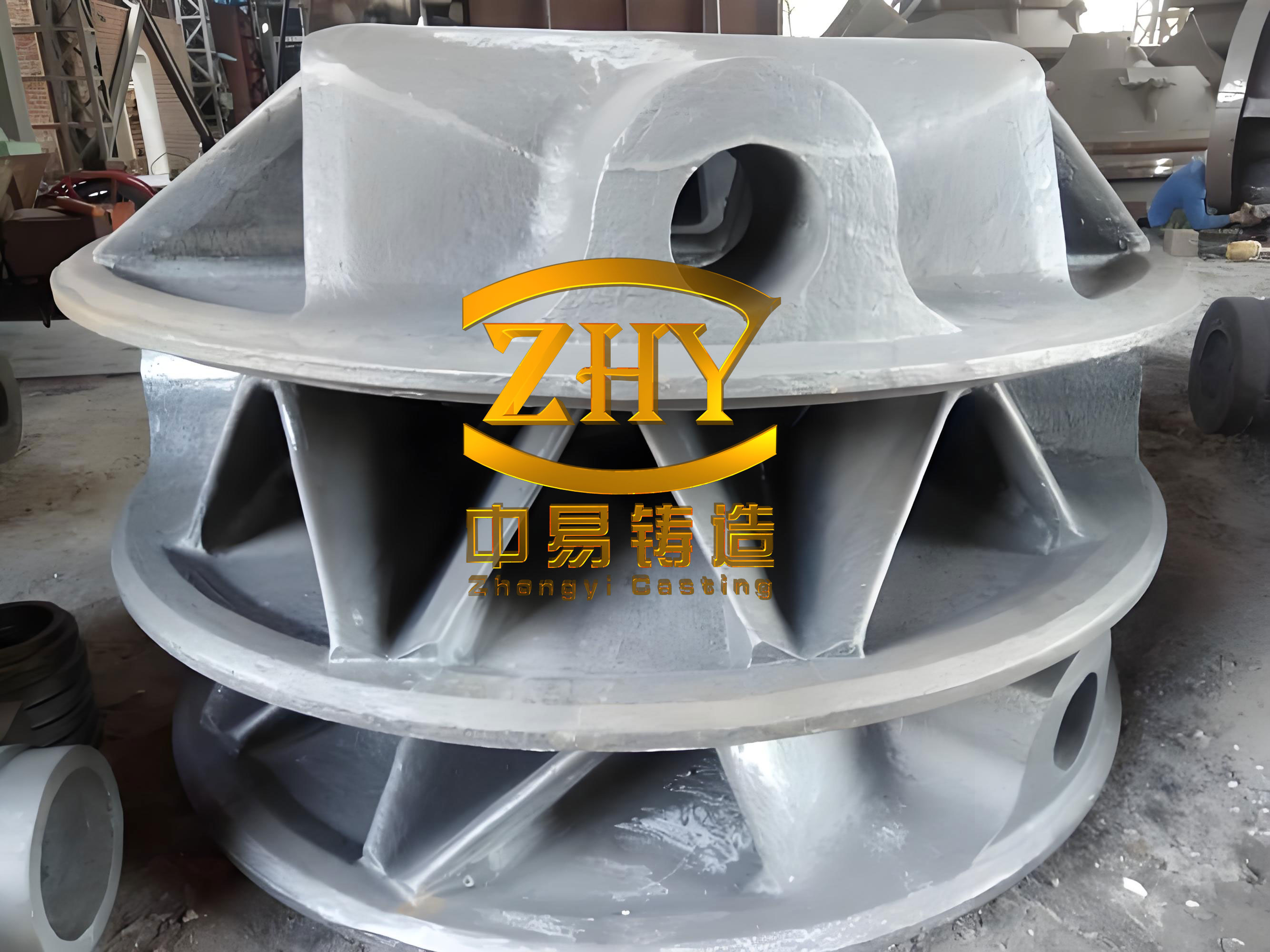
The molding process is equally vital for producing sound ductile cast iron castings. We use a nitrogen-free furan resin sand system with silica sand that has a high SiO2 content (>95%) and a controlled grain size distribution. The binder is a modified “wood-scent” furan resin, chosen for its environmental profile and lower emissions. Key parameters for the molding materials are detailed below.
| Material | Parameter | Specification / Value |
|---|---|---|
| Silica Sand | SiO2 Content | > 95% |
| Grain Fineness | 40-70 mesh (95% concentration) | |
| Fine Powder Content | 0% | |
| Wood-Scent Resin | Density (g/cm³) | 1.15 – 1.22 |
| Viscosity (mPa·s) | 38 – 42 | |
| Free Formaldehyde | ≤ 0.03% | |
| Nitrogen Content | ≤ 0.07% | |
| Low-Sulfur Curing Agent | Total Acidity (as H2SO4) | 40 – 44% |
| Free Acid | ≤ 18% |
The resin addition is 0.9-1.1% of sand weight, with the curing agent at 30-40% of the resin weight. This combination provides consistent strength with minimal sulfur introduction, which is crucial for the final properties of the ductile cast iron. The molds are coated with two layers: a primary alumina-based coating and a secondary graphite-alcohol coating to prevent metal penetration and sulfur pick-up.
The heart of producing high-quality ductile cast iron is the melting and treatment process. Precise chemical composition control is paramount. The base charge consists of high-purity pig iron (Q10), selected low-temperature scrap steel, crystalline graphite carburizer, returns, and alloying elements like pure nickel and copper. The target chemical ranges for the -40 °C ductile cast iron are as follows.
| Element | QT400-18L (wt.%) | QT500-7L (wt.%) |
|---|---|---|
| C | 3.3 – 3.9 | 3.3 – 3.9 |
| Si | 1.7 – 2.3 | 1.7 – 2.3 |
| Mn | < 0.2 | < 0.2 |
| P | < 0.035 | < 0.035 |
| S | < 0.02 | < 0.02 |
| Mg | 0.02 – 0.05 | 0.02 – 0.05 |
| Ni | 0.3 – 1.2 | 0.5 – 1.5 |
| Cu | 0 – 0.3 | – |
The melting sequence in a medium-frequency induction furnace begins with charging scrap steel and carburizer, followed by pig iron, returns, and nickel. After melting and superheating to 1530-1560 °C for refining and slag removal, copper and ferrosilicon are added. The treatment process is a covered ladle method. A mixture of nodulizer (1.1-1.3%), primary inoculant (0.5-0.7%), and a cover agent is placed and compacted in the treatment ladle. The molten ductile cast iron base is poured in two stages onto this bed. After reaction, a post-inoculant (0.7-0.9%) is added, and the remaining iron is tapped. Final inoculation during pouring (stream inoculation at 0.1-0.2%) completes the treatment. The treated iron is poured at 1390-1420 °C. The ductile cast iron castings are then cooled in the mold to below 300 °C before shakeout.
Systematic process control is implemented through detailed process flow documentation, Failure Mode and Effects Analysis (FMEA), control plans, and work instructions for all 29 defined process steps. This standardized and institutionalized approach to managing raw materials, tooling, batch traceability, and non-conformities has been instrumental in achieving stable production quality. Statistical data from mass production over several years demonstrates the effectiveness of this system for ductile cast iron components.
| Production Metric | Result |
|---|---|
| Total Production Quantity (pieces) | 43,789 |
| Magnetic Particle Testing (MT) Pass Rate | 100% |
| Radiographic Testing (RT) Pass Rate | > 97.87% |
| Material Property Qualification Rate | > 99.85% |
| Overall Product Yield | > 92.75% |
Building upon the robust production system for -40 °C ductile cast iron, our research delves into the more challenging realm of -60 °C service temperature. The objective is to understand the fundamental influence of key elements—silicon (Si), manganese (Mn), phosphorus (P), and sulfur (S)—on the Charpy V-notch impact toughness at this extreme low temperature. Experiments were conducted on three material conditions: fully annealed ferritic ductile cast iron (QT400-18LT), as-cast ferritic-pearlitic ductile cast iron (QT500-7LT), and a higher-strength as-cast pearlitic-ferritic ductile cast iron (QT600-7LT). All test samples were 25 mm Y-blocks cast in fresh furan resin sand coated with anti-sulfur wash to eliminate external variable.
The relationship between silicon content and low-temperature impact toughness is complex and critical for ductile cast iron. For the ferritic QT400-18L, impact energy decreases with increasing Si content, with a particularly sharp decline above approximately 1.9% Si. This can be modeled phenomenologically by a power-law decay function:
$$ KV_{2(-60^\circ C)} \approx K_1 \cdot [Si]^{-\alpha} \quad \text{for } [Si] > 1.9\% $$
where $K_1$ and $\alpha$ are material constants. This embrittlement is attributed to the stable segregation of silicon at grain boundaries, which reduces boundary cohesion and facilitates brittle fracture initiation at low temperatures. For the mixed-matrix QT500-7L ductile cast iron, the optimal Si range for -60 °C toughness was found to be 1.9-2.0%. The differential effect highlights the interaction between Si and the matrix structure in ductile cast iron.
The role of manganese in ultra-low temperature ductile cast iron presents a nuanced picture. Contrary to some conventional wisdom, our data on fully graphitized ferritic ductile cast iron (QT400-18LT) showed a slight positive correlation between Mn content (in the range 0.05-0.25%) and impact toughness at -60 °C. We hypothesize that Mn’s primary beneficial role at these levels is to getter sulfur by forming stable MnS inclusions, thereby reducing the amount of deleterious FeS that can form at grain boundaries. The detrimental effect of S is profoundly amplified at cryogenic temperatures. Therefore, a moderate Mn content can enhance toughness stability in ductile cast iron by mitigating sulfur’s impact. This relationship can be expressed as an interplay:
$$ \text{Toughness} \propto f\left(\frac{[Mn]}{[S]}\right) $$
where a higher ratio favors the formation of MnS over FeS.
Phosphorus is a notorious embrittling agent in ductile cast iron. Our experiments quantified its severe impact. For ferritic ductile cast iron, when the phosphorus content exceeds a critical threshold of about 0.07%, the low-temperature impact energy plummets. Below this threshold, the effect is relatively muted. This critical point corresponds to the solubility limit of P in the ferritic matrix under the given alloying conditions. Beyond this limit, hard, brittle phosphide eutectic networks form, acting as potent stress concentrators and crack initiators. The drop in toughness beyond the critical point can be described by a step-like function:
$$ KV_2(P) = \begin{cases}
KV_{2,\text{base}} & \text{for } P \leq P_{crit} \\
KV_{2,\text{base}} – \beta (P – P_{crit}) & \text{for } P > P_{crit}
\end{cases} $$
where $P_{crit} \approx 0.07\%$ and $\beta$ is a large negative constant. This underscores the necessity for extremely low phosphorus levels in ultra-low temperature ductile cast iron.
Sulfur’s detrimental effect on the toughness of ductile cast iron is exceptionally pronounced at cryogenic temperatures. The data clearly shows a steep decline in impact energy as sulfur content increases beyond approximately 0.012%. The mechanism involves the formation of low-melting point Fe-FeS eutectic films at austenite grain boundaries during solidification. These films are essentially pre-existing cracks that dramatically reduce the material’s resistance to crack propagation under impact loading at low temperatures. The sensitivity can be modeled with an exponential decay:
$$ KV_{2(-60^\circ C)} \propto \exp(-\gamma [S]) $$
where $\gamma$ is a sensitivity coefficient that is very high for ductile cast iron at -60 °C. For both ferritic and mixed-matrix ductile cast iron grades targeting -60 °C service, the sulfur content must be rigorously controlled to 0.015% or lower, necessitating high-purity charge materials and process safeguards against sulfur pick-up.
The collective findings from our production experience and targeted research lead to several key conclusions. Firstly, a holistic and tightly controlled production system encompassing optimized casting design, low-sulfur/nitrogen molding, precise melting and treatment, and rigorous quality management enables the consistent mass production of -40 °C ductile cast iron components with a comprehensive yield exceeding 92%. Secondly, the journey to -60 °C ductile cast iron requires a refined understanding of elemental interactions. For ferritic ductile cast iron, silicon must be kept below 1.9%, phosphorus below 0.07%, and sulfur below 0.012% to maintain adequate impact toughness. Manganese, within limits, can be slightly beneficial for toughness stability by controlling sulfur. Thirdly, by applying these refined compositional controls, it is technologically feasible to produce ductile cast iron grades that meet demanding -60 °C impact criteria: QT400-18L with single specimen impact energy >9 J and average >12 J, and QT500-7L with single specimen impact >3 J and average >4 J. The continuous evolution of ductile cast iron for cryogenic applications hinges on such deep metallurgical insight coupled with unwavering process discipline, ensuring the safety and performance of critical components in the world’s most challenging environments.