
The production of high-integrity castings from ductile cast iron presents a significant challenge due to the material’s unique solidification characteristics. Unlike gray iron, which forms a flake graphite structure that provides some internal expansion during the final stages of freezing, ductile cast iron solidifies with a pronounced austenitic dendrite network. The subsequent precipitation of spheroidal graphite within these interdendritic spaces creates a complex scenario for feeding. The expansion associated with graphite nodule formation can be substantial, but it occurs late in the solidification process and is often isolated within these interdendritic regions. This can lead to the formation of internal shrinkage porosity, a defect that severely compromises the mechanical properties and pressure tightness of the final component.
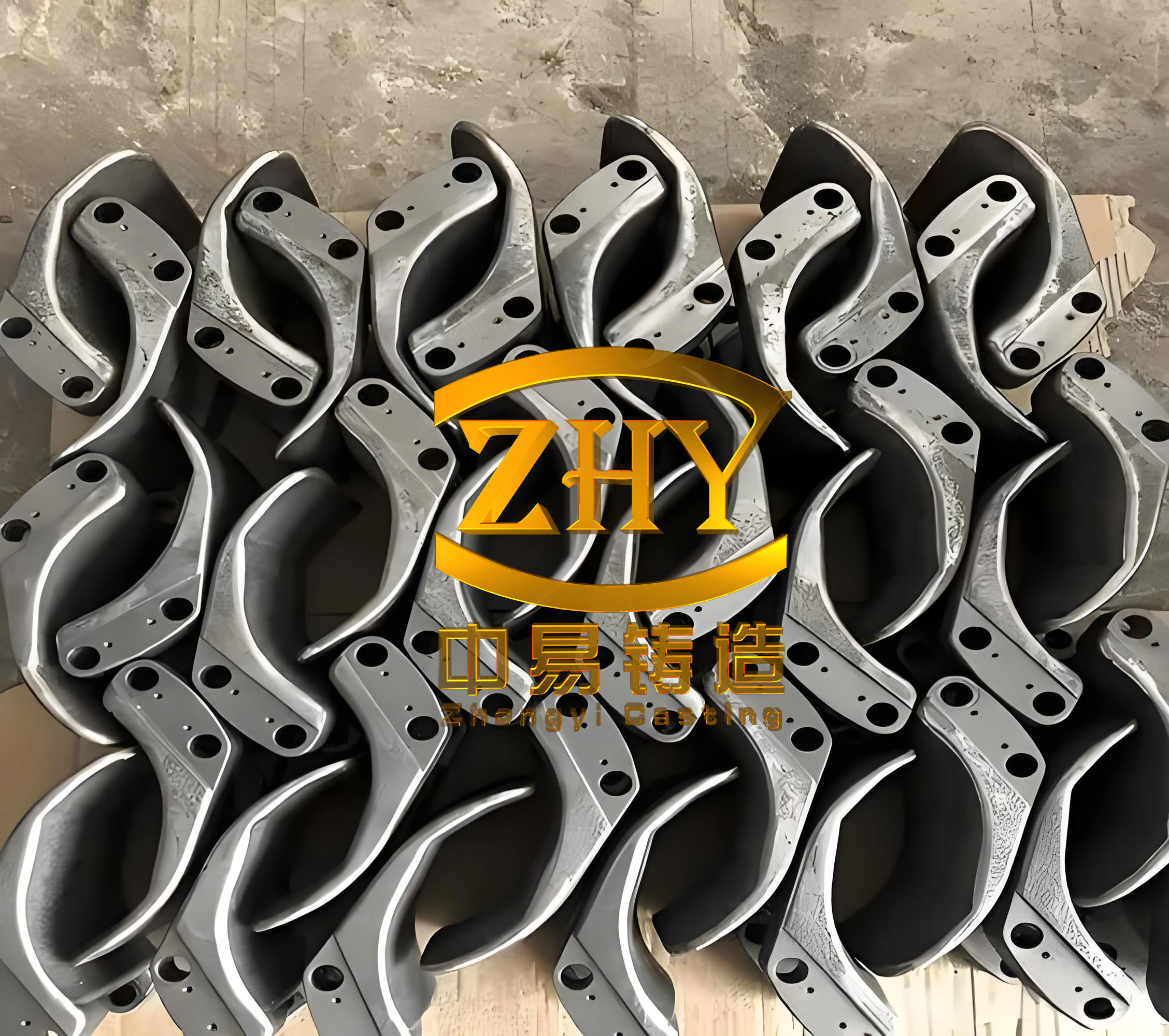
To counteract these tendencies and ensure the production of sound castings, foundries employ a range of techniques, with the strategic use of chills being one of the most direct and effective. A chill is defined as a material of high thermal conductivity and/or heat capacity placed within or against the mold cavity to locally increase the cooling rate of the solidifying metal. In the context of ductile cast iron, the primary objective of using chills is to control the solidification sequence, either by promoting directional solidification towards a feeder or by eliminating isolated thermal centers (hot spots) that would otherwise lead to shrinkage defects.
The effectiveness of a chill is governed by fundamental principles of heat transfer. When molten ductile cast iron comes into contact with a chill, the rate of heat extraction increases dramatically. The governing equation for one-dimensional heat conduction from the casting into the chill can be expressed as:
$$ q = -k \cdot A \cdot \frac{dT}{dx} $$
Where \( q \) is the heat transfer rate (W), \( k \) is the thermal conductivity of the chill material (W/m·K), \( A \) is the contact area (m²), and \( \frac{dT}{dx} \) is the temperature gradient at the interface. A higher \( k \) value results in a faster extraction of heat. Furthermore, the chill’s ability to absorb this heat without a significant rise in its own temperature is critical. This is related to its volumetric heat capacity:
$$ Q = \rho \cdot c_p \cdot V \cdot \Delta T $$
Where \( Q \) is the total heat absorbed (J), \( \rho \) is the density of the chill (kg/m³), \( c_p \) is its specific heat capacity (J/kg·K), \( V \) is its volume (m³), and \( \Delta T \) is its temperature increase. An ideal chill material combines high thermal conductivity with high volumetric heat capacity.
Chill Materials and Their Properties
The selection of chill material is a critical decision that depends on the severity of the chilling effect required, the geometry of the casting section, and economic factors. Not all materials are created equal in their ability to manipulate the solidification of ductile cast iron. The table below summarizes the key properties and characteristics of commonly used chill materials.
| Material | Typical Composition/Type | Approx. Thermal Conductivity (W/m·K) | Key Advantages | Key Disadvantages | Primary Application in Ductile Iron |
|---|---|---|---|---|---|
| Cast Iron | HT200, Gray Iron | 50 – 60 | Good thermal properties, easy to cast into complex shapes, low cost, good weldability for attachments. | Can fuse to casting if overheated, lower conductivity than copper or graphite. | General-purpose chilling for medium to heavy sections, ideal for custom-shaped chills. |
| Steel | Mild Steel (e.g., Q235), Low-Carbon Steel | 45 – 55 | Readily available, can be machined or formed, good structural strength for handling. | Thermal conductivity is moderate, can be prone to rust which affects surface contact. | Sheet chills for thin sections, rod chills for boss areas, often used where specific shapes are needed. |
| Copper & Copper Alloys | Pure Copper, Chromium Copper | 380 – 400 (Pure Cu) | Exceptionally high thermal conductivity, provides the most intense chilling effect. | Very high cost, low melting point (~1085°C) risks fusion with iron, heavy. | Critical applications requiring extreme chilling on very small, dense hot spots. Use is limited. |
| Graphite | High-Density (1.8-2.1 g/cm³), Regular | 80 – 150 (varies with density/graphitization) | Excellent thermal conductivity, high heat capacity, non-wetting to molten iron, reusable, easy to machine. | Fragile and brittle, requires careful handling, can be costly for high-density grades. | Excellent for promoting directional solidification without creating harsh thermal gradients; ideal for sensitive areas. |
| Exothermic/Insulating Sleeves | Alumino-Thermic Mixtures | Very Low (Insulating) | Not a chill in the traditional sense; used to slow cooling and prolong feeding. | Can only delay, not accelerate, solidification. | Used in feeders (risers) to improve feeding efficiency, opposite function to a chill. |
| Chilled Sand / Aggregate | Chromite Sand, Steel Shot bonded with resin | Higher than silica sand | Can conform to complex contours, provides a moderate, diffuse chilling effect. | Chilling effect is less intense and localized than solid metal chills. | For areas where a solid chill is impractical, to break up large sand masses. |
For most applications in ductile cast iron foundries, a choice between cast iron, steel, and graphite is made. The decision often hinges on the thermal demand. The required chilling power can be conceptualized by comparing the relative volumetric heat capacity and conductivity. One can consider a simplified “Chilling Power Index” (CPI) for initial comparison, though actual performance requires simulation or experience:
$$ CPI \propto k \cdot \rho \cdot c_p $$
Graphite often scores highly on this index due to its favorable combination of properties. However, the final choice is not based on a single number. For instance, while cast iron has a lower thermal conductivity than copper, its higher melting point and better resistance to fusion make it safer and more practical for direct contact with large sections of ductile cast iron.
Pre-Treatment and Application of Chills
Merely selecting the correct chill material is insufficient. Proper preparation and application are paramount to achieving the desired effect and avoiding new defects such as gas holes, chill fusion, or rough casting surfaces.
Surface Preparation
The interface between the chill and the sand mold, as well as between the chill and the molten ductile cast iron, must be carefully controlled. The primary goals are to ensure intimate thermal contact and to prevent gas evolution or metal penetration.
- Cleaning and Degreasing: All chills must be absolutely clean, dry, and free of rust, oil, sand, or previous coating residue. For metallic chills (iron, steel), methods include:
- Shot/Sand Blasting: The preferred method for cast iron and steel chills. It efficiently removes scale, rust, and old coatings while creating a uniform, slightly roughened surface that can improve coating adhesion.
- Grinding/Wire Brushing: A manual alternative, but less consistent and efficient. It is suitable for touch-up work or small-scale operations.
Graphite chills require simpler cleaning: brushing off loose material and ensuring the surface is sound and uncracked.
- Coating: Applying a refractory coating is almost always necessary. This coating serves multiple purposes:
- Prevents direct metal-to-chill contact, eliminating the risk of fusion (especially for steel/iron chills).
- Provides a thermal barrier that slightly moderates the initial shock of the chilling effect, which can be beneficial in preventing “over-chilling” and carbide formation in ductile cast iron.
- Seals the surface to prevent sand from sticking and creating rough patches on the casting.
Common coatings include alcohol-based graphite washes or proprietary chill coatings. The coating should be applied thinly and evenly—a thick, sloppy coat will insulate the chill and negate its purpose. A single dip or spray coat followed by drying is standard.
- Drying and Preheating: Before placement in the mold, chills must be thoroughly dried to remove any moisture from the coating process. Furthermore, preheating the chills prior to closing the mold is a critical step often overlooked. A cold chill placed in a mold can cause condensation on its surface when exposed to the warm, often somewhat humid, mold atmosphere. This moisture will turn to steam upon metal contact, causing blowholes or pinholes in the casting surface. Preheating to 80-150°C using a gas torch or in an oven eliminates this risk. For large or critical molds, inserting a hot air lance into the closed mold cavity to drive off any residual moisture is a recommended practice.
Secure Placement and Anti-Drop Measures
A chill that shifts or falls during mold handling, closing, or pouring is worse than useless—it becomes a piece of loose debris that can cause severe defects. Therefore, chills must be securely anchored to the mold or core. The method of attachment varies by material and geometry:
- Cast Iron Chills: These are often cast with integral attachment features. The most common is a “handle” or “tang” cast onto the non-working (back) surface of the chill. This tang is embedded deep into the supporting sand, firmly locking the chill in place.
- Steel Chills: Handles or tabs are typically welded onto the back of the chill. These are then embedded in the sand. For sheet steel chills, bent tabs or through-holes for wiring to core prints are common.
- Graphite Chills: Being brittle, they cannot be welded or cast with handles. Instead, grooves, slots, or undercuts are machined into their sides or back. Sand is rammed into these grooves, providing a mechanical lock. Sometimes, a steel wire or rod is inserted into a drilled hole in the graphite and bent to anchor in the sand.
The universal rule is that the anchoring feature must be on the side away from the molten metal and must rely on the mechanical strength of the compacted sand for hold-down force.
Engineering Considerations for Chill Design and Placement
The successful implementation of chills in ductile cast iron casting is an exercise in thermal management. It requires an understanding of the casting’s geometry, the solidification behavior of the iron grade being used, and the interaction with the overall gating and feeding system.
Determining Chill Size and Mass
A chill must have sufficient mass to absorb the latent heat of fusion from the section it is intended to solidify without becoming saturated. An undersized chill will warm up too quickly and lose its effectiveness, potentially creating a “re-heat” center that acts as a hot spot. A basic, conservative rule of thumb for estimating the required chill mass \( M_{chill} \) for a section of ductile cast iron is to equate the heat that needs to be absorbed to the chill’s heat absorption capacity:
$$ M_{casting-section} \cdot L \approx M_{chill} \cdot c_{p,chill} \cdot \Delta T_{chill} $$
Where \( M_{casting-section} \) is the mass of the casting section to be chilled, \( L \) is the latent heat of fusion of ductile cast iron (approx. 270 kJ/kg), \( c_{p,chill} \) is the specific heat of the chill material, and \( \Delta T_{chill} \) is the acceptable temperature rise of the chill (e.g., from 150°C preheat to 800°C). Solving for \( M_{chill} \):
$$ M_{chill} \approx \frac{M_{casting-section} \cdot L}{c_{p,chill} \cdot \Delta T_{chill}} $$
For a steel chill (\( c_p \approx 0.46 \, \text{kJ/kg·K} \)) and a \( \Delta T \) of 650°C, the ratio simplifies to roughly \( M_{chill} \approx 0.9 \cdot M_{casting-section} \). This indicates that the chill mass should be nearly equal to the mass of the metal it is chilling—a significant amount. In practice, chills are often smaller because they do not need to absorb all the latent heat, only enough to establish the correct solidification gradient. Foundries rely heavily on simulation software to optimize this, but the rule of thumb emphasizes that chills must be substantial.
Chill Shape and Contact Geometry
The shape of the chill should conform as closely as possible to the casting geometry to maximize contact area (the \( A \) in the heat transfer equation). For a thick flange between two thinner walls, a rectangular block or a custom-cast profile is used. For a hub or boss, a cylindrical or conical chill (often called a “chill pin”) is inserted into the core that forms the hole. For complex junctions like a “T-section” or a wheel hub, chills may need to be multi-faceted or assembled from pieces.
A key example is the use of stepped chills. Consider a casting with a stepped wall thickness. A chill with a matching stepped profile ensures uniform heat extraction across the entire face, promoting a flat solidification front. Using a rectangular chill against a stepped wall would over-chill the thin section and under-chill the thick step, potentially creating internal stresses or even hot tears.
Integration with Feeding System
Chills are rarely used in isolation. They are part of a holistic feeding strategy for ductile cast iron. The most common paradigm is to use chills to create or enhance directional solidification towards a feeder (riser).
- The Principle: A chill is placed on the side of a thermal center (hot spot) opposite the feeder. By extracting heat rapidly from that side, it forces the solidification front to initiate at the chill face and progress through the hot spot towards the feeder. The feeder, being the last to solidify, can then feed the shrinkage occurring in the hot spot.
- Simulation Example: Imagine a simple bar casting with a heavy central section and feeders at both ends. Without chills, the heavy center may solidify last, isolated from both feeders, leading to centerline shrinkage. Placing chills on the sides of the heavy section accelerates its cooling, linking its solidification with that of the adjacent thinner sections, thereby establishing a directional solidification path from the center towards the ends and into the feeders.
Material Selection for Specific Scenarios
The choice between a strong chill (like iron/steel) and a milder chill (like graphite) is crucial and is best illustrated with examples derived from simulation and practice.
Scenario A: Isolated Heavy Section (e.g., a thick flange on a thin-walled pipe).
Here, the goal is to eliminate the isolated thermal center entirely by making it solidify first. An intense chill is required. A cast iron or steel chill surrounding the flange provides the necessary powerful heat extraction to overcome the thermal mass of the flange and link its solidification to the faster-cooling pipe walls. Simulation confirms that a graphite chill may be insufficient, leaving a residual isolated liquid pool, while an iron chill successfully integrates the flange into the overall solidification pattern.
Scenario B: Transition Zone (e.g., a thin-walled cylinder meeting a heavy base).
Here, the goal is to manage the thermal gradient to prevent shrinkage at the junction without causing harmful over-chilling on the thin cylinder wall, which could lead to carbides or cracking. A graphite chill is often the superior choice. Placed at the junction, its high conductivity effectively draws heat from the hot spot, but its lower thermal diffusivity compared to metal creates a less severe gradient. This promotes directional solidification from the cylinder wall towards the base and feeder without shocking the thin section. Simulation shows a metal chill might create such a sharp gradient that it “pinches off” the feeding path, creating shrinkage at the interface, while a graphite chill facilitates a smoother thermal transition.
Practical Guidelines and Best Practices
- Simulation is Key: Modern casting simulation software (CAE) is indispensable for optimizing chill design. It allows engineers to test different chill materials, sizes, and placements virtually before committing to pattern tooling, saving time and cost.
- Avoid Over-Chilling: Excessive chilling, especially in thin sections or with very aggressive chills, can lead to undesirable microstructures in ductile cast iron, such as chill carbides (ledeburite) at the surface, which are hard and brittle. It can also increase residual stresses and the risk of hot tearing. The chilling effect must be balanced.
- Maintenance and Reuse: Metallic chills degrade over time. They can warp, develop cracks, or have their coating build up unevenly. A regular inspection and maintenance program is necessary. Graphite chills are more fragile and require careful handling to avoid breakage.
- Process Documentation: Successful chill applications should be thoroughly documented—material, dimensions, placement, coating used, preheat temperature. This creates a valuable knowledge base for future similar castings.
Conclusion
The strategic application of chills remains a cornerstone of robust foundry engineering for producing sound, high-quality ductile cast iron castings. Their function extends beyond simple cooling; they are precise tools for manipulating thermal gradients and solidification sequences. Success hinges on a systematic approach: understanding the thermal demands of the casting geometry, selecting the appropriate chill material (whether it be cast iron for intense local cooling or graphite for controlled directional solidification), rigorously applying pre-treatment and secure placement protocols, and integrating the chill into a comprehensive feeding strategy. As simulation technology advances, the design and application of chills become more scientific and optimized, but the fundamental principles of heat transfer and solidification control remain at the heart of preventing shrinkage defects in ductile cast iron.