
In the realm of internal combustion engine technology, pistons serve as critical components, functioning within the cylinder assembly alongside piston rings and cylinder liners to convert combustion pressure into mechanical work. With advancements such as high-pressure common rail, turbocharging, and direct injection, engine operating conditions have become increasingly severe—characterized by peak pressures exceeding 22 MPa and gas temperatures surpassing 400°C. These demands necessitate enhanced performance from engine parts, particularly pistons, which are often referred to as the “heart” of the engine. Traditionally, aluminum alloys have been used, but for higher stiffness and elevated temperature resistance, steel pistons have gained prominence, especially in welded split configurations. However, steel materials like 38MnVS6Ti non-quenched and tempered steel and 42CrMo4 quenched and tempered steel present challenges: high material costs, difficult machinability leading to increased tool wear, and slower processing speeds. Therefore, there is a pressing need for a new material that offers excellent machinability, lower cost, and mechanical properties suitable for high-performance, emission-compliant engines. This is where ductile cast iron emerges as a promising alternative.
Ductile cast iron, also known as nodular cast iron, is an engineering material where graphite is spheroidized through inoculation and magnesium treatment, resulting in a microstructure that combines the castability of iron with mechanical properties approaching those of steel. It has been widely adopted in various industrial applications. In the context of pistons, some companies have explored monolithic cast ductile cast iron pistons using methods like investment casting. However, monolithic casting poses significant工艺 challenges and high costs, especially as engine designs demand reduced piston height and weight. To address these limitations, we have developed a novel split-type piston fabricated from ductile cast iron profiles, utilizing friction welding—a solid-state joining technique—to integrate the piston head and skirt. This approach not only reduces material and machining costs but also enhances performance through tailored heat treatments.
The core of our innovation lies in the selection and processing of ductile cast iron. We prioritize the use of ferritic ductile cast iron grade QT600-7, which offers a balanced combination of strength and ductility. The chemical composition is meticulously controlled, as summarized in Table 1, to ensure optimal weldability and mechanical properties. Key elements include carbon and silicon for graphitization, with low sulfur and phosphorus contents (below 0.02%) to minimize impurities that could impair welding and toughness. Copper and nickel are added to enhance strength and corrosion resistance, while niobium refines the microstructure. Magnesium and cerium facilitate graphite spheroidization.
| C | Si | Cu | Ni | Nb | Mn | S | P | Mgres | Ce | Fe |
|---|---|---|---|---|---|---|---|---|---|---|
| 3.0-3.9 | 2.4-3.0 | 0.5-1.0 | 0.5-1.0 | 0.01-0.05 | <0.4 | <0.02 | <0.02 | 0.03-0.06 | 0.02-0.04 | Bal. |
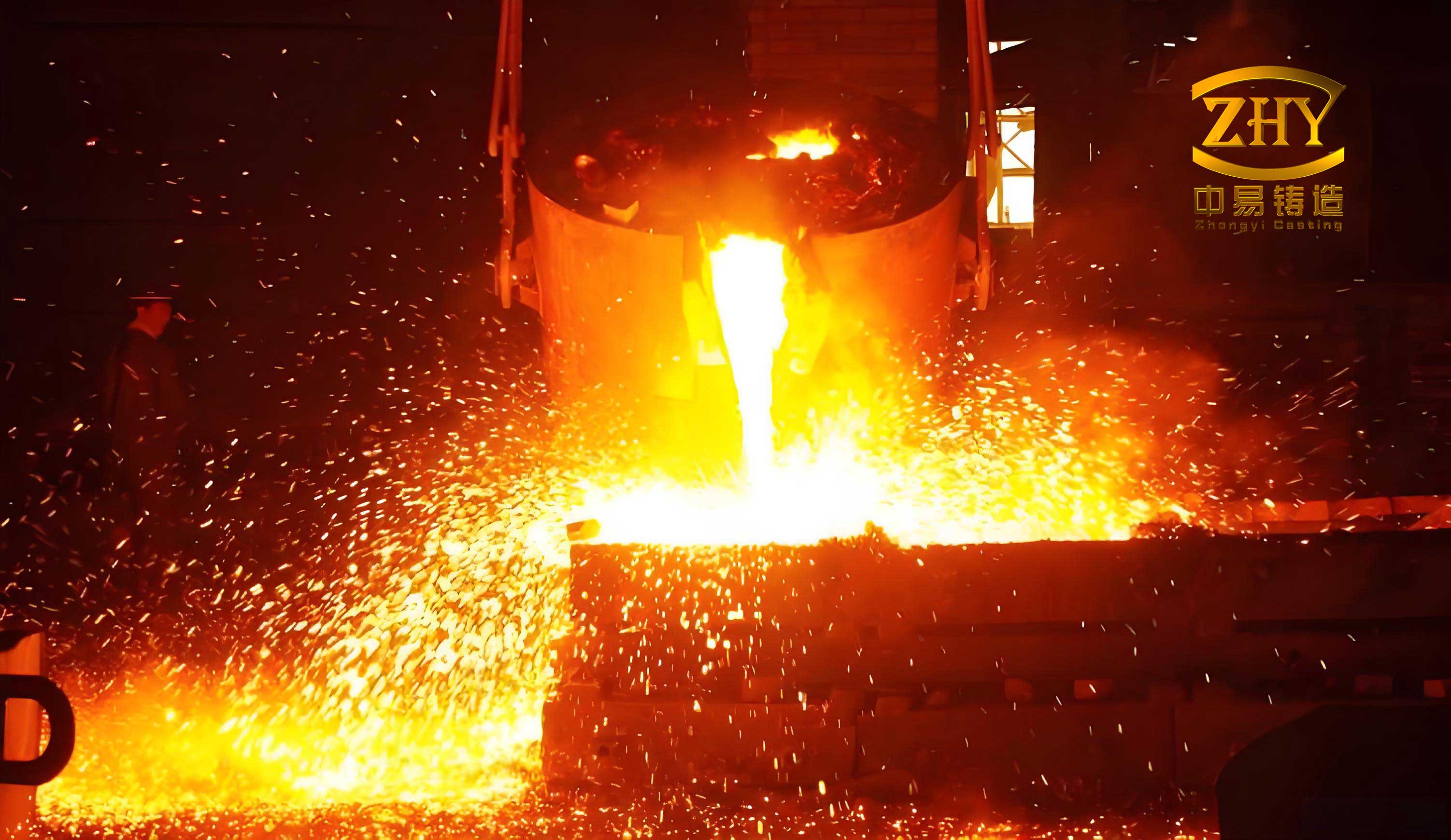
The production of ductile cast iron profiles involves melting in medium-frequency induction furnaces, followed by multiple inoculation and spheroidization treatments to increase graphite nodule count. We employ 75SiFe or strontium-bearing inoculants and FeSiMg6RE2 as a spheroidizing agent. The molten metal is then centrifugally cast using water-cooled metal molds, which minimizes casting defects and yields finer grains with superior mechanical properties. The as-cast profiles exhibit a spheroidization rate exceeding 95%, graphite nodule diameter less than 0.06 mm (corresponding to size grades 6-8), and a ferritic matrix content above 90%. The hardness ranges from 150 to 200 HBW, with tensile strength ≥600 MPa and elongation greater than 7%. The microstructure can be described by the graphite nodule count per unit area, which influences mechanical behavior. For instance, the yield strength of ductile cast iron can be related to microstructural parameters via the Hall-Petch-type relationship:
$$ \sigma_y = \sigma_0 + k \cdot N^{-1/2} $$
where $\sigma_y$ is the yield strength, $\sigma_0$ is the friction stress, $k$ is a constant, and $N$ is the number of graphite nodules per unit area. Higher nodule counts, achieved through effective inoculation, contribute to improved strength and toughness.
The manufacturing process for the novel piston begins with machining separate components from ductile cast iron profiles. The piston head is fabricated from a tubular profile, where half of the cooling oil passage is pre-machined, leaving a machining allowance of 3-5 mm on other surfaces. Similarly, the piston skirt is machined from a solid bar, with the other half of the cooling oil passage and the inner cavity finished to near-net shape, also with a 3-5 mm allowance. This split design allows for precise control over dimensions and reduces material waste compared to monolithic casting.
Joining the head and skirt is achieved through friction welding, a solid-state welding technique ideal for ductile cast iron. Unlike fusion welding, friction welding involves rotating one component against another under axial pressure, generating heat through friction that causes atomic diffusion and bonding without melting. The process parameters—such as rotational speed, friction pressure, and forging pressure—are optimized to ensure a defect-free joint. The advantages are manifold: absence of melting-related defects like porosity or solidification cracks, grain refinement in the weld zone due to severe plastic deformation, and a narrow heat-affected zone (HAZ) that minimizes microstructural coarsening. The weld integrity can be assessed using the following empirical formula for friction welding energy input:
$$ E = \frac{\pi \cdot \mu \cdot P \cdot \omega \cdot r^2 \cdot t}{A} $$
where $E$ is the energy per unit area, $\mu$ is the friction coefficient, $P$ is the axial pressure, $\omega$ is the angular velocity, $r$ is the radius of the joint, $t$ is the welding time, and $A$ is the contact area. Proper control ensures the weld strength matches or exceeds that of the base ductile cast iron.
Post-welding, the piston undergoes heat treatment to relieve residual stresses and enhance mechanical properties. Initially, stress relief annealing at 400-500°C is performed. However, to meet the high-strength requirements of modern engines, further热处理 is essential. We explore two primary routes: quenching and tempering, or austempering. Austempering, in particular, involves austenitizing followed by rapid quenching into a salt bath at an intermediate temperature to produce a matrix of acicular ferrite and stable austenite, known as ausferrite. This microstructure offers an excellent combination of strength, ductility, and wear resistance. The austempering kinetics can be described using the Johnson-Mehl-Avrami-Kolmogorov (JMAK) equation:
$$ f = 1 – \exp(-k t^n) $$
where $f$ is the transformed fraction, $k$ is a rate constant dependent on temperature, $t$ is time, and $n$ is the Avrami exponent. For ductile cast iron, the rate constant $k$ follows an Arrhenius relationship:
$$ k = A \exp\left(-\frac{Q}{RT}\right) $$
with $A$ as the pre-exponential factor, $Q$ the activation energy, $R$ the gas constant, and $T$ the absolute temperature. Typical austempering parameters for our ductile cast iron pistons include austenitizing at 890°C for 60 minutes, followed by quenching into a salt bath composed of 50% NaNO2 and 50% KNO3 at 450°C for 25 minutes. Alternatively, oil quenching from 920°C and tempering at 450°C for 3 hours is also effective. These treatments homogenize hardness across the weld and base material, eliminating hardness disparities in the HAZ that could cause tool wear during machining.
The mechanical properties of the heat-treated ductile cast iron piston are comparable or superior to those of steel pistons. As shown in Table 2, we compare the properties of standard 38MnVS6Ti steel with our QT600-7 ductile cast iron in both as-welded and heat-treated conditions. The data highlight the advantages of ductile cast iron in terms of machinability and cost.
| Material/Property | 38MnVS6Ti Steel Piston | QT600-7 Ductile Cast Iron (As-Welded) | QT600-7 Austempered Ductile Cast Iron | QT600-7 Quenched & Tempered Ductile Cast Iron |
|---|---|---|---|---|
| Brinell Hardness (HBW) | 250-300 | 150-200 | 250-300 | 250-300 |
| Yield Strength (MPa) | ≥520 | ≥400 | ≥550 | ≥550 |
| Tensile Strength (MPa) | ≥850 | ≥600 | ≥850 | ≥800 |
| Elongation (%) | ≥10 | ≥7 | ≥8 | ≥10 |
| Machinability Rating | Poor | Excellent | Excellent | Excellent |
| Material Cost (per kg) | 17 currency units | 8 currency units | 10 currency units | 9 currency units |
| Thermal Conductivity (W/m·K) | ~50 | ~35 | ~35 | ~35 |
| Density (g/cm³) | 7.85 | 7.10 | 7.10 | 7.10 |
The superior machinability of ductile cast iron stems from its graphite nodules, which act as chip breakers and provide lubrication during cutting. This reduces cutting forces and tool wear, as quantified by the Taylor tool life equation:
$$ VT^n = C $$
where $V$ is cutting speed, $T$ is tool life, and $n$ and $C$ are constants. For ductile cast iron, the constant $n$ is higher compared to steel, indicating longer tool life at given speeds. Additionally, the lower density of ductile cast iron (approximately 7.10 g/cm³ vs. 7.85 g/cm³ for steel) contributes to weight reduction in the piston, which can lower inertial forces and improve engine efficiency. The reduced thermal conductivity (around 35 W/m·K) compared to aluminum but similar to steel helps retain heat within the combustion chamber, potentially enhancing thermal efficiency.
Further analysis involves the performance under engine operating conditions. The fatigue strength of the piston is critical, especially for high-cycle fatigue. For ductile cast iron, the fatigue limit $\sigma_f$ can be estimated using the empirical relation:
$$ \sigma_f = 0.4 \cdot \text{Tensile Strength} + 50 \text{ MPa} $$
For austempered ductile cast iron with tensile strength ≥850 MPa, the fatigue limit approaches 390 MPa, sufficient for high-pressure applications. Moreover, the presence of graphite nodules imparts damping capacity, which reduces noise and vibration—a beneficial property for engine refinement.
To optimize the design, we utilize finite element analysis (FEA) to simulate thermal and mechanical stresses. The governing heat conduction equation during engine operation is:
$$ \rho c_p \frac{\partial T}{\partial t} = \nabla \cdot (k \nabla T) + \dot{q} $$
where $\rho$ is density, $c_p$ is specific heat, $T$ is temperature, $k$ is thermal conductivity, and $\dot{q}$ is heat generation rate. For ductile cast iron, the lower thermal conductivity results in higher temperature gradients, but the material’s high strength at elevated temperatures compensates for this. Stress analysis follows the von Mises criterion:
$$ \sigma_{vm} = \sqrt{\frac{1}{2}\left[(\sigma_1 – \sigma_2)^2 + (\sigma_2 – \sigma_3)^2 + (\sigma_3 – \sigma_1)^2\right]} $$
where $\sigma_1, \sigma_2, \sigma_3$ are principal stresses. Our simulations confirm that the split-type friction welded ductile cast iron piston maintains stress levels within safe limits, even under peak combustion pressures.
The economic advantages are substantial. The total cost savings encompass material, machining, and tooling. A detailed cost model can be expressed as:
$$ C_{total} = C_{material} + C_{machining} + C_{heat treatment} + C_{welding} $$
For ductile cast iron pistons, $C_{material}$ is roughly 50% lower than steel, and $C_{machining}$ is reduced by 30-40% due to better machinability. Even with additional heat treatment costs (around 10-15% of total), the overall cost is 20-25% lower than equivalent steel pistons. This makes ductile cast iron an economically attractive option for mass production.
In terms of applications, this innovative piston is suitable for a wide range of internal combustion engines, particularly those adhering to stringent emission standards like China VI or Euro VI. The combination of high strength, good thermal properties, and cost-effectiveness positions ductile cast iron as a viable material for next-generation pistons. Furthermore, the split design facilitates the integration of advanced cooling channels, which can be optimized using computational fluid dynamics (CFD) to enhance heat dissipation. The oil flow in cooling passages can be modeled with the Navier-Stokes equations:
$$ \rho \left( \frac{\partial \mathbf{u}}{\partial t} + \mathbf{u} \cdot \nabla \mathbf{u} \right) = -\nabla p + \mu \nabla^2 \mathbf{u} + \mathbf{f} $$
where $\mathbf{u}$ is velocity, $p$ is pressure, $\mu$ is dynamic viscosity, and $\mathbf{f}$ is body force. Efficient cooling extends piston life and prevents thermal overload.
Looking ahead, ongoing research focuses on further enhancing the properties of ductile cast iron pistons. This includes alloying with elements like molybdenum or vanadium to increase high-temperature strength, and surface treatments such as nitriding or coating to improve wear resistance. The potential for recycling ductile cast iron scrap also aligns with sustainability goals, reducing the environmental footprint compared to steel production.
In conclusion, the split-type friction welded ductile cast iron piston represents a significant advancement in engine technology. By leveraging the inherent benefits of ductile cast iron—excellent machinability, lower density, and competitive mechanical properties—we have developed a solution that addresses cost and performance challenges. The integration of solid-state welding and tailored heat treatments ensures structural integrity and uniformity. With its economic and technical advantages, this innovative ductile cast iron piston is poised to become a standard in high-performance, emission-compliant engines, contributing to improved efficiency and reduced manufacturing costs. The future of piston materials may very well be shaped by the continued evolution of ductile cast iron technologies.