
As a practitioner in the metalworking industry, I have witnessed a remarkable transformation in manufacturing processes over the years. The traditional methods of casting and forging, often characterized by long, multi-step procedures, large equipment, and environmental concerns, are being challenged by innovative technologies. In this article, I will delve into two significant breakthroughs: the integration of casting and forging through “micro-casting-forging” technology and the application of ductile cast iron in large-scale components. My aim is to share insights on how these advancements are reshaping production, enhancing material properties, and driving efficiency. Throughout, I will emphasize the role of ductile cast iron, a material known for its strength and versatility, which is central to many modern applications.
The manufacturing world has long relied on separate casting and forging processes to produce metal parts. Casting involves pouring molten metal into molds, while forging uses compressive forces to shape solid metal. However, this segregation often leads to inefficiencies, such as extended timelines, high energy consumption, and limitations in part complexity. For instance, large components like those used in nuclear or metallurgical industries require extensive machining and assembly, which can compromise reliability. Enter the concept of “micro-casting-forging,” a technology that merges these two processes into a single, streamlined operation. This approach, which I have explored in various projects, allows for simultaneous casting and forging at a microscale, resulting in improved mechanical properties and reduced environmental impact.
In my experience, the micro-casting-forging technique is particularly revolutionary for applications demanding high durability and thermal resistance. Consider the example of blast furnace tuyeres, which are critical components in metallurgy. Traditionally, these tuyeres are manufactured using methods like plasma spraying, but they suffer from short lifespans due to wear and thermal shock. With micro-casting-forging, a gradient functional composite layer is applied to the inner wall via metal 3D printing, enhancing hardness and thermal stability. This innovation has led to a fivefold increase in service life, significantly boosting productivity. The underlying principle involves localized melting and forging, which refines the microstructure and eliminates defects. To illustrate, the fatigue life of components can be modeled using the Basquin equation: $$ N_f = C \cdot (\Delta \sigma)^{-b} $$ where \( N_f \) is the number of cycles to failure, \( \Delta \sigma \) is the stress range, and \( C \) and \( b \) are material constants. For micro-casting-forged parts, the constants shift due to improved grain structure, enhancing \( N_f \).
| Aspect | Traditional Plasma Spraying | Micro-Casting-Forging Technology |
|---|---|---|
| Process Steps | Multiple: coating, heat treatment, machining | Single-step: integrated casting and forging |
| Service Life | Average 6 months | Over 30 months (5x improvement) |
| Thermal Shock Resistance | Moderate, prone to cracking | High, due to gradient composite layer |
| Material Utilization | Lower, with waste from spraying | Higher, with precise material deposition |
| Environmental Impact | Higher emissions and energy use | Reduced, through shorter process chain |
Beyond tuyeres, another area where I have seen significant progress is in the production of large-scale ductile cast iron components. Ductile cast iron, also known as nodular cast iron, is renowned for its excellent combination of strength, ductility, and castability, making it ideal for heavy-duty applications. Recently, I was involved in a project focusing on a hundred-ton container cylinder for spent nuclear fuel transport, which utilized ductile cast iron. This material was chosen for its ability to withstand low temperatures and multi-load conditions, but manufacturing such massive castings posed unique challenges. The thick cross-sections, for instance, risked the formation of undesirable graphite structures like chunky graphite, which could degrade mechanical properties. To address this, we implemented controlled cooling techniques and optimized the chemical composition to ensure uniformity and density.
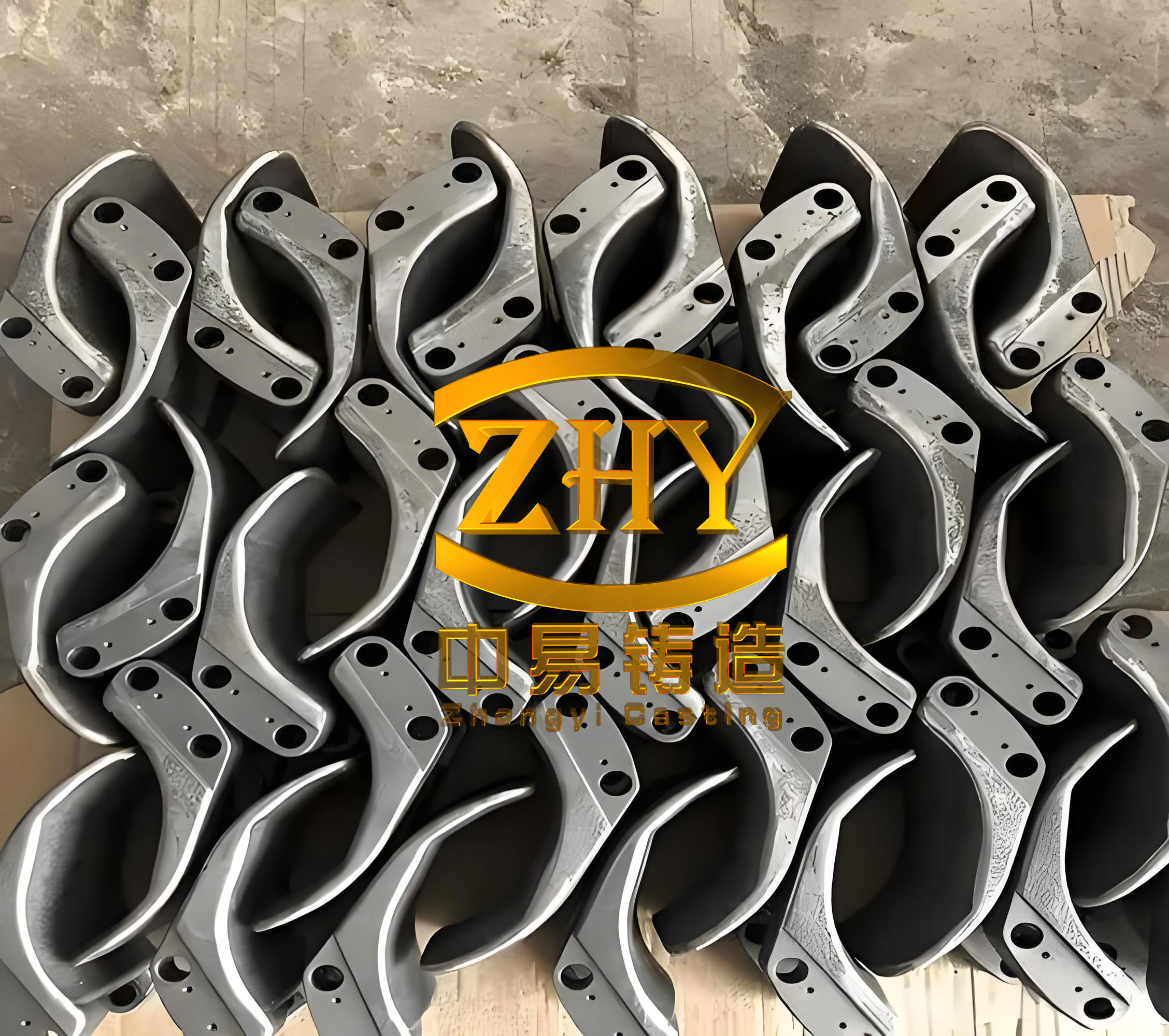
The image above illustrates the microstructure of ductile cast iron, highlighting the spherical graphite nodules that impart its ductility. In our project, we had to pour approximately 150 tons of molten iron quickly to prevent microstructural variations, which required precise coordination of melting, inoculation, and spheroidization processes. The mechanical performance of ductile cast iron can be described by equations such as the Hollomon equation for strength: $$ \sigma = K \cdot \epsilon^n $$ where \( \sigma \) is the true stress, \( \epsilon \) is the true strain, \( K \) is the strength coefficient, and \( n \) is the strain-hardening exponent. For ductile cast iron, \( n \) tends to be higher than in other cast irons, contributing to its toughness. Additionally, fracture toughness, a critical parameter for safety-critical components, is given by: $$ K_{IC} = Y \cdot \sigma \cdot \sqrt{\pi a} $$ where \( K_{IC} \) is the fracture toughness, \( Y \) is a geometry factor, \( \sigma \) is the applied stress, and \( a \) is the crack length. Our testing on the container cylinder involved extracting samples for tensile, impact, and fracture toughness evaluations to validate these properties.
| Property | Value Range | Importance for Container Cylinder |
|---|---|---|
| Tensile Strength | 400-900 MPa | Resists internal pressures and loads |
| Elongation at Break | 10-25% | Provides ductility under deformation |
| Impact Toughness (at -40°C) | 15-30 J | Ensures performance in cold environments |
| Fracture Toughness (\( K_{IC} \)) | 30-60 MPa√m | Prevents catastrophic crack propagation |
| Hardness (Brinell) | 150-300 HB | Balances wear resistance and machinability |
In my work, I have found that the success of such projects hinges not only on material science but also on collaborative knowledge sharing. The recent global forum on casting technologies, which I attended, underscored this point. Experts discussed topics like the use of inorganic binders in ductile cast iron production, quality control metrics for recycled sand, and applications in 3D printing. One key takeaway was the importance of optimizing process parameters to enhance the performance of ductile cast iron. For example, the inoculation process, which promotes graphite nodulation, can be modeled using kinetic equations: $$ \frac{dN}{dt} = k \cdot (C – C_{eq}) $$ where \( N \) is the number of nodules, \( t \) is time, \( k \) is a rate constant, \( C \) is the concentration of inoculant, and \( C_{eq} \) is the equilibrium concentration. This helps in predicting microstructure development during solidification.
Looking ahead, I believe that the integration of technologies like micro-casting-forging with advanced materials like ductile cast iron will drive further innovations. For instance, additive manufacturing techniques can be combined with traditional casting to produce complex geometries with tailored properties. In my view, the future lies in hybrid processes that leverage the strengths of both casting and forging, while minimizing drawbacks. This is especially relevant for industries such as energy, automotive, and aerospace, where components must endure extreme conditions. The use of ductile cast iron in these sectors is expanding due to its cost-effectiveness and reliability. To quantify this, we can consider the economic impact through a simple cost-benefit analysis: $$ \text{Net Benefit} = \sum (R – C) \cdot (1 + i)^{-t} $$ where \( R \) is revenue from increased lifespan, \( C \) is production cost, \( i \) is the discount rate, and \( t \) is time. For ductile cast iron components, the extended service life often yields positive net benefits.
In conclusion, from my perspective as an industry insider, the advancements in micro-casting-forging and ductile cast iron applications represent a paradigm shift in manufacturing. These technologies address longstanding challenges such as part integrity, production efficiency, and environmental sustainability. By repeatedly utilizing ductile cast iron in various forms—from large containers to precision parts—we can achieve superior mechanical performance and economic gains. The ongoing research and collaboration in forums and projects ensure that these innovations will continue to evolve, paving the way for a more resilient and efficient industrial landscape. As I reflect on these developments, I am optimistic about the potential for further breakthroughs that will redefine how we design and produce metal components.