
In my experience as a casting engineer, addressing shrinkage porosity in complex castings, particularly those made from special alloy gray iron, is a critical challenge that requires a multifaceted approach. This article delves into a detailed analysis of shrinkage defects in a diesel engine frame used in high-speed railway traction locomotives, and presents改进 methods that not only resolve the issue but also offer insights applicable to other materials like nodular cast iron. The铸件 structure is intricate, with wall thicknesses ranging from 15 mm to 120 mm, and material requirements介于 GG30 and GG35, with specific alloy additions that exceed常规灰铸铁. This combination leads to unique solidification characteristics, making the铸件 prone to shrinkage porosity in key regions, such as加工三连孔 areas. Through this discussion, I aim to share practical solutions involving temperature field simulation, statistical process control (SPC), and工艺 adjustments, while drawing parallels to nodular cast iron to highlight universal principles in casting quality control.
The铸件 in question, a special alloy gray iron frame, demands high mechanical properties: tensile strength over 258 MPa in critical sections, hardness between 170-269 HBW, and a microstructure comprising over 90% type A graphite with a fineness等级 of 4 or finer, and less than 2% carbide volume fraction. Such specifications necessitate careful control of alloying elements, including Si, Cu, Cr, Mo, and others, as outlined in Table 1. However, the壁厚 variations create significant thermal gradients during solidification, leading to倾向性缩松 defects, primarily at the 4 and 7 o’clock positions of small holes in the加工 areas. These defects manifest as irregular, tear-shaped pores under microscopic examination, confirming them as shrinkage porosity resulting from inadequate feeding during the液态收缩 and凝固收缩 phases. Understanding this mechanism is crucial not only for gray iron but also for materials like nodular cast iron, where similar issues can arise due to graphitization expansion differences.
| Element | Content Range |
|---|---|
| CE | 3.60–3.90 |
| C | 3.05–3.30 |
| Si | 1.55–2.10 |
| Mn | 0.65–1.10 |
| P | ≤0.09 |
| S | 0.03–0.10 |
| Ni | ≤0.60 |
| Cr | ≤0.20 |
| Mo | 0.40–0.60 |
| Cu | 0.40–0.60 |
To effectively combat shrinkage porosity, I first employed MAGMA simulation software to analyze the铸件 temperature field. The initial工艺 design, labeled as Scheme A, revealed concentrated hot spots near the inner gates in critical regions, exacerbating shrinkage risks. By重新布置内浇道位置 and implementing激冷措施 such as chills, Scheme B achieved a more uniform temperature distribution, reducing thermal junctions and promoting directional solidification. The comparison is illustrated through temperature contours, where Scheme B shows lower temperature gradients in problematic areas. This approach aligns with principles used in nodular cast iron production, where controlling solidification fronts is vital to minimize microshrinkage. The governing heat transfer equation during solidification can be expressed as:
$$ \frac{\partial T}{\partial t} = \alpha \nabla^2 T + \frac{L}{c_p} \frac{\partial f_s}{\partial t} $$
where \( T \) is temperature, \( t \) is time, \( \alpha \) is thermal diffusivity, \( L \) is latent heat, \( c_p \) is specific heat, and \( f_s \) is solid fraction. Optimizing this through simulation helps in predicting shrinkage zones accurately.
In parallel, I utilized SPC statistical process control to monitor key parameters, recognizing that fluctuations in pouring temperature and alloy content can significantly influence shrinkage tendencies. For instance, using Xbar-R control charts, I observed that浇注温度, Si, Cu, and Cr levels exhibited excessive variability over time, as shown in Figure 6. By adjusting the pouring temperature to a tighter range of 1370–1390°C and controlling Si content to 1.8–2.0%, Cu to 0.45–0.55%, and Cr to below 0.15%, the process stability improved, reducing the propensity for shrinkage. This methodology is equally applicable to nodular cast iron, where elements like Mg and Ce play critical roles in nodule formation and can affect shrinkage if not controlled. The relationship between alloy content and shrinkage can be modeled using empirical formulas, such as:
$$ S_r = k_1 \cdot \Delta T + k_2 \cdot [Si] + k_3 \cdot [Cu] + k_4 \cdot [Cr] $$
where \( S_r \) represents the shrinkage risk factor, \( \Delta T \) is the pouring temperature deviation, and \( k_1, k_2, k_3, k_4 \) are material-specific coefficients. For nodular cast iron, similar equations can incorporate [Mg] and [Ce] terms.
| Parameter | Target Mean | Upper Control Limit (UCL) | Lower Control Limit (LCL) |
|---|---|---|---|
| Pouring Temperature (°C) | 1380.5 | 1393.6 | 1367.4 |
| Si Content (%) | 1.98 | 2.15 | 1.80 |
| Cu Content (%) | 0.535 | 0.595 | 0.476 |
| Cr Content (%) | 0.117 | 0.175 | 0.058 |
The改进措施 were validated through destructive testing and penetrant inspection (PT) of the castings, which showed no缺陷显示 in the previously problematic regions. This success underscores the importance of proactive quality management. Extending these lessons to nodular cast iron, I note that while nodular cast iron benefits from graphitization expansion that can compensate for shrinkage, improper工艺 can still lead to porosity. For example, in nodular cast iron, the volume change during solidification is given by:
$$ \Delta V = V_l \cdot \beta_l \cdot \Delta T_l + V_s \cdot \beta_s \cdot \Delta T_s – \Delta V_g $$
where \( \Delta V \) is the net volume change, \( V_l \) and \( V_s \) are liquid and solid volumes, \( \beta_l \) and \( \beta_s \) are thermal expansion coefficients, \( \Delta T_l \) and \( \Delta T_s \) are temperature changes, and \( \Delta V_g \) is the expansion due to graphite precipitation. In nodular cast iron, \( \Delta V_g \) can be significant, but if the cooling rate is too high or alloying is imbalanced, shrinkage pores may form. Thus, the same SPC and simulation tools are invaluable.
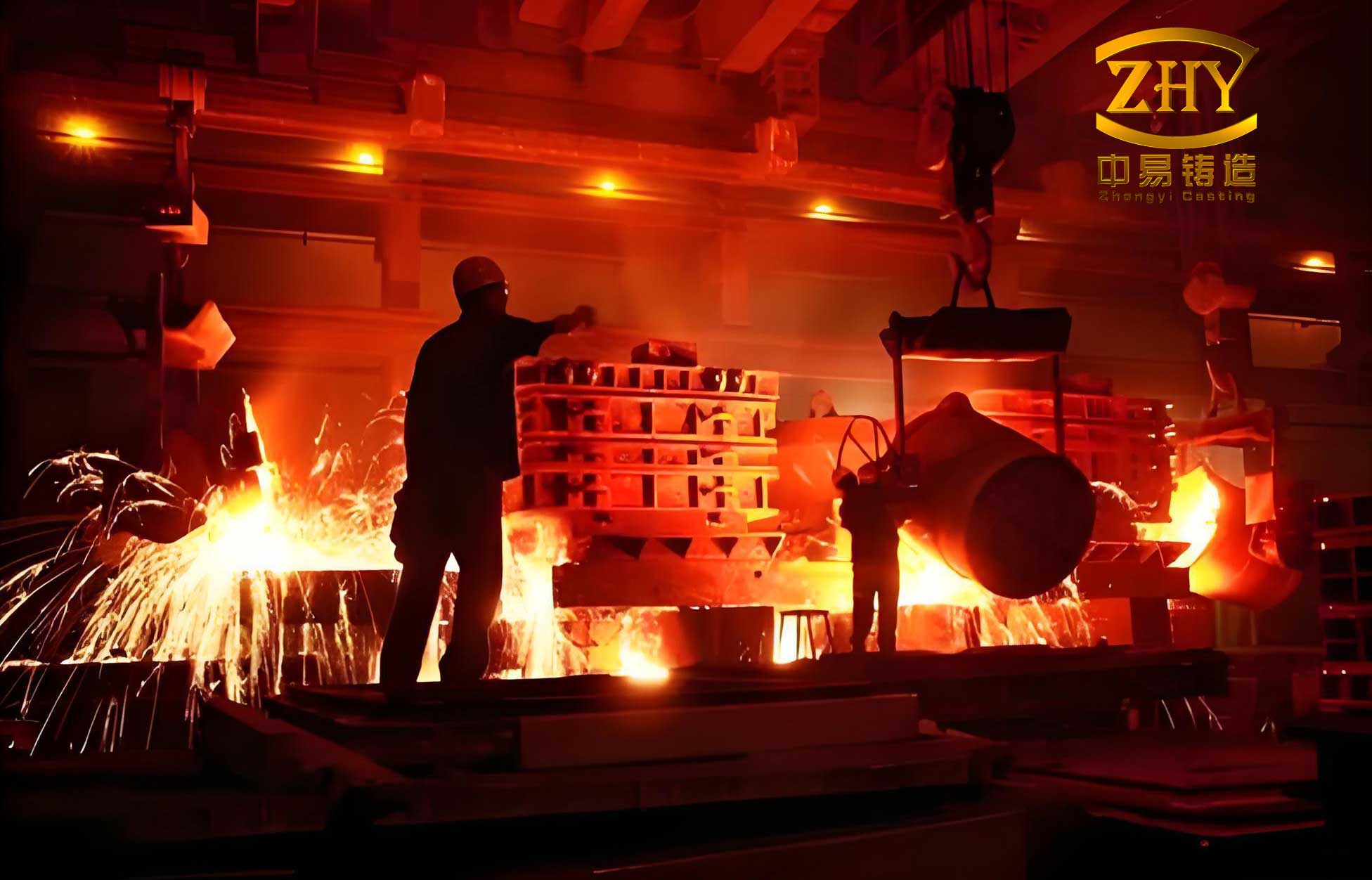
In practice, for both gray and nodular cast iron, I recommend integrating SPC from the early stages of production. By monitoring parameters like pouring temperature, chemical composition, and mold properties in real-time,异常点 or trends can be detected promptly, preventing batch quality issues. This reduces质量控制成本 and质量损失 significantly. For nodular cast iron, additional parameters such as nodule count and shape factor should be included in SPC charts. A comparative analysis between gray and nodular cast iron regarding shrinkage is summarized in Table 3.
| Aspect | Gray Iron | Nodular Cast Iron |
|---|---|---|
| Primary Shrinkage Mechanism | Liquid and solidification contraction without significant expansion | Graphitization expansion can offset contraction, but microshrinkage occurs if expansion is insufficient |
| Key Alloying Elements Affecting Shrinkage | Si, Cu, Cr, Mo | Mg, Ce, Si, Cu |
| Typical Shrinkage Porosity Morphology | Irregular, tear-shaped pores in interdendritic regions | Small, dispersed pores often associated with graphite nodules |
| Recommended Process Controls | Temperature field simulation, chills, SPC on pouring temperature and alloys | Similar simulation, but with focus on nodularization treatment, SPC on Mg residuals and cooling rates |
| Common Defect Locations | Hot spots near thick sections and gate areas | Last-to-freeze zones, especially in heavy sections |
Furthermore, the use of advanced simulation tools allows for optimizing gating and risering systems. For the gray iron frame, modifying the inner gate位置 reduced thermal节, a principle that applies equally to nodular cast iron. The effectiveness of chills can be quantified using the Chilling Power Index \( CPI \), defined as:
$$ CPI = \frac{k \cdot A \cdot (T_m – T_c)}{V} $$
where \( k \) is thermal conductivity of the chill material, \( A \) is contact area, \( T_m \) is melt temperature, \( T_c \) is chill initial temperature, and \( V \) is volume of the region. Higher CPI values enhance directional solidification, reducing shrinkage risks in both materials.
In terms of chemical control, for nodular cast iron, maintaining optimal Mg levels (typically 0.03–0.06%) is crucial to ensure proper nodularization without excessive dross formation that could entrap shrinkage pores. The relationship between Mg content and shrinkage can be described by:
$$ P_s = C_1 \cdot e^{-C_2 \cdot [Mg]} + C_3 $$
where \( P_s \) is the probability of shrinkage, and \( C_1, C_2, C_3 \) are constants derived from experimental data. This highlights the need for precise alloy addition control, similar to the Si and Cu controls in gray iron.
The validation phase involved extensive testing, including mechanical property checks and microstructure analysis. For the gray iron frame, after implementing the改进, tensile strength exceeded 260 MPa, hardness ranged within 180-250 HBW, and graphite morphology met specifications. These results confirm that the combined approach of simulation and SPC is effective. For nodular cast iron, analogous validation would involve measuring nodule count (aiming for 100-150 nodules/mm²) and ensuring absence of shrinkage via ultrasonic testing.
In conclusion, addressing shrinkage porosity in special alloy gray iron castings requires a holistic strategy encompassing temperature field optimization, rigorous process control, and continuous monitoring. The methods discussed—such as MAGMA simulation for redesigning gates and applying chills, and SPC for stabilizing key parameters—have proven successful in eliminating defects in critical applications. Moreover, these techniques are highly transferable to nodular cast iron production, where similar challenges with solidification and alloy sensitivity exist. By proactively applying SPC throughout the production cycle, engineers can mitigate batch quality risks, thereby reducing costs and enhancing reliability. This integrated approach not only solves immediate problems but also fosters a culture of quality excellence in foundry operations, benefiting a wide range of ferrous castings, including both gray and nodular cast iron. As casting technologies evolve, the synergy between simulation, statistics, and material science will continue to drive improvements, making processes more robust and efficient.
To further elaborate, I often consider the economic implications of these改进. For instance, by reducing scrap rates from shrinkage defects by even 5%, significant savings can be achieved in high-volume production of nodular cast iron components like crankshafts or gears. The cost of implementing SPC and simulation is offset by the reduction in rework and warranty claims. Additionally, in nodular cast iron, the impact of cooling rate on microstructure is critical; faster cooling can refine graphite nodules but increase shrinkage risk if not managed. Therefore,平衡 these factors through controlled工艺 is essential. Finally, I encourage foundries to invest in training for SPC and simulation tools, as they are indispensable for modern casting quality assurance across all iron grades, from gray to nodular cast iron.