
In the field of advanced materials engineering, nodular cast iron stands out as a functional material with high strength and elongation, playing an irreplaceable role in various industrial sectors. Particularly, low-temperature nodular cast iron is critical for applications in harsh environments, such as components for petroleum, natural gas, and petrochemical equipment in cold regions, as well as parts for engineering machinery, locomotives, high-speed rail, and wind power generation systems. The production of heavy-section nodular cast iron castings, however, presents significant challenges due to issues like graphite flotation, fragmentation, slag inclusions, and graphite distortion in thick sections. This article delves into the smelting production process for QT350-22AL conical support castings, which require stable low-impact properties at ultra-low temperatures (-40°C). Through meticulous control of chemical composition, innovative use of spheroidizing agents, and optimized inoculation practices, we have developed a reliable method to produce these demanding nodular cast iron components.
The conical support, a key component in wind power equipment, exemplifies the stringent requirements for heavy-section low-temperature nodular cast iron. According to standards such as GB/T 1348-2009, castings with wall thicknesses exceeding 60 mm but less than 200 mm must meet specific mechanical properties in attached test blocks (70 mm thick), including tensile strength ≥320 MPa, yield strength ≥220 MPa, elongation ≥15%, and an average impact energy ≥10 J at -40°C. Given that this casting has an average wall thickness of 80 mm and flange areas up to 300 mm, it falls into the category of heavy-section nodular cast iron, necessitating advanced smelting techniques to overcome the aforementioned defects. In this study, I focus on optimizing chemical composition, employing a combination of light and heavy rare earth spheroidizers, and implementing on-site ladle spheroidizing with multiple inoculation treatments to ensure consistent quality and performance.
The selection and control of chemical composition are foundational to achieving the desired properties in nodular cast iron. Each element plays a crucial role in microstructure and mechanical behavior, as summarized in Table 1 below, which outlines their effects and optimal ranges for low-temperature heavy-section applications.
| Element | Role in Nodular Cast Iron | Optimal Range for QT350-22AL | Rationale |
|---|---|---|---|
| Carbon (C) | Promotes graphitization, increases graphite nodule count, improves fluidity, reduces shrinkage | 3.5–4.0% (final) | Higher carbon enhances graphite formation and minimizes chilling tendency; however, excessive carbon can lead to graphite flotation in thick sections. |
| Silicon (Si) | Strong graphitizer, promotes ferrite formation, solid-solution strengthens ferrite but embrittles if too high | 1.7–2.0% (final) | Lower silicon content (below 2.0%) helps avoid chunk graphite formation in heavy sections while maintaining elongation; base iron silicon should be 0.6–1.0%. |
| Manganese (Mn) | Stabilizes pearlite, but segregates at grain boundaries, forming carbides that reduce toughness | ≤0.2% | Low manganese is essential for high toughness; high-purity pig iron is used to minimize manganese content. |
| Phosphorus (P) | Harmful element, forms phosphide eutectics that degrade mechanical properties | ≤0.04% | Kept as low as possible to prevent brittleness and segregation. |
| Sulfur (S) | Detrimental to nodularization, but some sulfur is needed for effective spheroidizing reactions | ≤0.02% (base iron) | Controlled low levels ensure proper spheroidizer performance without excessive slag formation. |
| Antimony (Sb) | Refines graphite nodules, promotes pearlite, but must be limited in ferritic grades | ≤0.008% | Trace amounts help prevent graphite distortion in heavy sections without compromising ferrite content. |
| Residual Rare Earth (RE) | Ensures spherical graphite growth, but excess increases chilling tendency and shrinkage | 0.01–0.03% | Balanced residual levels support nodularization while minimizing defects. |
| Residual Magnesium (Mg) | Essential for graphite spheroidization, similar to rare earth in effects | 0.03–0.05% | Optimal range ensures full spheroidization without excessive reactivity or porosity. |
From a thermodynamic perspective, the interaction of these elements can be modeled using equations that describe graphitization and phase transformations. For instance, the graphitization process in nodular cast iron involves the decomposition of cementite (Fe3C) into graphite and iron, which can be expressed as:
$$ \text{Fe}_3\text{C} \rightarrow 3\text{Fe} + \text{C}_{\text{graphite}} $$
This reaction is influenced by silicon content, as silicon lowers the activity of carbon in iron, promoting graphite formation. The effect of silicon on the eutectic temperature can be approximated by:
$$ T_{\text{eutectic}} = T_0 – k_{\text{Si}} \cdot [\text{Si}] $$
where \( T_0 \) is the eutectic temperature for pure Fe-C system, \( k_{\text{Si}} \) is a constant, and \( [\text{Si}] \) is the silicon concentration. Similarly, the role of manganese in stabilizing pearlite can be described by its impact on the austenite-to-pearlite transformation temperature, following an equation like:
$$ T_{\text{A→P}} = T_{\text{A→P}}^0 – \alpha [\text{Mn}] $$
where \( T_{\text{A→P}}^0 \) is the transformation temperature without manganese, and \( \alpha \) is a coefficient. These formulas highlight the delicate balance required in chemistry control for low-temperature nodular cast iron.
Temperature management during smelting is another critical factor. Overheating the molten iron above 1500°C helps dissolve coarse graphite from pig iron and reduce oxide inclusions, which is vital for heavy-section nodular cast iron. The process involves heating the base iron to 1360–1400°C for slag removal and composition adjustment, then superheating to 1500–1540°C. For spheroidization, the temperature must be carefully controlled: too high causes excessive burning of spheroidizers, while too low leads to incomplete reactions. We employ an on-site ladle spheroidizing technique, where the molten iron is transferred to a spheroidizing ladle at 1400–1450°C. This method allows precise temperature control and rapid cooling, preserving the innate nucleation rate of the iron. The pouring temperature is set at 1330–1370°C to balance fluidity and shrinkage prevention.
The choice of raw materials is equally important. We use low-impurity Q10 pig iron with minimal trace elements (especially Ti and V), low-manganese scrap steel, and graphite-based carburizers to enhance graphite nucleation. Charge materials are added strategically: scrap steel early in the melt, pig iron later to reduce nucleation loss, and returns (from cleaned risers of previous castings) in the mid-to-late stages. Carburizer is added initially with scrap steel, with a 0.1% reserve for pretreatment. Ferrosilicon (75% Si) is used for final silicon adjustment. This approach ensures a clean, homogeneous melt conducive to producing high-quality nodular cast iron.
Spheroidization and inoculation are the heart of nodular cast iron production. For heavy-section castings, we combine light and heavy rare earth spheroidizers to leverage their complementary benefits: light rare earths improve nodularization efficiency, while heavy rare earths enhance resistance to fading. The spheroidizer addition rate ranges from 0.9% to 1.3%, with equal parts of light and heavy rare earth types. The on-site ladle spheroidizing process involves multiple inoculation steps to maximize graphite nucleation. Inoculants with 2–4% barium are used, with grain sizes of 5–15 mm. The inoculation sequence includes: primary inoculation in the transfer ladle (0.2–0.4%), secondary inoculation in the spheroidizing ladle (0.3–0.6%), tertiary inoculation in the pouring ladle (0.05–0.15%), and instantaneous inoculation during pouring using cerium-containing inoculant (0.05–0.2%, grain size 0.5–1.5 mm). This multi-stage treatment promotes the formation of fine, round graphite nodules and refines the ferritic matrix.
The mechanisms behind these processes can be described through chemical reactions. For example, during spheroidization, magnesium and rare earths react with sulfur and oxygen in the molten iron:
$$ \text{Mg} + \text{S} \rightarrow \text{MgS} $$
$$ 2\text{RE} + 3\text{O} \rightarrow \text{RE}_2\text{O}_3 $$
These reactions form sulfide and oxide particles that serve as heterogeneous nucleation sites for graphite. Similarly, inoculation with silicon-barium alloys introduces additional nuclei, increasing the graphite nodule count. The effectiveness of inoculation can be quantified by the nodule count per unit area, which is crucial for mechanical properties. The relationship between inoculation practice and nodule density \( N_v \) can be expressed as:
$$ N_v = k \cdot \exp\left(-\frac{Q}{RT}\right) \cdot [\text{Inoculant}]^n $$
where \( k \) is a constant, \( Q \) is the activation energy, \( R \) is the gas constant, \( T \) is the temperature, and \( n \) is an exponent. This underscores the importance of precise control in producing nodular cast iron.
To validate our smelting process, we produced conical support castings and evaluated attached test blocks (70 mm thick). The results, summarized in Table 2, demonstrate consistent achievement of target properties for low-temperature nodular cast iron. The test blocks exhibited excellent tensile strength, yield strength, elongation, and impact energy at -40°C, all exceeding standard requirements.
| Sample No. | Tensile Strength (MPa) | Yield Strength (MPa) | Elongation (%) | Hardness (HBW) | Avg. Impact Energy at -40°C (J) | Graphite Morphology (Grade) | Pearlite Content (%) |
|---|---|---|---|---|---|---|---|
| 1 | 425 | 275 | 16.5 | 129 | 13.8 | 2 | 5 |
| 2 | 415 | 270 | 16.0 | 129 | 13.2 | 2 | 5 |
| 3 | 435 | 285 | 15.0 | 143 | 12.1 | 2 | 5 |
| 4 | 425 | 275 | 16.5 | 143 | 12.5 | 2 | 5 |
| 5 | 430 | 280 | 16.0 | 143 | 13.1 | 2 | 5 |
| 6 | 405 | 265 | 16.5 | 143 | 13.7 | 2 | 5 |
| 7 | 415 | 270 | 17.5 | 143 | 12.8 | 2 | 5 |
| 8 | 410 | 265 | 16.0 | 143 | 14.1 | 2 | 5 |
| 9 | 410 | 265 | 15.5 | 129 | 13.6 | 2 | 5 |
| 10 | 410 | 265 | 16.0 | 129 | 13.5 | 2 | 5 |
| 11 | 400 | 260 | 16.5 | 129 | 12.7 | 2 | 5 |
| 12 | 420 | 275 | 15.0 | 131 | 13.2 | 2 | 5 |
| 13 | 425 | 280 | 15.0 | 131 | 13.8 | 2 | 5 |
| 14 | 420 | 275 | 15.0 | 131 | 12.7 | 2 | 5 |
| 15 | 390 | 255 | 18.0 | 129 | 13.2 | 2 | 5 |
| 16 | 425 | 275 | 16.0 | 130 | 12.2 | 2 | 5 |
| 17 | 376 | 320 | 18.5 | 123 | 15.9 | 2 | 5 |
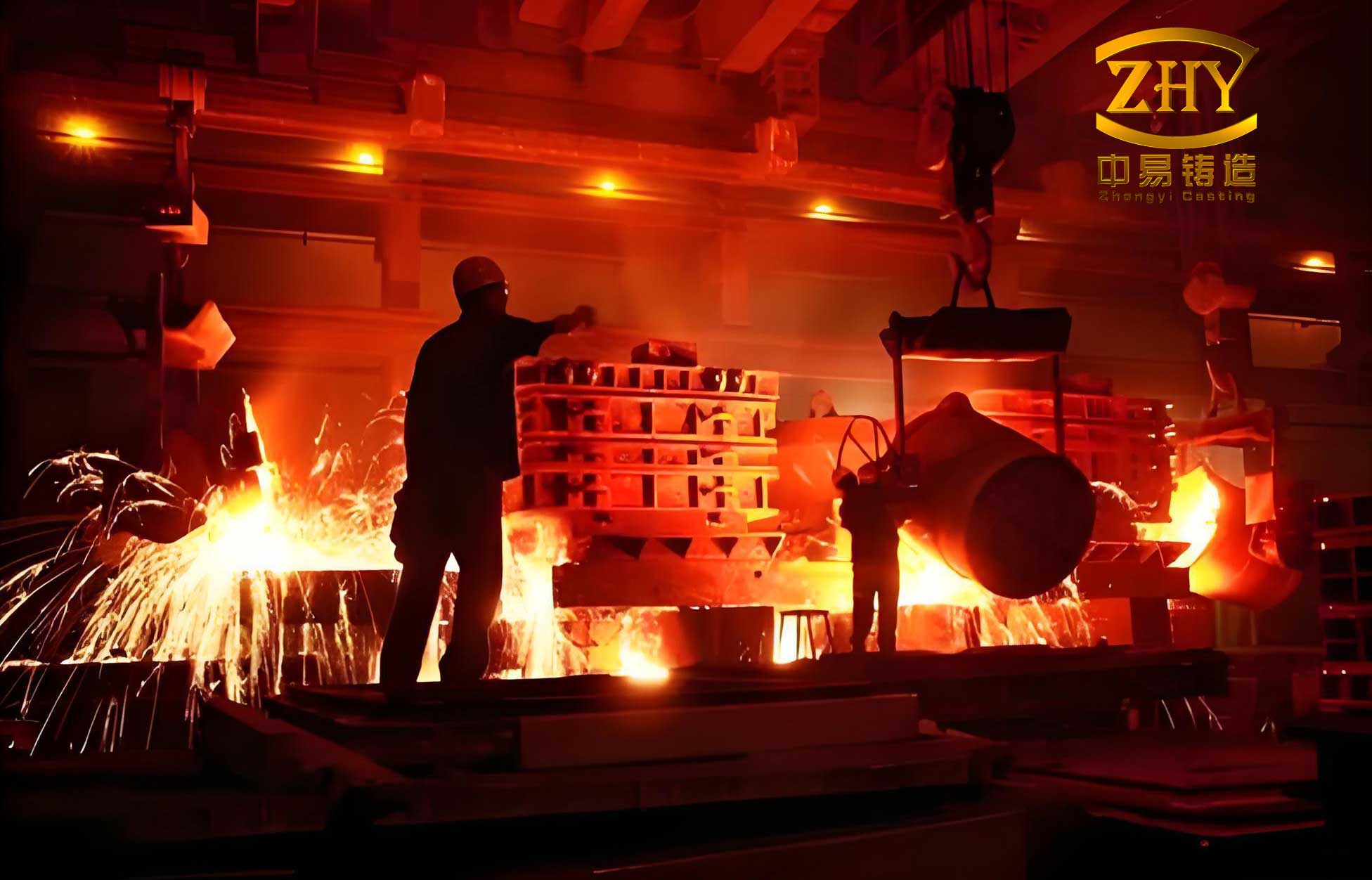
The microstructure of these test blocks, as observed through metallographic analysis, revealed fine, spherical graphite nodules uniformly distributed in a predominantly ferritic matrix. This is a testament to the effectiveness of our spheroidizing and inoculation strategy for heavy-section nodular cast iron. The graphite morphology was rated as grade 2 (excellent), with pearlite content below 5%, ensuring high toughness and low-temperature impact resistance. The image below illustrates a typical microstructure of the nodular cast iron produced, showcasing the successful formation of graphite nodules without distortion or floating slag.
Further analysis of the process reveals that the combination of light and heavy rare earth spheroidizers, coupled with multiple inoculations, significantly enhances the nucleation potency of the molten iron. The on-site ladle spheroidizing technique not only controls temperature but also creates a favorable environment for successive inoculations, each contributing to a higher nodule count. The role of antimony in trace amounts cannot be overlooked; it refines graphite and prevents畸变 in thick sections, which is critical for maintaining the integrity of nodular cast iron in heavy-section applications. The overall process can be modeled using kinetic equations for nodule growth, such as:
$$ \frac{dN}{dt} = A \cdot \exp\left(-\frac{E_a}{RT}\right) \cdot (C – C_{\text{eq}})^m $$
where \( N \) is the nodule count, \( t \) is time, \( A \) is a pre-exponential factor, \( E_a \) is activation energy, \( C \) is carbon concentration, \( C_{\text{eq}} \) is equilibrium concentration, and \( m \) is an exponent. This highlights the dynamic nature of nodular cast iron formation during smelting.
In conclusion, the production of heavy-section low-temperature nodular cast iron requires a holistic approach encompassing precise chemical composition control, optimized temperature regimes, careful selection of raw materials, and advanced spheroidizing and inoculation practices. Our study demonstrates that by using a blend of light and heavy rare earth spheroidizers, implementing on-site ladle spheroidizing, and applying multiple inoculation stages, we can consistently produce QT350-22AL conical support castings that meet or exceed stringent mechanical and low-temperature impact requirements. The key to success lies in understanding the interplay between elements like silicon, manganese, and antimony, and leveraging them to enhance graphite nucleation and matrix refinement. This process not only addresses the challenges of graphite distortion and slag inclusion in thick sections but also paves the way for reliable manufacturing of nodular cast iron components for critical applications in extreme environments. Future work could explore the integration of computational modeling to further optimize the smelting parameters for different geometries of nodular cast iron castings.