
As a researcher deeply involved in the field of advanced materials for renewable energy, I have witnessed the pivotal role that nodular cast iron plays in the wind energy industry. The demand for clean and sustainable power sources has propelled wind energy to the forefront, and nodular cast iron, with its exceptional combination of strength, toughness, and corrosion resistance, has become a cornerstone material for critical wind turbine components. In this comprehensive discussion, I will delve into the development status, influencing factors, and future trajectories of nodular cast iron for wind power castings, emphasizing the intricate interplay of chemistry, microstructure, and processing. Throughout this exploration, the term “nodular cast iron” will be frequently highlighted to underscore its centrality.
The global wind energy sector is experiencing unprecedented growth, driven by policy incentives and technological advancements. According to industry projections, both onshore and offshore installations are set to reach new heights in the coming years. This expansion directly fuels the demand for high-integrity castings, where nodular cast iron is often the material of choice. Its advantages—excellent castability, machinability, and balanced mechanical properties—make it economically and technically viable for large, complex parts like hubs, gearboxes, bedplates, and planetary carriers. In emerging markets, the capacity for producing wind power castings from nodular cast iron is rapidly scaling up, while mature markets continue to refine their technologies. The relentless push towards larger and heavier wind turbine components, however, presents significant challenges for nodular cast iron, particularly in managing solidification defects and microstructural degradation in thick sections.
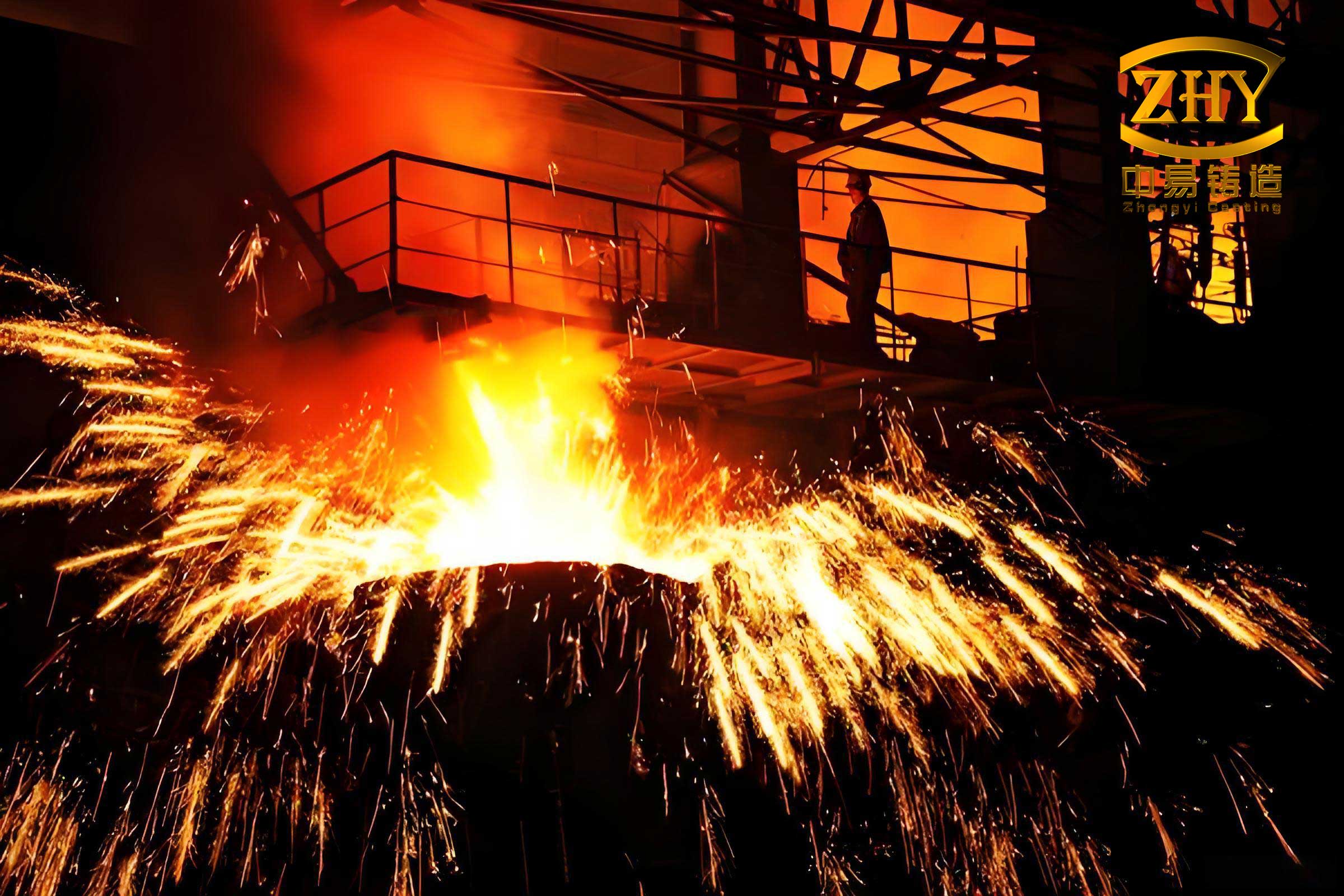
The performance of nodular cast iron is fundamentally governed by its microstructure, which consists of spheroidal graphite embedded in a metallic matrix. For wind power applications, the matrix is predominantly either ferritic or pearlitic, each selected based on the specific service requirements of the component. Ferritic nodular cast iron, with its high ductility and good low-temperature impact toughness, is mandated for parts like hubs and bedplates that require high reliability over decades. Pearlitic nodular cast iron, offering higher strength and wear resistance, is typically reserved for components like planetary carriers that endure severe torsional loads. The targeted microstructure and corresponding mechanical properties for various wind turbine castings are summarized in the table below.
| Grade Designation | Typical Wall Thickness (mm) | Tensile Strength (MPa), min | Yield Strength (MPa), min | Elongation (%), min | Ferrite Content (%), approx. | Primary Application |
|---|---|---|---|---|---|---|
| QT350-22AL | ≤ 200 | 320 – 350 | 200 – 220 | 15 – 22 | ≥ 90 | Hub, Bedplate |
| QT400-18AL | ≤ 200 | 370 – 400 | 220 – 240 | 12 – 18 | ≥ 90 | Hub, Gearbox Casing |
| QT700-2A | >60 – 200 | 660 | 380 | 1 | ≤ 10 | Planetary Carrier |
Achieving and consistently reproducing these microstructures in heavy-section nodular cast iron castings is a complex task influenced by a multitude of factors. The chemical composition acts as the foundational blueprint, dictating the phase formation and transformation behavior during solidification and cooling. Silicon is a quintessential element in nodular cast iron, primarily added to promote graphitization and solidify a ferritic matrix. However, its role is dual-edged. While increasing silicon content generally raises the ferrite fraction and refines graphite nodules, excessive silicon can lead to embrittlement, especially at low temperatures. This embrittlement can be conceptually related to the lattice strain induced by silicon atoms in solid solution, which impedes dislocation motion. The transition in fracture mode with increasing silicon can be qualitatively described by considering the competition between ductile and brittle failure mechanisms. The change in impact energy, $E_i$, might be empirically modeled as a function of silicon content, $C_{Si}$:
$$ E_i(C_{Si}) \approx E_0 – k \cdot (C_{Si} – C_0)^n $$
where $E_0$ is the impact energy at a reference silicon level $C_0$, and $k$ and $n$ are material constants reflecting the sensitivity to silicon. This underscores the need for precise control over silicon levels in nodular cast iron for wind power.
Beyond the major alloying elements, the strategic addition of trace elements and micro-alloys has emerged as a powerful tool to tailor the properties of nodular cast iron. These additions work by modifying the nucleation and growth kinetics of graphite and the matrix phases. For instance, lanthanum, often introduced via rare-earth-containing spheroidizers, can enhance graphite nodule count and uniformity. The effectiveness of such elements in increasing nodule count, $N_v$, can be thought of as providing additional heterogeneous nucleation sites. If we consider the nucleation rate, $I$, it may be enhanced by the presence of potent substrates introduced by these additives:
$$ I \propto \exp\left(-\frac{\Delta G^*}{kT}\right) $$
where $\Delta G^*$ is the activation energy barrier for nucleation, which is lowered by effective inoculant particles. Elements like bismuth and antimony are particularly interesting for heavy-section nodular cast iron. Bismuth, when balanced with sufficient rare earth content, loses its detrimental anti-nodularizing effect and instead acts as a potent inoculant, dramatically increasing graphite nodule count and suppressing the formation of degenerate “chunky graphite” in slow-cooling regions. Antimony is a strong pearlite promoter and can also refine graphite morphology. Their effects, along with others, are summarized in the following table.
| Element/Additive | Typical Addition Range (wt.%) | Primary Effect on Microstructure | Influence on Mechanical Properties | Key Consideration for Wind Power Castings |
|---|---|---|---|---|
| Bismuth (Bi) | 0.002 – 0.01 | Increases graphite nodule count; suppresses chunky graphite. | Improves ductility and toughness; may slightly reduce yield strength. | Critical for thick sections; must be balanced with RE. |
| Antimony (Sb) | 0.01 – 0.02 | Stabilizes pearlite; refines graphite. | Increases strength and hardness; reduces elongation. | Used for pearlitic grades (e.g., planetary carriers); excess causes brittleness. |
| Niobium (Nb) | 0.05 – 0.7 | Forms NbC carbides; refines pearlite lamellae. | Enhances strength through dispersion and refinement. | Can reduce nodularity if added in high amounts; use cautiously. |
| Modified Nano-VC Powder | ~0.1 | Provides numerous nucleation sites; refines both graphite and matrix grains. | Improves strength, toughness, and low-temperature impact properties. | Promising for high-performance grades; challenges with dispersion and agglomeration exist. |
The quest for enhanced performance has also led to the exploration of novel additive technologies. The incorporation of surface-modified nano-sized vanadium carbide powders, for example, represents a significant advancement. These nanoparticles, typically 20-80 nm in size, disperse within the melt and act as extremely efficient substrates for heterogeneous nucleation. The resultant microstructure exhibits a marked increase in graphite nodule density and a pronounced refinement of the ferritic grains. This grain refinement follows the well-known Hall-Petch relationship, where the yield strength, $\sigma_y$, increases with decreasing grain size, $d$:
$$ \sigma_y = \sigma_0 + \frac{k_y}{\sqrt{d}} $$
Here, $\sigma_0$ is the friction stress and $k_y$ is the strengthening coefficient. The nano-additives effectively decrease $d$, thereby boosting the strength and toughness of the nodular cast iron simultaneously—a crucial requirement for wind turbine components subjected to complex loading.
While chemistry sets the stage, the practical realization of high-quality nodular cast iron hinges on the spheroidization and inoculation treatments. These are the pivotal metallurgical operations that transform the graphite morphology from flake to spheroidal and ensure a fine, uniform microstructure. The spheroidizing agent, typically a magnesium-ferrosilicon alloy containing rare earths (like Ce or Y), is responsible for desulfurizing and deoxidizing the melt, creating conditions favorable for spheroidal graphite growth. The choice between light rare earth (e.g., Ce) and heavy rare earth (e.g., Y) spheroidizers is critical for heavy-section castings. Heavy rare earth elements offer superior fade resistance, meaning their nodularizing effect persists longer during the extended solidification of thick walls. This directly translates to better graphite nodularity in the casting’s thermal center, mitigating the risk of degenerated graphite forms.
Inoculation immediately follows or accompanies spheroidization to increase the number of graphite nuclei, promote a uniform distribution of nodules, and prevent carbide formation. For wind power nodular cast iron, especially thick-section variants,长效孕育剂 (long-lasting inoculants) containing elements like barium are preferred. Barium slows the diffusion of carbon and silicon in the melt, thereby prolonging the nucleation period and countering inoculation fade. The efficiency of an inoculant can be conceptualized in terms of its ability to maintain a high nucleation potential over time. If we denote the effective nucleus density at time $t$ as $N(t)$, its decay after addition might be modeled as:
$$ N(t) = N_0 \cdot \exp(-\beta t) $$
where $N_0$ is the initial nucleus density and $\beta$ is a fade rate constant. A superior inoculant for heavy-section nodular cast iron would have a very low $\beta$ value. The combined effect of optimized spheroidization and inoculation is often quantified by the nodularity percentage and the nodule count, which are directly correlated with the final mechanical properties. The relationship between ultimate tensile strength (UTS), nodule count ($N_v$), and nodularity ($\eta$) for ferritic nodular cast iron can be approximated by an empirical relationship:
$$ \text{UTS} \approx A + B \cdot \ln(N_v) + C \cdot \eta $$
where $A$, $B$, and $C$ are constants derived from experimental data for a given base composition.
Looking ahead, the development of nodular cast iron for wind power faces both persistent challenges and exciting opportunities. The first major challenge is the continuous enhancement of material properties. As turbines grow larger, components must withstand higher stresses and more aggressive environmental conditions without increasing weight prohibitively. This demands nodular cast iron grades with even better combinations of strength, ductility, and fatigue resistance, particularly at low temperatures. Research must focus on further refining microstructural control, potentially through advanced alloy designs combining multiple micro-additives and leveraging computational thermodynamics to predict phase stability. A second, equally critical challenge is the innovation and optimization of manufacturing processes. This includes not only refining melting, spheroidizing, and inoculation practices but also advancing casting design, gating, and risering to eliminate shrinkage porosity and segregation in massive castings. Simulation tools play an indispensable role here, modeling fluid flow, solidification, and stress development to guide process design virtually before any metal is poured.
Sustainability is becoming an inescapable driver for future development. The green manufacturing of nodular cast iron—minimizing energy consumption, reducing emissions, and maximizing the use of recycled scrap—will be paramount. This aligns with the very ethos of the wind energy industry. Furthermore, the integration of Industry 4.0 concepts, such as real-time process monitoring and adaptive control using sensor data and machine learning, holds the promise of achieving unprecedented consistency and quality in the production of wind power nodular cast iron castings. In my view, the future of nodular cast iron in this sector lies in smart, sustainable, and science-driven manufacturing. By deepening our understanding of the fundamental relationships between composition, processing, microstructure, and performance, we can engineer next-generation nodular cast iron materials that are not only stronger and tougher but also produced more efficiently and responsibly. The journey of nodular cast iron is far from over; it is evolving to meet the towering demands of modern wind energy, solidifying its position as an indispensable material in our pursuit of a cleaner future.
To encapsulate the complex interplay of factors, one can consider a holistic performance index, $P$, for wind power nodular cast iron, which might be formulated as a function of key variables:
$$ P = f(C_{\text{Si}}, C_{\text{RE}}, C_{\text{trace}}, N_v, \eta, d_{\gamma}, \lambda_P) $$
where $C_{\text{Si}}$ is silicon content, $C_{\text{RE}}$ is rare earth content, $C_{\text{trace}}$ represents trace element additions, $N_v$ is nodule count, $\eta$ is nodularity, $d_{\gamma}$ is ferrite grain size, and $\lambda_P$ is pearlite interlamellar spacing (if applicable). Optimizing this multi-variable function through coordinated adjustments in chemistry and processing is the ultimate goal in advancing nodular cast iron technology for wind energy applications. The continued prominence of nodular cast iron in this field is a testament to its versatility and potential, and through sustained research and development, its capabilities will only expand further.