
The pursuit of higher machining quality standards in diesel engine cylinder liners has inadvertently unveiled a significant casting defect characterized by irregular, dark patches on the machined outer surface. This phenomenon, distinct from the more commonly documented “cloudy spot” or “white spot” defects, leads to a perceptible increase in rejection rates. From my extensive involvement in centrifugal casting processes, I have observed that these black spots are not merely superficial discolourations but are manifestations of profound microstructural inhomogeneity. This article systematically investigates the root causes of these defects through comparative experimentation, focusing on the unique solidification conditions inherent to centrifugal casting of ferrous alloys, including nodular cast iron. The analysis encompasses the influence of inoculation practices, pouring parameters, cooling regimes, machining conditions, and critically, equipment stability. Based on the elucidated mechanisms, effective and practical control measures are proposed and validated.
The foundational material for this study is a vanadium-titanium alloyed grey cast iron, typical for high-duty cylinder liners. Its chemical composition is carefully controlled, as summarized in the table below.
| Element | Content Range, w% |
|---|---|
| C | 3.1 – 3.4 |
| Si | 2.3 – 2.5 |
| Mn | 0.7 – 0.8 |
| P | 0.3 – 0.4 |
| S | ≤ 0.1 |
| Cr | ≤ 0.4 |
| V | 0.25 – 0.35 |
| Ti | 0.05 – 0.15 |
| Fe | Balance |
Initial metallographic examination of the black spot regions reveals a microstructure dominated by coarse Type A graphite, accompanied by a hardness depression of approximately 10-30 HB compared to the surrounding normal matrix. This confirms that the defect is fundamentally a segregation issue. Segregation, the non-uniform distribution of alloying elements and phases, is a common challenge in casting. In centrifugal processes, it is exacerbated by both conventional microsegregation within the solidifying grains and macro-segregation driven by centrifugal forces and differential densities of liquid phases. The principles governing segregation in nodular cast iron, particularly concerning elements like Mn which retard ferrite nucleation, are highly relevant. Mn segregation can be described in part by the Scheil-Gulliver equation for non-equilibrium solidification:
$$ C_s = k C_0 (1 – f_s)^{k-1} $$
where \( C_s \) is the solute concentration in the solid, \( k \) is the partition coefficient, \( C_0 \) is the initial liquid concentration, and \( f_s \) is the fraction solidified. For elements with \( k < 1 \) (like Mn, P, S in iron), the last liquid to solidify becomes enriched, leading to interdendritic or intergranular segregation. In the forceful field of a centrifuge, these density gradients can lead to pronounced inverse segregation patterns.
The experimental approach was designed to isolate and evaluate the contribution of various production parameters suspected of influencing black spot formation. A series of controlled comparative tests were conducted.
1. Influence of Inoculant Dissolution
The hypothesis was that incomplete dissolution of ferrosilicon inoculant (75%SiFe) at lower pouring temperatures could create local pockets of high silicon concentration, leading to inconsistent graphite nucleation and growth. Tests were performed with varying pour temperatures and inoculant particle sizes.
| Test Condition | Pour Temp. | Inoculant (Size) | Samples | Black Spot Count |
|---|---|---|---|---|
| High Temp. | 1350-1420°C | Standard (1-2 mm) | 10 | 0 |
| Low Temp. | 1280-1320°C | Standard (1-2 mm) | 10 | 2 |
| Very Low Temp. | ~1250°C | Coarse (5-8 mm) | 20 | 0 |
The results were instructive. While low temperature with standard inoculant showed some incidence, forcing severe non-dissolution with coarse inoculant at very low temperature did not produce the defect. This indicates that localized silicon enrichment from undissolved inoculant is not a primary or sufficient cause. The solidification dynamics in nodular cast iron are highly sensitive to inoculation, but the mechanism here appears different.
2. Influence of Pouring Speed
A slow pour was theorized to promote laminar flow and layer-by-layer solidification, potentially freezing in compositional banding. Conversely, a very fast pour might reduce thermal gradients.
| Pouring Speed | Duration | Samples | Black Spot Count |
|---|---|---|---|
| Fast | ~8 s | 10 | 3 |
| Slow | >30 s | 10 | 1 |
The data contradicts the initial hypothesis; faster pouring correlated with a higher defect rate. This suggests that the speed of mold filling interacts complexly with the thermal field and fluid flow, but is not a direct, dominant factor.
3. Influence of Bulk Hardness and Microstructure
Since black spots are softer, an attempt was made to elevate the overall hardness of the liner, thereby bringing the soft spot hardness into the acceptable specification range and reducing the relative difference.
| Hardness Level | Typical HB | Samples | Black Spot Count |
|---|---|---|---|
| Normal (Low) | 230 ± 5 | 30 | 3 |
| Elevated (High) | 245 ± 5 | 30 | 4 |
The defect persisted irrespective of the base hardness. This confirms that the absolute hardness value is not the cause; rather, it is the local deviation in microstructure (graphite size, matrix phases) that creates the hardness differential and the visual contrast. The quest for uniform microstructure is as critical in high-strength grey iron as it is in nodular cast iron.
4. Influence of Cooling and Solidification Conditions
This factor proved to be paramount. The standard production practice involved a “delayed cooling” method: after pouring, the mold rotated for a set period before cooling water was applied. This creates a specific thermal history. Alternative cooling strategies were tested.
| Cooling Method | Description | Samples | Black Spot Count |
|---|---|---|---|
| Air Cool | Natural cooling in mold, no water | 20 | 0 |
| Forced Water Cool | Immediate & intensive water cooling | 20 | 0 |
| Standard Delay Cool | Delay, then moderate water cooling | 20 | 3 |
The results are highly significant. Both extreme cooling conditions suppressed the defect, while the standard industrial practice promoted it. The mechanism can be explained through solidification kinetics. Air cooling allows for a very slow solidification front, permitting sufficient time for diffusion to homogenize the melt and for density-driven (gravity/centrifugal) segregation to reach a more stable, uniform state before the loss of fluidity. Forced water cooling creates a very high thermal gradient (\( G \)) and rapid solidification rate (\( R \)), freezing the microstructure almost instantaneously and “locking in” the near-original homogeneous liquid composition. The critical parameter is the local solidification time \( t_f \), approximated by:
$$ t_f = \frac{\Delta T_f}{G \cdot R} $$
where \( \Delta T_f \) is the freezing range. The standard delayed cooling creates an intermediate condition: a brief period of slow cooling in the mushy zone allows for the initiation of solute redistribution and buoyancy-driven convection of enriched liquid, but the subsequent rapid quench freezes this unstable, partially segregated state into the final casting. This creates the erratic, patchy macro-segregation observed as black spots. The channels of solute-rich liquid formed are analogous to the “A-segregates” or “channel segregation” seen in large steel ingots and, under certain conditions, in heavy-section nodular cast iron castings.
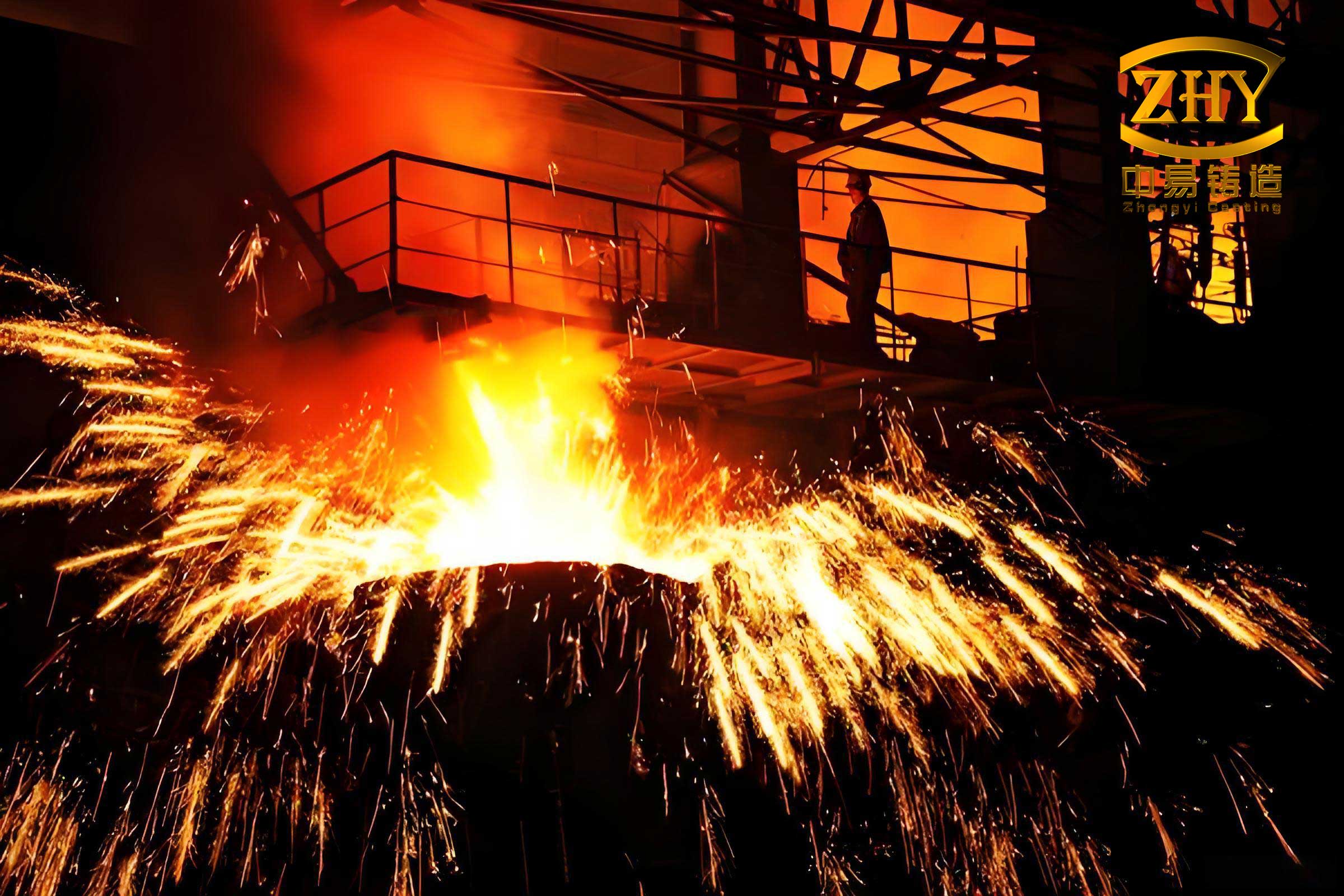
The image above illustrates the typical robust appearance of high-integrity cast iron components. Achieving such consistency requires precise control over the solidification process to avoid internal defects like segregation that manifest as surface anomalies after machining.
5. Influence of Centrifuge Spindle Vibration
This was identified as the most direct and severe contributing factor. In an ideal centrifugal casting process, the mold rotates about a fixed axis with uniform angular velocity \( \omega \), generating a steady radial body force field (\( \rho \omega^2 r \)) on the liquid metal. Abnormal spindle vibration—axial play, radial runout, or chatter—superimposes irregular, time-varying accelerations on this field. This mechanical disturbance agitates the solidifying mushy zone, disrupting normal dendritic growth and promoting the chaotic movement and entrapment of solute-rich inter-dendritic liquid. The effect is a profound disruption of sequential solidification.
Inspections of cross-sections from liners produced on vibrating machines revealed a chaotic grain structure, with coarse and fine grains intermixed randomly, unlike the normal radial gradient from fine outer grains to coarser inner grains. A targeted test was conducted:
| Centrifuge Condition | Samples | Black Spot Count | Defect Rate |
|---|---|---|---|
| Normal (Stable) | 120 | 0 | 0% |
| Abnormal (Vibrating) | 30 | 11 | 36.7% |
The correlation is unequivocal. Vibration acts as a potent catalyst for macro-segregation. The inertial forces from vibration can be modeled as an additional, random acceleration vector \( \vec{a}_{vib}(t) \) added to the centrifugal acceleration. This disturbs the delicate balance of forces governing fluid flow in the mushy zone, described by a modified Darcy’s law for flow through a porous medium (the dendrite network):
$$ \vec{u} = -\frac{K}{\mu f_l} (\nabla p – \rho_l \vec{g}_{eff}) $$
where \( \vec{u} \) is the inter-dendritic liquid velocity, \( K \) is the permeability, \( \mu \) is viscosity, \( f_l \) is liquid fraction, \( \nabla p \) is the pressure gradient, \( \rho_l \) is liquid density, and \( \vec{g}_{eff} \) is the effective gravity vector (combining centrifugal and vibrational accelerations). Uncontrolled vibration makes \( \vec{g}_{eff} \) highly unpredictable, leading to erratic \( \vec{u} \) and chaotic segregation patterns.
Synthesis of Formation Mechanism
The formation of black spot defects is a synergistic result of unfavorable solidification conditions exacerbated by equipment instability. The primary mechanism is macro-segregation driven by interrupted solidification and forced convection.
- Constitutional Underlying Cause: The alloy chemistry, particularly elements like Mn, P, and S with low partition coefficients, predisposes the iron to segregation during solidification. This is a fundamental characteristic also managed in the production of nodular cast iron.
- Process Trigger – Thermal Regime: The standard delayed cooling practice creates a “window of opportunity” for segregation. It allows for the development of a substantial mushy zone where solute-rich liquid exists. The relatively slow initial cooling provides time for the initiation of buoyancy-driven flows (thermosolutal convection) within this zone.
- Process Catalyst – Mechanical Disturbance: Abnormal centrifuge vibration provides the kinetic energy to violently agitate this mushy zone. It disrupts dendritic networks, remelts fragile dendrite arms, and forcibly redistributes the solute-enriched liquid into irregular pockets or channels. This transforms mild micro-segregation into severe, erratic macro-segregation.
- Manifestation: Upon final solidification, these pockets solidify with a different microstructure—often with coarser graphite, altered matrix phases (e.g., more ferrite), and possibly higher concentrations of phosphides or other secondary phases. This region has different chemical etching and light reflectance properties after machining, appearing as a dark “black spot” against the more uniform, desired matrix. Its lower hardness is a direct consequence of this altered microstructure.
Machining parameters (speed, feed) can alter the surface finish and thereby accentuate or mask the visual contrast between the segregated spot and the matrix, but they do not eliminate the underlying metallurgical inhomogeneity.
Proposed and Validated Control Measures
Based on the mechanistic understanding, the following integrated control strategy was implemented, which successfully reduced the defect rate to baseline levels.
| Measure Category | Specific Action | Intended Effect |
|---|---|---|
| Process Stabilization | Strict adherence to minimum pouring temperature (≥1320°C). Ensure sufficient holding time after alloy additions for homogenization. | Improves liquid metal homogeneity, ensures complete inoculant dissolution, and provides consistent thermal starting conditions. |
| Equipment Integrity | Implement routine inspection of centrifuge spindle bearings, alignment, and overall rigidity. Perform first-article cross-section checks per machine per shift. | Eliminates the primary catalyst (vibration). A stable force field is critical for orderly solidification in both grey and nodular cast iron centrifugal casting. |
| Cooling Process Optimization | Review and fine-tune the “delay time” before water cooling. The goal is to shorten the period where the mushy zone is extensive yet mobile, without inducing excessive thermal stress or chilling. | Minimizes the time window available for the initiation and growth of convective segregation channels. |
| Quality Standardization | Establish a clear, evidence-based acceptance criterion for black spots, referencing existing standards for cloudy spot defects. Distinguish between cosmetic variations and functionally harmful segregation. | Reduces unnecessary rejections for minor, non-detrimental inhomogeneities while safeguarding component performance. |
In conclusion, the black spot defect in centrifugally cast cylinder liners is a direct consequence of macro-segregation, fundamentally driven by an unfavorable combination of thermal history and mechanical vibration during solidification. While the study focused on a specific grey iron, the principles of controlling solidification stability, minimizing mushy zone agitation, and ensuring process uniformity are universally critical for high-quality casting production, whether for traditional grey iron, high-alloy iron, or nodular cast iron. The solutions lie not in complex chemistry changes, but in rigorous control over the physical dynamics of the casting process itself.