
As a researcher deeply involved in the field of high-temperature materials and manufacturing, I have witnessed the critical role of gas turbines in modern power generation and propulsion systems. The turbine blade, operating under extreme conditions of temperature and stress, is the heart of these machines. For large-size gas turbine blades, the investment casting process stands out as the premier manufacturing method due to its ability to produce complex, near-net-shape components with excellent surface finish and dimensional accuracy. In this article, I will delve into the intricacies of the investment casting process for these blades, highlighting key technologies, challenges, and future directions. Throughout, I will emphasize how each step of the investment casting process contributes to the final product’s performance and reliability.
The investment casting process, also known as lost-wax casting, involves creating a wax pattern, coating it with a ceramic shell, melting out the wax, and pouring molten metal into the resulting cavity. For large-size gas turbine blades—often exceeding 400 mm in length—this process demands precision at every stage. From my experience, the success of the investment casting process hinges on mastering several core areas: die design and manufacturing, wax pattern dimension control, shell building techniques, core manufacturing, and advanced solidification methods like directional and single-crystal casting. I will explore each of these, incorporating tables and formulas to summarize key concepts, and repeatedly underscore the importance of optimizing the investment casting process for large-scale applications.
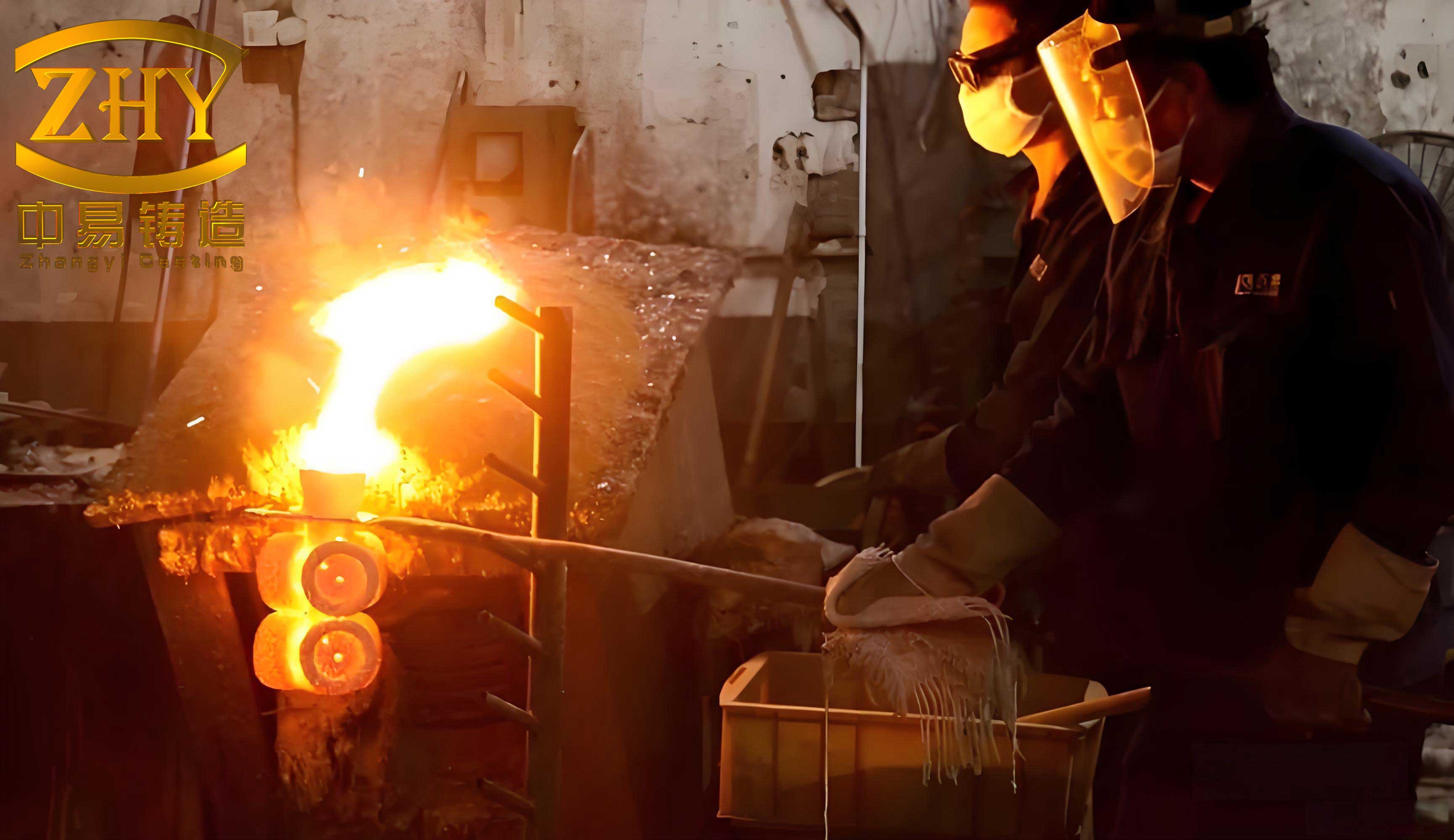
Let me begin with die design and manufacturing, a foundational step in the investment casting process. In the early days, die design relied heavily on manual 2D drafting, which was time-consuming and prone to errors. Today, we leverage advanced CAD/CAM/CAE software like UG, PRO/E, and CATIA to perform 3D modeling and simulation. This allows for iterative design improvements and virtual testing, significantly reducing lead times. For large blades, die manufacturing typically employs composite machining methods, combining mechanical processing with electrical discharge machining (EDM) to achieve high precision. Additionally, rapid prototyping (RP) techniques such as stereolithography or selective laser sintering offer quick turnaround for prototypes, though they may lack the durability for mass production. A critical aspect of die design is accounting for shrinkage—the reduction in size as the metal solidifies and cools. Since large blades have complex geometries with varying wall thicknesses, uniform shrinkage cannot be assumed. We often use compensation methods like uniform scaling, chord-length scaling, median-line scaling, or center-of-contraction scaling. However, these approximations can lead to deviations. A more sophisticated approach involves inverse deformation control, where the die cavity is adjusted based on predicted displacement fields from casting simulations. This ensures that the final blade meets dimensional tolerances. To illustrate, the total shrinkage in the investment casting process can be expressed as a function of wax contraction, alloy solidification shrinkage, and shell expansion:
$$ S_{total} = S_{wax} + S_{alloy} – E_{shell} $$
where \( S_{total} \) is the net shrinkage, \( S_{wax} \) is the wax pattern contraction, \( S_{alloy} \) is the alloy shrinkage during solidification and cooling, and \( E_{shell} \) is the thermal expansion of the ceramic shell. For nickel-based superalloys commonly used in blades, \( S_{alloy} \) typically ranges from 2.0% to 2.5%, but it varies with geometry. Table 1 summarizes key parameters in die design for large blade investment casting process.
| Parameter | Typical Range | Considerations for Large Blades |
|---|---|---|
| Shrinkage Allowance | 1.8% – 2.5% | Non-uniform due to complex geometry; requires finite element analysis (FEA) |
| Die Material | Tool steel, aluminum alloys | Must withstand high-pressure wax injection and frequent cycles |
| Surface Finish | Ra ≤ 0.4 μm | Critical for wax pattern quality and ease of demolding |
| Design Software | CAD/CAM/CAE integrated suites | Enables simulation of wax flow, solidification, and stress analysis |
| Manufacturing Tolerance | ± 0.05 mm | Tight tolerances essential for net-shape casting |
Moving on to wax pattern dimension control, this is a pivotal step in the investment casting process because any imperfections in the wax pattern directly translate to the final casting. For large blades, wax patterns are prone to significant shrinkage and distortion due to their size and slow cooling. To mitigate this, we employ wax pattern fake core technology. This involves inserting a pre-made wax core into the die before injecting the main wax. The fake core reduces the wall thickness of the wax pattern, promoting uniform cooling and minimizing shrinkage cavities. Additionally, it helps maintain dimensional stability. After demolding, the wax pattern continues to contract, often unpredictably. Therefore, we use wax pattern calibration molds—essentially precision fixtures that hold the wax pattern in its correct shape during cooling. This practice is indispensable in the investment casting process for large blades to prevent warpage. The wax injection parameters, such as temperature, pressure, and holding time, are optimized through Design of Experiments (DOE). For instance, the wax contraction can be modeled as a function of cooling time:
$$ \Delta L = \alpha_w \cdot L_0 \cdot \Delta T $$
where \( \Delta L \) is the length change, \( \alpha_w \) is the coefficient of thermal contraction for the wax (typically around 0.001–0.002 per °C), \( L_0 \) is the initial length, and \( \Delta T \) is the temperature drop. Controlling these factors ensures that the wax pattern adheres to specifications, laying a solid foundation for the subsequent steps in the investment casting process.
Now, let’s discuss shell building techniques, a cornerstone of the investment casting process. The ceramic shell must possess high strength, permeability, thermal stability, and accuracy to replicate the wax pattern’s details. For large turbine blades, we predominantly use silica sol-based shells due to their excellent high-temperature properties and environmental friendliness. Silica sol is a colloidal suspension of silica in water, which acts as a binder. The shell is built by repeatedly dipping the wax assembly into a slurry of silica sol and refractory flour (like zircon or alumina), then stuccoing with coarse refractory grains. Each layer must be thoroughly dried before applying the next. Drying is critical because incomplete drying leads to weak shells prone to cracking. The drying kinetics can be described by diffusion models. For example, the rate of moisture loss during drying often follows Fick’s second law:
$$ \frac{\partial C}{\partial t} = D \nabla^2 C $$
where \( C \) is the moisture concentration, \( t \) is time, and \( D \) is the diffusion coefficient. Factors like humidity, air velocity, and temperature affect \( D \). In practice, we control drying rooms at 20–25°C with 40–60% relative humidity and forced air circulation. After building 6–10 layers, the shell is dewaxed, usually via autoclaving or flash firing, to remove the wax and create the mold cavity. Dewaxing must be done carefully to avoid shell cracking from wax expansion. The shell is then fired at 970–1030°C to burn out residual organics and sinter the ceramic, enhancing its strength. Preheating before pouring is done at 950–1050°C to reduce thermal shock and improve metal fluidity. Table 2 outlines typical shell properties in the investment casting process for large blades.
| Property | Target Value | Testing Method |
|---|---|---|
| Green Strength | ≥ 1.5 MPa | Three-point bending test |
| Fired Strength (at 1000°C) | ≥ 10 MPa | Compressive test at elevated temperature |
| Permeability | 10⁻¹² – 10⁻¹⁰ m² | Gas permeability apparatus |
| Thermal Expansion Coefficient | 5–7 × 10⁻⁶ /°C | Dilatometry |
| Shell Thickness (for large blades) | 10–15 mm | Calipers or ultrasonic gauging |
To prevent microcracks from dewaxing and firing, we often reinforce shells with additional ceramic straps or use crack-resistant slurry formulations. Moreover, shell integrity can be checked via dye penetrant tests (e.g., methyl blue infiltration). All these measures ensure that the shell withstands the rigors of the investment casting process, especially when handling large molten metal volumes for blade casting.
Another vital component in the investment casting process is the ceramic core, which forms internal cooling passages in turbine blades. As efficiency demands increase, blades incorporate intricate, narrow cooling channels to withstand higher temperatures. These channels are impossible to produce via conventional shelling; hence, pre-formed ceramic cores are inserted into the wax pattern before shelling. Cores are typically made from silica-based or alumina-based materials. Silica cores offer good leachability but may react with molten metal, causing defects. Alumina cores are more refractory but harder to remove after casting. The core must have high hot strength, low thermal expansion, and chemical stability. We fabricate cores using injection molding or slip casting, followed by sintering. The core removal process often involves chemical leaching in molten caustic or hydrofluoric acid solutions. Research is ongoing to develop advanced cores with enhanced properties. For instance, the high-temperature strength of a silica core can be improved by adding zirconia or mullite as reinforcements. The core’s behavior during metal pouring can be analyzed via thermal stress models:
$$ \sigma_{core} = E_{core} \cdot \alpha_{core} \cdot \Delta T $$
where \( \sigma_{core} \) is the thermal stress, \( E_{core} \) is Young’s modulus, \( \alpha_{core} \) is the coefficient of thermal expansion, and \( \Delta T \) is the temperature difference between the core and metal. Minimizing \( \sigma_{core} \) is key to preventing core fracture during the investment casting process. Table 3 compares core types used in the investment casting process for large blades.
| Core Type | Base Material | Advantages | Challenges |
|---|---|---|---|
| Silica-based | SiO₂ with additives | Easy to leach, good dimensional accuracy | Prone to metal-core interaction, lower refractoriness |
| Alumina-based | Al₂O₃ with binders | High refractoriness, chemical inertness | Difficult to remove, higher cost |
| Composite | SiO₂-Al₂O₃ mixtures | Balanced properties, tailored expansion | Complex manufacturing process |
Directional and single-crystal solidification techniques represent the pinnacle of the investment casting process for high-performance blades. Directional solidification (DS) aligns grains along the blade’s longitudinal axis, eliminating transverse grain boundaries that are weak points under stress. Single-crystal (SC) casting takes this further by growing a blade from a single grain, devoid of all grain boundaries. For large blades, achieving DS or SC is challenging due to the need for steep temperature gradients and precise control over solidification fronts. We use Bridgman-type furnaces where the mold is withdrawn from a hot zone into a cooling zone. The thermal gradient \( G \) and growth rate \( R \) are critical parameters; for columnar growth, the condition \( G/R > \Delta T/D \) must be met, where \( \Delta T \) is the undercooling and \( D \) is the diffusion coefficient. For single crystals, a seed crystal is often employed to initiate growth. The investment casting process for DS/SC blades involves specialized shells with high thermal conductivity and insulation patterns to control heat flow. The famous Cahne-Hunt model describes the interface stability during directional solidification:
$$ G \geq \frac{m_L C_0 (1-k)}{k D_L} R $$
where \( m_L \) is the liquidus slope, \( C_0 \) is the initial composition, \( k \) is the partition coefficient, and \( D_L \) is the liquid diffusivity. This ensures planar front growth, avoiding cellular or dendritic structures. In practice, we monitor parameters like withdrawal rate (typically 2–10 mm/min) and zone temperatures (1500–1550°C for nickel superalloys). The investment casting process for directional and single-crystal blades has pushed the operating temperatures of gas turbines by 30–50°C, enabling higher efficiency.
Looking ahead, the investment casting process for large gas turbine blades must evolve to meet demands for even larger sizes, higher temperatures, and reduced costs. From my perspective, key future directions include: First, advancing inverse deformation and digital twin technologies for die design, using machine learning to predict shrinkage and distortion accurately. This will enhance the precision of the investment casting process. Second, developing novel core materials and removal methods, such as soluble cores or additive manufacturing of cores with graded properties. Third, optimizing shell compositions for better thermal shock resistance and lower environmental impact—for instance, water-based binders with nano-sized refractories. Fourth, scaling up DS and SC capabilities for blades over 500 mm, which may involve novel furnace designs or hybrid heating methods. Fifth, integrating in-process monitoring via sensors and IoT to real-time control parameters like shell dryness or metal temperature, making the investment casting process more robust. Additionally, sustainability aspects like recycling of ceramics and waxes will gain importance. Table 4 summarizes these future trends in the investment casting process.
| Technology Area | Current Status | Future Goals | Impact on Investment Casting Process |
|---|---|---|---|
| Digital Design | CAD/CAE simulations | AI-driven predictive models for distortion | Reduced trial-and-error, faster development |
| Core Technology | Silica/alumina cores | Additively manufactured multifunctional cores | Complex internal features, easier removal |
| Shell Materials | Silica sol with zircon | Eco-friendly binders, nano-composites | Lower emissions, higher strength |
| Solidification Control | Bridgman furnaces for DS/SC | Adaptive gradient control via magnetic fields | Larger single-crystal blades, fewer defects |
| Process Monitoring | Manual checks and sampling | Real-time sensors and closed-loop control | Improved consistency and yield |
In conclusion, the investment casting process for large-size gas turbine blades is a sophisticated sequence of steps that demands expertise in materials science, mechanical engineering, and process control. From die design to final solidification, each phase must be meticulously managed to produce blades that meet stringent performance criteria. As we continue to push the boundaries of gas turbine technology, innovations in the investment casting process will be crucial. By embracing digital tools, advanced materials, and sustainable practices, we can ensure that this time-honored manufacturing method remains at the forefront of producing critical components for power and propulsion. I am confident that ongoing research and collaboration across industries will further refine the investment casting process, enabling the next generation of efficient and reliable gas turbines.
To reinforce the technical aspects, let me provide some additional formulas and considerations. For example, the fluidity of molten metal during pouring in the investment casting process is influenced by shell preheat temperature \( T_s \) and metal superheat \( \Delta T_m \). The flow length \( L_f \) can be approximated by:
$$ L_f = k \cdot \sqrt{\frac{\rho \cdot g \cdot h \cdot \Delta T}{\mu}} $$
where \( k \) is a constant, \( \rho \) is density, \( g \) is gravity, \( h \) is metallostatic head, \( \Delta T \) is the temperature difference between metal and shell, and \( \mu \) is viscosity. Optimizing these parameters prevents misruns in large blade castings. Another key aspect is the thermal fatigue resistance of the blade, which depends on the coefficient of thermal expansion mismatch between the alloy and the shell. The stress \( \sigma_{th} \) due to thermal cycling can be expressed as:
$$ \sigma_{th} = \frac{E}{1-\nu} \cdot (\alpha_{alloy} – \alpha_{shell}) \cdot \Delta T_{cycle} $$
where \( E \) is Young’s modulus, \( \nu \) is Poisson’s ratio, \( \alpha \) are expansion coefficients, and \( \Delta T_{cycle} \) is the temperature swing. Minimizing this mismatch through shell material selection is vital in the investment casting process for longevity. Furthermore, the yield of the investment casting process can be modeled using statistical methods like Six Sigma, where defects per million opportunities (DPMO) are tracked. For large blades, achieving a DPMO below 1000 is often targeted, requiring tight control over variables such as wax injection pressure \( P_w \), slurry viscosity \( \eta \), and firing time \( t_f \). A multivariate regression might take the form:
$$ Yield = \beta_0 + \beta_1 P_w + \beta_2 \eta + \beta_3 t_f + \epsilon $$
where \( \beta \) are coefficients and \( \epsilon \) is error. By continuously refining these relationships, we enhance the reliability of the investment casting process.
In summary, the investment casting process is a dynamic field where tradition meets innovation. For large gas turbine blades, it is not merely a manufacturing method but a critical enabler of performance and efficiency. As I reflect on my experiences, I see immense potential in further integrating computational tools, advanced materials, and smart manufacturing principles into the investment casting process. This will not only improve blade quality but also reduce costs and environmental footprint. The journey of perfecting the investment casting process is ongoing, and I am excited to contribute to its evolution, ensuring that gas turbines continue to power our world sustainably and efficiently.