
In my extensive research on the investment casting process for high-temperature alloy components, I have focused on addressing critical defects in complex shell castings, particularly those made from K403 alloy. The investment casting process is a precision manufacturing technique essential for producing intricate parts with excellent surface finish and dimensional accuracy. However, when applied to K403 alloy shell castings, which are vital for aerospace engines, the investment casting process often faces challenges such as shrinkage porosity, cold shuts, dimensional deviations, and deformation. These issues stem from the alloy’s solidification characteristics and the part’s complex geometry. Through systematic experimentation and optimization of the investment casting process parameters, I have developed effective solutions to enhance casting quality and yield. This article details my approach, incorporating tables and formulas to summarize key findings, and emphasizes the iterative improvements in the investment casting process for such demanding applications.
The shell casting in question features a intricate structure with significant variations in wall thickness. The component has pillars reaching 129 mm in height, a length of 111 mm, and diameters ranging from 14 mm to 32 mm, with a nominal wall thickness of 6.5 mm. This geometry results in multiple thermal junctions, making it a challenging near-net-shape investment casting. The primary technical difficulties encountered in the investment casting process include: difficulty in wax pattern removal and dimensional instability due to complexity; susceptibility to mold cracking and fins during pouring due to structural constraints; and propensity for defects like porosity, cracks, and cold shuts due to poor feeding and filling. To tackle these, I analyzed each stage of the investment casting process—pattern making, shell building, and melting-pouring—to identify optimal parameters.
In the pattern-making phase of the investment casting process, controlling wax injection parameters is crucial for producing high-quality patterns that accurately replicate the final casting. The wax pattern’s dimensional precision, surface roughness, and freedom from defects like sinks or cold flows depend heavily on injection pressure, hold time, wax temperature, and mold temperature. Based on my experiments, I established that wax temperature should be maintained between 55–63°C to ensure adequate fluidity without excessive shrinkage. Mold temperature should be 25–35°C to facilitate filling and reduce thermal shock. Injection pressure is set at 15–25 bar, and hold time at 15–20 seconds. These parameters minimize shrinkage and improve accuracy. The relationship between wax shrinkage and temperature can be expressed by the linear contraction formula: $$ \Delta L = L_0 \cdot \alpha \cdot (T_{\text{injection}} – T_{\text{room}}) $$ where $\Delta L$ is the linear shrinkage, $L_0$ is the initial dimension, $\alpha$ is the thermal contraction coefficient of the wax (typically around 0.5–1.0% per °C), and $T_{\text{injection}}$ and $T_{\text{room}}$ are the wax injection and room temperatures, respectively. Optimizing these parameters is a key step in the investment casting process to prevent dimensional errors.
Initially, the wax pattern was produced in three separate segments and assembled using a jig, which introduced human variability and led to significant dimensional deviations. For instance, coaxiality errors of 1.7–2.2 mm between features like ϕ14 mm and 2-ϕ23 mm cylinders were observed. To eliminate this, I redesigned the pattern die to produce a one-piece wax pattern, thereby removing assembly-induced inaccuracies. This modification significantly improved dimensional consistency in the investment casting process. The table below summarizes the optimized pattern-making parameters:
| Parameter | Optimal Range | Effect on Investment Casting Process |
|---|---|---|
| Wax Temperature | 55–63°C | Balances fluidity and shrinkage; critical for filling thin sections. |
| Mold Temperature | 25–35°C | Reduces thermal gradient, preventing premature solidification. |
| Injection Pressure | 15–25 bar | Ensures complete filling without causing turbulence or gas entrapment. |
| Hold Time | 15–20 s | Allows for proper packing and reduces sink marks. |
Shell building is another critical stage in the investment casting process, as the shell must possess sufficient strength at room and elevated temperatures to withstand handling and metal pouring. For the shell casting, I employed a multi-layer ceramic shell system. To address thermal shrinkage porosity in thick sections, I implemented a local shell-thinning technique. After applying the fourth coating layer, soft wax was applied to specific areas, such as around inner gates and holes, to reduce shell thickness locally. This enhances cooling rates in thermal junctions, promoting directional solidification and reducing porosity. The shell-building parameters are detailed in the following table, which is integral to the investment casting process:
| Layer | Slurry Composition | Viscosity (s) | Stucco Material | Drying Time | Ammonia Dry |
|---|---|---|---|---|---|
| 1 | Silica sol-Zircon flour | 40–50 | White corundum WAF70 | ≥12 h air dry | Not applied |
| 2 | Ethyl silicate binder-Shangdian flour | 37–42 | Shangdian sand 36 mesh | ≥20 min | 10 min |
| 3–8 | Ethyl silicate binder-Shangdian flour | 13–15 | Shangdian sand 24 mesh | ≥20 min | 10 min |
| Sealer | Ethyl silicate binder-Shangdian flour | 13–15 | None | ≥12 h | Not applied |
The shell’s preheating temperature prior to pouring is vital in the investment casting process, as it affects the thermal gradient and fluidity of the molten alloy. I determined that a preheat temperature of 950–1000°C is optimal. This range reduces the temperature difference between the metal and mold, improving fillability without causing excessive grain growth. The heat transfer during preheating can be modeled using Fourier’s law: $$ q = -k \frac{dT}{dx} $$ where $q$ is the heat flux, $k$ is the thermal conductivity of the shell, and $\frac{dT}{dx}$ is the temperature gradient. By controlling preheat, I ensure uniform heat dissipation, which is crucial in the investment casting process for minimizing defects.
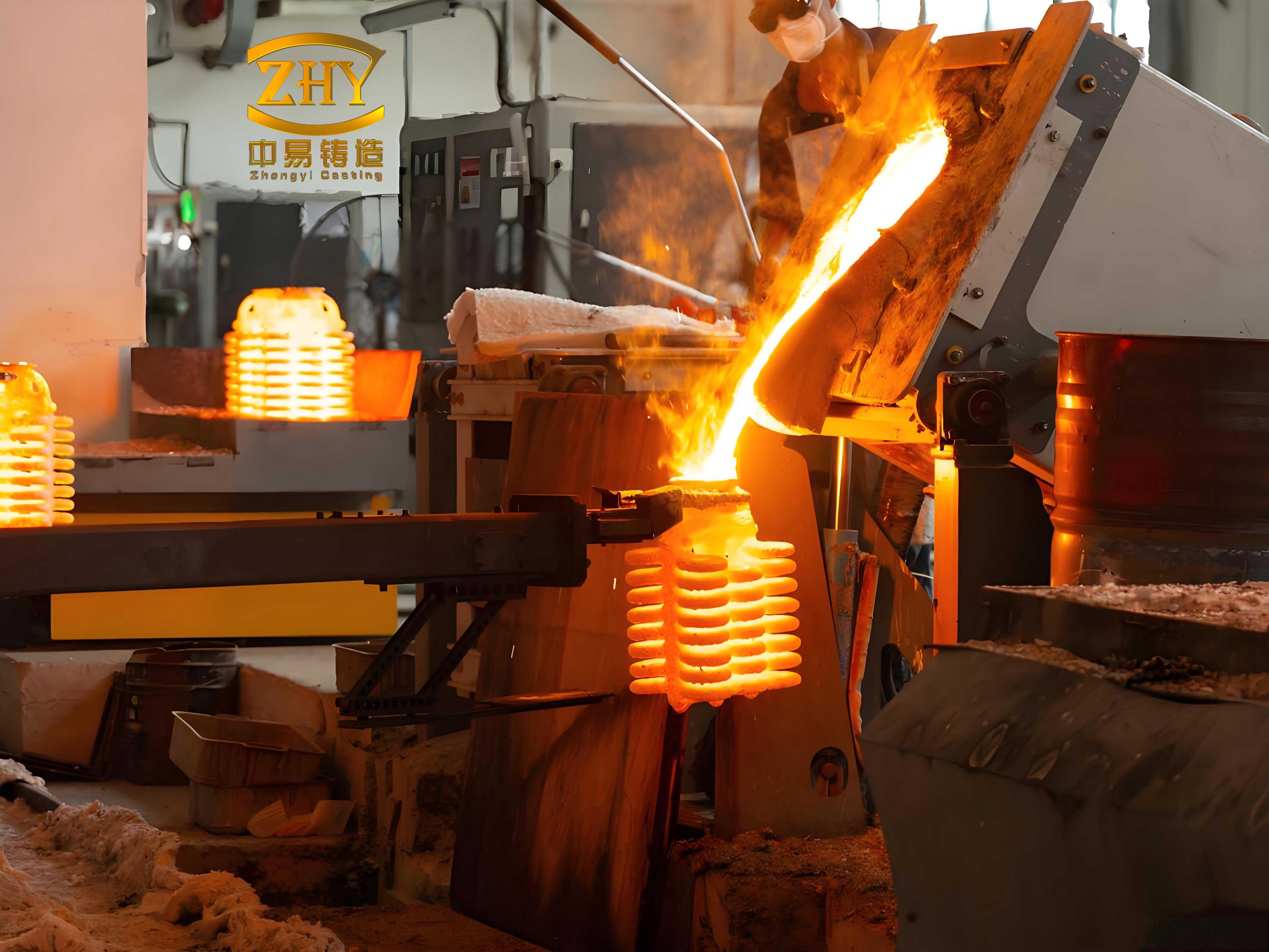
Melting and pouring parameters are decisive in the investment casting process for achieving sound castings. The gating system must provide adequate feeding and support. I selected a pouring temperature of 1430°C ±10°C, which is approximately 80–100°C above the alloy’s liquidus temperature, to enhance fluidity while avoiding excessive shrinkage. Pouring speed is set at 2–3 seconds per mold to ensure rapid filling and minimize cold shuts. The fluid flow during pouring can be described by the Bernoulli equation for incompressible flow: $$ P + \frac{1}{2} \rho v^2 + \rho gh = \text{constant} $$ where $P$ is pressure, $\rho$ is density, $v$ is velocity, $g$ is gravity, and $h$ is height. This principle guides the design of gating to maintain proper metal velocity. The table below outlines the key pouring parameters in the investment casting process:
| Parameter | Value | Role in Investment Casting Process |
|---|---|---|
| Shell Preheat Temperature | 950–1000°C | Reduces thermal shock and improves metal flow. |
| Pouring Temperature | 1430°C ±10°C | Ensures adequate superheat for filling thin walls. |
| Pouring Speed | 2–3 s/mold | Prevents premature freezing and cold shuts. |
To validate the optimized investment casting process, I conducted a production trial with 40 castings. The results showed a significant improvement: 35 castings met all quality standards, yielding a qualification rate of 87.5%. This demonstrates the effectiveness of the parameter adjustments in the investment casting process. Defects such as porosity and dimensional errors were substantially reduced. The success rate can be expressed using a simple formula: $$ \text{Quality Yield} = \frac{N_{\text{good}}}{N_{\text{total}}} \times 100\% $$ where $N_{\text{good}}$ is the number of acceptable castings and $N_{\text{total}}$ is the total poured. In this case, $ \text{Quality Yield} = \frac{35}{40} \times 100\% = 87.5\% $. This metric underscores the robustness of the refined investment casting process.
Further analysis of the solidification behavior in the investment casting process reveals the importance of thermal management. The Chvorinov’s rule, which estimates solidification time, is relevant: $$ t_s = B \left( \frac{V}{A} \right)^n $$ where $t_s$ is solidification time, $V$ is volume, $A$ is surface area, $B$ is a mold constant, and $n$ is an exponent (typically around 2). For the shell casting, local shell thinning reduces the effective $B$ value in thick sections, shortening $t_s$ and promoting faster solidification to avoid shrinkage. This principle is integral to optimizing the investment casting process for complex geometries.
In conclusion, my research on the investment casting process for K403 alloy shell castings has identified key optimizations across pattern making, shell building, and pouring stages. By adopting a one-piece wax pattern design, I eliminated assembly-related dimensional errors. Implementing local shell thinning and controlled preheating enhanced cooling in thermal junctions, reducing porosity. Precise control of pouring temperature and speed ensured complete filling and minimized defects. These improvements not only elevate the quality of this specific casting but also provide a reference for similar components in the investment casting process. The iterative refinement of the investment casting process, supported by parametric tables and engineering formulas, is essential for advancing precision casting technologies in high-performance applications. Future work may involve computational simulation to further optimize gating and solidification in the investment casting process, but the current empirical approach has proven highly effective.
The investment casting process is continually evolving, and my experience with K403 alloy highlights the need for tailored solutions. Each parameter interplays to affect final quality, and a holistic view of the investment casting process is necessary. For instance, the viscosity of ceramic slurries influences shell permeability, which in turn affects gas escape during pouring. This can be modeled with the Stokes’ law for particle settling: $$ v_t = \frac{2r^2(\rho_p – \rho_f)g}{9\mu} $$ where $v_t$ is terminal velocity, $r$ is particle radius, $\rho_p$ and $\rho_f$ are particle and fluid densities, and $\mu$ is viscosity. Optimizing slurry viscosity, as shown in the shell-building table, is thus a critical aspect of the investment casting process. By integrating such principles, the investment casting process becomes more predictable and controllable.
Moreover, the investment casting process benefits from statistical quality control. Monitoring parameters like wax injection pressure and hold time using control charts can help maintain consistency. For example, the mean and range of injection pressure can be tracked to ensure they remain within the optimal 15–25 bar range. This proactive approach in the investment casting process minimizes variability and enhances repeatability. In summary, the success of the investment casting process for complex shell castings relies on meticulous parameter optimization, evidence-based adjustments, and a deep understanding of materials science. My work demonstrates that through systematic experimentation, the investment casting process can achieve high yields and superior quality, even for challenging alloys like K403.