
In the highly demanding field of automotive component manufacturing, the valve rocker arm stands as a critical element within the engine’s valvetrain. Its performance directly influences engine efficiency, noise, and longevity. Consequently, the quality requirements for this component are exceptionally stringent, permitting minimal manufacturing flaws. Among various production methods, the investment casting process is often selected for its ability to produce parts with excellent dimensional accuracy, complex geometries, and superior surface finish, all with minimal machining allowance. However, this advanced process is not immune to defects, with porosity being a predominant and costly issue that can drastically reduce yield. This article delves into a detailed, first-person analysis of porosity defects encountered during the production of a specific engine’s valve rocker arm via the investment casting process. I will systematically explore the root causes from the perspectives of shell building and metal pouring, and propose a validated, multi-faceted improvement strategy that successfully reduced the defect rate from over 9% to approximately 2%.
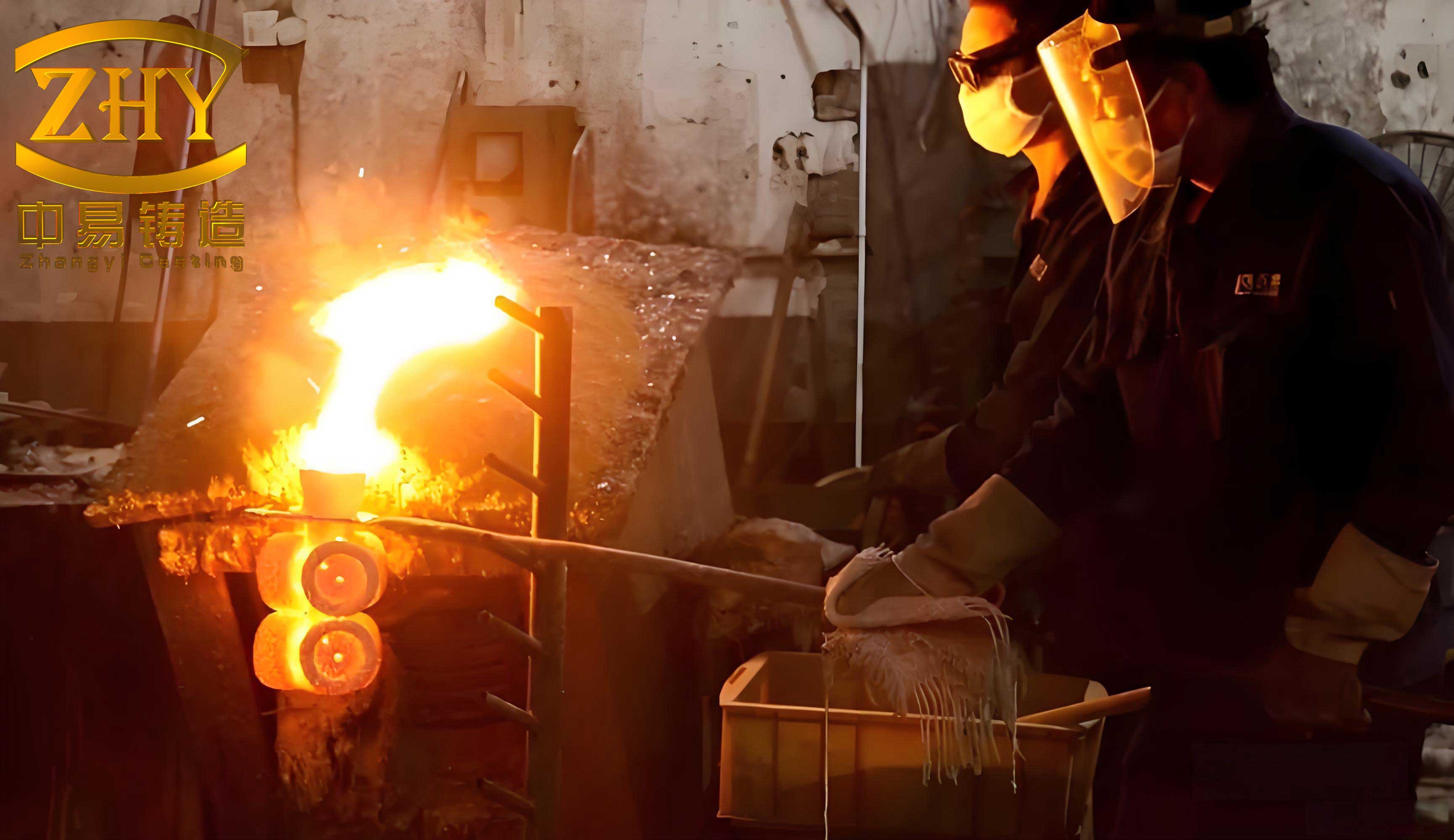
The investment casting process, also known as lost-wax casting, involves creating a precise wax pattern, assembling it onto a tree, building a ceramic shell around it, dewaxing, firing the shell, and finally pouring molten metal. Despite its precision, gas-related defects can arise at multiple stages. Porosity in castings is typically categorized into three main types, each with distinct formation mechanisms relevant to the investment casting process:
- Evolutionary (or Dissolved Gas) Porosity: This occurs when gases (primarily hydrogen, nitrogen, or oxygen) are dissolved in the molten metal during melting. Upon solidification, the decreasing solubility of these gases in the solid metal forces them to precipitate out, forming pores. This is highly dependent on melt practice and charge materials.
- Entrapped (or Inertial) Porosity: This forms from air or gases being trapped during the turbulent filling of the mold cavity. It is often influenced by gating design, pouring speed, and the viscosity of the metal.
- Reaction-Induced Porosity: This results from chemical reactions that generate gas within the mold or at the metal-mold interface. A common example in ferrous casting is the reaction between moisture (from the shell or atmosphere) and elements like aluminum in the melt, producing hydrogen gas. The shell’s properties are critical here.
In the case under investigation, the primary defects were identified as smooth pores located 1-2 mm beneath the surface, sometimes showing oxidation colors, with a higher concentration near the heavier sections of the rocker arm. Statistical process control data initially indicated a staggering scrap rate of over 10%, with porosity alone accounting for approximately 9.6% of failures. This clearly signaled a systemic issue within the investment casting process that required root-cause analysis.
Root Cause Analysis: A Systemic Breakdown
The investigation focused on two core pillars of the investment casting process: Shell/Mold Making and Metal Pouring. The interaction between these pillars is where the defect generation occurs.
1. Shell/Mold-Related Causes
The ceramic shell is not merely a negative of the part; it is a dynamic participant during pouring. Its permeability (gas permeability) and the amount of gas it can generate (gas evolution) are paramount.
- Inadequate Shell Permeability & Firing: The original process utilized a water glass-based binder system. The firing (or baking) cycle was set at 800-850°C for 1.0-1.5 hours. This proved insufficient to completely burn out all residual volatiles, binders, and moisture from the shell layers. An under-fired shell has lower permeability and acts as a significant gas source. When hot metal enters the mold, these trapped gases are violently released. If the shell’s permeability is too low, these gases cannot escape quickly enough through the shell wall and are instead forced into the solidifying metal, leading to subsurface porosity. The gas evolution rate of the shell, $G_{shell}(t)$, must be balanced against its permeability, $k_{shell}$, and the metal’s solidification time, $t_f$. A simplified condition for gas entrapment can be conceptualized as:
$$ \int_{0}^{t_f} G_{shell}(t) , dt > k_{shell} \cdot A \cdot \Delta P \cdot t_f $$
Where $A$ is the interfacial area and $\Delta P$ is the pressure differential. The original process parameters made the left side of this inequality too large relative to the right side. - Raw Material Gas Generation: The use of unclean charge materials—such as rusty, oily, or damp returns and scrap—introduces hydrogen sources. At high temperatures, water vapor reacts with elements like aluminum (often present in inoculants for cast iron) according to reactions like:
$$ 2Al + 3H_2O \rightarrow Al_2O_3 + 3H_2 \uparrow $$
The generated hydrogen gas is readily absorbed by the molten iron, especially in high-carbon, high-silicon alloys like ductile iron, leading to evolutionary porosity upon cooling.
2. Metal Pouring & Process-Related Causes
The thermal and kinetic conditions during metal transfer and solidification are equally critical in the investment casting process.
- Suboptimal Pouring Temperature: The initial process specified a tap temperature of 1480-1500°C and a pouring temperature of 1300-1350°C. This pouring temperature was too low for the ductile iron alloy being used. Lower temperature increases metal viscosity ($\mu$), drastically reducing its fluidity and, crucially, its ability to allow entrapped or evolved gas bubbles to float to the surface (Stokes’ Law velocity, $v_b$, is inversely affected by viscosity):
$$ v_b = \frac{2 g r^2 (\rho_m – \rho_g)}{9 \mu} $$
Where $g$ is gravity, $r$ is bubble radius, and $\rho$ denotes density. High viscosity impedes bubble ascent, trapping them within the casting, particularly in the last-to-freeze areas which correspond to the thicker sections of the rocker arm where our defects were concentrated. - Excessively Long Pouring Time: To ensure a “quiet fill” and avoid splashing, the pouring time for a cluster (tree) of 32 patterns was deliberately extended to 5-6 seconds. While minimizing turbulence, this slow pour allowed excessive heat loss from the metal stream, further lowering the effective metal temperature within the mold cavity and exacerbating the viscosity issue. This created a “double penalty” for gas escape.
| Process Area | Root Cause | Primary Defect Type Induced | Key Contributing Factors |
|---|---|---|---|
| Shell/Mold | Insufficient Firing (Temp/Time) | Reaction-Induced & Entrapped Porosity | Low shell permeability, high gas evolution at metal contact. |
| Unclean Charge Materials | Evolutionary Porosity | H2 generation from reactions with H2O, oil, rust. | |
| Metal Pouring | Low Pouring Temperature | Evolutionary & Entrapped Porosity | High metal viscosity, reduced bubble floatation velocity. |
| Slow Pouring Speed | Entrapped Porosity & Thermal Loss | Increased heat loss, effective temperature drop in cavity. |
The Integrated Improvement Strategy for the Investment Casting Process
Addressing the porosity issue required a holistic approach, targeting each identified root cause within the investment casting process. The improvements were not isolated changes but a synchronized optimization of several parameters.
1. Enhancing Shell Permeability and Reducing Its Gas Content
The goal was to maximize $k_{shell}$ and minimize $G_{shell}(t)$ by the time of pour.
– **Extended and Intensified Firing Cycle:** The firing temperature was raised from 800-850°C to 860-910°C. The holding time at peak temperature was increased from 1.0-1.5 hours to 2.0-2.5 hours. This ensured complete combustion of organics and dehydration of the ceramic, eliminating “black cores” and producing a uniformly fired, high-permeability shell. The shell had to reach a state of negligible gas evolution.
– **Strict Control of Shell Building:** The drying time for the primary (face coat) slurry layers was extended from 24 hours to a minimum of 36 hours under controlled humidity and temperature. This prevented “green” (undried) zones within the shell, which are major sources of steam during pouring.
2. Minimizing Gas Sources from Raw Materials and Melt
The focus was on reducing the initial hydrogen potential of the metal.
– **Charge Material Discipline:** A strict protocol was implemented for preparing returns and scrap. All materials were required to be clean, free of oil, grease, rust, and moisture before being charged into the furnace. This directly attacked the source of hydrogen-generating reactions.
– **Effective Melt Deoxidation and Degassing:** The melt practice was reviewed to ensure sufficient deoxidation was carried out, reducing the oxygen activity that can combine with hydrogen or carbon to form gas. While specific degassing techniques for ductile iron are limited compared to aluminum, maintaining a clean, dry charge is the primary defense.
3. Optimizing Thermal and Kinetic Pouring Parameters
This was the most critical operational adjustment to create conditions favorable for gas escape.
– **Raised Tap and Pouring Temperatures:** The tap temperature was elevated to 1580-1600°C to provide a sufficient temperature buffer. More importantly, the target pouring temperature range was critically re-evaluated. A series of designed experiments was conducted to map porosity rate against pouring temperature. The results were decisive, as summarized below.
| Tap Temperature Range (°C) | Pouring Temperature Range (°C) | Average Porosity Defect Rate (%) | Observation on Metal Fluidity & Solidification |
|---|---|---|---|
| 1580 – 1600 | 1300 – 1350 | 9.14 – 9.27 | Poor fluidity, rapid heat loss, severe gas entrapment. |
| 1350 – 1400 | 4.33 – 5.12 | Moderate fluidity, gas escape improved but not optimal. | |
| 1400 – 1450 | 1.64 – 2.30 | Optimal fluidity with low viscosity, excellent gas floatation and shell drying. | |
| 1450 – 1500 | 3.16 – 4.25 | Very good fluidity, but increased risk of metal-mold reaction and penetration. |
The data clearly identified the 1400-1450°C window as the optimal compromise. Within this range, the metal viscosity ($\mu$) is sufficiently low to maximize bubble floatation velocity ($v_b$) while remaining below the temperature that promotes excessive reaction with the shell or leads to other defects like shrinkage or penetration. This finding is central to optimizing the investment casting process for this alloy.
– **Optimized Pouring Speed:** The pouring time per cluster was reduced from 5-6 seconds to a target of 3-4 seconds. This was achieved by slightly enlarging the pour cup and sprue diameter to maintain a non-turbulent but faster fill. The faster fill reduced the total heat loss from the metal stream, helping to maintain the beneficial high temperature within the mold cavity, and reduced the time window for gas entrapment during filling.
Quantified Results and Conclusion
The implementation of this integrated improvement strategy yielded dramatic results. The synergistic effect of a more permeable shell, cleaner metal, and optimized pouring parameters brought the porosity defect rate under control.
| Defect Category | Original Process Defect Rate (%) | Improved Process Defect Rate (%) | Relative Reduction (%) |
|---|---|---|---|
| Porosity | 9.61 | ~2.0 – 2.3 | ~76 – 79 |
| Inclusions/Slag | 0.17 | < 0.1 | > 41 |
| Sand Inclusions | 0.22 | < 0.1 | > 55 |
| Total Scrap Rate | >10.0 | ~2.5 | > 75 |
The success of this project underscores a fundamental principle in the investment casting process: porosity is rarely the result of a single factor. It is a systemic outcome of the interaction between mold properties and metal processing parameters. A successful mitigation strategy must therefore be equally systemic. The key learnings can be generalized into a formulaic approach for troubleshooting porosity in the investment casting process:
- Maximize Shell Escape Paths: Ensure the shell is fired to full maturity (high $k_{shell}$, low $G_{shell}(t)$).
- Minimize Gas Input: Start with clean, dry charge materials to limit hydrogen sources.
- Optimize Metal Rheology: Identify and use the pouring temperature ($T_{pour}$) that minimizes viscosity for the specific alloy without creating other defects. This is found experimentally.
- Control Fill Dynamics: Use a pouring speed that balances fill tranquility with minimized heat loss (minimized $t_{pour}$).
While the improvements reduced the defect rate to a commercially acceptable level of ~2%, the pursuit of zero defects continues. Further refinements could involve investigating alternative shell binder systems (e.g., colloidal silica vs. water glass) for inherently higher permeability, implementing more sophisticated melt degassing techniques, or utilizing simulation software to optimize gating and venting designs specific to the rocker arm geometry. This case study serves as a testament to the fact that through rigorous, data-driven analysis and integrated process control, the inherent challenges of the investment casting process can be effectively managed to produce high-integrity, mission-critical components like the engine valve rocker arm.