
The investment casting process stands as a preeminent manufacturing technique for producing complex, near-net-shape components from high-performance superalloys. These alloys, renowned for their exceptional mechanical strength, fatigue resistance, and thermal stability at elevated temperatures, are indispensable in the aerospace and power generation industries, particularly for turbine blades and other critical hot-section parts. The success of the investment casting process is fundamentally contingent upon the performance of the ceramic shell mold, which must precisely replicate the component’s geometry while withstanding extreme thermal and mechanical stresses during metal pouring and solidification. However, a persistent and critical challenge in this process is the occurrence of interfacial reactions between the molten superalloy and the ceramic shell. These reactions can lead to surface defects, compositional deviations, and microstructural degradation in the cast component, adversely affecting its dimensional accuracy, surface finish, and mechanical properties. This article synthesizes recent research progress in ceramic shell technology for superalloy casting and provides a detailed analysis of the mechanisms governing alloy-ceramic interfacial interactions.
Ceramic Shells for Investment Casting
The ceramic shell is a multi-layered composite structure whose properties directly dictate the quality of the final casting. Key performance requirements include adequate green strength for handling, sufficient fired strength to resist metalostatic pressure and thermal stress, low reactivity with the alloy melt, appropriate thermal conductivity to control solidification, and good collapsibility for easy shell removal post-casting.
Refractory Materials
Refractory materials constitute over 90 wt.% of the shell, serving as the structural backbone. The choice of refractory is paramount, influencing thermal expansion, chemical inertness, and mechanical properties. Common refractory materials and their key properties are summarized in Table 1.
| Material | Chemical Formula | Melting Point (°C) | Density (g/cm³) | Linear Expansion Coefficient (×10⁻⁶ °C⁻¹, typical range) |
|---|---|---|---|---|
| Fused Silica | SiO₂ | ~1723 | ~2.2 | ~0.5 (low up to ~1000°C) |
| Alumina | Al₂O₃ | ~2045 | 3.95-4.02 | ~8.4 (20-1250°C) |
| Mullite | 3Al₂O₃·2SiO₂ | ~1810 | 3.08-3.15 | ~5.3 (20-1250°C) |
| Zircon | ZrSiO₄ | ~2400 | 4.3-4.6 | ~4.5 (20-1500°C) |
| Yttria | Y₂O₃ | ~2425 | 5.01 | ~8.0 (20-1000°C) |
Alumina (Al₂O₃)-based systems are widely used for directional solidification of superalloys due to their favorable thermal conductivity and matched thermal expansion. Research has shown that modifying alumina with kyanite (Al₂SiO₅) can in-situ generate mullite during firing, enhancing mechanical strength, creep resistance, and porosity while reducing sintering shrinkage. The properties can be tailored by the kyanite content, as conceptually described by the following relationship for a composite property \( P_c \):
$$ P_c = P_m V_m + P_k \phi(V_k) $$
where \( P_m \) and \( P_k \) are properties of the matrix and kyanite-derived phase, \( V_m \) and \( V_k \) are their volume fractions, and \( \phi \) is a function accounting for the transformation and interaction effects.
While zircon offers excellent chemical stability, it can dissociate at high temperatures (\( ZrSiO_4 \rightarrow ZrO_2 + SiO_2 \)), releasing reactive silica. Fused silica is sometimes used for its low thermal expansion but is highly susceptible to reaction with active alloying elements. Consequently, the core challenge lies in selecting or designing a refractory system that minimizes deleterious interfacial reactions, a topic explored in depth later.
Binders
The binder consolidates the refractory particles, providing strength to the green (unfired) and fired shell. Colloidal silica binder, a suspension of nano-sized SiO₂ particles in water, is the industry standard. Its bonding mechanism involves the formation of siloxane (Si-O-Si) networks as water evaporates. The particle size of the colloidal silica significantly impacts slurry viscosity and final shell properties; smaller particles generally lead to lower fired strength but better permeability and collapsibility.
A critical limitation of silica-based binders is their potential to participate in interfacial reactions with reactive elements (e.g., Hf, Al, Y) in the superalloy melt. To mitigate this, research into non-silica binders based on Al₂O₃, ZrO₂, or Y₂O₃ colloids is ongoing. Furthermore, polymer-modified silica binders can enhance green strength and reduce shell cracking but may compromise the surface finish of the final casting, making them more suitable for backup layers rather than the face coat.
Fiber Modification Technology
A significant innovation in shell manufacturing is the incorporation of fibrous materials to modify properties. Traditional shells often require increased thickness to achieve sufficient strength, which reduces thermal conductivity and compromises the temperature gradient critical for directional solidification. Fiber reinforcement allows for thinner, stronger shells with improved thermal management. Different fibers impart distinct advantages, as summarized in Table 2.
| Fiber Type | Key Benefits | Mechanism / Consideration |
|---|---|---|
| Nylon/Polypropylene | Increased green strength, permeability; reduced drying time. | Burns out during firing, creating micro-channels for gas escape. |
| Ceramic (Alumina, Zirconia) | Enhanced high-temperature strength, creep resistance. | Acts as a reinforcing phase within the ceramic matrix. |
| Carbon Fiber | Improved thermal conductivity and mechanical strength. | Must be used in non-oxidizing atmospheres to prevent burnout. |
| Mixed Fiber Systems | Synergistic improvement in strength, permeability, and crack resistance. | Optimization of fiber orientation and distribution is challenging. |
The strengthening effect from randomly oriented short fibers can be approximated by the rule of mixtures for composite strength \( \sigma_c \):
$$ \sigma_c = \eta_0 \eta_l V_f \sigma_f + (1 – V_f) \sigma_m $$
where \( V_f \) is the fiber volume fraction, \( \sigma_f \) and \( \sigma_m \) are the fiber and matrix strength, and \( \eta_0 \) and \( \eta_l \) are efficiency factors for fiber orientation and length, respectively. However, if fibers are not optimally aligned or if the burnout pores are oriented parallel to the stress direction, they can act as crack initiation sites.
The Investment Casting Process
The investment casting process is a multi-step sequence crucial for achieving high geometrical fidelity. The following flowchart outlines the primary stages:
- Pattern Assembly: Wax or polymer patterns of the desired component are attached to a central sprue to form a cluster or “tree.”
- Shell Building: The assembly is repeatedly dipped into a ceramic slurry (refractory flour + binder), coated with stucco (coarser refractory grains), and dried. This builds up a multi-layered shell.
- Dewaxing: The shell is heated, typically using steam autoclaves or flash firing, to melt out the wax pattern, leaving a precise cavity.
- Firing: The shell is fired at high temperatures (e.g., 1000-1100°C for alumina-based shells) to develop strength through sintering and remove residual organics.
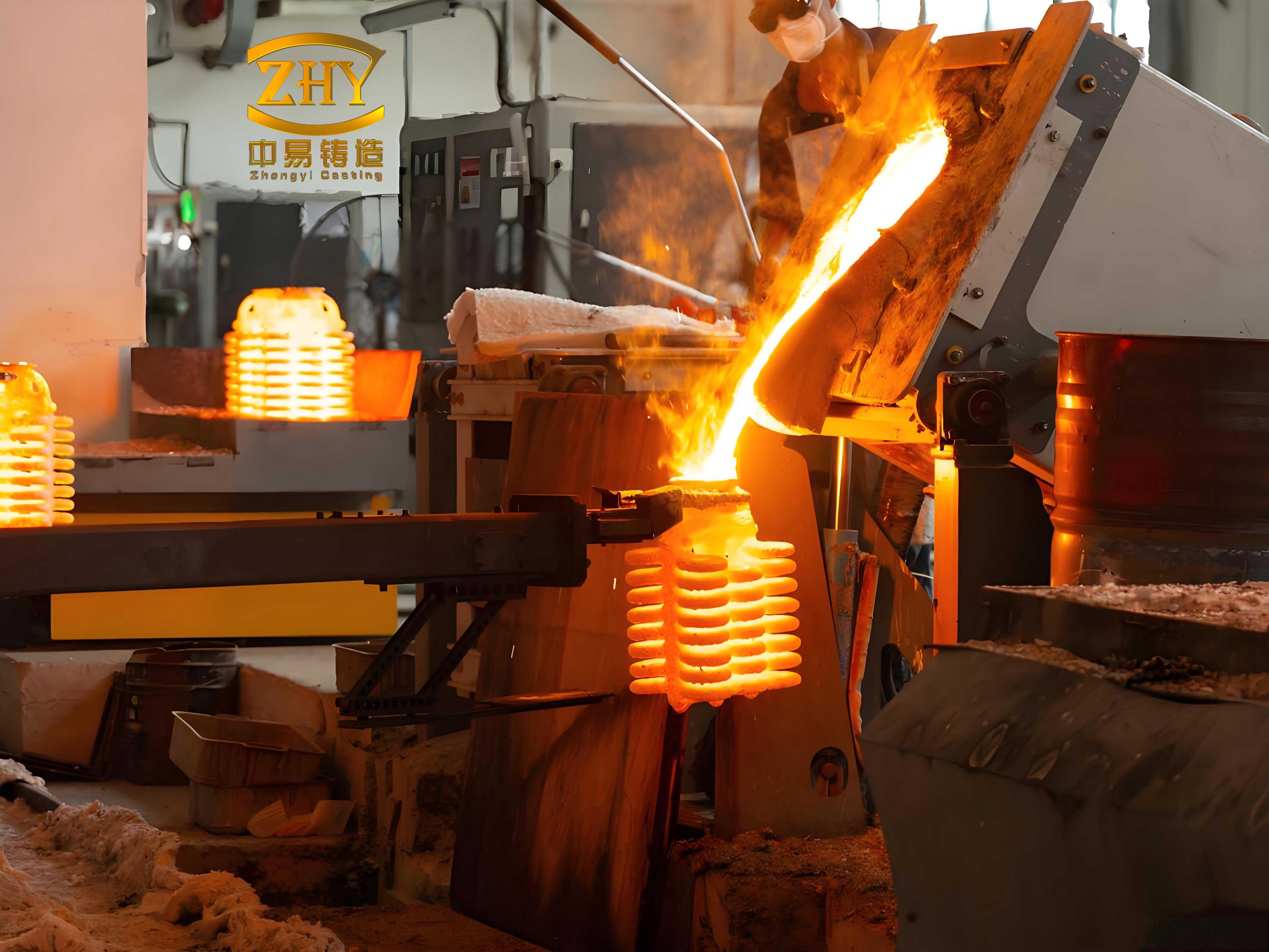
- Pouring and Solidification: The molten superalloy is poured into the preheated shell. For directionally solidified or single-crystal components, the shell is withdrawn from a furnace hot zone into a cooling chamber to establish a controlled thermal gradient.
- Shell Removal and Finishing: After solidification, the ceramic shell is mechanically broken away (knock-out), and the castings are cut from the sprue and subjected to post-casting processes like heat treatment and surface finishing.
Optimizing parameters at each stage—such as slurry viscosity, stucco size, drying environment, firing cycle, and preheat temperature—is essential for shell integrity and final casting quality. The prolonged contact between the high-temperature melt and the ceramic shell during pouring and solidification is the stage where interfacial reactions become critical.
Interfacial Reactions Between Ceramic Molds and Superalloys
Interfacial reactions are complex physico-chemical processes that can severely degrade the surface layer of the casting, leading to defects known as “chemical sand burn-on” or surface contamination. These reactions become more pronounced with newer generations of superalloys that have higher melting points and contain higher concentrations of reactive elements, and with larger castings that have longer solidification times.
Mechanisms of Interfacial Chemical Reaction
The reaction sequence typically involves: (1) decomposition or dissolution of ceramic oxide components at the interface, (2) diffusion of reactants across the interface, and (3) formation of new reaction products. The reactions can be categorized as follows, where \( M_xO_y \) represents a ceramic oxide and \( M_A \) an active alloying element:
1. Decomposition/Dissolution:
$$ M_xO_y (s) \rightarrow x M_{(dissolved)} + y O_{(dissolved)} $$
$$ M_xO_y (s) \rightarrow x M_{(g)} + y O_{(dissolved)} $$
The released oxygen dissolves into the melt, potentially oxidizing alloy elements internally.
2. Displacement/Redox Reaction:
$$ M_xO_y (s) + z M_A (l) \rightarrow M_AO_{y} (s/l) + x M_{(dissolved)} $$
This is the most common mechanism. For example, silica reacts with Hf or Al:
$$ SiO_2 (s) + [Hf]_{alloy} \rightarrow HfO_2 (s) + [Si]_{alloy} $$
$$ 3SiO_2 (s) + 4[Al]_{alloy} \rightarrow 2Al_2O_3 (s) + 3[Si]_{alloy} $$
3. Complex Compound Formation:
$$ M_xO_y (s) + z M_A (l) \rightarrow M_A,_zM_{x-w}O_y (s) + w M_{(dissolved)} $$
This leads to the formation of mixed oxides at the interface.
4. Ceramic Phase Transformation:
$$ M_xO_y (s) \rightarrow M_xO_y (l) $$
While not a chemical change, the formation of a liquid ceramic phase increases its mobility and penetration by the metal, exacerbating interaction.
The thermodynamic driving force for these reactions is the negative change in Gibbs free energy (\( \Delta G^0 < 0 \)). The reaction rate is governed by kinetics, including diffusion rates and interfacial conditions.
Influence of Ceramic Material
The chemical nature of the shell face coat material is a primary factor. Silica-containing materials (e.g., zircon, mullite, silica-based binder) are generally more reactive with superalloys than pure alumina or yttria. Zircon dissociation provides a source of reactive silica. Studies comparing different oxides (MgO, Y₂O₃, Al₂O₃, ZrO₂) have shown that Y₂O₃ exhibits the lowest reactivity with many Ni-based superalloys, often forming a thin, continuous, and stable Y₂O₃-rich layer that acts as a diffusion barrier. Alumina, while relatively stable, can still react with highly reactive elements like Y or Hf.
Influence of Superalloying Elements
Active elements in the superalloy play a defining role in interfacial chemistry. Their effects are summarized in Table 3.
| Element | Role in Alloy | Effect on Interfacial Reaction | Typical Reaction Products |
|---|---|---|---|
| Chromium (Cr) | Oxidation/corrosion resistance. | Moderate reactivity. Can react with silica and other oxides, especially above 1500°C. | Cr₂O₃, (Cr,Al)₂O₃ mixed oxides. |
| Aluminum (Al) | γ’-former (Ni₃Al), oxidation resistance. | Highly reactive, especially with silica and certain binders. | Al₂O₃, Mullite (3Al₂O₃·2SiO₂). |
| Hafnium (Hf) | Grain boundary strengthening, improves castability. | Extremely reactive. A primary driver for interfacial reactions with most ceramics. | HfO₂ (often the dominant product). |
| Yttrium (Y) | Improves oxidation resistance, refines microstructure. | Extremely reactive. Strong affinity for oxygen leads to significant interface reaction. | Y₂O₃, Y-Al garnets (Y₃Al₅O₁₂), Y₄Al₂O₉. Product depends on Y/Al ratio. |
| Rhenium (Re) | Solid solution strengthener, reduces creep rate. | Chemically inert. Does not react directly but can influence wettability and slow reaction kinetics. | None directly. May suppress other reactions. |
| Carbon (C) | Carbide former for strengthening. | Can alter the activity of reactive elements like Hf, indirectly affecting reaction severity. | May promote formation of HfO₂ or other oxides. |
Research indicates a synergistic effect; for instance, the combined presence of C and Hf significantly increases the severity of the reaction layer formation compared to alloys with only one of these elements. The reaction layer morphology can evolve from a flat interface (no C/Hf) to a continuous HfO₂ layer, and finally to a duplex layer containing HfO₂ and complex Cr/Al oxides with increasing C and Hf content.
Wettability and Its Relationship to Interfacial Reaction
Wettability, quantified by the contact angle (\( \theta \)), is a crucial interfacial phenomenon in the investment casting process. Ideally, the melt should have moderate wettability—sufficient for complete mold filling but not so high as to promote extensive capillary penetration into the shell pores, which increases the reaction area.
Wetting can be classified as non-reactive (driven by van der Waals forces, \( \theta \) often > 90°) or reactive (driven by chemical interaction, leading to a decreasing \( \theta \) over time). The relationship is often described by the modified Young’s equation for reactive systems:
$$ \cos \theta(t) = \frac{\sigma_{sg}(t) – \sigma_{sl}(t)}{\sigma_{lg}} $$
where \( \sigma_{sg} \), \( \sigma_{sl} \), and \( \sigma_{lg} \) are the solid-gas, solid-liquid, and liquid-gas interfacial energies, which change over time (\( t \)) due to reaction product formation.
Active elements dramatically influence wettability. Elements like Hf and C improve wetting (reduce \( \theta \)) by participating in interfacial reactions, which lowers \( \sigma_{sl} \). Conversely, Re has been found to increase the contact angle, suggesting it can inhibit wetting and, by extension, moderate the extent of interfacial reaction. The reaction layer thickness often correlates inversely with the equilibrium contact angle in such reactive systems.
Conclusions and Future Perspectives
The development of advanced ceramic shells is pivotal for pushing the boundaries of the investment casting process for next-generation superalloys. While oxide-based refractories like alumina remain central, composite or functionally graded structures offer promising pathways to tailor thermal, mechanical, and chemical properties. The replacement of silica-based binders with more stable colloidal oxides (Y₂O₃, Al₂O₃) is a critical research direction to mitigate face coat reactions.
Additive Manufacturing (AM) presents a transformative opportunity for shell fabrication. AM can enable the production of complex, thin-walled shell architectures with controlled porosity and integrated cooling channels, which could improve thermal management during directional solidification. Furthermore, AM allows for rapid prototyping and digital customization of shell designs, potentially reducing lead times and material waste compared to traditional dip-slurry processes.
Regarding interfacial reactions, a more profound and quantitative understanding is needed. Future research should focus on:
- Mechanistic Modeling: Developing coupled kinetic-thermodynamic models to predict reaction layer growth and composition as a function of alloy chemistry, ceramic composition, temperature, and time.
- In-situ Characterization: Employing high-temperature microscopy and spectroscopy to observe reaction dynamics in real-time.
- Integrated Study of Wettability and Reaction: Systematically investigating how specific alloying elements alter interfacial energies and how these changes feedback into reaction kinetics. The goal is to identify compositions that yield an optimal, mildly reactive interface that ensures good fillability without deep chemical penetration.
- Advanced Barrier Coatings: Exploring the application of ultra-stable, non-wetting coatings (e.g., via CVD or sol-gel) on the shell’s inner surface to completely isolate the melt from the bulk ceramic.
Addressing these challenges will be essential for achieving high-integrity, defect-free castings of complex superalloy components, ensuring the continued advancement and reliability of the investment casting process in demanding aerospace and energy applications.