
In the realm of advanced manufacturing, the integration of additive manufacturing with traditional foundry techniques has opened new avenues for rapid prototyping and small-batch production. From my perspective, the investment casting process, particularly when combined with 3D printing of wax patterns, represents a transformative approach for creating complex metal components. This analysis delves into the technical intricacies of employing 3D printed wax patterns within a plaster mold investment casting process to fabricate aluminum alloy transmission housings. I will explore the entire technical route, key procedural steps, dimensional accuracy considerations, and the overall efficacy of this hybrid methodology. The investment casting process is inherently versatile, but its adaptation with digital tools amplifies its value in product development cycles where speed, flexibility, and precision are paramount.
The foundational principle of the investment casting process involves creating a sacrificial pattern, embedding it within a refractory mold, melting out the pattern, and then pouring molten metal into the resultant cavity. Traditionally, wax patterns are injection-molded using metal dies. However, for prototype or low-volume applications, this approach is often cost-prohibitive and time-consuming due to the need for hard tooling. Herein lies the advantage of 3D printing, or additive manufacturing, which enables the direct, tool-less fabrication of patterns. My focus is on the specific synergy between laser-based 3D printing of wax-like patterns and the plaster mold investment casting process. Plaster molds are renowned for their exceptional replication fidelity, allowing for the casting of intricate, thin-walled geometries with excellent surface finish. When this is preceded by a digital pattern-making step, the entire investment casting process becomes significantly more agile.
The specific component under examination is an automotive transmission housing. This part is structurally complex, with numerous bosses, ribs, and critical bearing bores. Its functional requirements demand high dimensional accuracy, pressure tightness, and good mechanical properties. While high-pressure die casting is the standard for mass production, the investment casting process using 3D printed patterns offers a compelling alternative for design validation and functional testing. The primary technical challenge I address is ensuring that the dimensional integrity of the original CAD model is maintained through the two-stage transformation: first from digital data to a physical 3D printed wax pattern, and second from that pattern to a final aluminum casting via the investment casting process.
| Evaluation Criterion | Metal Die Pressure Die Casting | 3D Printed Wax Pattern Investment Casting |
|---|---|---|
| Initial Tooling Cost | Very High (tens of thousands USD) | Negligible (cost of printed pattern) |
| Lead Time for First Article | Approximately 3 months | Approximately 3-4 weeks |
| Adaptability to Design Changes | Very Low (expensive and slow die modifications) | Very High (digital model alteration only) |
| Economic Batch Size | High-volume production (>10,000 parts) | Single pieces to low-volume batches (<100 parts) |
| Typical Casting Tolerance Grade (CT) | CT4 to CT7 | CT5 to CT7 |
The decision to adopt the 3D printed wax pattern investment casting process was driven by the factors quantified in Table 1. The target material for the housing was an aluminum alloy. For the investment casting process, a common foundry alloy like ZL101A (Al-Si-Mg system) was selected, which, after T6 heat treatment, offers mechanical properties superior to typical die-casting alloys like ADC12, as shown in Table 2. This material compatibility further justifies the choice of this hybrid investment casting process for functional prototypes.
| Property | ZL101A (T6 Heat Treated) – Investment Casting | ADC12 – High Pressure Die Casting |
|---|---|---|
| Tensile Strength (MPa) | 275 | 228 |
| Elongation (%) | 2.0 | 1.4 |
| Brinell Hardness (HB) | ~85 | ~74 |
The core of this integrated methodology is a meticulously designed sequence. The technical route begins with the 3D CAD model of the transmission housing. This model must be processed to account for the dual shrinkage occurring during the investment casting process: first during the pattern burnout and mold heating, and second during the solidification and cooling of the metal. The total linear shrinkage compensation factor (S) for an aluminum casting in a plaster mold can be approximated empirically. If the pattern shrinkage is denoted by $$S_p$$ and the metal shrinkage by $$S_m$$, the overall model scaling factor (F) applied to the CAD geometry is not simply additive but must consider interaction effects. A common simplified approach is:
$$F = 1 + (S_p + S_m)$$
Where typical values for a plaster investment casting process might be $$S_p \approx 0.006$$ and $$S_m \approx 0.013$$ for aluminum, giving an F of approximately 1.019. However, in practice, I derived this factor through prior calibration trials specific to the material and mold system.
The scaled CAD model is then converted into an STL (Stereolithography) file format, which tessellates the surfaces into a mesh of triangles. The resolution of this conversion, defined by the chordal deviation and angular tolerance, introduces the first potential source of error in the investment casting process. This error, $$E_{stl}$$, is usually controlled to be less than 0.1 mm. The STL file drives the 3D printing system.
For pattern making, the Selected Laser Sintering (SLS) process was utilized. In this process, a laser selectively fuses layers of polymer-based powder to build the pattern layer by layer. The resulting “green” part is then infiltrated with molten wax to form a robust, fully waxy pattern suitable for the investment casting process. The key SLS parameters that influence pattern accuracy are detailed in Table 3.
| Process Parameter | Symbol | Value / Setting | Influence on Pattern Quality |
|---|---|---|---|
| Laser Power | P | 31 W | Affects fusion depth and feature resolution. |
| Scan Speed | v | Optimized for material | Inversely related to energy density; impacts sintering quality. |
| Layer Thickness | Δz | 0.15 mm | Directly affects Z-axis resolution and stair-stepping effect. |
| Build Chamber Temperature | Tc | 110 °C | Minimizes thermal distortion and curl during build. |
| Beam Offset Compensation | Ob | Calibrated value | Compensates for laser beam diameter to improve dimensional accuracy. |
The dimensional deviation of the SLS wax pattern, $$D_{pattern}$$, can be modeled as a combination of systemic and stochastic errors:
$$D_{pattern} = f(E_{stl}, E_{layer}, E_{thermal}, E_{post-process})$$
where $$E_{layer}$$ is the layer-related error (including stair-step effect and Z-axis calibration), $$E_{thermal}$$ is error due to thermal shrinkage and distortion during cooling, and $$E_{post-process}$$ is error introduced during wax infiltration and support removal. To evaluate this, I employed optical 3D scanning. The point cloud data from the scan was aligned with the reference CAD model (already scaled for shrinkage) using a best-fit algorithm, and the deviations were computed for thousands of data points.
The statistical analysis of the pattern deviation yielded a standard deviation $$\sigma_{pattern}$$ of 0.5468 mm. According to the empirical rule, for a normal distribution, 99.73% of data lies within ±3σ. In this case, 98.89% of the scanned points fell within ±3σpattern (i.e., ±1.64 mm), indicating a generally well-controlled pattern fabrication process, though with some outliers likely on complex freeform surfaces. This pattern is the direct input for the next phase of the investment casting process.
The heart of the traditional investment casting process is mold creation. Here, a plaster-based investment material is used. The composition of the slurry is critical for achieving the necessary mold strength, permeability, and collapsibility after casting. A typical formulation is summarized in Table 4.
| Component | Type / Example | Weight Percentage (%) | Primary Function |
|---|---|---|---|
| Binder | α-Hemihydrate Plaster (CaSO₄·0.5H₂O) | 30 – 50 | Provides green strength and sets via hydration. |
| Refractory Filler | Silica Flour, Alumina | 50 – 70 | Provides high-temperature stability and reduces shrinkage. |
| Additives | Silica Sol, Cement, Fibers | < 5 | Modify setting time, strength, permeability, and crack resistance. |
| Water (additional) | Deionized Water @ 35°C | 50 – 80 (of dry mix weight) | Medium for slurry fluidity and plaster hydration. |
The slurry is mixed under vacuum to eliminate air bubbles and poured around the assembled wax patterns (often mounted on a central gating system) contained within a flask. The setting reaction of plaster is exothermic:
$$CaSO_4\cdot0.5H_2O (s) + 1.5H_2O (l) \rightarrow CaSO_4\cdot2H_2O (s) + \Delta H$$
This heat must be managed to avoid damaging the wax pattern. After setting, the mold undergoes a controlled drying and burn-out cycle. This is a critical thermal cycle in the investment casting process where the wax is melted and vaporized, and the mold is sintered to develop high-temperature strength. The cycle must be carefully designed to prevent mold cracking from rapid gas generation or thermal stress. A representative time-temperature profile can be described piecewise. For the heating ramp to dewaxing temperature (Td ≈ 150-200°C), a slow rate R1 (e.g., 1°C/min) is used. After a hold for wax removal, the mold is heated to a pre-cast baking temperature (Tb ≈ 600-700°C) at a rate R2 (e.g., 3°C/min), followed by a prolonged soak to ensure thermal uniformity.
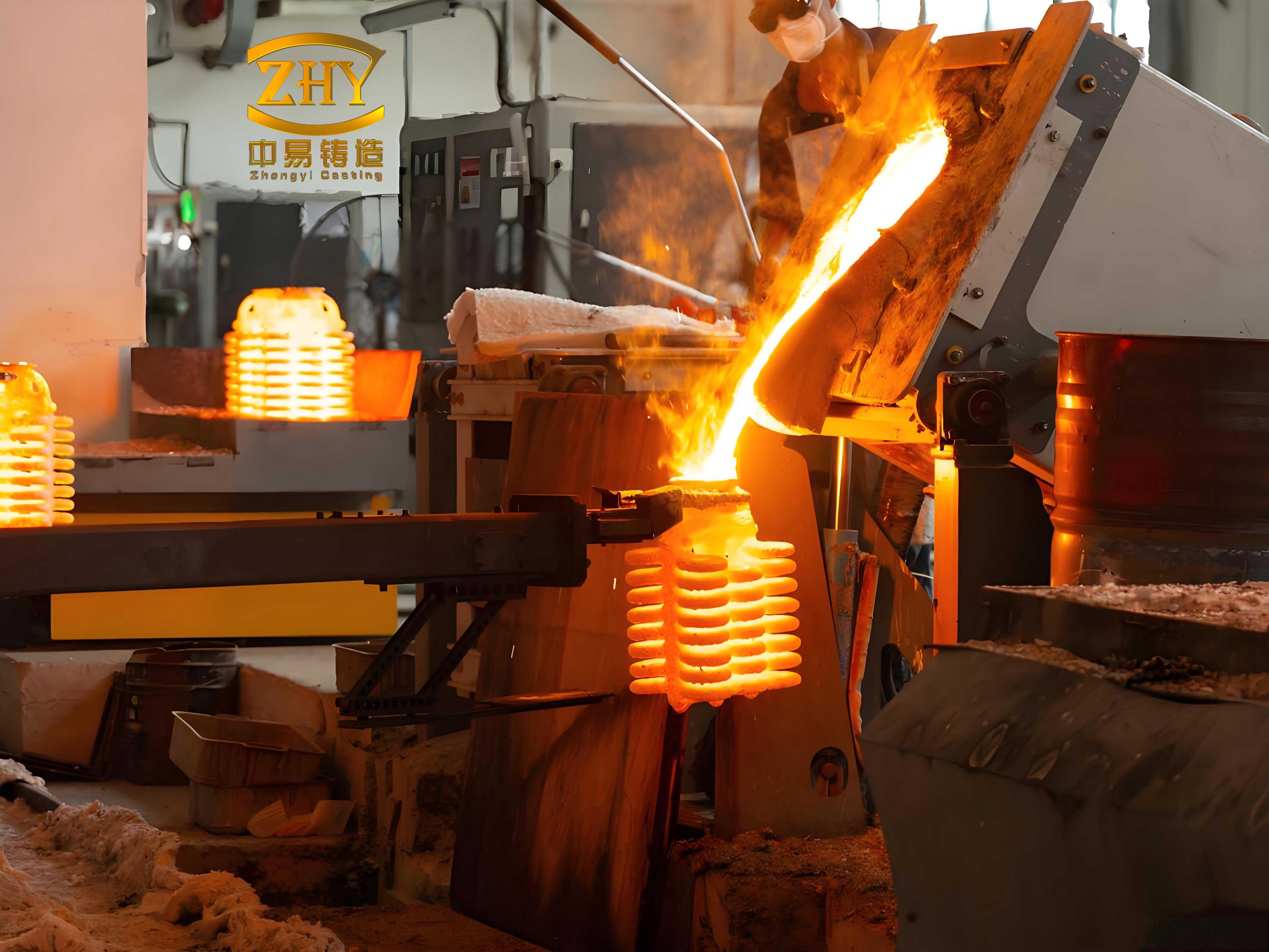
The final and most dynamic step in this investment casting process is metal pouring and solidification. To enhance mold filling and feeding for the complex, thin-walled housing, a vacuum-assisted pressure casting technique was employed. The preheated mold is placed in a sealed chamber. A vacuum is drawn on the chamber (Pchamber << 1 atm) while molten aluminum alloy is poured. The pressure differential between the atmosphere above the melt and the evacuated mold cavity greatly improves the metal’s ability to fill intricate details. Immediately after pouring, the chamber is pressurized with an inert gas (e.g., nitrogen or argon) to a pressure Papplied (e.g., 0.6 MPa). This pressure is maintained on the solidifying metal, effectively increasing the effective feeding pressure according to:
$$P_{effective} = P_{atmospheric} + \rho g h + P_{applied}$$
where ρ is the metal density, g is gravity, and h is the metallostatic head height. This $$P_{effective}$$ acts to suppress microporosity formation and improve metallurgical soundness, which is crucial for the pressure-tightness requirements of a transmission housing. The entire sequence—vacuum, pour, pressurize—constitutes a highly controlled variant of the investment casting process.
After solidification and cooling, the plaster mold is broken away, and the castings are cut from the gating system. The resulting aluminum transmission housing castings were then subjected to a comprehensive dimensional analysis, mirroring the methodology used for the wax patterns. The total deviation of the casting, $$D_{casting}$$, accumulates errors from all previous stages:
$$D_{casting} = D_{pattern} + \Delta_{mold} + \Delta_{metal}$$
where $$\Delta_{mold}$$ represents dimensional change due to mold heating and distortion during the investment casting process, and $$\Delta_{metal}$$ represents shrinkage and distortion during metal solidification and cooling. Optical scanning and analysis of the final casting showed a standard deviation $$\sigma_{casting}$$ of 0.483 mm, with 97.34% of points within ±3σcasting (±1.449 mm). The slight improvement in σ from pattern to casting may seem counterintuitive but can be attributed to the averaging effect of the mold replication and the fact that the metal shrinkage was already compensated for in the original CAD scaling. Critical functional dimensions were also manually verified, as shown in Table 5, confirming the casting’s conformance to CT5 tolerance grade, which is excellent for a prototype investment casting process.
| Feature Description (See Figure 1 for location reference) | Nominal Dimension (mm) | Measured Dimension (mm) | Deviation (mm) | Tolerance Grade Assessment |
|---|---|---|---|---|
| Center Distance: Bearing Bore A to B | 78.00 | 78.40 | +0.40 | Within CT5 limits for this dimension range. |
| Center Distance: Bearing Bore A to C | 85.00 | 84.50 | -0.50 | Within CT5 limits for this dimension range. |
| Overall Distance: Flange Face G to H | 141.00 | 141.80 | +0.80 | Within CT5 limits for this dimension range. |
| Distance: Bore A Center to Boss E | 151.00 | 151.60 | +0.60 | Within CT5 limits for this dimension range. |
The practical application of this 3D printed wax pattern investment casting process yielded highly positive results. A batch of ten transmission housing prototypes was successfully manufactured. The total lead time from CAD data to finished castings was approximately 21 days, a reduction of over 50% compared to the lead time expected for a machined prototype or a die-cast tooling approach. All castings were machined on CNC equipment, assembled into functional transmissions, and subjected to dynamometer testing. They performed satisfactorily, meeting the required standards for sealing, strength, and durability. This validates the investment casting process, when augmented with 3D printing, as a reliable method for producing functional prototypes.
In conclusion, this deep dive into the integrated methodology confirms its significant value. The 3D printed wax pattern investment casting process establishes a robust digital thread from design to metal part. I have demonstrated that careful control of each sub-process—from CAD scaling and SLS parameter optimization to plaster slurry formulation and vacuum-pressure casting parameters—results in aluminum castings with commendable dimensional accuracy (achieving CT5) and sound mechanical properties. The key strength of this investment casting process variant is its agility: it bypasses the need for hard tooling, accommodates design changes with minimal cost and time impact, and delivers functional parts suitable for rigorous testing. For industries like automotive and aerospace where complex, high-integrity components are continually being developed, the fusion of additive manufacturing and the venerable investment casting process is not just an alternative but a strategic enabler for innovation and rapid product realization. Future work could focus on further quantifying the relationships between process parameters and final casting properties using statistical design of experiments, and on expanding the material palette to include higher-performance alloys within this flexible investment casting process framework.