
The production of large-scale nozzle rings presents a significant challenge in the foundry industry, particularly for applications in exhaust gas turbochargers. These components operate under extreme conditions of high temperature and pressure, demanding exceptional material properties and geometric accuracy. Traditionally, welded assemblies were employed, but they suffer from numerous drawbacks including complex machining, significant welding distortion, and reduced overall structural integrity. This document details a comprehensive and innovative approach to manufacturing such components as a single, monolithic piece using the advanced investment casting process. The shift from a fabricated to a cast design not only enhances performance but also streamlines production by eliminating multiple manufacturing steps.
The component in question is a large nozzle ring with an overall diameter of 656 mm and a height of 112 mm. Its monolithic construction via the investment casting process offers superior strength, minimal distortion, and significantly reduced machining allowances compared to its welded counterpart. The material specified is the heat-resistant steel alloy G-X40CrNiSi22.9, chosen for its high-temperature creep and oxidation resistance. The core challenge lies in adapting standard investment casting techniques to a part whose size and complexity push against the conventional limits of standard foundry equipment and shell-making practices.
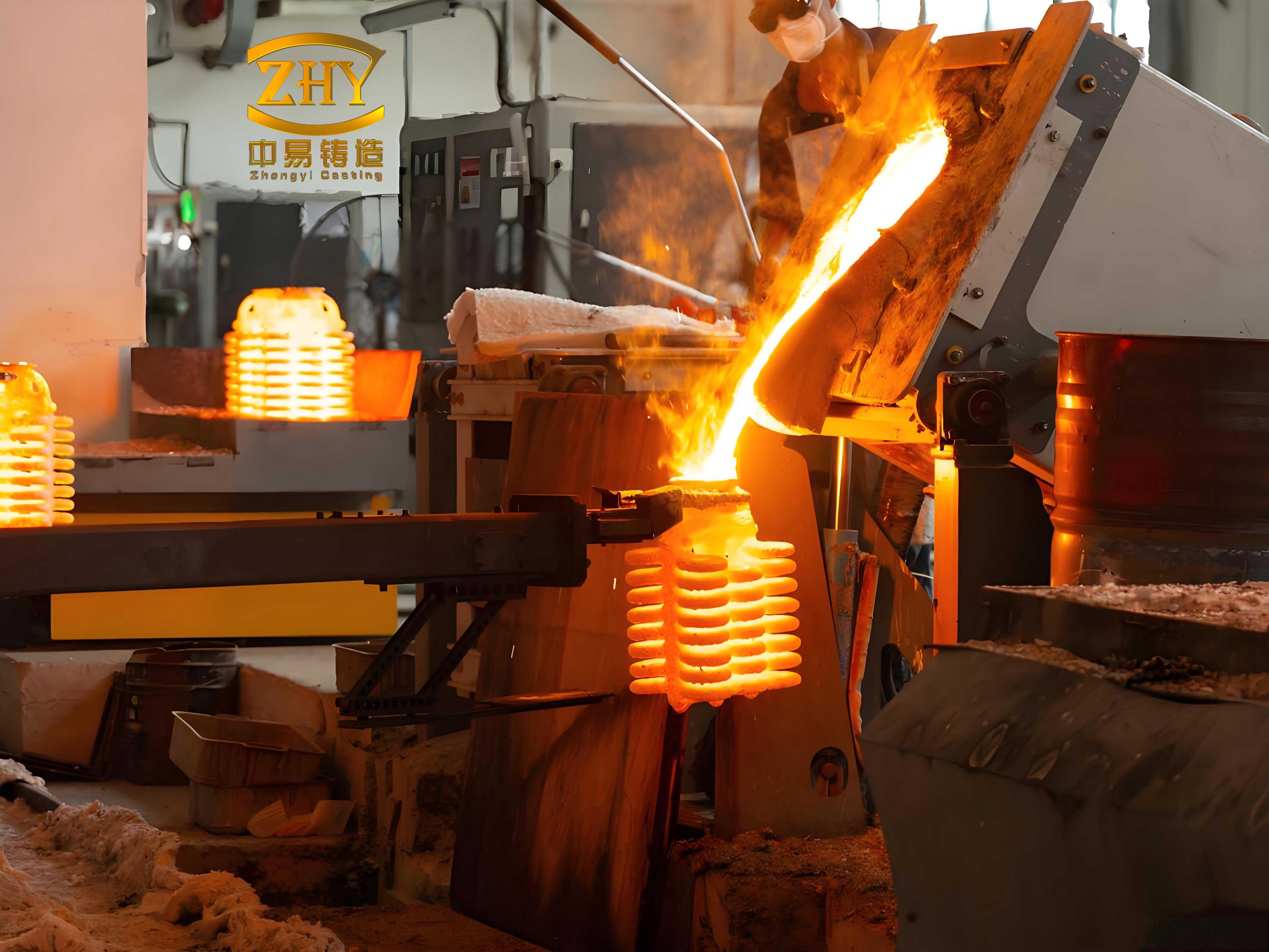
The fundamental advantage of the monolithic investment casting process is evident in the structural homogeneity it provides. A welded nozzle ring consists of an outer ring, an inner ring, and multiple airfoil-shaped blades brazed or welded together. These joints become potential failure points under thermal cycling. In contrast, a cast version grows from a single pool of molten metal, creating a continuous grain structure across the entire component. This integrity is crucial for withstanding the dynamic thermal and pressure loads experienced inside a turbocharger. The investment casting process is uniquely suited to achieve the complex, near-net-shape geometry of the thin blade sections and the integrated mounting lugs on the inner flange.
Technical Challenges and Strategic Solutions
The journey to a successful casting began with two primary technical obstacles that threatened to derail the project using conventional methods. The first was a fundamental equipment limitation, and the second was a concern regarding the structural adequacy of the ceramic shell during high-temperature processing and casting.
Challenge 1: Wax Pattern Mold Exceeds Standard Injection Machine Capacity
The wax assembly for the nozzle ring is built from three distinct pattern types: an outer ring, 24 individual nozzle blades, and a large inner ring with integrated mounting lugs. While the outer ring pattern could be produced by simple gravity pouring of liquid medium-temperature wax into its mold, and the small blade patterns were easily made on a standard wax injection machine, the inner ring pattern posed a unique problem. Its mold, necessary to capture the detailed “L”-shaped cross-section and lugs with high fidelity, had an external dimension of approximately 600 mm. The available wax injection machine had a clear working space (distance between guide columns) of only 580 mm. Under standard operating conditions, this made it impossible to mount the mold on the machine’s platens for conventional clamping and injection. Simply attempting to gravity-pour the inner ring resulted in incomplete filling and unacceptable pattern quality.
Solution: Innovative “Dummy Mold” Tooling for Extended Machine Functionality
The solution was an ingenious adaptation that separated the machine’s clamping and injection functions. The core idea was to use the injection machine’s hydraulic pressure system while bypassing its physical platen constraints for this specific, oversized mold. The procedure was executed as follows:
- A standard, smaller mold (the “dummy mold”) was placed and clamped on the injection machine’s platens in the normal working position. This satisfied the machine’s control system requirements for initiating an injection cycle.
- The injection nozzle (or gun) was then carefully detached from the machine’s injection head.
- The large inner ring mold was positioned on a stable, level surface adjacent to the machine, within the flexible hose reach of the detached injection nozzle.
- A temporary but rigid fixture was constructed to hold the injection nozzle perfectly vertical and aligned with the sprue hole at the center of the inner ring mold cavity.
- With the “dummy mold” clamped on the machine (triggering the “mold closed” signal), the injection parameters were set, and the cycle was initiated. The wax was injected under pressure vertically downward into the stationary inner ring mold.
This method effectively expanded the application range of the existing wax injection equipment without requiring capital investment in a larger machine. It demonstrates a critical principle in adaptable manufacturing: leveraging existing assets through creative process engineering. The success of this step was foundational to the entire investment casting process, as it ensured the production of a high-quality, dimensionally accurate inner ring wax pattern, which is the structural core of the final assembly.
| Component | Standard Production Method | Challenge for This Part | Adapted Solution | Key Outcome |
|---|---|---|---|---|
| Outer Ring | Gravity Pour (Liquid Wax) | None | Standard practice applied. | Adequate pattern quality achieved. |
| Nozzle Blades (x24) | Machine Injection | None (small size) | Standard practice applied. | High-precision patterns achieved. |
| Inner Ring | Machine Injection | Mold size (600mm) > Machine clearance (580mm) | “Dummy Mold” technique with detached, fixtured injection nozzle. | High-fidelity pattern with complex features achieved without new equipment. |
Challenge 2: Insufficient Ceramic Shell Strength for Large-Scale Centrifugal Casting
The second major challenge concerned the ceramic mold, or shell. The final casting is a large, disc-like structure with delicate, thin trailing edges on the airfoil blades. The planned use of centrifugal casting to ensure complete filling applies significant dynamic stress on the shell. Furthermore, the shell must withstand a two-stage high-temperature dewaxing and preheat cycle without cracking or distorting. A standard ceramic shell build-up, while sufficient for smaller or static-poured castings, was deemed to have a high risk of failure—either during handling, firing, or the violent centrifugal casting process—for a part of this size and geometry. Shell failure at any stage leads to a complete loss of the product and considerable time and material waste.
Solution: Integrated Wire Reinforcement in the Ceramic Shell
To overcome the shell strength limitation, a reinforcement strategy inspired by reinforced concrete was implemented. The standard shell-building sequence was modified to integrate a mesh of fine steel wire. The shell build-up protocol was as follows:
- Face Coat: A slurry of fused alumina (Al2O3) powder was applied, followed by stuccoing with fused alumina sand. This layer provides a smooth, refractory surface in direct contact with the molten metal.
- Transition Coat(s): One or more layers using alumina powder slurry and silica (SiO2) sand were applied.
- Reinforcement Step: After the transition coats were complete and dried, but before applying the standard backup coats, the entire shell assembly was carefully wrapped with a continuous winding of fine steel wire with a diameter of less than 1 mm. This created a reinforcing mesh embedded within the shell wall.
- Backup Coats: The standard shell-building process resumed, applying multiple (totaling 10 layers) backup coats using silica flour slurry and silica sand. These layers encapsulate the wire mesh, locking it into the ceramic matrix.
The embedded wire mesh dramatically increases the shell’s tensile strength and fracture toughness. It helps the shell resist the centrifugal forces during pouring, reduces thermal stress cracking during the high-temperature preheat, and allows for safer handling of the large, heavy mold. This modification is a critical enhancement to the conventional investment casting process for heavy-section or large-diameter components.
| Layer Number | Slurry Type | Stucco Material | Primary Function | Special Note |
|---|---|---|---|---|
| 1 (Face) | Fused Alumina Powder | Fused Alumina Sand | Provides smooth surface finish and high-temperature stability. | Critical for surface detail. |
| 2-3 (Transition) | Fused Alumina Powder | Silica Sand | Acts as an intermediate bond between face and backup coats. | — |
| — (Reinforcement) | — | — | Structural reinforcement. | Fine steel wire (<1mm dia.) wound around shell after transition layers. |
| 4-10 (Backup) | Silica Flour | Silica Sand | Provides bulk strength and thickness to the shell. | Wire mesh is fully encapsulated within these layers. |
Optimized Process Parameters for Casting Success
With high-quality wax patterns and a robust shell secured, the focus shifted to the melting, pouring, and solidification parameters. These were meticulously controlled to achieve a sound casting.
Gating, Feeding, and Centrifugal Pouring Strategy
The wax patterns (outer ring, 24 blades, inner ring) were assembled into a complete tree. The gating system was designed with a central sprue of Ø80 mm. A large, annular hot top (riser) with a height of 140 mm and a maximum outer radius of 230 mm was attached to the back (flange side) of the inner ring pattern. The connection between the riser and the part was a generous ring-shaped feeder channel, 60 mm wide and 10 mm high, to ensure adequate directional solidification and feed metal to the entire casting, particularly the thick inner flange section. The use of centrifugal casting was non-negotiable for this part geometry. The thin trailing edges of the blades are prone to mistruns (cold shuts) in gravity pouring due to the rapid heat loss in such thin sections. Centrifugal force ensures rapid, turbulent-free filling and improved metallurgical quality by forcing metal into the thinnest sections and helping to float inclusions toward the center.
The centrifugal pressure acting on the molten metal can be described by the formula:
$$ P_c = \rho \omega^2 r $$
where \( P_c \) is the centrifugal pressure, \( \rho \) is the density of the molten metal, \( \omega \) is the angular velocity, and \( r \) is the radius from the axis of rotation. For this process, an optimal rotational speed of 2 revolutions per second was determined empirically. This speed generated sufficient pressure head to fill the thin sections without being so high as to cause mold erosion or excessive segregation.
Melting, Dewaxing, and Thermal Cycles
The alloy G-X40CrNiSi22.9 was melted in a 150 kg medium-frequency induction furnace lined with a basic magnesia refractory, suitable for high-temperature alloy steels. Charge materials were carefully weighed according to a predefined schedule to ensure correct final chemistry. The shell firing cycle was designed in two stages to thoroughly remove wax residues and preheat the mold uniformly:
$$ \text{Stage 1: } 550^\circ\text{C} \text{ for 1 hour} \quad \text{(Low-temperature wax burnout)} $$
$$ \text{Stage 2: } 850^\circ\text{C} \text{ for 2 hours} \quad \text{(High-temperature sintering and preheat)} $$
The mold was removed from the furnace just before pouring for “hot mold” casting, maintaining a mold temperature high enough to prevent premature freezing of the metal stream. The superheat of the molten metal was critically controlled; the pouring temperature was maintained at or above \( 1580^\circ\text{C} \). This high temperature, combined with the hot mold and centrifugal force, provided the fluidity necessary for complete filling. The total poured weight was 150 kg, yielding a final casting with a rough weight of 63 kg, indicating a significant gating and risering system necessary for feeding such a component.
| Process Stage | Parameter | Value / Specification | Rationale |
|---|---|---|---|
| Shell Making | Total Layers | 10 | To build sufficient thickness and strength; reinforcement prevents cracking under thermal/mechanical stress. |
| Reinforcement | <1 mm steel wire after transition layers | ||
| Final Firing | 550°C (1h) + 850°C (2h) | ||
| Melting & Pouring | Furnace | 150 kg Medium Frequency (Basic Lining) | Ensures proper alloy chemistry, sufficient superheat, and complete mold filling of thin sections. |
| Pouring Temperature | ≥ 1580°C | ||
| Pouring Method | Centrifugal Casting at 2 rev/sec | ||
| Results | Cast Weight / Poured Weight | 63 kg / 150 kg | High yield loss is typical for complex, high-integrity investment castings requiring massive feeders. |
Results, Verification, and Concluding Insights
The implementation of the described adapted investment casting process yielded successful results. Post-casting, the component underwent standard finishing operations where the central gating system was removed by machining. The final casting was then subjected to a full battery of inspections:
- Chemical Analysis: Verified the composition met the G-X40CrNiSi22.9 specification.
- Mechanical Testing: Tensile and impact tests performed on separately cast coupons confirmed the required strength and ductility at temperature.
- Dimensional Inspection: The cast geometry was measured and found to be within the drawing tolerances, with minimal distortion and consistent wall thickness in the delicate blade sections.
- Visual Examination: No major defects such as mistruns, cracks, or significant inclusions were found on critical surfaces.
The cast nozzle ring successfully met all design requirements and was integrated into the turbocharger assembly, performing its function of efficiently converting axial exhaust gas flow into a high-velocity swirling stream to drive the turbine.
Summary of Innovations and Broader Applicability
This project underscores the flexibility and potential of the investment casting process when supported by innovative problem-solving. The two key adaptations—the “dummy mold” injection technique and the wire-reinforced ceramic shell—were decisive in transforming an unmanufacturable (with standard tools) design into a producible reality.
- The wax pattern production method demonstrates that equipment limitations can be overcome with clever tooling design, avoiding costly capital expenditure for low-volume or prototype parts. This approach is directly applicable to other large, low-quantity components where investing in a larger wax injector is not justified.
- The shell reinforcement technique provides a reliable method to enhance the structural integrity of ceramic molds for large-scale or centrifugal castings. It is a simple, low-cost insurance policy against shell failure, a principle that can be applied to any investment casting process where shell strength is a concern.
- The holistic process design, integrating centrifugal pouring with optimized thermal cycles, ensured the metallurgical and geometric quality of a complex, thin-walled structure made from a challenging high-temperature alloy.
In conclusion, this case study provides a validated technical blueprint for the monolithic production of large, rotationally symmetric components like nozzle rings, turbine wheels, or large impellers via the investment casting process. It proves that through strategic modifications to pattern production and shell fabrication, the inherent advantages of investment casting—precision, complexity, and material flexibility—can be successfully scaled to meet the demands of large-format, high-performance applications.