
In the field of advanced manufacturing, the investment casting process stands out for its ability to produce complex, near-net-shape components with exceptional dimensional accuracy and surface finish. As an engineer specializing in this domain, I have been involved in the development of模具 for large-scale, thin-walled castings, where the design of the die is critical to successful wax pattern formation. This article delves into the intricate design of a die for a cabin body casting, highlighting innovative approaches to活块分型, positioning, locking mechanisms, and hollow structures. The investment casting process, being a cornerstone of this work, will be frequently referenced to underscore its principles and challenges.
The cabin body casting, as the core component, presents significant design hurdles due to its size, geometry, and wall thickness. Utilizing the investment casting process, we first create precise wax patterns via die injection, which are then used to form ceramic shells for metal pouring. The success of this investment casting process hinges on a die that can reliably produce wax patterns without defects, facilitate easy demolding, and withstand operational pressures. Here, I will detail our design methodology, incorporating analytical tools, tables, and formulas to encapsulate key decisions.
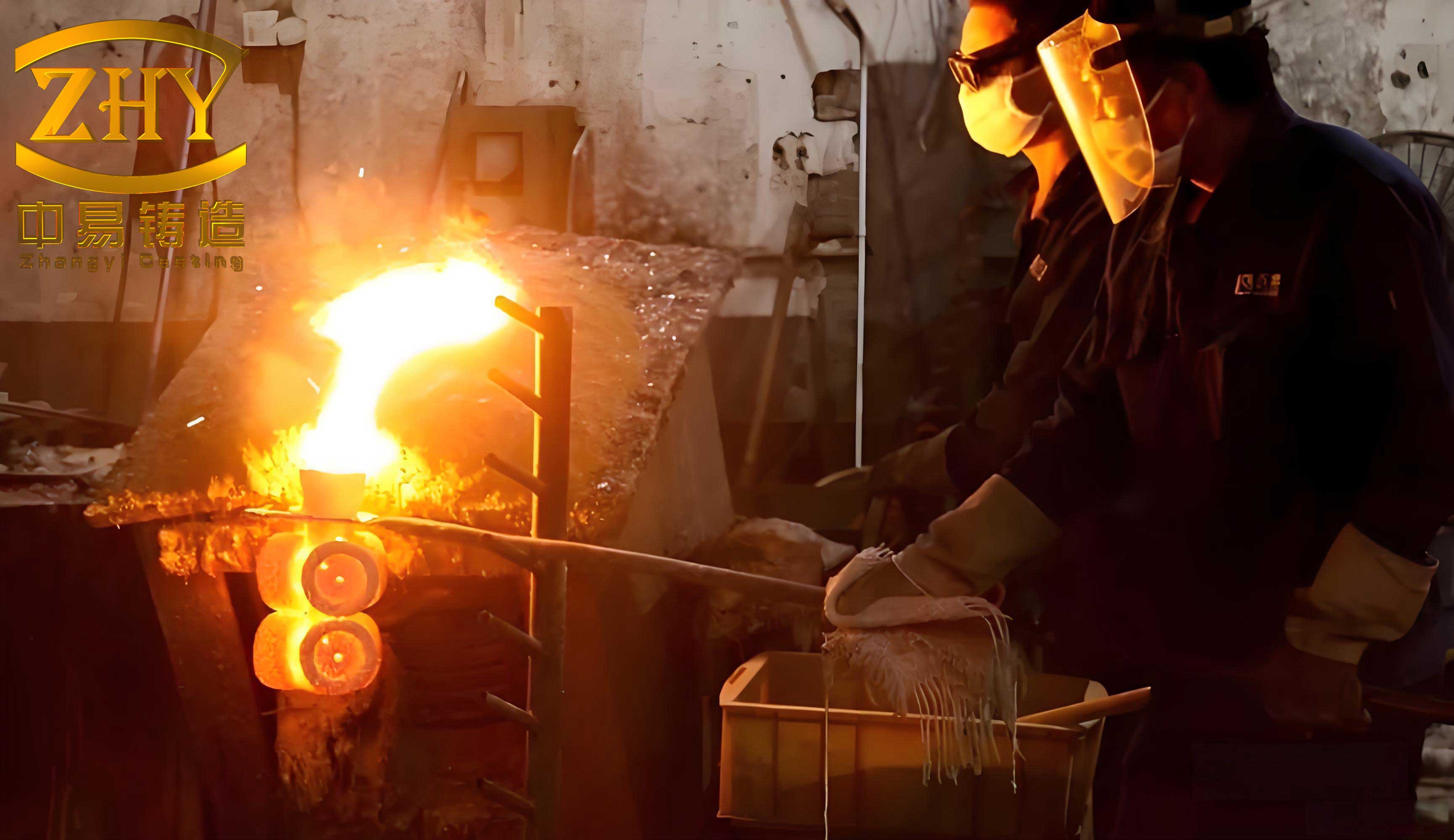
The铸件 in question is a large, thin-walled structure with dimensions approximately 700 mm × 650 mm × 500 mm, featuring a typical wall thickness of only 2.5 mm. It has flanged ends, with nine internal lugs and holes distributed at one end, and is reinforced with 12工艺加强筋 (8 longitudinal and 4 transverse) to enhance充型 and structural integrity. These characteristics impose strict demands on the die design for the investment casting process, particularly regarding demolding,活块 management, and dimensional stability. To summarize the铸件 specifications, consider the following table:
| Parameter | Value | Unit |
|---|---|---|
| Overall Length | 700 | mm |
| Overall Width | 650 | mm |
| Overall Height | 500 | mm |
| Wall Thickness | 2.5 | mm |
| Internal Height (cavity) | 640 | mm |
| Number of Internal Lugs | 9 | – |
| Number of Reinforcement Ribs | 12 | – |
Analyzing this铸件 within the context of the investment casting process, the die must address several critical issues. The wax pattern, being fragile and having low弹塑性, requires that the die has no undercuts that hinder demolding.活块 must be sized and weighted for manual handling, with smooth surfaces for easy wax release. Moreover, the腰鼓形 shape—smaller at the ends and larger in the middle—necessitates a unitary die core in the height direction to ensure uniform wall thickness and avoid misalignment. This is paramount in the investment casting process to prevent defects like mismatches or wall variations. Radial splitting of活块 reduces weight, simplifies demolding, and aids in assembly and inspection, directly supporting the precision goals of the investment casting process.
The internal lugs and holes further complicate demolding, as活块 must be extracted both inward and outward. Those forming the internal lugs and flange require a separate活块 set to avoid compromising the 2.5 mm wall. This demands reliable positioning between活块 sets. Given the die’s large size, strength under injection pressure is essential, yet weight reduction and吊装 facilities are needed for operational efficiency—a balance typical in the investment casting process for large components.
Our die design, modeled using UG software, adopts a structure with上下锁紧,左右开模, and two internal活块组 with positioning blocks in a hollow configuration. This approach optimizes the investment casting process by addressing the above challenges. The die comprises key components: upper/lower locking mechanisms, positioning pins, upper die plate, upper positioning block, internal活块组 I and II, left/right活块, support rods, lower positioning block, lower die base, left/right半模, injection ring, ejection mechanisms, and external活块. The demolding sequence is meticulously planned to ensure wax pattern integrity.
To elaborate on the demolding procedure, which is crucial in the investment casting process: After wax injection and pressure holding, 18 positioning pins are removed, followed by unlocking the upper/lower mechanisms. The upper die plate is taken off, exposing the upper positioning block. Internal活块组 I is then extracted inward toward the center in a specific sequence (a, b, c…), forming the internal lugs and flange. Next, the left/right locking mechanisms are loosened, allowing the left/right半模 to separate slightly. The lower positioning block is lifted out via support rods, enabling internal活块组 II to be demolded inward in another sequence (a, b, c…). Ejection mechanisms on initial活块 assist in overcoming wax adhesion, with a 3° draft angle on活块 interfaces. Finally, the wax pattern remains on the lower die base for removal. This systematic process minimizes stress on the wax, adhering to best practices in the investment casting process.
The wax pattern’s formation relies on precise die surfaces: internal contours from internal活块组 I and II, external contours from left/right活块 and半模, and end faces from the upper die plate and lower die base. Positioning and locking are vital for dimensional accuracy. Internal活块组 are positioned via pins between sets and against the upper/lower die components. The left/right半模 locate against the lower die base, with additional locking mechanisms to resist injection forces. This ensures consistent wall thickness, a key metric in the investment casting process. The locking force can be analyzed using the formula for pressure equilibrium during injection: $$ P_{\text{injection}} = \frac{F_{\text{locking}}}{A_{\text{seal}}} $$ where $P_{\text{injection}}$ is the wax injection pressure (typically 0.5-2 MPa in the investment casting process), $F_{\text{locking}}$ is the total locking force provided by mechanisms, and $A_{\text{seal}}$ is the effective sealing area between die halves. Ensuring $F_{\text{locking}} > P_{\text{injection}} \times A_{\text{seal}}$ prevents die opening and flash formation.
A distinctive feature of this die is its hollow structure between the upper and lower positioning blocks over a 600 mm height. This reduces weight, minimizes contact surfaces between活块, and saves material and machining time—all beneficial for the investment casting process’s efficiency. The weight reduction can be quantified as: $$ \Delta W = \rho \cdot V_{\text{hollow}} $$ where $\Delta W$ is the weight reduction, $\rho$ is the density of the die material (e.g., steel, ~7.85 g/cm³), and $V_{\text{hollow}}$ is the volume of the hollowed section. Assuming a simplified cylindrical hollow of diameter 200 mm and height 600 mm, $$ V_{\text{hollow}} = \pi \left(\frac{d}{2}\right)^2 h = \pi \times (100 \text{ mm})^2 \times 600 \text{ mm} \approx 1.885 \times 10^7 \text{ mm}^3 = 1.885 \times 10^{-2} \text{ m}^3 $$ Then, $$ \Delta W = 7850 \text{ kg/m}^3 \times 1.885 \times 10^{-2} \text{ m}^3 \approx 148 \text{ kg} $$ This significant reduction facilitates manual handling and reduces fatigue in the investment casting process operations.
The support rods play a dual role: transmitting pressure from the upper positioning block to keep the lower block seated, and serving as lifting points for demolding. This design exemplifies how mechanical principles are integrated into die for the investment casting process. Furthermore, the活块 in internal活块组 I are arranged in 11 pieces to accommodate the nine lugs’ varying orientations, with a 5° draft on interfaces to ease demolding without damaging the wax. Internal活块组 II consists of 9 elongated pieces, positioned via the lower block and die base, ensuring accurate internal contours. The use of multiple活块 enhances manufacturability and inspection, aligning with the precision demands of the investment casting process.
In terms of manufacturing and validation, this die was successfully produced without post-machining corrections, and it has entered normal production. The design considerations—such as活块 splitting, positioning methods, locking systems, and hollow construction—have proven effective in the investment casting process for large complex castings. Below, a table summarizes the key die components and their functions, emphasizing their role in the investment casting process:
| Component | Quantity | Function in Investment Casting Process |
|---|---|---|
| Positioning Pins | 18 | Align活块 sets for precise wax pattern formation |
| Upper/Lower Locking Mechanisms | 2 sets | Secure die halves during wax injection |
| Internal活块组 I | 11 pieces | Form internal lugs and flange; demold inward |
| Internal活块组 II | 9 pieces | Form main internal cavity; demold inward |
| Left/Right半模 | 2 pieces | Form external contours; separate laterally |
| Support Rods | Multiple | Transfer force and aid吊装 for demolding |
| Ejection Mechanisms | On initial活块 | Assist in releasing wax adhesion |
The investment casting process relies heavily on such detailed die design to achieve high-quality wax patterns. For instance, the pressure distribution during injection can be modeled using fluid dynamics principles. The wax flow in the die cavity, assuming Newtonian behavior for simplicity, follows the Navier-Stokes equation: $$ \rho \left( \frac{\partial \mathbf{v}}{\partial t} + \mathbf{v} \cdot \nabla \mathbf{v} \right) = -\nabla p + \mu \nabla^2 \mathbf{v} + \mathbf{f} $$ where $\rho$ is wax density, $\mathbf{v}$ is velocity vector, $p$ is pressure, $\mu$ is dynamic viscosity, and $\mathbf{f}$ is body force. In practice, for the investment casting process, this informs gate and runner design to ensure complete cavity filling without entrapped air, which is critical for the cabin body’s thin walls.
Moreover, the mechanical strength of the die under cyclic loading is vital for longevity in the investment casting process. Using fatigue analysis, the stress concentration factors at活块 interfaces can be evaluated to prevent cracking. For a typical fillet radius $r$ at a corner, the stress concentration factor $K_t$ can be estimated as: $$ K_t \approx 1 + \frac{0.5}{\sqrt{r/t}} $$ where $t$ is the wall thickness. Keeping $K_t$ low through design optimization reduces failure risk, ensuring reliable performance over multiple cycles in the investment casting process.
In conclusion, this die design for a large cabin body casting demonstrates how innovative approaches to活块分型, positioning, locking, and hollow structures can overcome challenges in the investment casting process. By reducing weight, simplifying demolding, and enhancing precision, the design supports efficient production of complex wax patterns. The successful implementation without修模 underscores the value of thorough analysis and simulation in the investment casting process. As the investment casting process evolves for larger and more intricate components, such design strategies will remain essential, offering valuable insights for future projects in precision manufacturing.