
In the realm of advanced manufacturing, producing high-integrity thin-walled aluminum alloy castings poses significant challenges, particularly when traditional gravity pouring methods fall short in achieving complete mold filling and sound metallurgical quality. This study focuses on leveraging the synergistic combination of the investment casting process and counter-gravity casting techniques to address these issues. Through a detailed investigation of key parameters such as filling velocity and pouring temperature, we have successfully fabricated a representative thin-walled component, demonstrating the efficacy of this integrated approach. The investment casting process, known for its ability to produce complex, near-net-shape parts with excellent surface finish, is further enhanced by counter-gravity methods, which improve metal flow and reduce defects. This article delves into the principles, experimental design, results, and analysis, employing tables and formulas to summarize critical aspects, while consistently emphasizing the role of the investment casting process in achieving optimal outcomes.
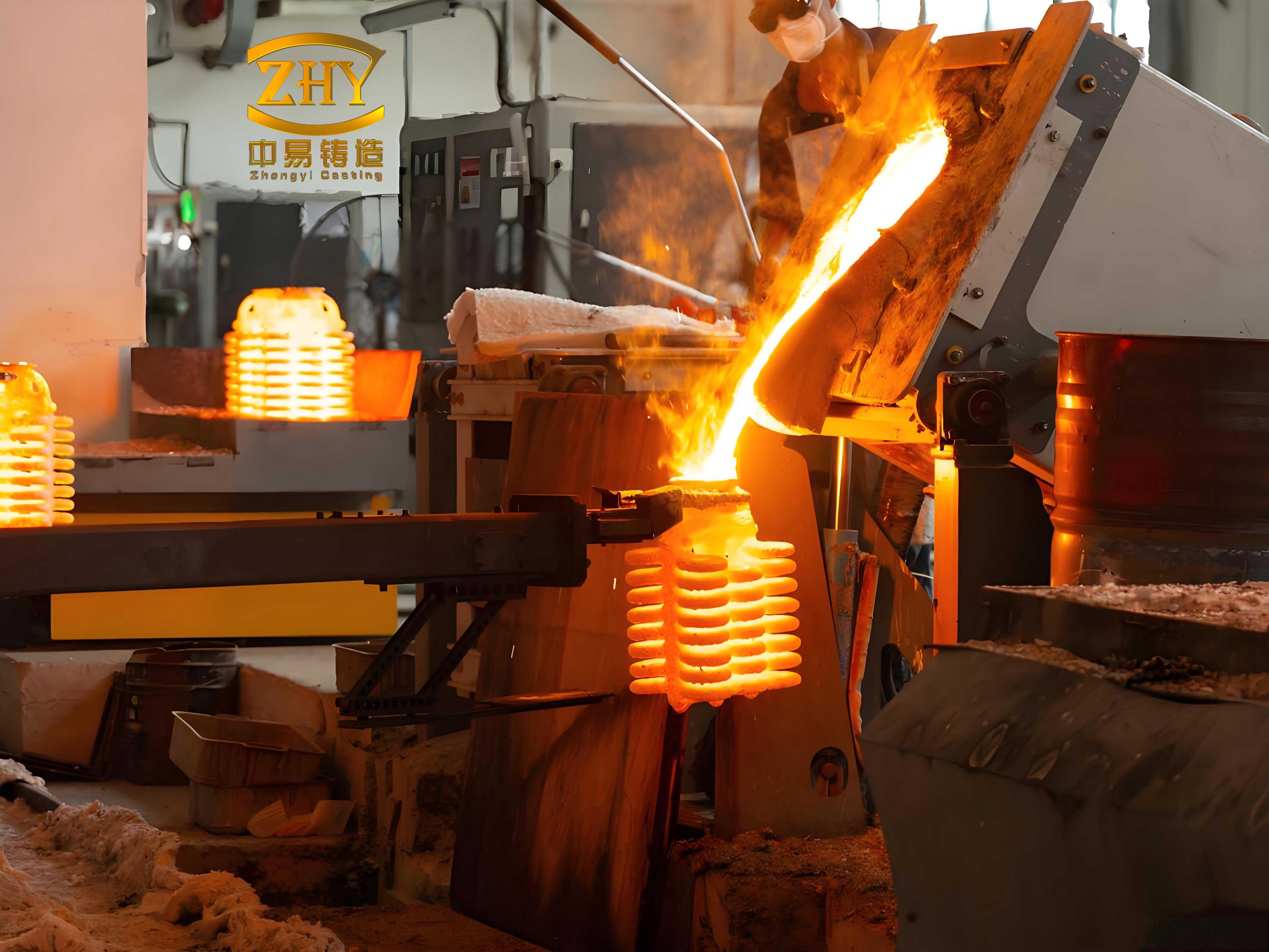
The investment casting process begins with the creation of a precise wax pattern, which is then coated with ceramic slurries to form a multi-layer shell. After dewaxing and firing, the resulting mold offers high dimensional accuracy and surface quality, making it ideal for intricate geometries. However, for thin-walled structures with uniform thicknesses as low as 2 mm, conventional gravity casting often leads to misruns or cold shuts due to inadequate fluidity and premature solidification. To overcome this, we integrated counter-gravity casting, specifically the vacuum-assisted filling and pressure-assisted solidification technique, into the investment casting process. This method not only enhances the filling capability of molten aluminum but also minimizes gas entrapment and improves feeding during solidification, thereby elevating the overall quality of the castings produced through the investment casting process.
The fundamental principle of the counter-gravity system used here is based on differential pressure control. The setup consists of two chambers: an upper chamber housing the preheated ceramic mold and a lower chamber connected to the molten metal bath. Initially, the upper chamber is evacuated to a predetermined vacuum level, creating a pressure differential that draws the metal into the mold cavity in a controlled manner. After complete filling, the lower chamber is pressurized with an inert gas, applying a consistent pressure on the molten metal to promote directional solidification and reduce shrinkage porosity. This process can be mathematically described using fluid dynamics equations. For instance, the filling velocity \(v\) is related to the pressure difference \(\Delta P\) and the metallostatic head \(h\) by:
$$ v = \frac{\Delta P}{\rho g t} $$
where \(\rho\) is the density of the molten alloy, \(g\) is gravitational acceleration, and \(t\) is the filling time. In practice, \(\Delta P\) is controlled by adjusting the vacuum level in the upper chamber, and \(v\) is derived from empirical observations. This relationship underscores how precise control in the investment casting process, combined with counter-gravity forces, enables optimized filling for thin-walled sections. The vacuum environment during filling reduces air resistance, thereby enhancing the fluidity of the alloy, a critical factor in the investment casting process for complex geometries.
To systematically evaluate the process, we designed an experimental matrix centered on two primary variables: metal filling velocity and pouring temperature. These parameters were chosen because they directly influence mold filling completeness and defect formation in thin-walled investment castings. The ceramic shell was fabricated using a silica sol-silicate ethyl hybrid system, preheated to 350°C to minimize thermal shock and ensure uniform metal flow. The gating system was optimized to facilitate smooth entry and minimize turbulence, as turbulent flow can introduce oxides and gas pores, compromising the integrity of the investment casting process. Table 1 summarizes the six parameter combinations tested, with filling velocities calculated based on vacuum settings and observed filling times.
| Experiment | Filling Velocity (mm/s) | Pouring Temperature (°C) |
|---|---|---|
| 1 | 63 | 725 |
| 2 | 63 | 735 |
| 3 | 77 | 725 |
| 4 | 77 | 735 |
| 5 | 100 | 725 |
| 6 | 100 | 735 |
The results from these trials provided clear insights into the interplay between parameters. As shown in Table 2, only specific combinations yielded castings that were fully formed and met the stringent quality standards, which included radiographic and fluorescent inspection for defects. The investment casting process, when coupled with counter-gravity, proved highly sensitive to both filling speed and temperature; insufficient velocity led to incomplete filling, while excessive temperature promoted shrinkage at geometric hotspots like corner junctions. This highlights the need for precise parameter optimization in the investment casting process for thin-walled applications.
| Experiment | Result |
|---|---|
| 1 | Misrun |
| 2 | Misrun |
| 3 | Misrun |
| 4 | Complete filling, but with microporosity at hotspots |
| 5 | Complete filling, meeting all quality requirements |
| 6 | Complete filling, but with microporosity at hotspots |
Analysis of these results reveals that a filling velocity of 100 mm/s and a pouring temperature of 725°C produced the optimal outcome. At lower velocities, such as 63 mm/s, the metal front solidified before completely filling the thin sections, regardless of temperature. This can be explained by the heat transfer dynamics in the investment casting process. The rate of heat loss \(Q\) from the molten metal to the ceramic mold can be approximated by:
$$ Q = h_c A (T_m – T_s) $$
where \(h_c\) is the heat transfer coefficient, \(A\) is the surface area, \(T_m\) is the metal temperature, and \(T_s\) is the shell temperature. For thin walls, \(A\) is large relative to volume, leading to rapid cooling. Thus, higher filling velocities reduce the time for heat loss, enabling complete filling. However, increasing the pouring temperature to 735°C at 77 mm/s or 100 mm/s introduced shrinkage defects due to prolonged solidification times at hotspots, as described by the solidification time \(t_s\):
$$ t_s = \frac{V \rho L}{A h_c (T_m – T_s)} $$
where \(V\) is volume, \(L\) is latent heat, and other terms are as defined. Higher \(T_m\) increases \(t_s\), allowing more time for shrinkage voids to form in isolated regions. Therefore, balancing velocity and temperature is crucial in the investment casting process to ensure both filling integrity and sound metallurgy.
Beyond the primary parameters, other factors in the investment casting process also contribute to success. For example, the ceramic shell properties, such as permeability and thermal conductivity, affect metal flow and cooling rates. We used a composite shell system to balance strength and collapsibility, which is vital for demolding after casting. The shell’s behavior during heating and cooling can be modeled using thermal expansion coefficients, but for brevity, we focus on the metal-related aspects. Additionally, the vacuum level during filling must be calibrated to achieve the desired velocity without causing turbulence. Empirical data suggest that for thin-walled investment castings, a vacuum of approximately 0.5 to 0.7 bar relative to atmospheric pressure yields velocities around 100 mm/s, though this varies with alloy composition and mold geometry.
To further generalize our findings, we can derive a performance index \(PI\) for the investment casting process under counter-gravity conditions, combining filling and solidification quality:
$$ PI = \alpha v + \beta \frac{1}{T_m – T_{eutectic}} $$
where \(\alpha\) and \(\beta\) are weighting factors based on casting geometry, \(v\) is filling velocity, and \(T_{eutectic}\) is the eutectic temperature of the alloy. A higher \(PI\) indicates better overall performance, and our optimal parameters maximize this index. This formula underscores the integrated nature of the investment casting process, where multiple variables must be tuned in unison.
In practice, implementing this optimized investment casting process requires careful control systems. Automated vacuum and pressure regulators ensure repeatability, while real-time monitoring of temperature and velocity via sensors can adapt to variations. For the thin-walled ventilation hole casting studied, the successful implementation involved preheating the shell, setting the vacuum to achieve 100 mm/s, and pouring at 725°C, followed by a pressure hold of 2-3 bar during solidification. This protocol resulted in castings free of misruns, porosity, and cracks, fully meeting ASTM E155 Class C standards. The investment casting process, enhanced by counter-gravity, thus offers a robust solution for producing high-quality thin-walled components in aerospace and other demanding industries.
Looking ahead, there are opportunities to refine the investment casting process further. For instance, computational fluid dynamics (CFD) simulations can predict metal flow and temperature distribution, reducing trial-and-error. Incorporating advanced alloys or composite reinforcements may also benefit from this method. Moreover, the principles discussed here apply to other counter-gravity variants, such as low-pressure casting, expanding the versatility of the investment casting process. Throughout this study, the investment casting process has been central to achieving precision and complexity, and its integration with counter-gravity techniques represents a significant advancement in casting technology.
In conclusion, the fusion of the investment casting process with counter-gravity casting, specifically vacuum-assisted filling and pressure-assisted solidification, enables the reliable production of thin-walled aluminum alloy castings. By optimizing filling velocity to 100 mm/s and pouring temperature to 725°C, we achieved complete mold filling and excellent metallurgical quality, as validated by non-destructive testing. The investment casting process provides the foundational accuracy, while counter-gravity addresses fluidity and feeding challenges. This synergistic approach, supported by empirical data and theoretical formulas, highlights the importance of parameter control in the investment casting process for thin-walled applications. Future work may explore adaptive control systems or new shell materials to push the boundaries of this technology, but the core principles remain rooted in the meticulous integration of the investment casting process with advanced casting methods.