
In the field of advanced manufacturing, particularly for aerospace applications, the production of high-performance components with complex geometries is paramount. Among these, superalloy castings featuring hollow internal structures present significant challenges due to their intricate designs, thin walls, and stringent quality requirements. As a researcher specializing in metallurgical engineering, I have extensively studied the investment casting process to address these challenges, focusing on a specific large-scale hollow blind-tube component analogous to an X-type pull rod used in aero-engines. This component, approximately 410 mm in length with a wall thickness of 2.5 mm, necessitates a meticulous approach to ensure dimensional accuracy, metallurgical integrity, and structural reliability. The core of this work revolves around optimizing the investment casting process through advanced numerical simulation and precise mold design, which are critical for mitigating defects and enhancing production efficiency. Throughout this article, I will delve into the methodologies, analytical tools, and iterative improvements employed, emphasizing the pivotal role of the investment casting process in achieving high-integrity castings.
The foundation of this research lies in the selection and characterization of the superalloy material. The alloy used is a nickel-based casting superalloy with high aluminum and titanium content, offering a favorable combination of strength, ductility, and castability. Its chemical composition is detailed in Table 1, which summarizes the weight percentages of key elements. This alloy is particularly suited for components subjected to high temperatures and stresses, such as turbine blades and structural parts. In the investment casting process, the master alloy is melted using a vacuum induction furnace, ensuring minimal contamination and precise compositional control. The wax patterns are fabricated using an automated injection molding machine, followed by the standard stages of shell building, dewaxing, and pre-firing to produce the ceramic mold. Finally, the mold is preheated and filled with the molten alloy under vacuum conditions to achieve a sound casting. This systematic approach underscores the complexity and precision inherent in the investment casting process.
| Element | Content Range (%) | Element | Content Range (%) |
|---|---|---|---|
| C | 0.14–0.20 | Fe | ≤2.0 |
| Cr | 8.5–10.5 | W | 1.0–1.8 |
| Mo | 2.7–3.4 | V | 0.5–1.0 |
| Co | 12.0–15.0 | Si | ≤0.4 |
| Ti | 4.2–4.7 | Mn | ≤0.4 |
| Al | 5.0–5.7 | S | ≤0.015 |
| Nb | 0.5–1.0 | P | ≤0.015 |
| Ni | Balance |
A critical aspect of the investment casting process for hollow components is the design and fabrication of ceramic cores. The casting in question incorporates an internal triangular cavity with a cross-sectional area of only 10 mm × 8 mm, extending over a length of about 350 mm. Given the complexity and size, a monolithic ceramic core is indispensable, as alternative methods like soluble cores would compromise shell integrity. However, the use of such large ceramic cores introduces challenges related to dimensional stability during sintering and compatibility with wax pattern molds. To address this, I focused on the mold shrinkage design, which must account for multiple phase transformations: ceramic core sintering shrinkage, wax pattern contraction, and alloy solidification shrinkage. The overall shrinkage coefficient for mold design is derived from empirical measurements and statistical analysis. Specifically, the ceramic core sintering shrinkage rate, denoted as $S_L$, is calculated using the formula:
$$ S_L = \frac{L_{\text{sintered}} – L_{\text{green}}}{L_{\text{green}}} \times 100\% $$
where $L_{\text{green}}$ and $L_{\text{sintered}}$ are the core lengths before and after sintering, respectively. Similarly, the wax pattern contraction rate $\sigma_W$ and the casting solidification shrinkage $\sigma_C$ are determined through dimensional analysis of produced samples. The total mold design shrinkage $\sigma_T$ integrates these factors to ensure final casting dimensions meet tight tolerances, typically within ±0.45 mm for a 350.5 mm feature, complying with aerospace standards. This holistic approach to shrinkage compensation is vital in the investment casting process for achieving net-shape components. The ceramic core material selected is a high-quality silica-based system, chosen for its thermal stability and compatibility with the alloy. During wax injection, parameters such as low wax temperature are optimized to minimize volumetric shrinkage and reduce core breakage. Through iterative trials, the core breakage rate was lowered to below 5%, demonstrating the efficacy of this tailored approach in the investment casting process.
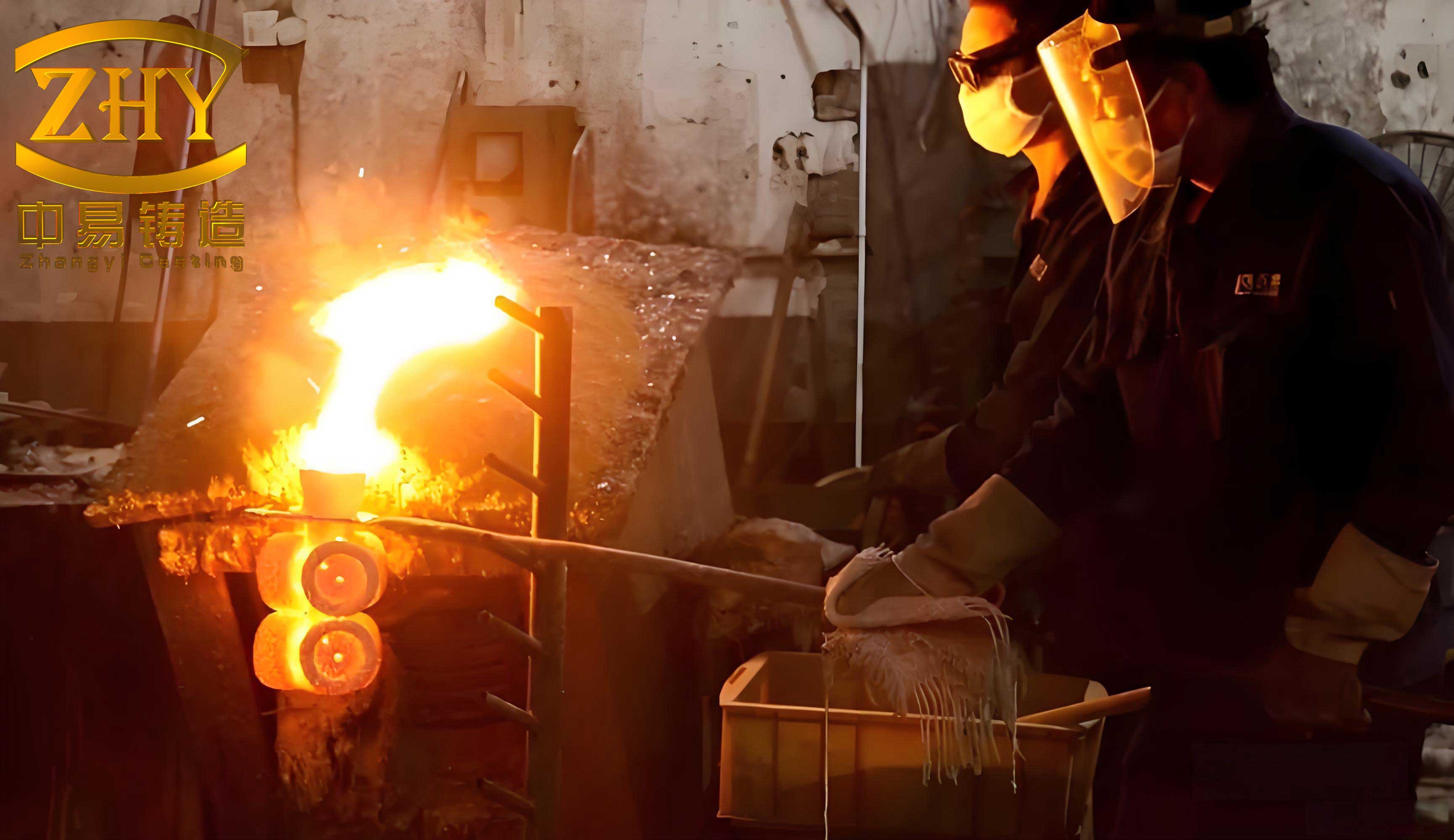
To further refine the investment casting process, numerical simulation plays a pivotal role in predicting and mitigating casting defects. I employed ProCAST software, a finite-element-based tool, to simulate the filling, solidification, and thermal behavior of the casting. This allows for virtual optimization of gating systems and process parameters before physical trials, thereby reducing development time and cost. The simulation workflow begins with constructing a 3D geometric model of the casting and gating system, meshing it into discrete elements, and assigning boundary conditions based on actual process settings. Key parameters include a mold preheat temperature of 1000°C, a pouring temperature of 1460°C, and a filling time of 5 seconds. The thermophysical properties of the superalloy are derived from the BackDiffusion model in ProCAST, using the alloy composition from Table 1, while the mold material (mullite) properties are sourced from the software’s database. Heat transfer interfaces account for conduction between the casting and mold, as well as radiation between the mold and insulation. The simulation outputs provide insights into temperature distributions, solidification sequences, and defect formation, which are crucial for enhancing the investment casting process.
Initially, a side-gating system was designed, where multiple ingates are attached along one side of a vertical sprue. This configuration aims to promote directional solidification by allowing open access for cooling. The filling sequence simulation, as shown in Figure 4 (though not referenced explicitly, described textually), reveals that molten metal fills the sprue first, then enters the casting through bottom ingates, ascending steadily without turbulence over approximately 3 seconds. The temperature field during solidification, depicted in Figure 5, indicates a generally progressive cooling from the casting extremities toward the gating system. However, analysis of the solid fraction evolution (Figure 6) identifies an isolated liquid zone at the root of a top lug feature between 30 to 50 seconds, suggesting inadequate feeding and a potential shrinkage porosity risk. This is quantitatively assessed using the Niyama criterion, a predictive metric for shrinkage defects. The Niyama value $N_i$ is defined as:
$$ N_i = \frac{G}{\sqrt{\dot{T}}} $$
where $G$ is the temperature gradient and $\dot{T}$ is the cooling rate. Regions with $N_i$ below a critical threshold (e.g., 1 °C1/2·mm-1 for this alloy) are prone to microporosity. The simulation predicts such zones precisely at the lug root, corroborated by X-ray inspection of actual castings that revealed porosity defects. This validation underscores the reliability of numerical simulation in the investment casting process for defect forecasting.
Based on these findings, I optimized the gating design to eliminate the defect. The solution involved adding a dedicated feeder at the lug root to ensure adequate liquid metal supply during solidification. This modification transforms the thermal profile, eliminating the isolated liquid zone and promoting sequential solidification from the casting to the feeders. The revised gating system was simulated again, confirming a reduction in Niyama values below critical levels at the lug. Physical trials with this optimized design yielded castings free of porosity, meeting all metallurgical specifications. This iterative process—simulation, prediction, and modification—highlights how advanced modeling tools can revolutionize the investment casting process, enabling first-pass success and resource efficiency.
Beyond gating optimization, other process parameters were studied to enhance the investment casting process. For instance, the effect of pouring temperature on fluidity and defect formation was analyzed through simulation. A higher pouring temperature improves metal flow but may increase thermal stresses and grain size, while a lower temperature risks mistruns. An optimal range of 1450–1470°C was identified for this alloy. Similarly, mold preheat temperature influences the cooling rate; a balance is needed to avoid premature solidification or excessive mold reactions. Table 2 summarizes key process parameters and their optimized values derived from simulation and experimental validation. This comprehensive parameter optimization is integral to mastering the investment casting process for complex hollow components.
| Parameter | Symbol | Optimized Value | Influence on Process |
|---|---|---|---|
| Pouring Temperature | $T_p$ | 1460 °C | Ensures adequate fluidity while minimizing shrinkage |
| Mold Preheat Temperature | $T_m$ | 1000 °C | Reduces thermal shock and promotes directional solidification |
| Filling Time | $t_f$ | 5 s | Balances turbulence avoidance and complete filling |
| Ceramic Core Sintering Shrinkage | $S_L$ | 0.8–1.2% | Critical for dimensional accuracy of internal cavities |
| Wax Pattern Contraction | $\sigma_W$ | 0.5–0.7% | Affects mold cavity size and core alignment |
| Casting Solidification Shrinkage | $\sigma_C$ | 2.0–2.5% | Determines final part dimensions and feeding requirements |
The mathematical modeling of shrinkage phenomena is further elaborated through constitutive equations. The total linear shrinkage $\sigma_T$ from wax pattern to final casting can be expressed as a composite function:
$$ \sigma_T = f(S_L, \sigma_W, \sigma_C) = \alpha \cdot S_L + \beta \cdot \sigma_W + \gamma \cdot \sigma_C $$
where $\alpha$, $\beta$, and $\gamma$ are weighting factors determined empirically for the specific investment casting process. For the X-type pull rod, these factors were calibrated using coordinate measurement data from multiple production runs, resulting in a robust mold design shrink rule. Additionally, the heat transfer during solidification is governed by the Fourier equation:
$$ \rho C_p \frac{\partial T}{\partial t} = \nabla \cdot (k \nabla T) + Q $$
where $\rho$ is density, $C_p$ is specific heat, $k$ is thermal conductivity, $T$ is temperature, $t$ is time, and $Q$ represents latent heat release. ProCAST solves this equation numerically to predict temperature fields, which directly inform defect analysis. This integration of physics-based modeling into the investment casting process enables a deeper understanding of material behavior and process interactions.
Another critical aspect is the mechanical behavior of ceramic cores during the investment casting process. Core deflection under thermal and mechanical loads can lead to wall thickness variations in the casting. To quantify this, I analyzed core strength and deformation using simulation. The stress $\sigma$ in the core during wax injection can be estimated via:
$$ \sigma = E \cdot \epsilon $$
where $E$ is Young’s modulus of the core material and $\epsilon$ is strain. By ensuring core design with adequate support and optimized geometry, deflection is minimized. Furthermore, the interaction between core and mold during solidification induces thermal stresses, which are mitigated by matching thermal expansion coefficients. This attention to core integrity is essential in the investment casting process for hollow structures, as it directly impacts dimensional precision and defect formation.
To summarize the improvements achieved, Table 3 contrasts key metrics before and after process optimization. The data underscores the effectiveness of numerical simulation and design refinements in enhancing the investment casting process for high-quality superalloy castings.
| Metric | Initial Process | Optimized Process | Improvement |
|---|---|---|---|
| Porosity Defect Rate at Lug Root | High (Defects Present) | Negligible (No Defects) | >90% reduction |
| Dimensional Accuracy (Max Feature) | ±0.6 mm | ±0.4 mm | 33% enhancement |
| Core Breakage Rate | ~10% | <5% | 50% reduction |
| Development Cycle Time | Extended (Multiple Trials) | Shortened (Simulation-Guided) | ~40% reduction |
| Material Yield | Lower due to scrap | Higher due to fewer rejects | ~20% increase |
In conclusion, this research demonstrates a comprehensive methodology for advancing the investment casting process for complex hollow superalloy castings. By integrating precise mold shrinkage design, robust ceramic core fabrication, and advanced numerical simulation with ProCAST, I successfully addressed challenges related to dimensional accuracy and metallurgical defects. The iterative optimization of gating systems based on simulation predictions proved instrumental in eliminating shrinkage porosity, thereby enhancing casting integrity. The repeated emphasis on the investment casting process throughout this work highlights its centrality in manufacturing high-performance aerospace components. Future directions may involve incorporating machine learning for predictive analytics or exploring additive manufacturing for ceramic cores to further push the boundaries of the investment casting process. Ultimately, this study contributes to the broader goal of achieving reliable, efficient, and high-quality production through continuous refinement of the investment casting process.
The mathematical framework and empirical data presented herein provide a foundation for scaling this approach to other complex geometries. For instance, the generalized shrinkage model can be adapted for different alloys by adjusting coefficients based on material properties. Similarly, the simulation protocols established offer a template for virtual prototyping in the investment casting process. As industries demand ever-more intricate and reliable components, the role of such integrated engineering practices becomes indispensable. Through persistent innovation and validation, the investment casting process will continue to evolve, meeting the stringent requirements of modern engineering applications.