
The relentless pursuit of efficiency and performance in automotive engineering has placed turbochargers at the forefront of engine technology. By compressing intake air, they significantly enhance power output and fuel economy while reducing emissions. Traditionally, the demanding operational environment of turbocharger turbines—characterized by high rotational speeds and elevated exhaust gas temperatures—has necessitated the use of nickel-based superalloys. However, their high density presents a fundamental limitation. The quest for weight reduction without compromising performance has catalyzed the exploration of intermetallic alloys, with titanium aluminides (TiAl) emerging as a prime candidate. TiAl alloys offer an exceptional combination of low density (approximately half that of nickel superalloys), high specific strength and stiffness, and good oxidation resistance at elevated temperatures. This makes them ideal for rotating components where inertial forces are critical.
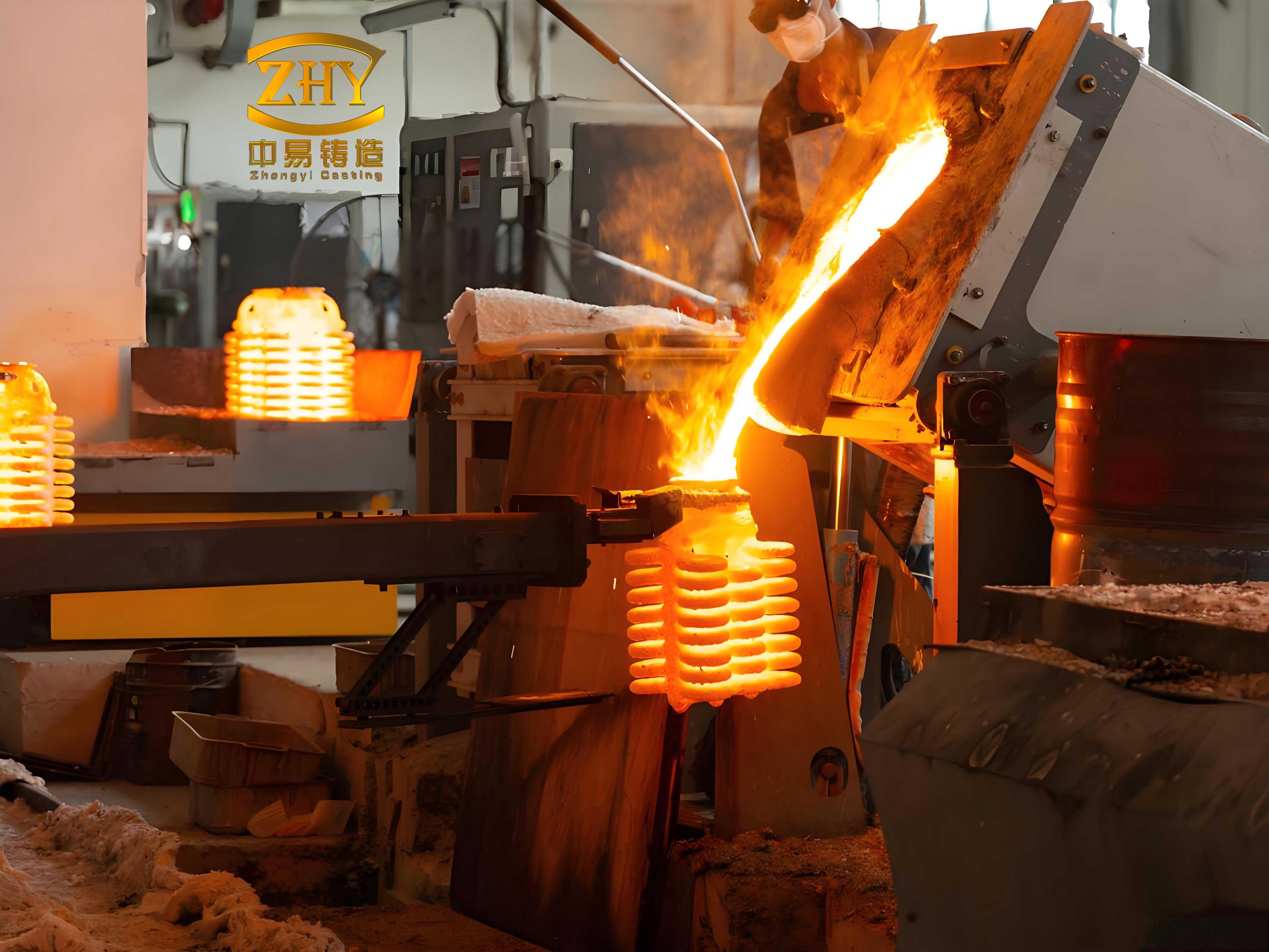
Among TiAl alloys, those with high niobium (Nb) additions, such as Ti-45Al-8Nb (at.%), represent a significant advancement. Niobium improves high-temperature strength, creep resistance, and oxidation performance, pushing the operational envelope further. However, these advanced alloys inherit the inherent challenges of conventional TiAl: limited room-temperature ductility and poor machinability. Consequently, near-net-shape manufacturing techniques are essential. The investment casting process, also known as lost-wax casting, is the predominant method for producing complex, thin-walled TiAl components like turbocharger wheels. This process allows for the creation of intricate geometries with excellent surface finish, minimizing the need for costly and difficult post-casting machining.
Despite its advantages, the investment casting process for high-Nb TiAl alloys is fraught with technical challenges. The high melting point and relatively poor fluidity of the alloy, coupled with its high reactivity with atmospheric gases and mold materials, can lead to severe casting defects. Misruns (incomplete filling) and shrinkage porosity are particularly detrimental. Misruns result in a scrapped component, while shrinkage porosity—manifesting as internal voids or micro-porosity—acts as stress concentrators, severely degrading fatigue life and potentially causing premature failure in a high-integrity component like a turbocharger turbine. Therefore, understanding and controlling the filling and solidification sequence is paramount.
Physical trial-and-error in casting development is prohibitively expensive and time-consuming, especially for reactive alloys processed in vacuum or inert environments. This is where numerical simulation becomes an indispensable tool. By digitally replicating the investment casting process, engineers can predict defect formation, optimize gating system design, and determine ideal process parameters before any metal is melted. This study employs advanced numerical simulation to perform a comprehensive analysis of the investment casting process for a Ti-45Al-8Nb turbocharger wheel, comparing gravity and centrifugal casting under different gating configurations.
Fundamentals of the Investment Casting Process and Numerical Modeling
The investment casting process begins with the creation of a wax pattern assembly, which is repeatedly dipped in ceramic slurries and stuccoed to build a robust shell mold. The wax is then melted out, and the ceramic mold is fired at high temperature to develop strength. For TiAl alloys, this mold is typically preheated to reduce thermal shock and improve metal flow. The alloy is melted, often in a vacuum or argon atmosphere, and poured into the mold. After solidification, the ceramic shell is removed to reveal the cast component.
Numerical simulation of this process requires solving coupled physical phenomena: fluid flow, heat transfer, and solidification with possible phase transformations. The governing equations are the Navier-Stokes equations for fluid flow (which transition to a zero-velocity condition in the solidified regions) and the energy equation for heat transfer. For an incompressible flow, the momentum equation considering body forces (like gravity or centrifugal force) is:
$$
\rho \left( \frac{\partial \vec{v}}{\partial t} + \vec{v} \cdot \nabla \vec{v} \right) = -\nabla p + \mu \nabla^2 \vec{v} + \rho \vec{g} + \vec{F}_{centrifugal}
$$
where \( \rho \) is density, \( \vec{v} \) is velocity, \( t \) is time, \( p \) is pressure, \( \mu \) is dynamic viscosity, \( \vec{g} \) is gravitational acceleration, and \( \vec{F}_{centrifugal} \) is the centrifugal force source term. The energy equation, including the latent heat of fusion (\( L \)), is:
$$
\rho c_p \frac{\partial T}{\partial t} + \rho c_p \vec{v} \cdot \nabla T = \nabla \cdot (k \nabla T) – \rho L \frac{\partial f_s}{\partial t}
$$
Here, \( c_p \) is specific heat, \( T \) is temperature, \( k \) is thermal conductivity, and \( f_s \) is the solid fraction. The last term is the latent heat release rate. The simulation tracks the liquid fraction to define the mushy zone, where flow is modeled using a porosity function that reduces velocity to zero as solid fraction increases.
For centrifugal casting, the rotating frame of reference introduces additional acceleration terms. The body force in the momentum equation becomes dominated by the centrifugal and Coriolis forces. If \( \vec{\omega} \) is the angular velocity vector of the rotation, the effective body force in the rotating frame is:
$$
\vec{F}_{body} = \rho \left[ \vec{\omega} \times (\vec{\omega} \times \vec{r}) + 2\vec{\omega} \times \vec{v} \right]
$$
The first term is the centrifugal acceleration (directed radially outward), and the second is the Coriolis acceleration. These forces significantly enhance mold filling and feeding pressure.
Critical to accurate simulation are the thermophysical properties of the alloy and mold materials across the relevant temperature range. For Ti-45Al-8Nb, key properties were derived using computational thermodynamics software (e.g., Pandat™ with appropriate databases). These properties are summarized in the table below.
| Material | Property | Value / Range | Notes |
|---|---|---|---|
| Ti-45Al-8Nb | Density, \( \rho \) (kg/m³) | 4213 (solid) – 3790 (liquid) | Temperature-dependent |
| Thermal Conductivity, \( k \) (W/m·K) | 14.9 – 25.9 | Increases with temperature | |
| Specific Heat, \( c_p \) (kJ/kg·K) | 0.65 – 1.04 | Peak near solidus/liquidus | |
| Latent Heat, \( L \) (kJ/kg) | ~340 | Enthalpy method used | |
| Liquidus Temperature, \( T_L \) (°C) | ~1585 | ||
| Solidus Temperature, \( T_S \) (°C) | ~1445 | ||
| Dynamic Viscosity, \( \mu \) (mPa·s) | 8.8 (at \( T_L \)) – 4.65 | Decreases with superheat | |
| ZrO₂-based Mold | Density, \( \rho_m \) (kg/m³) | ~2780 | Assumed constant |
| Thermal Conductivity, \( k_m \) (W/m·K) | 0.83 – 0.97 | ||
| Specific Heat, \( c_{p,m} \) (kJ/kg·K) | 0.44 – 0.85 | ||
| Interfacial Heat Transfer Coefficient (W/m²·K) | 500 – 1000 | Estimated for ceramic/TiAl |
The mold properties are for a typical zirconia-based investment shell. The interfacial heat transfer coefficient (IHTC) is a crucial parameter that governs the rate of heat extraction from the casting into the mold. It is highly transient, depending on air gap formation due to shrinkage. For simplicity in this study, an effective constant value within the estimated range was used.
Simulation Methodology and Process Parameters
The geometry of the turbocharger wheel is a critical factor influencing the investment casting process. The model features a 100 mm diameter wheel with a 50 mm height hub and thin, aerodynamically complex blades. The blade sections can be as thin as 0.5 mm, presenting a significant challenge for complete filling, especially given the modest fluidity of TiAl alloys. Two distinct gating system designs were modeled to assess their effectiveness: a Top-Pouring system and a Side-Pouring system.
The Top-Pouring system is vertically oriented, with the turbocharger wheel positioned above a central sprue. Metal flows from a pouring cup down the sprue and directly into the hub of the wheel. This design is simple and promotes directional solidification from the blade tips back towards the sprue if thermal conditions are right. The Side-Pouring system employs an offset gating approach. The wheel is positioned with its axis horizontal, and metal is delivered via a horizontal runner into the side of the blade cluster. To reduce computational cost, symmetry was exploited by modeling only one-quarter of the full assembly. This design aims to introduce metal more gently into the thin sections and can improve thermal distribution.
The commercial finite element-based software ProCAST was utilized for all simulations. This software is specifically designed for modeling casting processes, incorporating capabilities for fluid flow, heat transfer, stress, and microstructure prediction. The meshing of the complex geometry, particularly the thin blades, was performed with care to ensure a sufficient number of elements through the thickness to accurately capture temperature gradients.
The baseline process parameters for the simulation are detailed below. Both gravity and centrifugal casting scenarios were investigated.
| Parameter | Value | Remarks |
|---|---|---|
| Alloy | Ti-45Al-8Nb (at.%) | Composition by atom percent |
| Pouring Temperature, \( T_{pour} \) | 1600 °C | ~15°C superheat above liquidus |
| Initial Mold Temperature, \( T_{mold} \) | 20 °C to 800 °C (varied) | Room temperature to high preheat |
| Pouring Velocity (Initial) | 0.5 m/s | Applied at the pour cup inlet |
| Gravity Casting Acceleration | 9.81 m/s² | Standard gravity |
| Centrifugal Casting Speed | 400 rpm | Rotational speed about wheel axis |
| Ambient Conditions | Vacuum / Inert Gas | Oxidation/reaction not modeled |
| Filling & Solidification Criteria | 99.5% liquid fraction for filling | Standard cut-off for flow stoppage |
The primary outputs analyzed were the filling pattern, the percentage of the mold cavity filled (filling rate), and the location and volume fraction of shrinkage porosity predicted using a dedicated porosity model (e.g., Niyama criterion or a direct volume deficit method). The Niyama criterion, \( G/\sqrt{\dot{T}} \), where \( G \) is the temperature gradient and \( \dot{T} \) is the cooling rate, is a common indicator for shrinkage porosity risk, with lower values indicating higher risk.
Results and Analysis: Gravity Casting Simulation
The simulations for the gravity investment casting process revealed significant challenges in achieving a sound casting. For both gating systems at a room-temperature mold condition (20°C), severe misrun defects were predicted. The metal front lost heat rapidly upon contact with the cold, massive ceramic mold, causing premature solidification before the intricate blade sections could be filled.
The Top-Pouring system performed particularly poorly. The metal stream falling from the sprue into the hub experienced significant cooling. While the central hub and the root of some blades filled, the majority of the blade length and the outer periphery of the wheel remained unfilled. The Side-Pouring system demonstrated a relative improvement. By introducing metal laterally into the blade region, the flow path into the thin sections was shorter and more direct. Consequently, a higher percentage of the blade geometry was filled before the metal solidified, though complete filling was still not achieved under cold mold conditions.
A key parameter study was conducted by varying the initial mold preheat temperature. This is a critical control variable in the actual investment casting process for reactive alloys, as it reduces thermal shock and slows the solidification rate. The simulation results quantified this effect clearly. The filling rate showed a strong, nearly linear correlation with mold preheat temperature, as summarized in the table below.
| Mold Preheat Temperature (°C) | Top-Pouring Filling Rate (%) | Side-Pouring Filling Rate (%) | Improvement from 20°C (%) |
|---|---|---|---|
| 20 | 51.2 | 65.8 | 0.0 / 0.0 |
| 200 | 55.1 | 70.4 | 3.9 / 4.6 |
| 400 | 59.7 | 75.9 | 8.5 / 10.1 |
| 600 | 63.8 | 81.9 | 12.6 / 16.1 |
| 800 | 67.1 | 88.2 | 15.9 / 22.4 |
The data confirms the Side-Pouring design’s superiority in fillability across all temperatures. At 800°C preheat, the Side-Pouring system achieved a filling rate of 88.2%, while Top-Pouring only reached 67.1%. The improvement per 100°C increase is roughly 4% for both systems, highlighting the universal benefit of mold preheating. However, even at 800°C—a very high preheat temperature for ceramic molds—complete filling (100%) was not achieved. In practice, such high preheat temperatures are often undesirable for TiAl alloys due to increased chemical reactivity with the mold, potentially leading to surface contamination and the formation of a brittle “alpha-case” layer. Therefore, relying solely on mold preheat is insufficient for producing a sound Ti-45Al-8Nb turbocharger wheel via gravity investment casting process.
Results and Analysis: Centrifugal Casting Simulation
To overcome the filling limitations of gravity casting, centrifugal casting was simulated. In this variant of the investment casting process, the entire mold assembly is rotated at high speed. The centrifugal force generated acts as the primary driving force for filling and feeding, dramatically increasing the effective pressure on the molten metal. At a rotational speed of 400 rpm, the simulation results were markedly different from the gravity scenario.
Both the Top-Pouring and Side-Pouring gating systems achieved complete mold filling. The powerful centrifugal force effectively pushed the metal into the thinnest blade sections, overcoming the resistance from surface tension and viscous drag, and counteracting the rapid heat loss to the mold. This confirms that centrifugal casting is a technologically necessary approach for thin-walled, complex geometries made from low-fluidity alloys like high-Nb TiAl.
With the filling challenge resolved, the focus shifts to solidification defects, primarily shrinkage porosity. The pattern of solidification, dictated by the gating design and thermal environment, determines where the final liquid metal pools exist and whether they can be fed adequately. The simulation’s porosity prediction module provided critical insights.
For the Top-Pouring investment casting process under centrifugal conditions, the shrinkage porosity was concentrated in two main locations: the central hub of the turbocharger wheel and the hot spot at the junction of the sprue and the hub. The solidification sequence typically progresses from the outer blade tips and wheel rim inward towards the hub and from the blade surfaces towards their mid-planes. The hub, being the thickest section and the last point to receive hot metal, becomes a thermal center. Despite the centrifugal force enhancing feeding pressure, the isolated liquid pool in the hub’s center can still form shrinkage cavities as it solidifies without a liquid feed path. The predicted porosity volume in the wheel (excluding the gating) was significant, approximately 1.67 cm³.
In contrast, the Side-Pouring investment casting process under centrifugation resulted in a radically different porosity distribution. The porosity was not concentrated in a large central mass but was dispersed as smaller voids within the individual turbine blades, particularly along their mid-planes or chord-wise centers. This occurs because each blade solidifies from both surfaces inward, creating isolated liquid zones along the blade centerline. While the centrifugal force aids feeding, the long, thin path to these zones limits its effectiveness. However, the key finding was that the total volume of predicted porosity was drastically lower than in the Top-Pouring case, measured at only about 0.08 cm³.
The implications for mechanical performance are substantial. A large shrinkage cavity in the wheel’s hub is catastrophic. It sits in a high-stress region under rotational loads, acting as a potent stress concentrator and crack initiation site, likely leading to low-cycle fatigue failure. Dispersed micro-porosity within the blades, while still detrimental, is less severe. The stress state in the blades is complex but generally lower in mean stress than in the hub, and small, dispersed pores are less effective as crack starters than a single large void. Therefore, the Side-Pouring centrifugal investment casting process yields a component with superior structural integrity potential.
| Process & Gating | Filling Completion | Primary Defect Location | Relative Porosity Volume | Mechanical Integrity Risk |
|---|---|---|---|---|
| Gravity – Top Pour | No (≤67%) | Misrun in blade tips/rim | N/A (unfilled) | Very High (scrap part) |
| Gravity – Side Pour | No (≤88%) | Misrun in outer blade regions | N/A (unfilled) | Very High (scrap part) |
| Centrifugal – Top Pour | Yes | Shrinkage in central hub | Large (1.67 cm³) | High (major stress concentrator) |
| Centrifugal – Side Pour | Yes | Dispersed micro-porosity in blades | Small (0.08 cm³) | Moderate (managed defect) |
Optimization Strategies and Future Directions for the Investment Casting Process
Based on the simulation findings, the optimal route for manufacturing this specific Ti-45Al-8Nb turbocharger wheel is a centrifugal investment casting process with a Side-Pouring gating design. However, the process can be further optimized. Simulation allows for virtual experimentation with numerous parameters to refine the outcome.
1. Gating and Risering Optimization: For the Top-Pouring design, a larger, thermally active sprue or a hub riser could be designed to act as a feeder for the hub shrinkage. For the Side-Pouring design, modifying the runner size and entry points, or adding small blade-end feeders (chills or insulating sleeves), could help promote directional solidification and reduce blade centerline porosity. The optimal design minimizes the Niyama criterion value throughout the casting.
2. Process Parameter Fine-Tuning: A design of experiments (DoE) using simulation can identify the optimal combination of mold temperature, pouring temperature, and rotational speed. The relationship is multi-variate. For instance, a moderate mold preheat (e.g., 400°C) combined with centrifugal force might achieve perfect filling with lower reactivity risk. The pouring superheat must be balanced: too low risks misruns, too high increases grain size and shrinkage volume. The centrifugal speed must provide sufficient pressure without causing turbulent entrainment of oxide films or excessive segregation. The feeding pressure provided by centrifugation, \( P_{cent} \), is proportional to the square of the angular velocity and the radius:
$$
P_{cent} = \frac{1}{2} \rho \omega^2 (r_{max}^2 – r_{min}^2)
$$
where \( \omega \) is angular velocity in rad/s, and \( r_{max} \) and \( r_{min} \) define the limits of the liquid metal column. This equation guides the selection of an adequate rotation speed.
3. Advanced Modeling Considerations: The present study uses a simplified constant IHTC. A more accurate simulation would model the transient IHTC, which drops sharply as an air gap forms due to solidification shrinkage. Coupling the fluid-thermal simulation with a stress model can predict this gap formation and its feedback on cooling rates. Furthermore, modeling the potential for mold-metal reaction and alpha-case formation would require incorporating diffusion kinetics at the interface.
4. Microstructure Prediction: State-of-the-art simulation tools can couple macro-scale heat transfer with micro-scale models (e.g., CAFE – Cellular Automaton Finite Element) to predict grain size, morphology (columnar vs. equiaxed), and phase distribution. Since the mechanical properties of TiAl alloys are highly microstructure-sensitive, predicting and controlling the as-cast microstructure through the investment casting process parameters is the ultimate goal.
The successful investment casting process for high-performance intermetallics like Ti-45Al-8Nb is a cornerstone for lightweighting strategies in aerospace and automotive sectors. Numerical simulation has evolved from a diagnostic tool to a predictive and prescriptive platform, enabling the virtual prototyping of both the component and its manufacturing route. By comprehensively analyzing fluid flow, heat transfer, and defect formation, it dramatically reduces development time, cost, and risk. This case study on a turbocharger wheel clearly demonstrates that for thin-section, complex TiAl castings, centrifugal force is essential, and gating design is critical not just for filling but for dictating the nature and severity of solidification defects. The continued integration of more sophisticated physical models into the simulation of the investment casting process will further enhance our ability to produce reliable, high-integrity components from these advanced materials.