
In the realm of modern manufacturing, the investment casting process stands out as a pivotal technique for producing complex, high-precision components with excellent surface finish and dimensional accuracy. As global technological advancements drive increased energy demands, material efficiency has become a critical goal across industries. The investment casting process, unlike traditional casting methods, minimizes material waste and enables near-net-shape manufacturing, reducing the need for extensive machining. This study focuses on optimizing the investment casting process for a 304 stainless steel ball valve, a component widely used in fluid control systems where high pressure resistance and defect-free integrity are paramount. Historically, reliance on empirical methods in the investment casting process has led to defects such as shrinkage porosity and cold shuts at critical junctions, specifically at the corners between the valve body and flange, resulting in low yield rates. To address this, I integrated computer simulation with practical casting techniques, leveraging ProCAST software to analyze and refine the process, thereby enhancing product quality and reducing development costs.
The investment casting process involves creating a wax pattern, coating it with a ceramic shell, melting out the wax, and pouring molten metal into the cavity. For stainless steel components like the ball valve, controlling solidification dynamics is essential to prevent defects. In this investigation, I first examined the traditional investment casting process parameters applied to the 304 stainless steel ball valve. The valve has overall dimensions of 186 mm × 186 mm × 120 mm, with flange thickness averaging 12.5 mm. The material composition, crucial for simulation accuracy, is detailed in Table 1. Using SolidWorks, I developed a 3D model of the valve, which was imported into ProCAST for meshing and analysis. The mesh quality was assessed with a global element size of 4, generating 116,162 surface elements and, after adding a 6 mm shell, 666,312 volume elements. This discretization forms the foundation for simulating the investment casting process.
| Element | C | Cr | Mn | Mo | Ni | S | Si |
|---|---|---|---|---|---|---|---|
| Content (%) | 0.08 | 18 | 1.5 | 0.5 | 8 | 0.03 | 1 |
In the traditional investment casting process setup, the gating system was a stepped design, with pouring temperature set at 1550°C, shell preheating temperature at 1150°C, and a pouring speed of 1.5 kg/s under gravity filling. The interfacial heat transfer coefficient between the 304 stainless steel and zircon sand shell was determined using a COINC model, accounting for thermal interactions. The heat flux equation governing this interface is expressed as:
$$ Q = \text{Flux} + h(T – T_{\alpha}) + \sigma \epsilon (T^4 – T_{\alpha}^4) $$
where \( Q \) is the interfacial heat transfer coefficient (set to 500 W/(m²·K) based on calculations and literature), \( h \) is the convective heat transfer coefficient, \( T \) is the casting surface temperature, \( T_{\alpha} \) is the ambient temperature, \( \sigma \) is the Stefan-Boltzmann constant, and \( \epsilon \) is the material emissivity. Simulation results revealed significant shrinkage porosity defects, with a maximum rate of 13.2%, concentrated at the valve body-flange corners. These defects arise from non-uniform wall thickness and poor heat dissipation in these regions, leading to disordered solidification. As metal solidifies, areas with faster cooling solidify first, while slower-cooling zones lack sufficient feeding, resulting in voids. This analysis underscores the limitations of empirical approaches in the investment casting process and highlights the need for systematic optimization.
To mitigate these defects, I redesigned the gating system, a critical aspect of the investment casting process. The new design employs a top-pouring system with two ingates positioned on opposite flange faces to ensure balanced filling and directional solidification. The sprue has a length of 100 mm and diameter of 24 mm, with a cross-sectional area 1.4 times that of the total ingate area to facilitate gravity-driven flow. A buffer is incorporated 30 mm from the ingates in the runner to reduce turbulence. The ingates are扇形-shaped (fan-shaped) with a length of 12 mm, aligning with the valve’s threaded hole geometry for easy cut-off. This configuration aims to promote sequential solidification and improve feeding to critical sections. After implementing this design in ProCAST, with mesh refinement to 147,072 surface elements and 785,303 volume elements, simulation under traditional parameters showed reduced shrinkage porosity, with a maximum rate of 3.75%. The solidification sequence, indicated by the solid fraction plot, demonstrated no isolated liquid zones, confirming better control in the investment casting process. However, residual porosity persisted, necessitating further optimization through parameter adjustment.
I then focused on optimizing process parameters in the investment casting process using design of experiments. Three key factors were identified: pouring temperature (A), pouring speed (B), and shell preheating temperature (C). Each factor was studied at three levels, as shown in Table 2, to form an L9(3³) orthogonal array. The response variable was the maximum shrinkage porosity percentage, simulated via ProCAST for each trial. The orthogonal layout and results are summarized in Table 3. To analyze the effects, I calculated the mean response for each factor level and determined the range (R) by subtracting the minimum mean from the maximum. The ranges were \( R_A = 0.1363 \), \( R_B = 1.4563 \), and \( R_C = 0.7954 \), indicating that pouring speed (B) has the most significant influence on shrinkage porosity, followed by shell preheating temperature (C), and then pouring temperature (A). This hierarchy guides prioritization in tuning the investment casting process.
| Level | A: Pouring Temperature (°C) | B: Pouring Speed (kg/s) | C: Shell Preheating Temperature (°C) |
|---|---|---|---|
| 1 | 1520 | 1.0 | 1120 |
| 2 | 1550 | 1.5 | 1150 |
| 3 | 1580 | 2.0 | 1180 |
| Trial No. | A (°C) | B (kg/s) | C (°C) | Maximum Shrinkage Porosity (%) |
|---|---|---|---|---|
| 1 | 1520 | 1.0 | 1120 | 3.10 |
| 2 | 1520 | 1.5 | 1150 | 3.88 |
| 3 | 1520 | 2.0 | 1180 | 3.74 |
| 4 | 1550 | 1.0 | 1150 | 2.29 |
| 5 | 1550 | 1.5 | 1180 | 3.52 |
| 6 | 1550 | 2.0 | 1120 | 4.51 |
| 7 | 1580 | 1.0 | 1180 | 2.44 |
| 8 | 1580 | 1.5 | 1120 | 4.27 |
| 9 | 1580 | 2.0 | 1150 | 3.93 |
To statistically validate these findings, I performed analysis of variance (ANOVA) on the shrinkage porosity data, as presented in Table 4. The F-values confirm that pouring speed (B) is the most statistically significant factor (\( F = 119.30 \)), followed by shell preheating temperature (C) (\( F = 38.41 \)), and pouring temperature (A) (\( F = 13.96 \)). The optimal parameter combination, derived from minimizing the mean shrinkage porosity, is A2B1C2: pouring temperature of 1550°C, pouring speed of 1.0 kg/s, and shell preheating temperature of 1150°C. This combination aligns with principles of the investment casting process, where lower pouring speeds enhance feeding control, and moderate shell temperatures balance heat transfer. I applied these parameters in a final simulation using the redesigned gating system, resulting in a maximum shrinkage porosity of 2.29%, a substantial improvement from the initial 13.2%. The defect distribution showed elimination of shrinkage holes at critical corners, affirming the efficacy of the optimized investment casting process.
| Factor | Sum of Squares | Degrees of Freedom | Mean Square | F-value |
|---|---|---|---|---|
| Pouring Temperature (A) | 0.0104 | 2 | 0.0052 | 13.96 |
| Pouring Speed (B) | 1.0637 | 2 | 0.5319 | 119.30 |
| Shell Preheating Temperature (C) | 0.3422 | 2 | 0.1711 | 38.41 |
| Error | 0.0356 | 2 | 0.0178 | – |
| Total | 1.4519 | 8 | – | – |
The optimization of the investment casting process extends beyond parameter tuning to encompass fundamental understanding of solidification mechanics. Shrinkage porosity formation can be modeled using the Niyama criterion, which relates thermal gradients and cooling rates to predict defect susceptibility. In the investment casting process, this criterion is expressed as:
$$ G / \sqrt{\dot{T}} \geq C $$
where \( G \) is the temperature gradient (K/m), \( \dot{T} \) is the cooling rate (K/s), and \( C \) is a material-dependent constant. For stainless steel, values below a threshold indicate high risk of microporosity. By simulating thermal fields in ProCAST, I computed this criterion across the valve geometry, identifying regions prone to defects. The optimized investment casting process parameters improved \( G \) and \( \dot{T} \) profiles, ensuring the criterion was met in critical zones. Additionally, the feeding efficiency during solidification can be quantified using the mass conservation equation:
$$ \frac{\partial \rho}{\partial t} + \nabla \cdot (\rho \mathbf{v}) = 0 $$
where \( \rho \) is density and \( \mathbf{v} \) is velocity. In the investment casting process, proper gating design maintains positive pressure gradients to feed shrinkage, reducing void formation. The redesigned system with two ingates enhances flow dynamics, as evidenced by velocity vector plots from simulation, which show uniform filling and minimized turbulence.
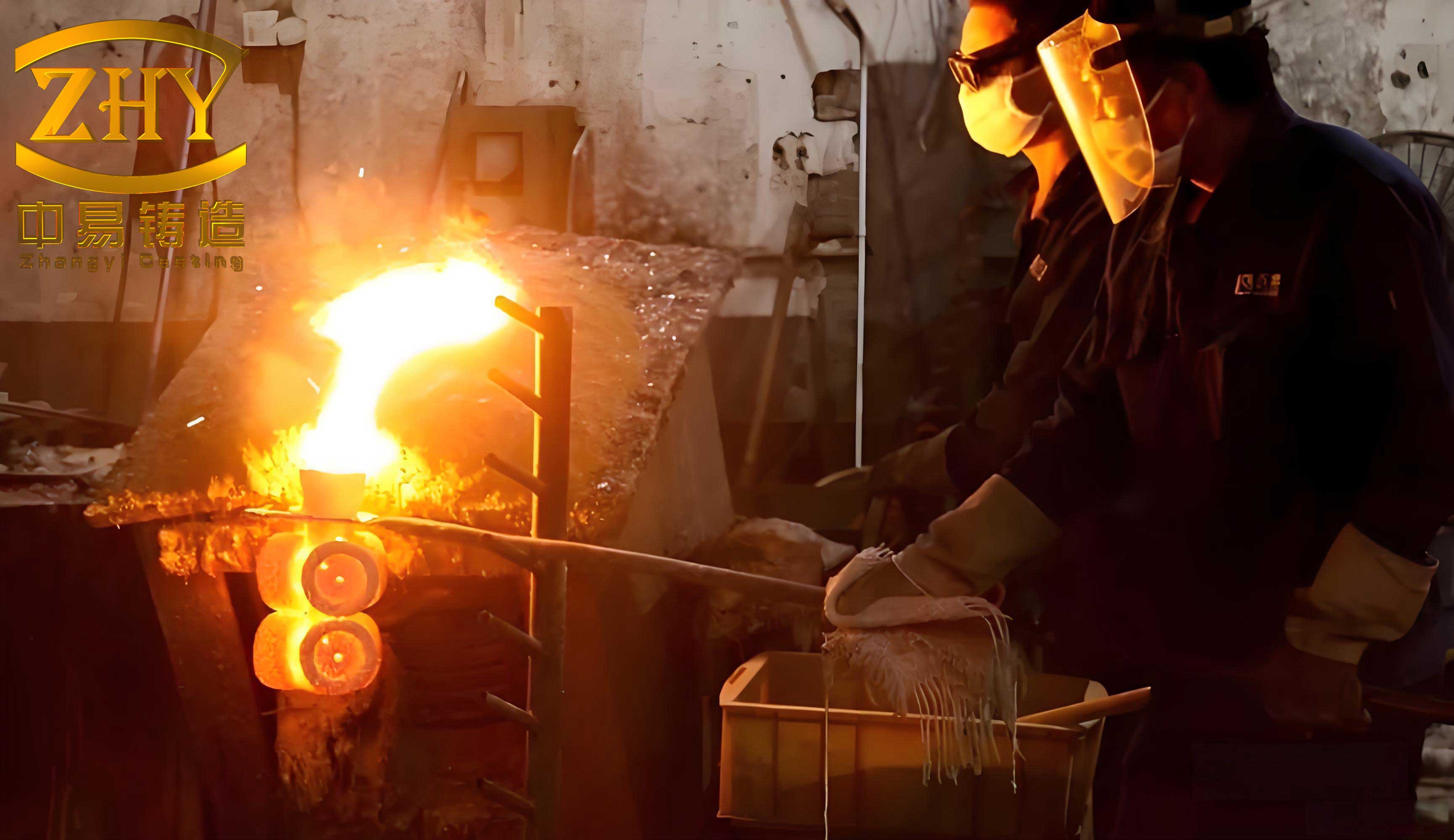
To validate the simulation results, the optimized investment casting process was implemented in actual production. The 304 stainless steel ball valves were cast using the redesigned gating system and optimal parameters: pouring temperature 1550°C, pouring speed 1.0 kg/s, and shell preheating temperature 1150°C. The castings exhibited no visible shrinkage porosity at the valve body-flange corners, with smooth surfaces and dimensional conformity. Non-destructive testing, such as X-ray inspection, confirmed the absence of internal defects, meeting industry standards for high-pressure applications. This practical validation underscores the reliability of combining simulation with experimental design in the investment casting process, enabling data-driven decisions that transcend empirical guesswork. The success of this approach highlights its potential for other complex components in aerospace, automotive, and energy sectors, where the investment casting process is pivotal for manufacturing critical parts.
In conclusion, this study demonstrates a comprehensive methodology for optimizing the investment casting process, focusing on a 304 stainless steel ball valve. Through ProCAST simulation, I identified shrinkage porosity defects in traditional practices and addressed them via gating system redesign and orthogonal experiment-based parameter optimization. The optimal parameters—pouring temperature 1550°C, pouring speed 1.0 kg/s, and shell preheating temperature 1150°C—reduced maximum shrinkage porosity to 2.29%, eliminating defects at critical junctions. The investment casting process benefits immensely from such integrative approaches, leveraging computational tools to enhance yield, reduce costs, and ensure quality. Future work could explore advanced materials, multi-objective optimization, or real-time monitoring in the investment casting process, further pushing the boundaries of precision manufacturing. By continuously refining the investment casting process, industries can achieve greater sustainability and performance in component production.