
In my extensive experience in precision manufacturing, I have often encountered the challenges associated with producing complex components like impellers, which are critical in sectors such as urban drainage, chemical processing, power generation, and aerospace. The intricate geometry of impellers, especially closed-type ones with irregular internal blades, makes traditional machining methods impractical. Therefore, the investment casting process becomes indispensable for creating these parts. As a key tooling in the investment casting process, the mold design directly impacts the final casting quality. In this article, I will delve into the design nuances of molds for impellers, drawing from practical insights to guide engineers through each critical aspect. The investment casting process relies heavily on precise mold fabrication to achieve dimensional accuracy and surface finish.
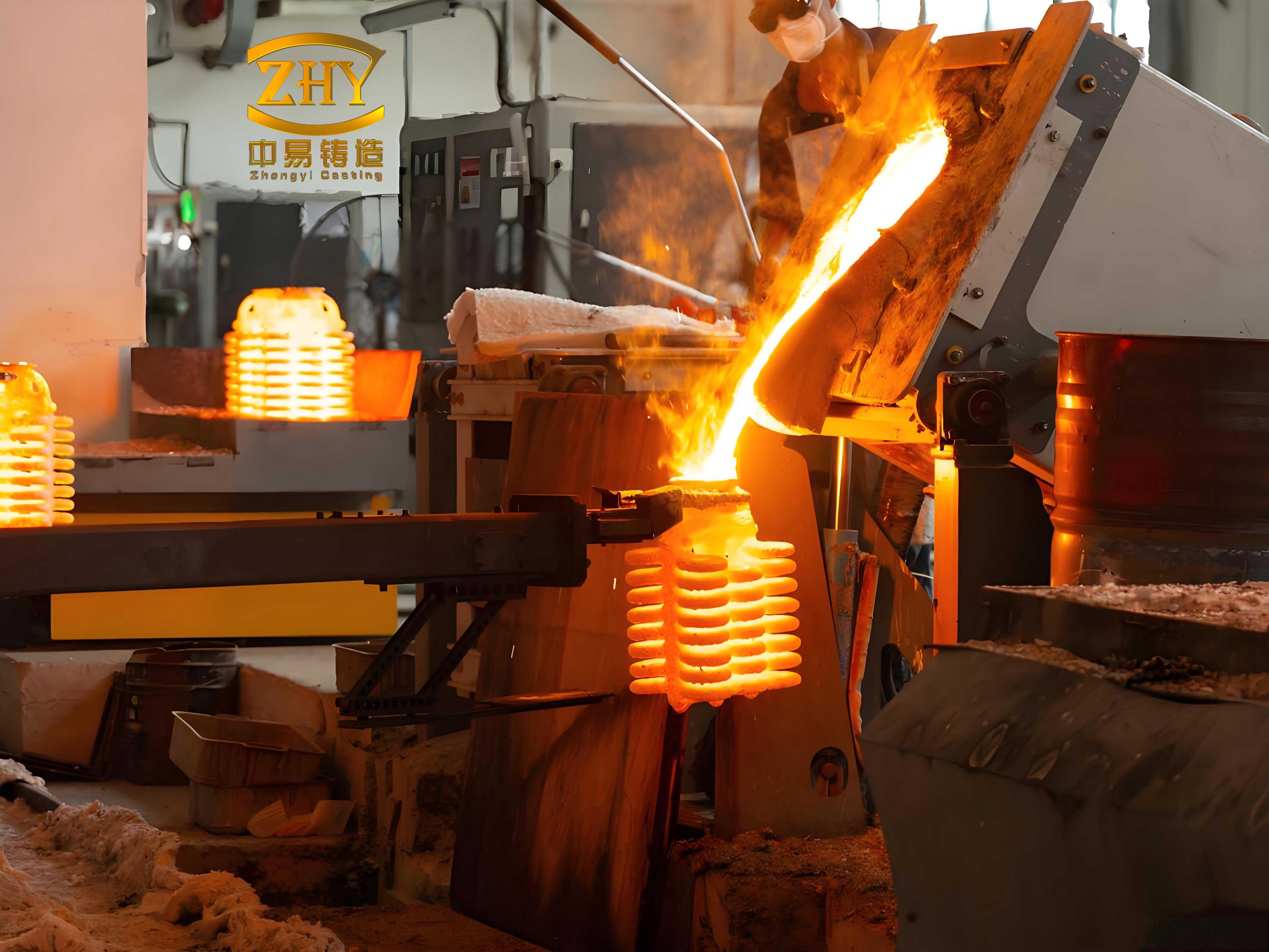
To begin, let me outline the fundamental components of an impeller mold used in the investment casting process. The mold typically consists of several parts that work together to form the wax pattern, which is later used to create the ceramic shell for casting. Based on my observations, these components can be summarized in the following table, which highlights their functions and interactions within the investment casting process.
| Component | Function | Design Consideration |
|---|---|---|
| Mold Body (Type Body) | Forms the external shape of the impeller wax pattern. | Must accommodate core inserts and allow for easy assembly. |
| Core (Type Core) | Creates the internal cavity and blade structures. | Often requires a separate core mold due to complexity; must align precisely with the main mold. |
| Positioning Elements | Ensures accurate alignment of mold halves and cores. | Uses pins or slots to restrict degrees of freedom; prevents misalignment during the investment casting process. |
| Locking Mechanism | Secures mold parts together during wax injection. | Must withstand injection pressures; options include bolted connections or rotary bolts. |
| Ejection Mechanism | Facilitates removal of the wax pattern without damage. | Critical for maintaining pattern integrity; often uses ejector pins or plates. |
| Auxiliary Structures | Includes features like venting holes, gating systems, and handling slots. | Enhances mold functionality and ease of use in the investment casting process. |
The investment casting process demands careful material selection for molds to ensure durability and precision. From my work, I have found that the core molds, which shape the intricate internal blades, are prone to deformation and wear. Therefore, harder materials like 45 steel are preferred for these parts. In contrast, the main mold body, which requires lightweight and easy machining, often uses aluminum alloys. However, in critical areas susceptible to stress, steel inserts may be incorporated. This hybrid approach balances cost and performance in the investment casting process. To quantify material properties, I often refer to mechanical equations, such as the yield strength $\sigma_y$ and hardness $H$, which influence mold life. For instance, the relationship between wear resistance and material hardness can be expressed as:
$$ W \propto \frac{1}{H^n} $$
where $W$ is the wear rate and $n$ is an empirical exponent. In the context of the investment casting process, selecting materials with high $H$ for cores minimizes wear during repeated wax injections. The table below compares common mold materials used in the investment casting process for impellers.
| Material | Typical Use | Advantages | Disadvantages | Relevance to Investment Casting Process |
|---|---|---|---|---|
| 45 Steel | Core molds and critical inserts | High hardness, good wear resistance, maintains shape under stress | Heavier, more expensive, requires heat treatment | Ideal for complex cores that endure frequent use in the investment casting process. |
| Aluminum Alloy | Main mold body | Lightweight, easy to machine, good thermal conductivity | Softer, prone to deformation, lower strength | Facilitates quick assembly and ejection in the investment casting process. |
| Hybrid (Aluminum with Steel Inserts) | Mold bodies with high-stress areas | Combines lightness with localized strength, cost-effective | More complex fabrication, potential for differential expansion | Enhances durability in key zones of the investment casting process. |
Moving on to the selection of the parting line, which is a critical decision in mold design for the investment casting process. The parting line defines where the mold separates to remove the wax pattern. In my practice, I follow principles that maximize ease of pattern ejection and mold manufacturability. For impellers, the largest flange or backing plate area often serves as the optimal parting line. This choice minimizes undercuts and simplifies machining. Mathematically, the parting line can be analyzed using geometric constraints. For example, the surface area $A_p$ of the parting plane should encompass the maximum cross-section of the impeller to ensure smooth ejection. If the impeller profile is described by a function $f(x,y,z)=0$, the parting plane can be defined as $z = C$, where $C$ is chosen to satisfy:
$$ \iint_{D} \left| \frac{\partial f}{\partial z} \right| \, dx\,dy \text{ is minimized for ease of molding.} $$
Here, $D$ is the projection area. This approach aligns with the investment casting process goal of reducing mold complexity. The table below summarizes key factors in parting line selection for the investment casting process.
| Factor | Description | Impact on Investment Casting Process |
|---|---|---|
| Maximum Cross-Section | Parting line placed at the largest diameter of the impeller. | Facilitates wax pattern removal and reduces ejection forces. |
| Dimensional Accuracy | Ensures minimal mismatch between mold halves. | Critical for maintaining tolerances in the final casting via the investment casting process. |
| Mold Manufacturing Simplicity | Prefers flat or planar parting surfaces. | Lowers machining costs and time in the investment casting process. |
| Integration with Cores | Allows easy placement and fixation of core inserts. | Enhances internal cavity definition in the investment casting process. |
Positioning and locking mechanisms are vital for maintaining mold integrity during the investment casting process. I typically use positioning pins to align mold halves, with two pins placed diagonally to constrain rotational and translational movements effectively. This avoids over-constraint, which can cause binding. The positioning accuracy $\delta$ can be related to pin spacing $L$ and manufacturing tolerances $\epsilon$ through an equation like:
$$ \delta \approx \frac{\epsilon}{\sqrt{2}} \cdot \frac{1}{L} $$
where larger $L$ improves accuracy. For locking, given the soft nature of aluminum molds, I often recommend embedding wire thread inserts in bolt holes to enhance thread strength. Alternatively, bolt slots with rotary bolts offer quick disassembly. Both methods must withstand the injection pressures $P_{inj}$ encountered in the investment casting process, which can be modeled as:
$$ P_{inj} = \frac{F_{inject}}{A_{gate}} $$
where $F_{inject}$ is the injection force and $A_{gate}$ is the gate area. The table below compares locking mechanisms in the investment casting process.
| Mechanism Type | Description | Advantages | Challenges | Suitability for Investment Casting Process |
|---|---|---|---|---|
| Bolted with Wire Thread Inserts | Bolts screwed into inserts embedded in aluminum mold. | Improved thread durability, secure clamping | Requires additional machining for inserts | Ideal for high-pressure wax injection in the investment casting process. |
| Rotary Bolts with Slots | Bolts rotated into machined slots for quick locking. | Fast assembly/disassembly, minimal thread wear | May provide less clamping force if not designed properly | Suitable for molds requiring frequent access in the investment casting process. |
Venting is another crucial aspect of mold design in the investment casting process. During wax injection, trapped air can cause defects like incomplete filling or gas pockets. From my experience, I utilize core gaps and ejector pin gaps for venting in impeller molds. The venting efficiency $\eta_v$ can be expressed as a function of gap size $d$ and injection velocity $v$:
$$ \eta_v = 1 – \exp\left(-\frac{d \cdot v}{k}\right) $$
where $k$ is a constant related to wax viscosity. Proper venting ensures complete wax flow, which is essential for the investment casting process to produce defect-free patterns. The table below outlines venting methods applicable to the investment casting process.
| Venting Method | Implementation | Benefits | Limitations |
|---|---|---|---|
| Core Gap Venting | Small gaps between core and mold body allow air escape. | Effective for deep cavities, integrates with core design | May cause flash if gaps are too large |
| Ejector Pin Gap Venting | Gaps around ejector pins serve as air passages. | Dual function (ejection and venting), simplifies mold structure | Requires precise pin fitting to avoid wax leakage |
| Parting Line Venting | Air escapes through the parting surface间隙. | Simple, no additional machining | Less effective for complex internal geometries |
The ejection mechanism is paramount in the investment casting process to ensure the wax pattern is removed without distortion. For impellers, I often employ an ejector plate supplemented with cylindrical pins to provide uniform ejection force. The ejection force $F_e$ required can be calculated based on wax adhesion and geometry:
$$ F_e = \tau \cdot A_c + \mu N $$
where $\tau$ is the wax shear strength, $A_c$ is the contact area, $\mu$ is the friction coefficient, and $N$ is the normal force. Using an ejector plate distributes this force evenly, preventing pattern damage. The investment casting process benefits from robust ejection systems to maintain pattern integrity for subsequent shell building. The table below compares ejection methods in the investment casting process.
| Ejection Type | Description | Advantages | Disadvantages |
|---|---|---|---|
| Ejector Plate with Pins | A plate pushes multiple pins to eject the pattern. | Uniform force distribution, suitable for complex shapes | Requires more space, adds mold complexity |
| Ejector Pins Direct | Individual pins activated independently. | Simple design, easy to implement | Risk of uneven ejection causing pattern warpage |
| Combined Ejection | Uses pins and plates together for critical areas. | Enhanced control, good for delicate features | Higher cost and maintenance |
Auxiliary structures, such as handling slots, cut lines, and gating systems, further optimize the investment casting process. In my designs, I include handling slots on mold halves to facilitate manual separation. Cut lines are incorporated on the wax pattern to guide riser removal after casting. The gating system, particularly the wax injection gate, is strategically placed at the mold center for impellers. This central location ensures balanced filling pressure $P_{fill}$, which can be described by Bernoulli’s principle for incompressible flow:
$$ P_{fill} = P_0 + \frac{1}{2} \rho v^2 $$
where $P_0$ is the injection pressure, $\rho$ is wax density, and $v$ is flow velocity. A central gate promotes uniform wax distribution, crucial for the investment casting process to achieve complete cavity filling. The table below summarizes these auxiliary features in the investment casting process.
| Structure | Purpose | Design Guideline | Impact on Investment Casting Process |
|---|---|---|---|
| Handling Slots | Provide grip for mold separation. | Machined on outer mold surfaces, sized for tool access | Speeds up mold handling, reduces downtime in the investment casting process. |
| Cut Lines | Mark areas for riser cutting on wax pattern. | Shallow grooves or raised lines on mold surface | Facilitates post-casting operations, improving efficiency in the investment casting process. |
| Wax Injection Gate | Channel for wax entry into mold cavity. | Located centrally, sized based on wax flow rates | Ensures balanced filling, reducing defects in the investment casting process. |
Throughout my career, I have refined these design principles through iterative testing in the investment casting process. The investment casting process is highly sensitive to mold geometry, and small optimizations can yield significant improvements in casting yield and quality. For instance, the relationship between mold temperature $T_m$ and wax injection parameters can be modeled using heat transfer equations. The cooling rate of wax in the mold affects pattern shrinkage, which is critical for dimensional accuracy. A simplified heat balance gives:
$$ m_w c_w \frac{dT_w}{dt} = h A (T_m – T_w) $$
where $m_w$ is wax mass, $c_w$ is specific heat, $h$ is heat transfer coefficient, $A$ is surface area, and $T_w$ is wax temperature. Controlling $T_m$ in the investment casting process minimizes thermal stresses in the pattern.
In conclusion, designing molds for impellers in the investment casting process requires a holistic approach that integrates material science, mechanical engineering, and process optimization. By leveraging tables and formulas, as I have discussed, engineers can make informed decisions on mold components, parting lines, locking mechanisms, venting, ejection, and auxiliary features. The investment casting process demands precision at every step, and a well-designed mold is foundational to producing high-quality impeller castings. I encourage continued innovation in this field, as advancements in mold design directly enhance the efficiency and reliability of the investment casting process for complex components like impellers.