
In the realm of advanced manufacturing for aerospace and power generation components, the vacuum equiaxed crystal precision casting process stands as a cornerstone technology. It is indispensable for producing critical parts like turbine blades, disks, and structural elements that demand exceptional metallurgical integrity and dimensional accuracy. For decades, the dominant equipment for this investment casting process has been the traditional vertical furnace layout. However, our extensive research and practical experience have revealed significant functional limitations in these traditional systems, particularly when addressing the production of thin-walled castings, large-scale components, and parts requiring low-temperature pouring. This article, written from the perspective of our development team, delves into the conceptualization, design, and operational advantages of a novel horizontal-layout vacuum equiaxed crystal precision casting furnace. This innovation is not merely an incremental improvement but a structural re-imagination aimed at overcoming longstanding challenges inherent in the conventional investment casting process.
The traditional investment casting process, often referred to as the “transfer method,” has been the industry standard. Its workflow is elegant in its repetition: a pre-heated ceramic mold (shell) is transported from an external furnace into the casting chamber of a vertical vacuum furnace; after vacuum equalization, the mold is elevated into the melting chamber for pouring; following solidification, it is returned and extracted. This method offers high throughput for standard applications. However, its core vulnerability lies in thermal management of the mold. During the transfer phases, the mold experiences unavoidable heat loss. While techniques like insulation wrapping or increased pumping speed can mitigate this, they are often insufficient for demanding scenarios. This is where the need for an in-situ mold heater within the furnace becomes critical. The conventional approach to integrating such a heater has been to place it within the upper melting chamber of a vertical furnace, a design shared with directional solidification systems. While this offers flexibility, it introduces several detrimental side effects for the equiaxed investment casting process.
| Feature | Traditional Vertical Furnace with Internal Heater | New Horizontal-Layout Furnace |
|---|---|---|
| Furnace Orientation | Vertical (Dual-chamber, stack design) | Horizontal (Dual-chamber, side-by-side design) |
| Mold Heater Location | Inside the upper melting chamber, coaxial with the pouring axis. | Inside the melting chamber, positioned laterally above the melting coil’s home position. |
| Visual Obstruction During Pouring | Severe. The heater assembly blocks the operator’s line of sight to the mold cup. | Minimal to none. Pouring occurs with the mold positioned away from the heater. |
| Adjustability of Pouring Height | Highly restricted. Mold height is fixed by the heater’s internal dimensions. | Fully adjustable. The mold can be lowered to any optimal height before pouring. |
| Exposure to Metal Splash | High. The heater is directly above the pour, leading to frequent contamination and damage. | Very Low. The heater is retracted and not in the line of fire during the pour. |
| Mold Transfer Mechanism | Vertical elevator through an interlock valve. | Horizontal translation cart moving between chambers. |
| Coil Positioning | Fixed or with limited external translation. | Integrated, long-stroke internal translation mechanism. |
| Suitability for Thin-Wall/Large Castings | Poor due to inadequate thermal control and pouring visibility issues. | Excellent, specifically designed for these challenging investment casting processes. |
The fundamental drawbacks of the traditional layout are threefold. First, the heater severely obstructs the view of the mold during the critical pouring phase of the investment casting process. Second, the fast pouring rates typical of equiaxed casting generate significant metal splash, which irreparably damages the delicate heater elements, increasing maintenance downtime. Third, the fixed spatial relationship between the heater and the pouring point eliminates the ability to fine-tune the drop distance for different mold geometries, often compromising fill dynamics and casting quality. These issues collectively undermine the reliability and cost-effectiveness of the investment casting process when an internal heater is deemed necessary.
Driven by these challenges, our development mission was clear: to create a furnace where the mold heating and pouring functions are spatially and temporally separated without sacrificing process efficiency. The solution emerged as a horizontal dual-chamber configuration. In this new layout, the melting chamber and the mold lock chamber are arranged side-by-side rather than stacked. The core innovation is the placement of the built-in mold heater. It is situated within the melting chamber but laterally offset from the central axis. The mold is transported horizontally into the melting chamber on a dedicated cart, lifted into the heater for re-heating or stabilization, and then lowered to a freely chosen height for pouring. Meanwhile, the melting coil, mounted on an internal translation mechanism, moves horizontally into the optimal pouring position. This sequence fundamentally decouples the heating and pouring events.
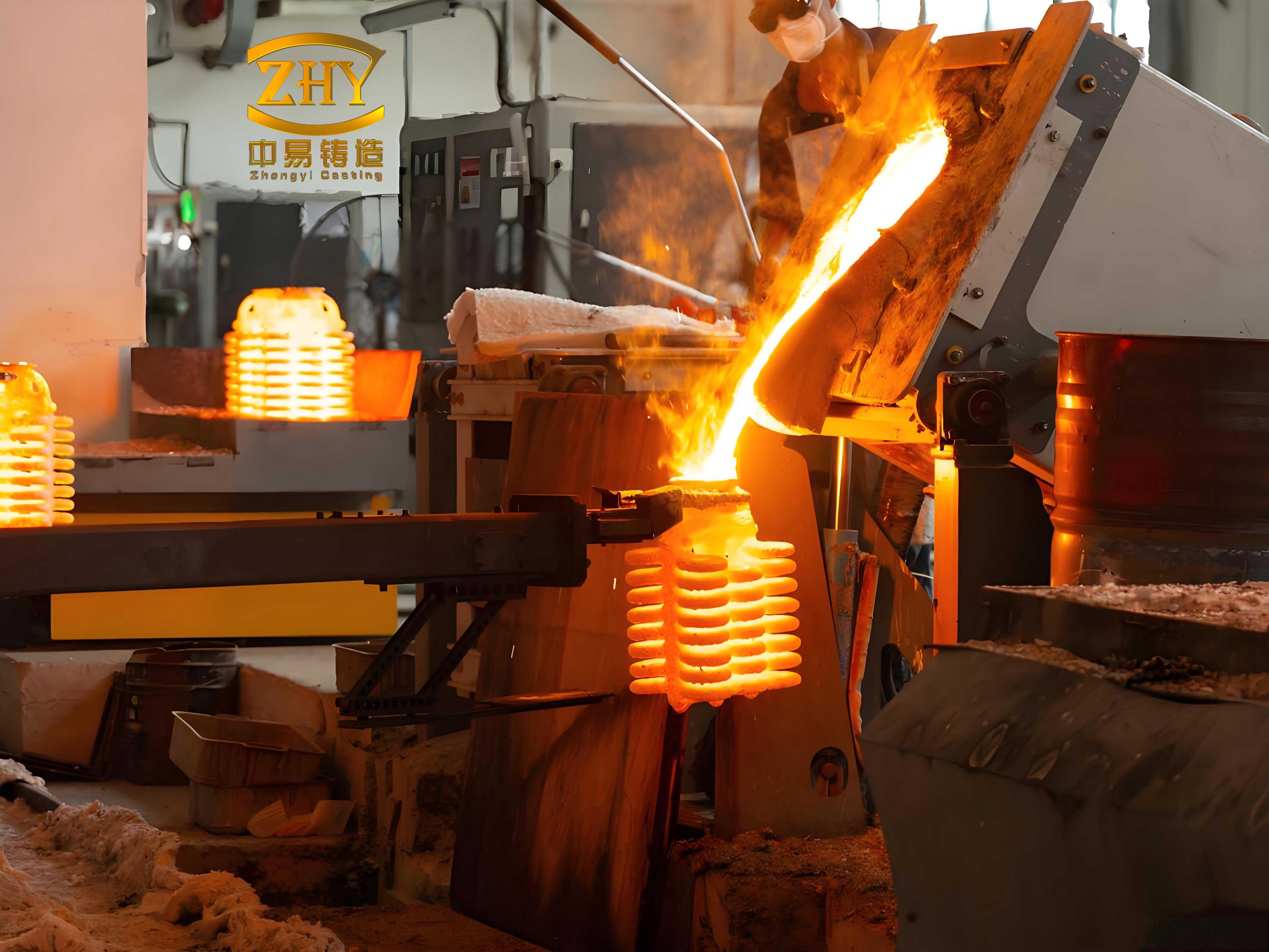
The operational workflow of this new furnace for the investment casting process can be summarized in a series of distinct stages. Let’s define the mold’s target pre-pour temperature as $T_{target}$, its initial pre-heat temperature from the external oven as $T_{pre}$ (where $T_{pre} < T_{target}$ for many low-pour scenarios), and the melting temperature of the alloy as $T_{melt}$. The furnace must ensure $T_{mold} \rightarrow T_{target}$ before the pour is initiated.
Stage 1: Mold and Charge Loading. The pre-heated mold at temperature $T_{pre}$ is loaded onto the mold translation cart in the lock chamber. The charge material is simultaneously placed into the crucible.
Stage 2: Vacuum Transfer. After rough pumping, the lock chamber is isolated and brought to high vacuum, matching the melting chamber’s pressure $P_{vac}$. The interlock valve opens, and the cart translates the mold horizontally into the melting chamber to a predefined position.
Stage 3: Mold Re-Heating. The mold lift mechanism engages, raising the mold off the cart and into the cavity of the laterally positioned mold heater. The heater power $P_{heater}$ is applied for a time $t_{heat}$ to achieve the temperature rise. The required energy can be approximated by:
$$ Q_{required} = m_{shell} \cdot c_{p, shell} \cdot (T_{target} – T_{pre}) + Q_{loss}(t_{heat}) $$
where $m_{shell}$ is the mold mass, $c_{p, shell}$ is its specific heat, and $Q_{loss}$ represents heat losses to radiation and conduction during the heating cycle, a function of time and temperature difference.
Stage 4: Pouring Preparation. Concurrently, the induction melting coil powers up, melting the charge. The energy input follows standard induction heating principles governed by the skin depth $\delta$:
$$ \delta = \sqrt{\frac{\rho}{\pi \mu f}} $$
where $\rho$ is resistivity, $\mu$ is permeability, and $f$ is frequency. Once the mold reaches $T_{target}$, the lift mechanism lowers it to the optimal pouring height $h_{pour}$. Simultaneously, the internal coil translation mechanism moves the entire melting assembly (coil and crucible) horizontally over a distance $d_{translate}$ (often >500 mm) to align the crucible lip with the mold cup.
Stage 5: Pouring and Solidification. The crucible is tilted, initiating the pour. The metal flow, driven by gravity and influenced by vacuum, fills the mold. The horizontal separation ensures an unobstructed path and clear visibility. After pouring, the coil retracts, and the mold is transferred back to the lock chamber for controlled cooling or extraction.
The horizontal layout is enabled by several key subsystem innovations. The first is the internal coil translation mechanism. Unlike external systems prone to vacuum seal wear and slower motion, this fully internalized system houses the coil, crucible, and tilt frame on a robust carriage that rides on precision rails inside the vacuum chamber. It allows for rapid, precise positioning over long distances, essential for bridging the gap between the melting station and the pouring station now separated by the mold heater’s footprint. All vulnerable components are shielded from metal splash, drastically reducing maintenance.
The second is the horizontal mold translation cart. This device features a dual-stage motion: an outer stage for sealing against the lock chamber door and an inner stage for traversing between chambers. It carries a specialized mold pallet with self-locating features that ensure precise engagement with the mold lift mechanism. This design replaces the vertical elevator, making the system more compact in height and mechanically simpler for horizontal integration.
The third, and perhaps most significant from an efficiency standpoint, is the integration of coaxial water-cooled power cables for both the melting coil and the mold heater. In a standard single-conductor cable carrying high-frequency AC current for induction heating, the surrounding electromagnetic field induces significant reactive voltage drops in nearby conductive structures, leading to high reactive power (VARs) and reduced system power factor. The coaxial cable, with its concentric inner and outer conductors carrying opposing currents, contains the magnetic field within the cable’s annular space. This minimizes inductive coupling to the environment. The effective impedance $Z_{cable}$ and the resulting voltage drop $\Delta V$ are dramatically reduced. The power transfer efficiency $\eta_{power}$ from the power supply to the load (coil) is improved as the ratio of real power $P_{real}$ to apparent power $S$ increases:
$$ \text{Power Factor} = \frac{P_{real}}{S} = \cos \phi \rightarrow \text{Higher with coaxial cable} $$
$$ \eta_{power} \propto \frac{P_{real, load}}{P_{real, supply}} $$
Our proprietary CC-series coaxial cables have been developed to match international performance standards, enabling our furnaces to achieve higher electrical efficiency and allow power supplies to operate closer to their full rated capacity, a critical factor for the energy-intensive investment casting process.
The advantages of this new layout for specific investment casting processes are quantifiable. For thin-walled castings, rapid heat loss from the mold can lead to misruns or cold shuts. The ability to re-heat and stabilize the mold at a precise temperature $T_{target}$ just before pouring is paramount. The new furnace provides a controlled thermal environment where the mold’s temperature history can be finely tuned. For large castings like turbine disks, thermal mass is significant, and temperature gradients during transfer are problematic. The in-situ heater allows for homogenization. For alloys requiring low superheat pouring (where $T_{pour} – T_{liquidus}$ is small), precise mold temperature control is non-negotiable to avoid premature freezing. Our system offers this control without the penalties of the old design.
| Process Challenge | Traditional Furnace Constraint | New Furnace Solution & Metric Improvement |
|---|---|---|
| Mold Temperature Drop | Uncontrolled loss during transfer; $\Delta T_{loss}$ can be 100-200°C. | Active in-situ heating; $\Delta T_{loss} \approx 0°C$, can achieve $\Delta T_{gain}$. |
| Pouring Visibility | Blocked view; qualitative assessment only. | Clear line of sight; enables quantitative monitoring and real-time intervention. |
| Pouring Height Flexibility | Fixed; $h_{pour}$ is constant. | Fully variable; $h_{pour}$ can be optimized per mold geometry ($h_{min}$ to $h_{max}$). |
| Heater Contamination Rate | High; requires cleaning/replacement every $N_{1}$ cycles. | Negligible; maintenance interval extended to $N_{2} \gg N_{1}$ cycles. |
| System Power Factor | Lower due to inductive losses in long, single cables. | Higher (e.g., 0.85 vs. 0.70) due to coaxial cables, reducing $kVA$ demand. |
Beyond solving immediate problems in conventional equiaxed casting, this new furnace architecture possesses inherent scalability for advanced investment casting processes. Its layout is remarkably congruent with the requirements for fine grain and dual-property casting, such as for manufacturing integrally bladed rotors (blisks). In fine grain casting, the mold is typically rotated at high speed within a heated field while being sprayed with fine alloy droplets. The traditional approach often requires breaking vacuum on the melting chamber for mold manipulation. Our horizontal design, with its spacious melting chamber and separate mold handling zone, can readily integrate a high-speed rotation and spray mechanism without compromising the main vacuum integrity. By modifying the mold translation cart to include a rotation drive and adding a spray atomizer unit, the same furnace platform can be adapted. This transforms the equipment from a dedicated equiaxed caster into a versatile platform for multiple advanced investment casting processes, maximizing capital investment return.
In conclusion, the development of this new horizontal-layout vacuum equiaxed crystal precision casting furnace represents a significant leap forward in foundry technology. By fundamentally rethinking the spatial relationship between heating, pouring, and handling functions, we have successfully eliminated the critical flaws associated with traditional internal heater designs. The key innovations—the horizontal chamber layout, the internal long-stroke coil translator, the robust mold cart, and the efficient coaxial power delivery—work in concert to provide unprecedented control, visibility, and reliability for the investment casting process. This system is specifically engineered to excel in the most demanding applications: thin-walled structures, large components, and low-temperature pouring scenarios where thermal management is paramount. Furthermore, its modular design philosophy opens a direct pathway to even more advanced manufacturing techniques like fine grain casting. We are confident that this new furnace paradigm will establish itself as a valuable tool, enhancing quality, yield, and economic efficiency in precision casting foundries dedicated to producing the high-integrity components that modern aerospace and energy industries depend on. The evolution of the investment casting process continues, driven by such purposeful engineering aimed at turning persistent challenges into operational advantages.