
In my extensive experience with the investment casting process, particularly for thin-walled stainless steel components, shrinkage porosity and microshrinkage (often referred to as shrinkage cavities and shrinkage porosity) represent a significant and persistent challenge. These defects disproportionately affect thin-walled castings, severely compromising internal integrity and mechanical properties. Addressing these issues is therefore a critical aspect of process optimization in precision investment casting. This article delves into the root causes of these defects and presents a series of practical, first-hand accounts of process improvements, supported by analytical frameworks, formulas, and summarized data, to guide practitioners in mitigating these costly problems.
The investment casting process, renowned for its ability to produce complex, near-net-shape components with excellent surface finish, involves creating a ceramic shell around a wax pattern. After dewaxing, molten metal is poured into the preheated shell. For thin-walled stainless steel castings, the rapid solidification inherent to thin sections interacts with the alloy’s solidification characteristics, often leading to shrinkage defects if not meticulously controlled. The core of the problem lies in the inability to provide adequate liquid metal feed to compensate for volumetric shrinkage during the liquid-to-solid transformation.
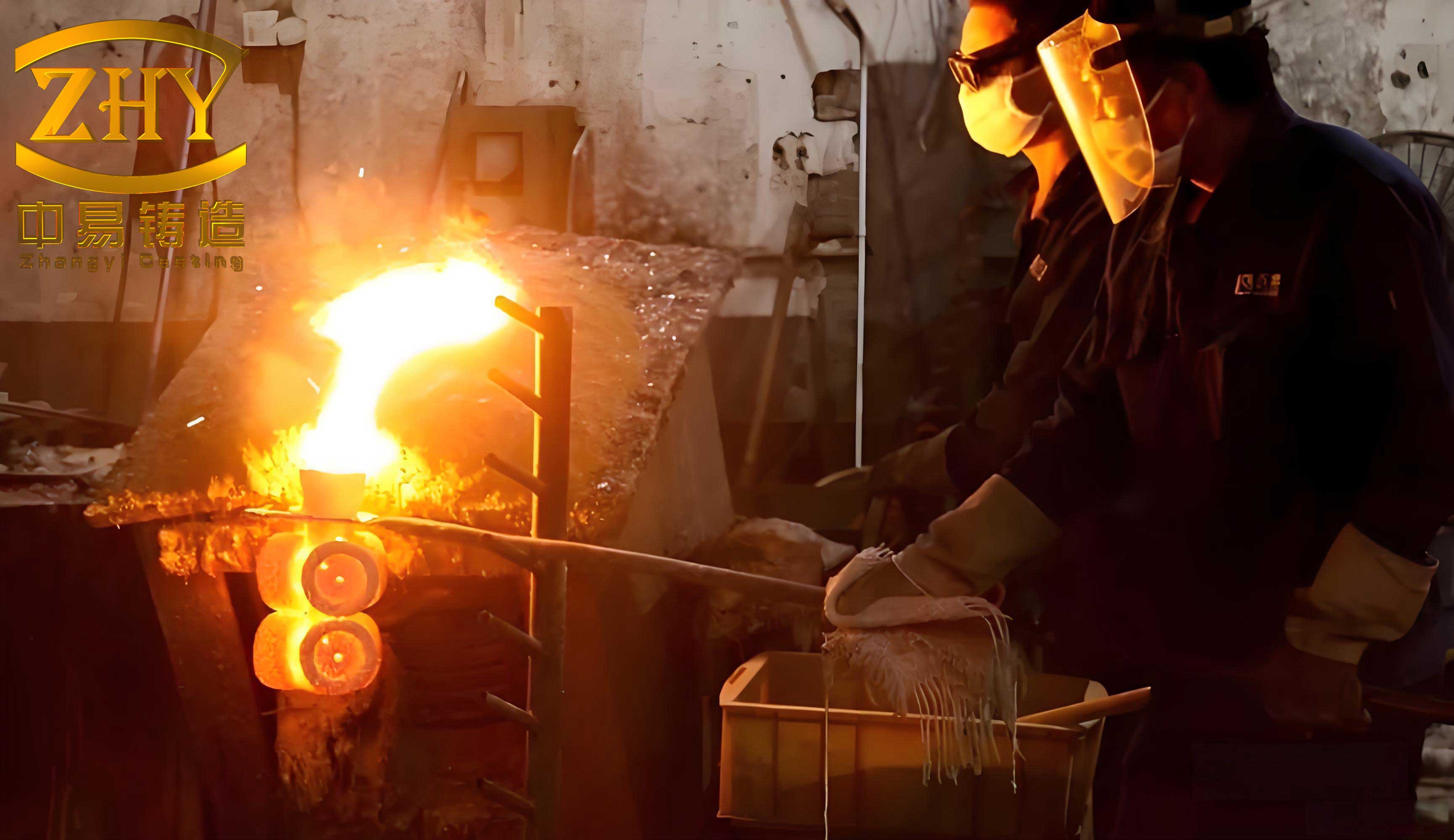
The formation mechanisms of shrinkage cavities and porosity are fundamentally linked to the thermodynamics and kinetics of solidification within the investment casting process. A shrinkage cavity is a concentrated void, typically localized in the last-to-freeze hotspots (or thermal centers) of a casting. It forms when the volumetric contraction during the liquid and凝固 stages cannot be compensated by incoming feed metal because the feeding path has solidified. Shrinkage porosity, conversely, consists of numerous small, dispersed pores. It occurs in alloys with a wide freezing range, where solidification proceeds in a “mushy” or pasty manner over a broad temperature interval. In this regime, dendrites grow extensively and interconnect, isolating small pools of residual liquid that eventually solidify without external feed.
Mathematically, the total volumetric shrinkage from pouring to room temperature can be considered as the sum of liquid contraction,凝固 contraction, and solid-state contraction. The critical period for defect formation is during the liquid and凝固 phases. The susceptibility to shrinkage porosity is often related to the solidification temperature range, \(\Delta T_f\), defined as:
$$ \Delta T_f = T_l – T_s $$
where \(T_l\) is the liquidus temperature and \(T_s\) is the solidus temperature. A larger \(\Delta T_f\) promotes a wider mushy zone and increases the risk of interdendritic feeding blockage, leading to microporosity. The local solidification time, \(t_f\), which is inversely related to the cooling rate, also plays a crucial role. For a thin wall of thickness \(d\), cooled from both sides, a simplified approximation for local solidification time can be derived from heat transfer principles:
$$ t_f \propto \frac{d^2}{\alpha} $$
where \(\alpha\) is the thermal diffusivity of the metal. Shorter solidification times in thin sections can hinder the establishment of a favorable temperature gradient for directional solidification towards a feeder.
The fundamental requirement for preventing a concentrated shrinkage cavity is establishing a functional feeding path, governed by the concept of feeding distance. In the investment casting process, the effective feeding distance from a riser or gate is not fixed but depends on the section thickness, alloy properties, and mold conditions. A generalized Niyama-type criterion, often used in simulation, relates the local thermal conditions to porosity risk through the temperature gradient \(G\) and cooling rate \(\dot{T}\):
$$ \frac{G}{\sqrt{\dot{T}}} > C $$
where \(C\) is a critical value specific to the alloy. In thin-walled castings, achieving a high \(G\) is challenging, making this criterion difficult to satisfy without process intervention.
| Defect Type | Morphology | Primary Formation Condition | Typical Location | Alloy Susceptibility |
|---|---|---|---|---|
| Shrinkage Cavity | Large, concentrated void | Localized hot spot, inadequate directional solidification towards feeder. | Thermal centers, junctions (e.g., wall intersections). | Alloys with narrow freezing range (e.g., some carbon steels). |
| Shrinkage Porosity (Microshrinkage) | Dispersed, fine pores | Broad mushy zone, interdendritic liquid isolation. | Throughout mushy zone, often in thicker sections adjacent to thin walls. | Alloys with wide freezing range (e.g., many stainless steels like 304, 316). |
Through numerous projects, we have encountered and addressed these issues in various thin-walled stainless steel investment castings. The following are detailed accounts of specific cases and the iterative process improvements undertaken. Each case underscores the need to tailor the investment casting process parameters to the unique geometry of the part.
Case 1: A Simple Thin-Walled Enclosure (SS304, Uniform 2.5mm Wall)
Initial gating was positioned at a single top location (analogous to point A in the original discussion). Castings consistently exhibited shrinkage porosity at the junctions between side walls and rounded corners. Thermal analysis, albeit rudimentary at the time, indicated these junctions acted as thermal nodes. The feeding distance from the single gate exceeded the effective limit for such a thin section within the investment casting shell. The solution involved redesigning the gating system to incorporate two additional, smaller ingates positioned closer to these problematic junctions. This effectively reduced the feeding distance and provided more direct thermal and mass feed paths. The improvement was quantifiable, reducing the scrap rate due to these defects by over 70%.
Case 2: A Pump Housing with Thin Legs (SS304, Wall Thickness 5.1–9.9mm)
The initial trial used a gate on the main body face. This resulted in major shrinkage cavities at the four junctions where the thin legs met the housing body. The legs, though thinner, created a thermal bottleneck, solidifying last. The innovative solution was to relocate the primary gates to the end faces of the four legs themselves. To counteract the rapid heat loss from these thin sections—which could prematurely freeze the feeding channels—we implemented localized insulation around the leg gates within the investment casting shell assembly. This maintained the legs as molten feeders for the heavier body sections for a longer duration, successfully eliminating the shrinkage defects entirely.
Case 3: A Tubular Fitting (316, Thin-Walled)
A specific circumferential location on the fitting showed intermittent microshrinkage. Geometry constraints prohibited adding a gate or modifying the profile via increased fillets. After several experimental batches in our investment casting process, we systematically varied the pouring temperature. The results were conclusive: increasing the superheat significantly reduced the defect incidence. We raised the pouring temperature from approximately 1580°C to 1670°C. The higher thermal content delayed the onset of solidification at the problematic zone, allowing the surrounding metal to solidify first and exert a feeding pressure on the still-liquid area, thereby preventing pore formation. This can be conceptualized by the effect of superheat, \(\Delta T_{sh}\), on the temperature gradient:
$$ G \approx \frac{T_{pour} – T_{interface}}{\delta} $$
where a higher \(T_{pour}\) increases the numerator initially, potentially improving feeding for a short duration.
| Case Description | Key Problem | Implemented Solution | Principle Applied | Outcome |
|---|---|---|---|---|
| Uniform 2.5mm wall enclosure | Shrinkage at wall junctions, long feeding distance. | Added multiple, strategically placed ingates. | Reduced effective feeding distance; improved feed metal accessibility. | Major reduction in scrap rate (>70%). |
| Pump housing with thin legs | Shrinkage cavities at leg-body junctions. | Gated at leg ends; applied gate insulation. | Reversed solidification sequence; maintained feeding channel open. | Defect eliminated. |
| Tubular fitting | Circumferential microshrinkage. | Increased pouring temperature significantly. | Increased superheat to delay solidification at hotspot, promoting better feeding. | Problem resolved. |
| Pedal component (generalized from Case 4) | Multiple, scattered shrinkage spots. | Post-pouring water quenching of specific casting areas. | Forced rapid cooling of thin areas to promote simultaneous solidification. | Defects largely mitigated (requires precise control). |
Case 4: A Pedal Component (304) with Multiple Thin Sections
With gating from a central sprue, shrinkage appeared at several isolated thin sections. It was impractical to gate each location. We adopted a controlled quenching technique. Immediately after pouring and a brief initial solidification period, the entire cluster was partially immersed in water, targeting the problematic thin regions. This drastically increased the cooling rate of those areas, forcing them to solidify rapidly and nearly simultaneously with the heavier sections. The key was precise control over timing, depth, and cluster orientation to avoid thermal shock cracking. This approach leverages the heat extraction coefficient, \(h_{quench}\), which is much higher for water than for air:
$$ \dot{q} = h_{quench} (T_{casting} – T_{water}) $$
This high heat flux \(\dot{q}\) forces \(t_f\) to become very small, preventing the formation of isolated hot spots.
Case 5: General Principle for Large Thin-Walled Castings
For expansive thin-walled structures, establishing a dominant temperature gradient for directional solidification is often impossible. The strategy shifts towards promoting simultaneous solidification across large areas to avoid creating distinct last-to-freeze zones. This can be achieved by strategically combining chilling (e.g., using chill inserts in the investment casting shell) at potential hotspots and insulating thinner, connecting regions. The goal is to balance the local solidification times, \(t_{f,i}\), across different sections \(i\):
$$ \text{Minimize } |t_{f,1} – t_{f,2}| \text{ for adjacent sections 1 and 2} $$
This minimizes pressure drop in the interdendritic liquid and reduces feeding demand.
Synthesizing these experiences within the framework of the investment casting process, a systematic set of preventive measures can be formulated. The choice and combination of measures depend on the specific part geometry, alloy, and production constraints.
| Measure Category | Specific Actions | Underlying Mechanism / Principle | Suitability in Investment Casting Process |
|---|---|---|---|
| Design Modification | Increase fillet radii; eliminate sharp corners; transition wall thickness smoothly. | Reduces stress concentration and thermal hotspots; promotes smoother heat dissipation. | Requires customer approval. Ideal in early design phase to facilitate casting. |
| Gating & Feeding System Design | Add multiple, strategically located gates/risers; use insulated sleeves or exothermic materials on feeders. | Shortens feeding distance; maintains feeding channels open longer; establishes favorable temperature gradient. | Core strength of investment casting process design. Highly flexible for complex clusters. |
| Thermal Management | Adjust pouring temperature & shell preheat temperature; use chills or cooling fins in shell; apply post-pouring quenching. | Controls solidification rate and pattern; promotes simultaneous或 directional solidification as needed. | Shell design and process control are key. Quenching requires careful execution. |
| Process Enhancement | Employ vacuum-assisted gravity pouring; pressure-assisted solidification (though less common in standard investment casting). | Improves metal fluidity and feeding pressure; helps fill thin sections and compresses gas/pores. | Vacuum assistance is a viable upgrade with relatively low cost and complexity. |
For the investment casting process, vacuum-assisted gravity pouring deserves special mention. It involves creating a partial vacuum within the shell mold chamber before and during pouring. This significantly reduces air resistance to metal flow, improves filling of intricate thin sections, and can enhance feeding by reducing the pressure difference needed to draw metal from feeders. The governing equation for fluid flow under a pressure differential \(\Delta P\) is given by Bernoulli’s principle modified for viscous flow:
$$ \Delta P = \frac{1}{2} \rho v^2 + \rho g h + \Delta P_{viscous} $$
Applying a vacuum reduces the back-pressure on the metal stream, effectively increasing the net \(\Delta P\) driving flow and feeding.
The measures outlined are not mutually exclusive. An integrated approach is often necessary. For instance, a casting might require both an optimized gating system designed via simulation software and a slight increase in pouring temperature. The sequence of implementation should follow a logical order, starting with the simplest and least costly modifications, such as tuning temperatures, before moving to more involved changes like gating redesign or the addition of chills/insulation. The following table provides a heuristic guide for selecting initial corrective actions based on defect manifestation.
| Observed Defect Pattern | Likely Cause | Recommended First-Line Actions |
|---|---|---|
| Single, large cavity at a thick junction. | Inadequate feeding to a defined hot spot. | 1. Add a directed feeder/gate near the spot. 2. Consider a chill on the opposite side of the hotspot. |
| Dispersed porosity throughout a section. | Wide mushy zone solidification; poor interdendritic feeding. | 1. Increase pouring temperature. 2. Increase shell temperature to reduce cooling rate. 3. Evaluate alloy composition (if possible). |
| Porosity at the end of long, thin sections away from gate. | Exceeded feeding distance limit. | 1. Add an additional gate at or near the problematic end. 2. Apply insulation along the thin section to slow its solidification. |
| Porosity in multiple isolated thin areas. | Simultaneous formation of multiple micro-hotspots. | 1. Implement controlled cooling (quenching) of those areas. 2. Redesign gating to feed areas more centrally if possible. 3. Consider vacuum-assisted pouring to improve overall feeding. |
It is imperative to recognize that while the principles and strategies discussed provide a robust framework, the investment casting process is highly sensitive to specific production environments. Variables such as the ceramic shell material’s thermal conductivity, the exact alloy composition within specification limits, wax pattern properties, and ambient conditions can all influence solidification behavior. Therefore, a solution that works flawlessly in one foundry may require adjustment in another. The most effective approach combines fundamental understanding with empirical validation. Computer simulation of solidification has become an indispensable tool in the modern investment casting process, allowing for virtual testing of gating designs and thermal management strategies before committing to expensive tooling and trial runs. These simulations solve the complex heat transfer equations during solidification, providing visual maps of temperature gradients, solid fraction evolution, and predicted shrinkage locations based on criteria like the Niyama criterion mentioned earlier.
In conclusion, combating shrinkage porosity and cavities in thin-walled investment cast stainless steel components demands a proactive and analytical approach deeply embedded in the nuances of the investment casting process. Success hinges on correctly diagnosing the specific feeding failure mechanism—whether it is due to excessive feeding distance, unfavorable solidification morphology, or inadequate thermal gradients—and then applying a tailored combination of design, gating, and thermal management solutions. The iterative process of observation, hypothesis, experimentation, and implementation, as illustrated in the case histories, remains the cornerstone of foundry engineering. As the demand for lighter, stronger, and more complex thin-walled castings grows, continued refinement of these techniques within the investment casting paradigm will be essential for achieving high yields and superior quality.