
In the pursuit of enhancing the design and manufacturing quality of motorcycle frames, I have embarked on a project to develop a fully integrated, large thin-walled motorcycle frame through the investment casting process. Traditional motorcycle frames, often fabricated via welding of aluminum components, face significant challenges such as reduced strength in heat-affected zones and susceptibility to fatigue failure at weld joints. By leveraging the investment casting process, we aim to eliminate welds, improve structural integrity, and achieve lightweighting. This article details the comprehensive approach, from redesign and finite element analysis to the implementation of the investment casting process, highlighting its critical role in producing high-quality, cost-effective frames.
The motorcycle frame is a critical component that influences overall vehicle safety, comfort, and fuel economy. It must meet stringent strength and stiffness requirements while being lightweight and dynamically efficient. Aluminum alloys are preferred for lightweighting, but conventional methods like welding introduce weaknesses. The investment casting process offers a solution by enabling the production of complex, thin-walled structures with minimal joints. Our goal is to replace a multi-part welded frame with a single, integrally cast frame using the investment casting process, thereby enhancing performance and durability.
Redesign of the Motorcycle Frame
The original frame consisted of eight separate components welded together, primarily made of ZL101 aluminum alloy. This assembly had a total mass of 12.4 kg, with weld seams totaling 1.8 meters. Fatigue failures were observed at weld locations due to stress concentrations and material degradation in heat-affected zones. To address this, I redesigned the frame as a single integrated component, maintaining all mounting interfaces and external contours but optimizing the internal structure for the investment casting process.
Key redesign aspects include:
- Elimination of Welds: By integrating multiple parts into one, weld seams are removed. Transition zones replace welds, with internal reinforcement ribs optimized for continuous load paths, reducing stress concentrations.
- Structural Modifications: The original closed tubular sections were converted to open profiles to facilitate the investment casting process. This reduces casting complexity while allowing for increased cross-sectional dimensions and strategic rib placement to compensate for stiffness loss.
- Wall Thickness and Rib Optimization: Wall thicknesses are varied continuously based on stress analysis, and rib heights are adjusted to minimize weight while ensuring strength. Additional mounting brackets are integrated into the frame, simplifying assembly.
The redesigned frame, also using ZL101A aluminum alloy, has a mass of 11.7 kg, representing a 5% weight reduction. The investment casting process is central to achieving this integrated design, as it allows for precise control over thin-walled geometries and internal features.
Finite Element Analysis for Performance Validation
To evaluate the redesigned frame, I conducted finite element analysis (FEA) under极限 static loading and free modal conditions. The analysis compared the original welded frame with the new integrated frame, assuming linear elastic material behavior with properties typical of ZL101A alloy. The investment casting process ensures uniform material properties, which enhances the reliability of FEA results.
Static Analysis under Maximum Front Load: This simulates emergency braking where the rear wheel lifts, with all forces acting on the front wheel. The applied load is calculated based on vehicle dynamics. For a total vehicle mass (including rider, passenger, cargo, and curb weight) of 350 kg, the horizontal force at the front wheel center is derived from moment equilibrium. The equation is:
$$ M = F_0 d_1 = F_r d_2 – F_1 e $$
where \( M \) is the moment (N·m), \( F_0 \) is the horizontal force at the front wheel center (N), \( d_1 = 0.456 \, \text{m} \) is the vertical distance from the front wheel center to the steering head bearing, \( F_r = G \phi_p \) is the ground braking force (N), \( d_2 = 0.748 \, \text{m} \) is the vertical distance from the ground to the bearing, \( F_1 = G \) is the ground reaction force (N), \( e = 0.223 \, \text{m} \) is the horizontal offset, \( G = 350 \times 9.81 \, \text{N} \) is the total weight, and \( \phi_p = 0.9 \) is the ground adhesion coefficient. Solving yields \( F_0 = 3,386 \, \text{N} \).
The FEA model uses high-order tetrahedral elements with a 5 mm mesh size. Boundary conditions constrain the rear swingarm mounts and front wheel center appropriately. Results show significant improvements for the integrated frame, as summarized in Table 1.
| Parameter | Original Welded Frame | Integrated Cast Frame | Improvement |
|---|---|---|---|
| Maximum Stress (MPa) | 577.7 | 134.0 | 76.8% reduction |
| Maximum Deformation (mm) | 2.09 | 1.68 | 19.6% reduction |
The stress distribution in the integrated frame is more uniform, with no concentrated peaks at former weld locations, underscoring the benefits of the investment casting process in producing seamless structures.
Free Modal Analysis: This assesses dynamic stiffness by evaluating natural frequencies. Higher frequencies indicate improved rigidity. Table 2 compares the first four mode shapes between the two frames.
| Vibration Mode | Original Welded Frame (Hz) | Integrated Cast Frame (Hz) | |||
|---|---|---|---|---|---|
| First Torsion | 184.12 | 197.48 | |||
| Y-direction Bending | 246.28 | 256.69 | |||
| Z-direction Bending | 283.43 | 296.05 | Diagonal Stretching | 332.11 | 350.99 |
The integrated frame exhibits higher frequencies across all modes, confirming enhanced stiffness from the investment casting process, which allows for optimized rib layouts and material continuity.
Implementation of the Investment Casting Process
The investment casting process is pivotal for manufacturing the large thin-walled frame. This process involves creating a wax pattern, coating it with ceramic slurry to form a mold, dewaxing, and pouring molten metal. It is ideal for complex geometries with tight tolerances. For this frame, the investment casting process must address challenges like dimensional control, internal quality, and surface finish.
Cast Specifications: The frame is made of ZL101A aluminum alloy, with chemical composition per GB/T 1173-2013. Mechanical properties require tensile strength ≥275 MPa, elongation ≥2%, and hardness ≥80 HB. Dimensional tolerances follow HB 6103-2004 CT8 grade. The frame undergoes 100% X-ray inspection, with critical areas classified as Class I per GB/T 9438-2013. Heat treatment is in T6 condition.
Casting Difficulties and Control Measures:
- Dimensional and Shape Control: The frame has overall dimensions of 742 mm × 687 mm × 335 mm and an average wall thickness of 4 mm. To manage distortion, specialized tooling is used:
- Wax pattern assembly jigs for aligning left and right halves.
- Combination fixtures for shell building to maintain shape during mold making.
- Correction jigs for castings to ensure post-casting accuracy.
The investment casting process enables precise replication of these features through controlled mold making and solidification.
- Internal Quality and Surface Defect Control: The complex internal rib structure necessitates careful gating design. The gating system ensures smooth filling, slag removal, and directional solidification to avoid shrinkage. All gates are placed internally or at mounting points to preserve external aesthetics. The gating layout can be described by fluid dynamics principles. The metal flow velocity \( v \) in the gates is governed by:
$$ v = \frac{Q}{A} $$
where \( Q \) is the volumetric flow rate (m³/s) and \( A \) is the cross-sectional area (m²). To minimize turbulence, the Reynolds number \( Re \) should be kept low:
$$ Re = \frac{\rho v D}{\mu} $$
with \( \rho \) as density, \( D \) as hydraulic diameter, and \( \mu \) as dynamic viscosity. The investment casting process allows for optimized gate sizes and positions to achieve laminar flow.
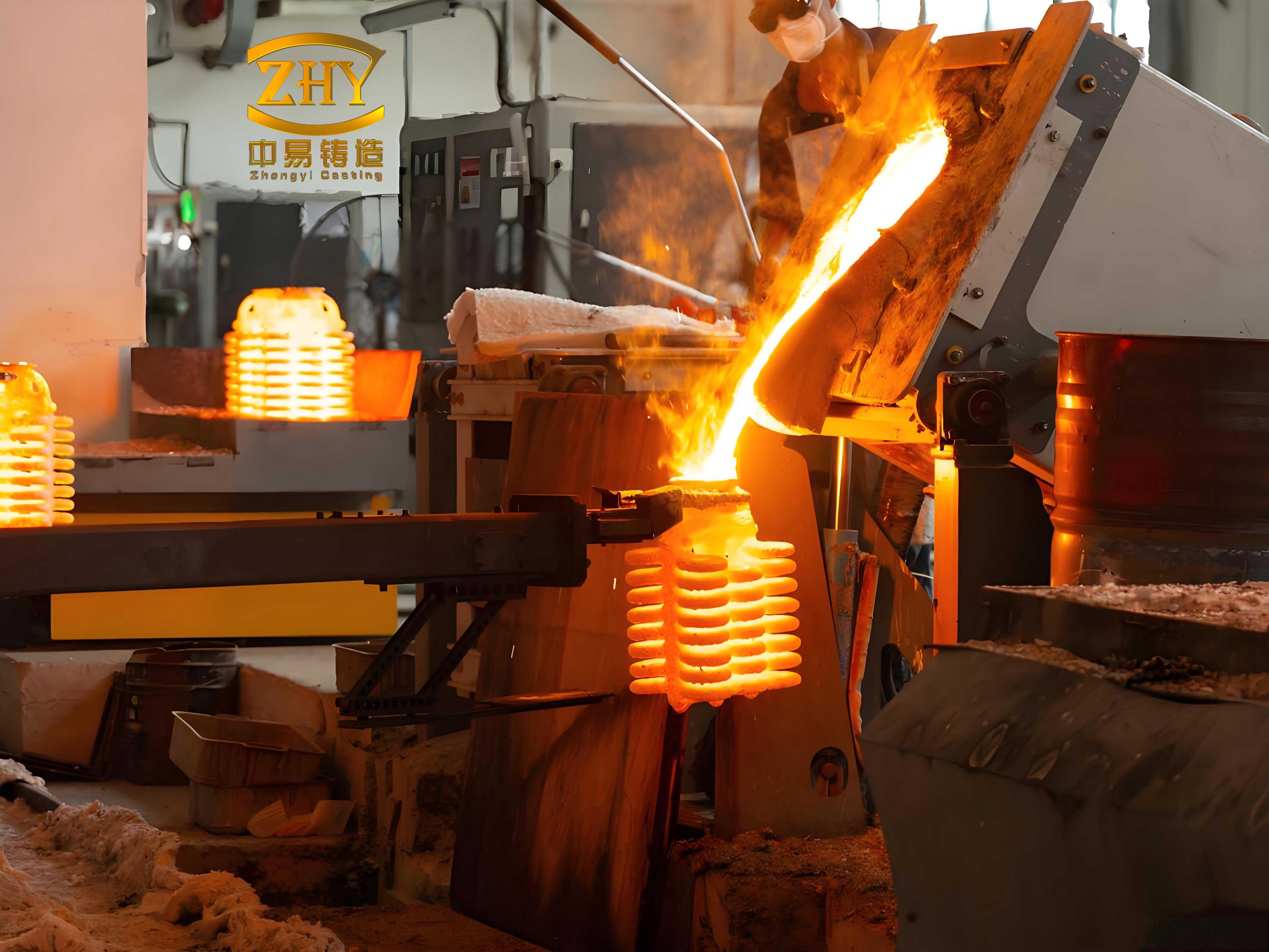
The image above illustrates the precision achievable through the investment casting process, showcasing complex thin-walled components similar to our motorcycle frame. This visual emphasizes the capability of the investment casting process to produce intricate details and smooth surfaces.
Process Parameters: Key parameters for the investment casting process are summarized in Table 3, derived from iterative trials to achieve optimal results.
| Parameter | Value or Range | Role in Quality Control |
|---|---|---|
| Wax Injection Temperature (°C) | 60-70 | Ensures precise pattern formation |
| Ceramic Slurry Viscosity (cP) | 1500-2000 | Controls shell thickness and strength |
| Dewaxing Method | Steam Autoclave | Removes wax without mold damage |
| Preheat Temperature (°C) | 800-850 | Reduces thermal shock during pouring |
| Pouring Temperature (°C) | 720-740 | Prevents premature solidification |
| Cooling Rate (°C/min) | 10-15 | Minimizes residual stresses |
| Heat Treatment (T6) | Solution: 535°C, Aging: 155°C | Enhances mechanical properties |
These parameters are critical for the investment casting process to yield defect-free castings. The investment casting process also incorporates simulation software to predict mold filling and solidification, further refining the gating design.
Casting Inspection and Testing
After process optimization, trial castings were produced and evaluated. The investment casting process delivered frames that met all specifications for internal quality, dimensional accuracy, and surface finish. Key test results are summarized below.
Mechanical Properties: Tensile tests on separately cast coupons (φ6 mm) showed average values exceeding requirements. Table 4 compares properties with the original welded frame material.
| Property | Original Welded Frame (Base Material) | Integrated Cast Frame (Investment Casting) | Standard Requirement |
|---|---|---|---|
| Tensile Strength (MPa) | 280-300 | 290-310 | ≥275 |
| Elongation (%) | 2-3 | 3-4 | ≥2 |
| Hardness (HB) | 85-90 | 90-95 | ≥80 |
The improved elongation and hardness are attributed to the homogeneous microstructure from the investment casting process, which avoids weld-induced heterogeneity.
Fatigue Testing: The frame underwent bench fatigue testing under maximum front load conditions. The integrated cast frame endured over 1 million cycles without failure, whereas the original welded frame cracked at 250,000 cycles. The fatigue life \( N_f \) can be modeled using the Basquin equation:
$$ \sigma_a = \sigma_f’ (2N_f)^b $$
where \( \sigma_a \) is the stress amplitude (MPa), \( \sigma_f’ \) is the fatigue strength coefficient, and \( b \) is the fatigue exponent. For the cast frame, the absence of welds increases \( \sigma_f’ \), leading to longer life. This demonstrates the superiority of the investment casting process in enhancing durability.
Dimensional Inspection: Coordinate measuring machine (CMM) checks confirmed that all critical dimensions were within CT8 tolerances. The investment casting process achieved this through precise mold making and controlled solidification shrinkage, calculated as:
$$ \Delta L = \alpha L_0 \Delta T $$
where \( \Delta L \) is the shrinkage (mm), \( \alpha \) is the linear expansion coefficient (23.6 × 10⁻⁶ /°C for ZL101A), \( L_0 \) is the initial dimension (mm), and \( \Delta T \) is the temperature drop from liquidus to room temperature (°C). By accounting for this in pattern design, the investment casting process ensures dimensional accuracy.
Discussion on the Investment Casting Process Advantages
The investment casting process offers numerous benefits for large thin-walled components like motorcycle frames. Key advantages observed in this project include:
- Design Freedom: The investment casting process allows for complex internal rib networks and varying wall thicknesses that are impractical with welding or machining.
- Material Efficiency: Near-net-shape production minimizes material waste, contributing to cost savings and sustainability.
- Enhanced Properties: The investment casting process yields fine-grained, uniform microstructures, improving mechanical properties and fatigue resistance compared to welded assemblies.
- Cost Reduction: By integrating multiple parts into one, the investment casting process reduces assembly steps, labor, and quality control overhead.
To quantify these benefits, consider the cost model for production. The total cost \( C_{\text{total}} \) for a frame can be expressed as:
$$ C_{\text{total}} = C_{\text{material}} + C_{\text{processing}} + C_{\text{assembly}} $$
For the welded frame, \( C_{\text{assembly}} \) is high due to welding and inspection; for the cast frame, \( C_{\text{processing}} \) dominates but \( C_{\text{assembly}} \) is negligible. The investment casting process streamlines production, lowering overall cost per unit.
Moreover, the investment casting process supports lightweighting through topology optimization. The frame’s mass reduction of 5% directly improves fuel economy and handling. The relationship between mass \( m \) and energy consumption \( E \) can be approximated as:
$$ E \propto m v^2 $$
for kinetic energy, where \( v \) is velocity. Thus, reducing mass through the investment casting process has cascading benefits.
Conclusion
This project successfully developed a large thin-walled integrated motorcycle frame using the investment casting process. The redesigned frame eliminates welds, optimizes structure through finite element analysis, and leverages the investment casting process for manufacturing. Results show significant improvements: static strength increased by over 75%, deformation reduced by 20%, modal frequencies raised by 5-10%, fatigue life extended fourfold, and weight cut by 5%. The investment casting process proved essential in achieving these outcomes, enabling precise control over geometry, material properties, and cost. Future work could explore further weight reduction via advanced alloys and simulation-driven optimization of the investment casting process parameters. Overall, the investment casting process presents a transformative approach for high-quality, efficient production of complex structural components in the automotive and aerospace industries.
In summary, the investment casting process is not merely a manufacturing technique but a strategic enabler for innovation in lightweight design. By adopting the investment casting process, manufacturers can overcome traditional limitations, enhance product performance, and achieve sustainable production goals. This case study underscores the value of integrating the investment casting process into early design stages to unlock full potential.