
In the demanding field of aerospace propulsion, the manufacture of critical components like turbine guide vanes and rings presents a significant challenge, where mechanical performance is inextricably linked to internal structural integrity. Defects such as shrinkage porosity, inclusions, and hot tears are unacceptable, often leading to catastrophic failure. Having worked extensively on developing such components, I have found that the investment casting process offers the geometric freedom and surface finish required, but its success hinges almost entirely on a single, crucial aspect: the design of the gating and feeding system. This article delves into the principles of gating system design within the investment casting process, expanding upon foundational case studies to explore the fluid dynamics, thermal management, and practical methodologies essential for producing sound, high-integrity castings.
The investment casting process, also known as the lost-wax process, is a multi-step sequence that transforms a precise pattern into a near-net-shape metal component. Its relevance in aerospace stems from its ability to produce complex geometries from high-performance alloys that are difficult or impossible to machine. The core steps are methodical:
- Pattern Creation: A disposable pattern, historically wax but now often polymer-based for rapid prototyping, is produced to the exact shape of the desired part.
- Assembly & Gating: Individual patterns are attached to a central wax gating system (sprue, runners, gates) to form an assembly or “tree.”
- Shell Building (Investing): The assembly is repeatedly dipped into ceramic slurries and stuccoed with refractory granules to build a multi-layer ceramic shell.
- Dewax & Shell Firing: The wax/polymer is melted or burned out in an autoclave or furnace, leaving a hollow ceramic mold. The shell is then fired at high temperature to develop strength and remove residues.
- Metal Pouring: Molten alloy is poured into the preheated shell under vacuum or controlled atmosphere.
- Knock-out, Cut-off, and Finishing: After solidification and cooling, the ceramic shell is mechanically removed, and individual castings are cut from the gating system for subsequent heat treatment and inspection.
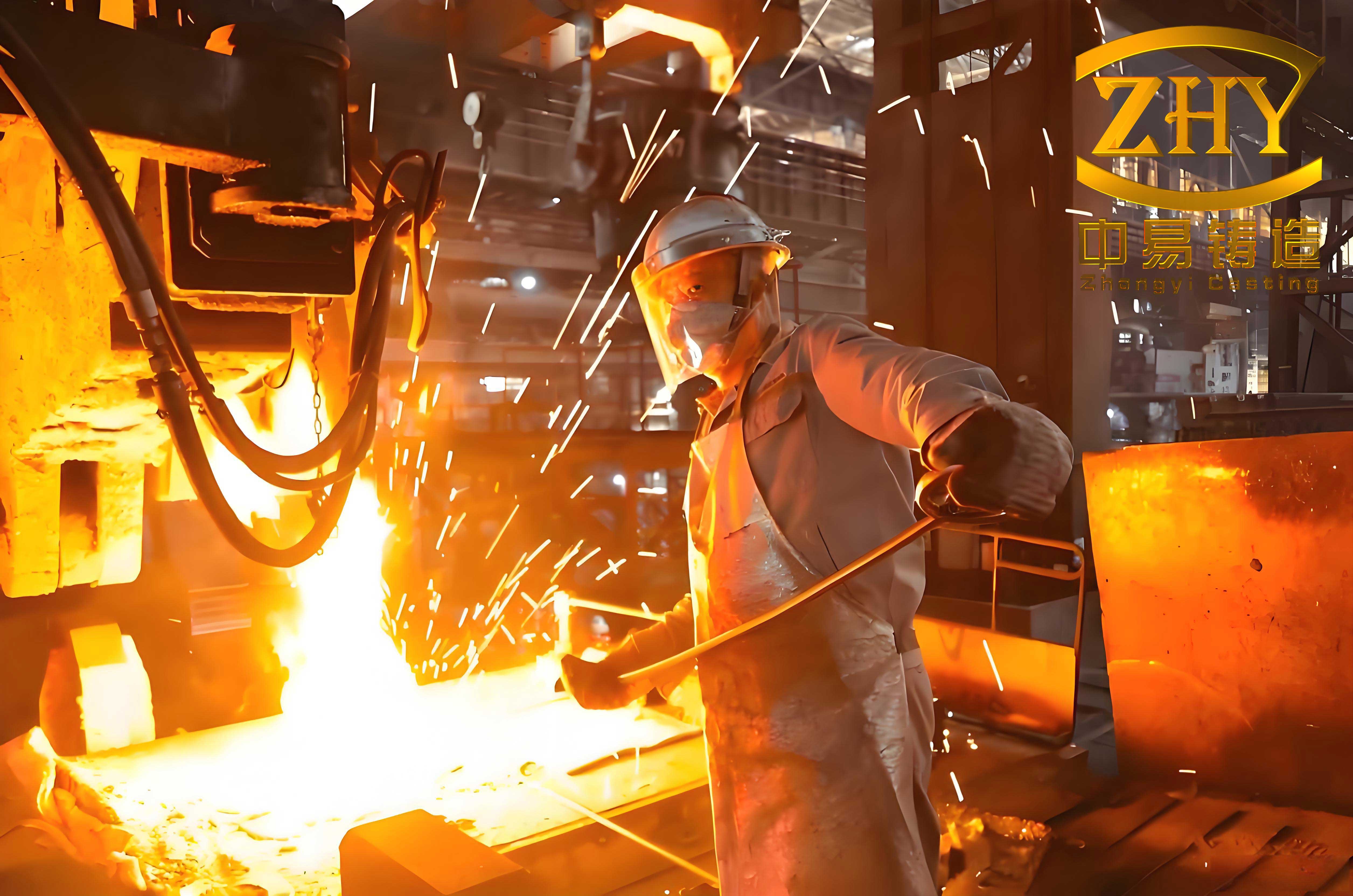
Within this sophisticated investment casting process, the gating system is not merely a channel for liquid metal; it is the primary control mechanism for the casting’s metallurgical quality. Its design dictates the velocity, thermal gradient, and directional solidification path of the metal, all of which directly influence defect formation.
Theoretical Foundations of Gating and Feeding
Fluid Dynamics Principles
The flow of molten metal must be controlled to prevent turbulence, which entraps air and oxide films, leading to inclusions. The basic governing equation for incompressible fluid flow, simplified for gating design, relates the flow rate (Q) to the cross-sectional area (A) and velocity (v):
$$ Q = A \cdot v $$
To minimize turbulence, the system should be designed to maintain a “choked” flow at the smallest cross-section (typically the ingate), ensuring the sprue is always full. A common rule is the continuity equation applied across the gating system (sprue base, runner, gate):
$$ A_{sprue-base} \cdot v_{sprue-base} = A_{runner} \cdot v_{runner} = A_{gate} \cdot v_{gate} $$
Furthermore, the velocity at the gate can be estimated using Torricelli’s theorem, considering the effective metallostatic head (h):
$$ v_{gate} \approx \sqrt{2gh} $$
where g is the acceleration due to gravity. The goal is to keep this velocity below a critical threshold specific to the alloy to avoid mold erosion and splashing.
Solidification and Feeding Principles
The primary role of the gating system is often to act as a feeder (riser) to compensate for volumetric shrinkage during solidification. Chvorinov’s Rule is fundamental here, stating that the solidification time (t) of a simple shape is proportional to the square of its volume-to-surface area ratio, known as the modulus (M):
$$ t = k \cdot M^n = k \cdot \left( \frac{V}{A} \right)^n $$
where k is a constant dependent on mold material and metal properties, and n is typically ~2. For effective feeding, the modulus of the feeder must be greater than that of the casting section it is intended to feed:
$$ M_{feeder} > M_{casting} $$
This ensures the feeder remains liquid longer, supplying molten metal to compensate for shrinkage in the casting. In the investment casting process for thin-walled aerospace components, the gating system itself is often designed with strategically larger cross-sections to act as these thermal reservoirs.
Heat Transfer and Thermal Gradients
A successful design promotes directional solidification, moving from the casting extremities back toward the feeder/gate. This requires managing the thermal gradient. The rate of heat extraction can be modeled using Fourier’s law. The design must avoid creating isolated “hot spots”—areas of thick material or metal confluence that cool slower than surrounding sections—as these are prone to shrinkage porosity. The thermal diffusivity (α) of the alloy, a property in the heat equation, is key:
$$ \frac{\partial T}{\partial t} = \alpha \nabla^2 T $$
where T is temperature and t is time. A good gating design in the investment casting process actively shapes these temperature fields.
Case Study Analysis: Gating Simplicity vs. Complexity
Consider the development of a simple structural ring, a common aerospace component. The initial, seemingly logical approach (Scheme A) might employ multiple gates to ensure “adequate” feeding. For instance, a design with two opposing gates aimed at filling a ring-shaped cavity from two points.
| Parameter | Scheme A (Complex) | Scheme B (Simplified) |
|---|---|---|
| Number of Ingates | 2 (Opposing) | 1 (Tangential) |
| Filling Pattern | Converging flow fronts | Unidirectional, swirling flow |
| Probable Flow Regime | Turbulent meeting point | More laminar |
| Thermal Consequence | Creates a hot spot at convergence | Distributes heat more evenly |
| Predicted Defect Location | Center of ring (convergence zone) | Minimal; possible at end of flow |
| Feeding Path | Ambiguous, competitive | Clear, directional from gate |
In Scheme A, the metal streams from two gates collide in the center of a thin section. This collision causes:
- Turbulence & Oxide Entrapment: The colliding flows disrupt the liquid front, folding in surface oxides.
- Hot Spot Formation: The kinetic energy of the streams is converted to heat, and the converging metal creates a localized volume with higher thermal mass. This area solidifies last, isolated from a feeding source, leading to shrinkage porosity as described by the local modulus becoming unfavorable: $M_{hot-spot} > M_{surrounding\ thin\ wall}$.
A simplified Scheme B, using a single, well-sized tangential gate, often yields superior results. The metal enters and establishes a unidirectional, swirling flow around the ring.
- Controlled Flow: The metal front advances smoothly, minimizing turbulence.
- Progressive Solidification: Solidification initiates at the point furthest from the gate and progresses back toward the gate, which acts as a feeder. This establishes a positive temperature gradient.
- Elimination of Convergence Hot Spot: The thermal problem is fundamentally avoided.
This case underscores a critical principle in the investment casting process: for geometrically simple castings, an overly complex gating system can be detrimental. The designer’s goal is not to maximize the number of feeding points but to control the solidification sequence. The governing relationship for feeding distance (L) from a gate/feeder in a thin wall can be approximated by:
$$ L \propto \frac{\Delta T \cdot \kappa}{\rho L_f} $$
where ΔT is the superheat, κ is thermal conductivity of the mold, ρ is density, and L_f is latent heat. A single, correctly sized gate often provides sufficient feeding distance without introducing flow complexities.
Systematic Design Methodology for Investment Casting Gating
Based on experience and analysis, I propose a systematic approach to gating design within the investment casting process:
- Define Quality Objectives & Critical Zones: Identify non-destructive testing (NDT) requirements and areas of the casting most sensitive to stress or fatigue.
- Analyze Casting Geometry & Calculate Moduli: Divide the casting into thermal sections and calculate the modulus (V/A) for each. This identifies natural “hot spots” that will require feeding.
Example Modulus Calculation for Different Sections of a Component Section Description Volume (V) [mm³] Surface Area (A) [mm²] Modulus (M=V/A) [mm] Solidification Order (1=first) Thin Flange 500 1000 0.5 1 Boss 2000 800 2.5 3 Main Body 15000 5000 3.0 4 (Last) Proposed Feeder Gate 8000 2000 4.0 5 (Feeder) - Determine Pouring Time & Gate Size: Use empirical formulas based on casting weight and section thickness to estimate the ideal pouring time (t_pour). The total gate area (A_gate_total) can then be sized using:
$$ A_{gate\_total} = \frac{W}{\rho \cdot t_{pour} \cdot C_d \cdot \sqrt{2gh}} $$
where W is casting weight, ρ is metal density, C_d is discharge coefficient (~0.8), and h is effective head height. - Select Gating Type & Layout: Choose between bottom, top, or side gating. For aerospace alloys prone to oxides, a bottom-filling “tapered sprue, runner, gate” system that minimizes turbulence is often preferred. The layout should promote directional solidification toward the gate/feeder.
- Model and Simulate: Modern simulation software solves the coupled Navier-Stokes and energy equations during filling and solidification:
$$ \rho \left( \frac{\partial \mathbf{v}}{\partial t} + \mathbf{v} \cdot \nabla \mathbf{v} \right) = -\nabla p + \mu \nabla^2 \mathbf{v} + \rho \mathbf{g} $$
$$ \rho C_p \left( \frac{\partial T}{\partial t} + \mathbf{v} \cdot \nabla T \right) = \nabla \cdot (k \nabla T) + \dot{Q}_{latent} $$
This step is invaluable for visualizing flow patterns, predicting hot spots, and iterating the design virtually before committing to costly tooling and trials in the investment casting process. - Design Feeders (if separate from gates): Use the modulus method to size feeders (M_feeder = 1.2 * M_casting). Ensure they are connected to the casting at the hottest section.
Advanced Considerations and Defect Mitigation
Beyond basic principles, successful implementation of the investment casting process requires attention to:
- Alloy-Specific Behavior: High-performance nickel-based superalloys have a wide freezing range, making them susceptible to micro-porosity. This necessitates stricter control over thermal gradients compared to eutectic alloys.
- Filter Integration: Ceramic foam filters placed in the runner system are highly effective at reducing turbulence and filtering out non-metallic inclusions, dramatically improving reliability.
- Shell Preheating Temperature: This is a critical process parameter. A higher shell preheat (e.g., 1000°C vs. 800°C) slows the cooling rate, which can improve feeding but may degrade grain structure. It changes the boundary condition in the heat transfer equation, affecting the gradient ∇T at the metal-mold interface.
- Common Defect Links to Gating:
Gating-Related Defects and Corrective Actions Defect Likely Gating Cause Corrective Action Shrinkage Porosity Inadequate feeder modulus, poor directional solidification, hot spot creation. Increase feeder/gate size, relocate gate to hottest section, use chills. Oxide Inclusions Turbulent filling, waterfall effects in sprue. Implement laminar flow sprue/runner design, use filters, switch to bottom gating. Cold Shuts Metal front too cold before filling complete; gates too small. Increase gate area, raise pour temperature/shell preheat. Hot Tear Non-uniform cooling causing stress concentration during solidification; rigid gating. Redesign gating to allow for more uniform cooling or gentle yielding, modify gate location.
Conclusion
The design of the gating system is the cornerstone of quality in the investment casting process, particularly for mission-critical aerospace components. As demonstrated, a “more is better” approach to gating complexity can be fundamentally flawed. The primary objectives are to achieve laminar filling to prevent inclusions and to establish a controlled, directional solidification pattern to eliminate shrinkage. This is governed by the interplay of fluid mechanics ($\mathbf{v} \cdot \nabla \mathbf{v}$) and heat transfer ($\nabla \cdot (k \nabla T)$). A systematic methodology—starting with modulus analysis, progressing through hydraulic sizing, and culminating in digital simulation—provides a robust framework for design. Ultimately, the most elegant gating design is often the simplest one that correctly manages the thermal and fluid dynamic parameters of the specific casting geometry and alloy. Mastery of this aspect of the investment casting process transforms it from an art into a predictable engineering discipline, enabling the reliable production of components where internal soundness is non-negotiable.