
The investment casting process is renowned for its ability to produce components with complex geometries, excellent surface finish, and high dimensional accuracy. This makes it the preferred manufacturing method for critical parts such as stainless steel impellers used in centrifugal pumps. However, the very complexity that makes investment casting suitable also introduces significant challenges in preventing defects like shrinkage porosity, macro-shrinkage cavities, and mistruns. These defects are intrinsically linked to the coupled phenomena of molten metal filling and subsequent solidification within the ceramic shell. Traditional trial-and-error methods for optimizing the investment casting process are costly and time-consuming. Therefore, numerical simulation has emerged as a powerful tool to virtually prototype the process, visualize flow patterns, predict temperature fields, and identify potential defect locations before any metal is poured. This article, from my perspective as a process engineer utilizing simulation daily, delves deeply into the mathematical foundations, practical application, and parameter optimization of simulating the investment casting process for a stainless steel impeller.
The fundamental steps of the investment casting process begin with the creation of a wax pattern assembly, which is then repeatedly dipped in ceramic slurries and stuccoed to build a robust shell. After dewaxing and firing, the resulting hollow ceramic mold is ready for pouring. The complexity of an impeller—with its shrouded blades forming enclosed passages—means that the molten metal must navigate a tortuous path during filling, and the solidification must be carefully controlled to feed these isolated thermal masses. Any failure in the filling sequence or in establishing a directional solidification pattern inevitably leads to scrap. This underscores the necessity of a coupled analysis that does not treat filling as an instantaneous event but rather as a transient, heat-losing flow process that sets the initial conditions for solidification.
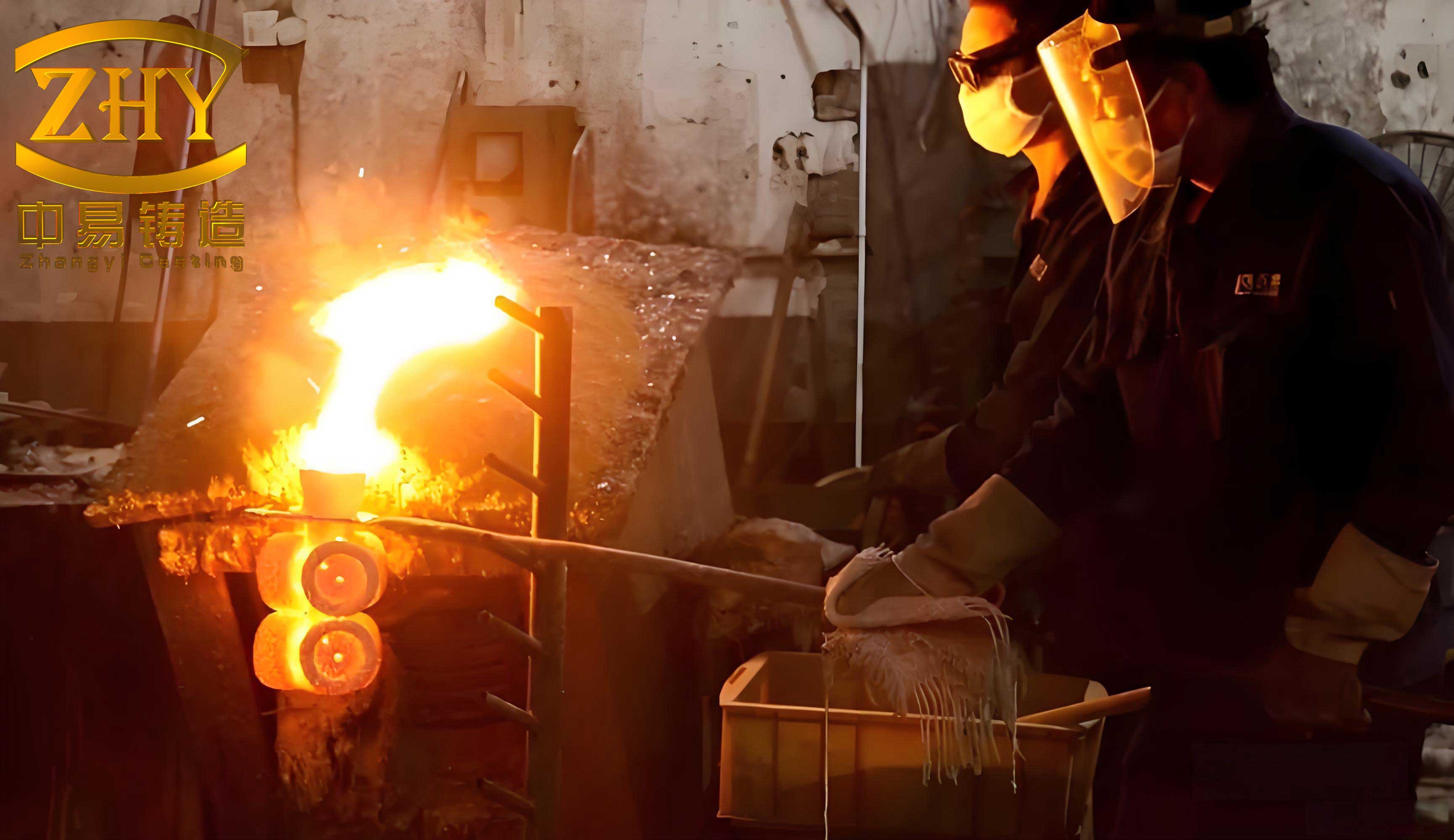
At the core of any credible simulation for the investment casting process lies a set of governing equations that describe the physics of fluid flow, heat transfer, and phase change. The filling stage is modeled as the flow of an incompressible Newtonian fluid (the molten metal) with a free surface moving through the mold cavity. This is described by the laws of conservation of mass, momentum, and energy.
The continuity equation for incompressible flow is given by:
$$\nabla \cdot \vec{u} = 0$$
where $\vec{u}$ is the velocity vector field. The momentum conservation is governed by the Navier-Stokes equations:
$$\rho \left( \frac{\partial \vec{u}}{\partial t} + (\vec{u} \cdot \nabla) \vec{u} \right) = -\nabla p + \mu \nabla^2 \vec{u} + \rho \vec{g}$$
where $\rho$ is the fluid density, $t$ is time, $p$ is pressure, $\mu$ is the dynamic viscosity, and $\vec{g}$ is the gravitational acceleration vector. The energy equation, accounting for heat transfer during filling, is:
$$\rho c_p \left( \frac{\partial T}{\partial t} + \vec{u} \cdot \nabla T \right) = \nabla \cdot (k \nabla T)$$
where $c_p$ is the specific heat capacity, $T$ is temperature, and $k$ is the thermal conductivity. To track the movement of the metal-air interface (the free surface), the Volume of Fluid (VOF) method is typically employed, which uses a scalar function $F$:
$$\frac{\partial F}{\partial t} + \nabla \cdot (F \vec{u}) = 0$$
Here, $F=1$ represents a cell full of metal, $F=0\) a cell full of air, and \(0 < F < 1\) a cell containing the interface.
Once filling is complete, the focus shifts entirely to solidification. The governing equation for heat transfer during this phase, including the latent heat release $L$, is described by:
$$\rho c_p \frac{\partial T}{\partial t} = \nabla \cdot (k \nabla T) + \rho L \frac{\partial f_s}{\partial t}$$
where $f_s$ is the solid fraction, which evolves from 0 (fully liquid) to 1 (fully solid). The term $\rho L \frac{\partial f_s}{\partial t}$ is the source term for the latent heat. The challenge in the investment casting process is solving these equations in a coupled manner, as the initial temperature distribution from filling directly influences the nucleation and growth of solid phases.
For this study, the component of interest is a shrouded (closed) centrifugal pump impeller cast from AISI 304 stainless steel. The chemical composition and key thermophysical properties used in the simulation are critical inputs and are summarized in the tables below.
| C | Si | Mn | P | S | Cr | Ni | Fe |
|---|---|---|---|---|---|---|---|
| 0.07 | 1.0 | 2.0 | 0.035 | 0.03 | 18.0 | 9.0 | Bal. |
| Temperature (°C) | Specific Heat, $c_p$ (kJ·kg⁻¹·K⁻¹) | Thermal Conductivity, $k$ (W·m⁻¹·K⁻¹) |
|---|---|---|
| 1500 | 0.75 | 28.5 |
| 1400 | 0.72 | 26.2 |
| 1300 | 0.70 | 24.8 |
| 1200 | 0.68 | 23.5 |
| Solidus (~1400°C) | — | — |
| Liquidus (~1450°C) | — | — |
| Latent Heat, $L$ (kJ/kg) | ~270 | |
A three-dimensional model of the impeller, gating system (including a central down sprue, runner, and ingates), and the ceramic shell was created. The simulation was performed using a commercial finite element-based software capable of coupled fluid-thermal analysis, which is essential for an accurate investment casting process simulation. The initial conditions included a pouring temperature of 1580°C and a preheated mold temperature of 1000°C. The analysis was conducted for different pouring gate velocities to investigate their effect.
The simulation of the filling stage provided profound insights. At a very low gate velocity of 0.25 m/s, the metal front progressed slowly, losing significant heat to the ceramic mold. This resulted in premature solidification of thin sections, particularly at the extremities of the blades, leading to a large unfilled area and a high risk of a mistrun defect. The equation governing the heat loss at the metal-mold interface, $q = h (T_{metal} – T_{mold})$, where $h$ is the interfacial heat transfer coefficient, explains this phenomenon: with a longer filling time ($t$), the total heat loss $Q_{loss} = \int q \, dA \, dt\) increases, raising the fraction solid \(f_s$ prematurely and impeding flow.
Conversely, at a very high gate velocity of 1.0 m/s, the metal jet impacted the mold cavity walls with excessive force. The dynamic pressure $P_{dynamic} = \frac{1}{2} \rho u^2$ at the point of impact was disproportionately high, as velocity $u$ is squared in the equation. This high-impact velocity, visualized in velocity vector plots, significantly increases the risk of mold erosion, where ceramic fragments can be dislodged and become entrapped in the casting as non-metallic inclusions. The optimal filling velocity was found to be around 0.5 m/s. This velocity provided a balance, ensuring complete mold filling without excessive turbulence or thermal loss, thereby establishing a favorable temperature gradient for the subsequent investment casting process solidification stage.
| Filling Velocity (m/s) | Filling Completion | Max. Impact Velocity (m/s) | Primary Defect Risk |
|---|---|---|---|
| 0.25 | Incomplete (Mistrun) | ~1.08 | Cold Shut, Mistrun |
| 0.50 | Complete | ~1.56 | Low |
| 1.00 | Complete | ~2.25 | Mold Erosion, Inclusions |
The solidification analysis revealed the root cause of shrinkage defects. Solid fraction plots over time showed that while the thin blades and outer rims solidified quickly from the mold wall inwards, the thick hub and central core of the impeller remained liquid much longer, creating an isolated liquid pool or “hot spot.” This is a classic problem in the investment casting process for thick sections. Mathematically, the local solidification time $t_f$ is proportional to the square of the modulus (Volume/Surface Area): $t_f \propto \left( \frac{V}{A} \right)^2$. The impeller hub has a high V/A ratio, leading to a long $t_f$. As the surrounding areas solidified, the feeding path to this hot spot was interrupted (i.e., the critical solid fraction, often around 0.6-0.7, for interdendritic feeding was exceeded in the paths). According to the mass continuity for feeding, $\nabla \cdot (\rho \vec{u}) = – \frac{\partial \rho}{\partial t}$ due to solidification shrinkage, if no liquid metal can flow into the region ($\vec{u} = 0$), a shrinkage cavity or dispersed porosity must form to compensate for the volume deficit $\Delta V$. The simulation’s shrinkage porosity criterion, often based on the Niyama criterion $G / \sqrt{\dot{T}}$ where $G$ is temperature gradient and $\dot{T}\) is cooling rate, confirmed a high probability (\(>60\%\)) of shrinkage in the hub.
The solution lay in actively modifying the thermal field. The most effective method simulated was the strategic placement of a chill—a high thermal conductivity material—inside the core of the impeller hub. The chill acts as a heat sink, dramatically increasing the local heat flux $q_{chill} = k_{chill} \cdot ( \nabla T )_{interface}$. This intervention had a transformative effect: the hot spot was significantly reduced and shifted upward. The solid fraction in the critical zone increased from approximately 27% to over 53% at the same timestamp in the simulation. Consequently, the predicted shrinkage porosity probability in that zone dropped from over 60% to around 28%. This virtual experiment highlights a key optimization strategy for the investment casting process: using active cooling to promote directional solidification toward a designed feed path or riser.
Beyond filling speed and local chills, the investment casting process offers several other levers for optimization via simulation. The design of the gating system itself is paramount. The cross-sectional area of runners and ingates can be optimized using Bernoulli’s principle and the law of continuity ($A_1 u_1 = A_2 u_2$) to ensure balanced filling of all parts of the mold. The placement and size of feed risers are calculated based on Chvorinov’s rule and modulus extension principles to ensure they remain liquid longest. Furthermore, the properties of the ceramic shell, such as its thermal conductivity $k_{shell}$ and thickness, are crucial simulation parameters. A shell with lower conductivity insulates more, slowing solidification, while a thinner shell cools the metal faster. Preheating temperature of the mold, $T_{mold, initial}$, is another critical factor; a higher preheat reduces thermal shock and allows better metal flow but can negatively impact grain structure and solidification direction if not optimized.
| Parameter Category | Key Variables | Primary Influence | Optimization Goal |
|---|---|---|---|
| Gating & Pouring | Gate velocity, Pouring temperature, Gating geometry | Filling completeness, Turbulence, Thermal loss | Complete, quiescent fill with minimal heat loss |
| Feeding Design | Riser size/location, Chills, Insulating sleeves | Thermal gradients, Feeding paths | Directional solidification toward riser |
| Mold System | Shell conductivity/thickness, Mold preheat temperature | Cooling rate, Thermal gradient | Controlled cooling to manage grain structure and feeding |
| Alloy Properties | Solidification range, Shrinkage factor, $c_p$, $k$, $L$ | Mushy zone size, Feeding demand | Accurate input data for simulation |
In conclusion, the numerical simulation of the coupled filling and solidification stages is an indispensable tool for advancing the investment casting process. It moves the practice from an art based on experience to a science driven by predictive analysis. For complex components like stainless steel impellers, simulation allows us to:
- Visually analyze the filling sequence to prevent mistruns and air entrapment by optimizing gate velocity and geometry.
- Identify isolated liquid regions and hot spots during solidification by solving the energy equation with a latent heat source.
- Quantitatively assess the risk of shrinkage defects using criteria based on thermal parameters like $G$ and $\dot{T}$.
- Virtually test and validate optimization strategies, such as the placement of chills or modification of risers, without the cost of physical trials.
The successful application demonstrated here—where an optimal fill speed of 0.5 m/s was identified and a chill was designed to reduce hub shrinkage—exemplifies the power of this approach. As computational power increases and material databases become more refined, the integration of advanced simulation into the investment casting process workflow will become even more seamless, ensuring the production of higher integrity castings with greater efficiency and reduced cost. The governing equations of fluid dynamics and heat transfer, when solved with fidelity, provide a virtual window into the casting mold, revealing the intricate dance of flowing and freezing metal that determines final quality.