
In the demanding field of railway component manufacturing, the production of critical safety items like bogie axle box housings presents a significant challenge. The investment casting process, renowned for its ability to produce complex, near-net-shape components with excellent surface finish and dimensional accuracy, is often the chosen method. However, successfully applying the investment casting process to large, thick-sectioned steel castings with stringent non-destructive testing (NDT) requirements necessitates a deep, systematic understanding of the interplay between geometry, thermal dynamics, and ceramic shell behavior. This article details a first-hand investigation and optimization of the investment casting process for a specific axle housing, transforming initial production setbacks into a reliable, high-yield manufacturing protocol.
The component in question is a B-grade steel axle box housing for a heavy-duty locomotive bogie. With a maximum envelope dimension of approximately 700 mm and a significant variation in wall thickness—ranging from 12 mm to 55 mm—the part embodies several classic casting difficulties. The as-cast weight is 92 kg. The most critical requirement is the internal soundness of specific regions, mandating Level 2 or better according to radiographic inspection standards. Additionally, magnetic particle inspection must meet Grade 1 criteria. The structural configuration, featuring eight thick bolt bosses and a network of reinforcing ribs, creates isolated thermal masses that are prone to shrinkage porosity if not properly fed during solidification.
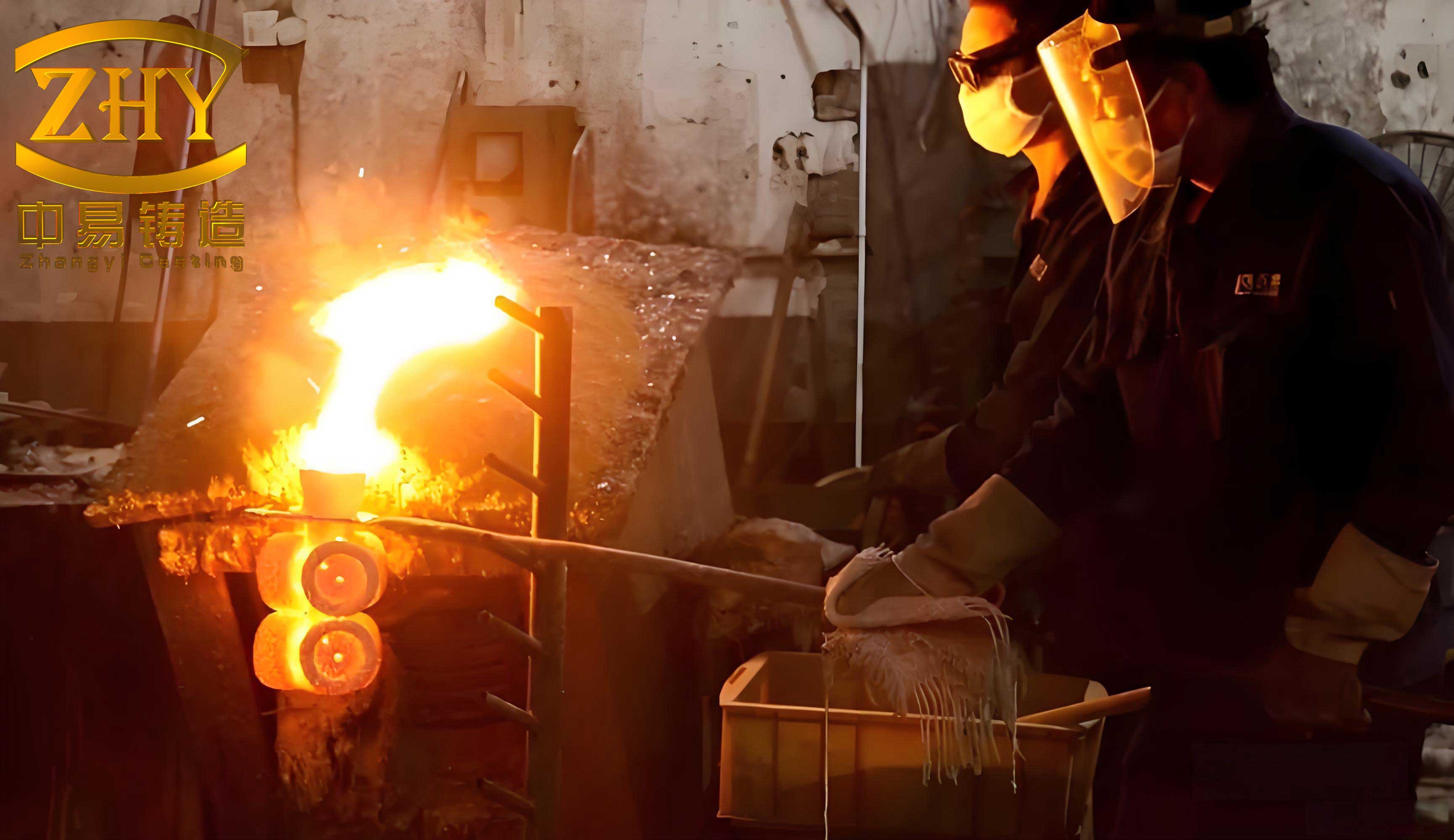
The initial investment casting process design followed conventional wisdom. A linear shrinkage allowance of 2.5% was applied to the pattern dies. The gating and risering system was designed to feed the thick sections, employing large top risers over the bolt bosses and a central downgate for filling. The ceramic shell was built with a standard sequence: one primary slurry coat, one intermediate slurry coat, and seven backup slurry coats. After the third backup coat, the shell was reinforced with external steel wire wrapping to withstand the metallostatic pressure of the substantial metal volume. The mold was poured using a central sprue.
The results from the first trial batch were revealing and highlighted key areas for improvement in the investment casting process. Dimensional inspection showed a critical center-distance of 460 mm had grown to 463.7 mm, indicating the assumed 2.5% shrinkage was excessive. Radiographic testing revealed unacceptable shrinkage porosity (Level 4) in areas adjacent to the smaller, rectangular side risers. Most notably, after rough machining, the large planar surface beneath the central sprue exhibited widespread fine sand inclusions approximately 1 mm deep, a defect detrimental to the fatigue life of the component.
Root Cause Analysis and Theoretical Framing
A systematic analysis was conducted to understand the root causes behind these defects within the context of our specific investment casting process.
1. Dimensional Inaccuracy: The Constrained Contraction Phenomenon
The primary cause of the oversized dimension was an overestimation of the total linear contraction. In investment casting, the final casting size is a function of pattern shrinkage (wax and polymer) and metal contraction during solidification and cooling. The standard 2.5% allowance failed to account for the mechanical constraint imposed by the component’s geometry. The housing features a cruciform rib structure that significantly hinders free contraction during the cooling phase. This “constrained contraction” necessitates a lower effective pattern allowance. The relationship can be conceptually described as the difference between free and hindered shrinkage:
$$ \epsilon_{\text{applied}} = \epsilon_{\text{free}} – \epsilon_{\text{constrained}} $$
Where:
$\epsilon_{\text{applied}}$ is the pattern shrinkage allowance to be used.
$\epsilon_{\text{free}}$ is the nominal shrinkage of the metal (e.g., 2.5% for carbon steel).
$\epsilon_{\text{constrained}}$ is the reduction in shrinkage due to geometric stiffness and mold resistance.
For this rigid ribbed structure, $\epsilon_{\text{constrained}}$ was significant, leading to an $\epsilon_{\text{applied}}$ closer to 1.5%.
2. Internal Shrinkage: Riser Efficacy and Modulus Calculations
The shrinkage porosity near the rectangular risers pointed to inadequate feeding. The efficiency of a riser in the investment casting process is governed by its ability to remain liquid longer than the casting section it feeds (Chvorinov’s Rule). The thermal modulus (Volume/Surface Area ratio) is the key metric. The original rectangular risers, despite their volume, had a relatively high surface-area-to-volume ratio, causing them to solidify prematurely. A riser’s solidification time $t$ is proportional to the square of its modulus $M$:
$$ t \propto M^2 = \left( \frac{V}{A} \right)^2 $$
A cylindrical or “slinger” (腰形) riser of equivalent volume has a lower surface area `A`, thus a higher modulus `M` and longer solidification time, making it a more efficient feeder. Furthermore, the feeding distance from the riser was likely exhausted before the thick, isolated boss sections fully solidified.
3>Sand Inclusions: Fluid Dynamics and Shell Integrity
The sand inclusions on the large horizontal plane were a direct consequence of the gating design. Pouring molten steel (at approximately 1550°C) directly onto a large, flat section of the ceramic shell creates a severe thermal shock and sustained high-temperature exposure. This can lead to:
- Localized Shell Cracking: Thermal stresses exceed the shell’s green strength.
- Secondary Phase Formation: Interaction between the silica-based shell and molten steel, potentially forming low-melting-point phases that weaken the interface.
- Erosion: High-velocity metal flow scours the shell surface.
The erosion mechanism can be related to the fluid’s kinetic energy: $E_k = \frac{1}{2} \dot{m} v^2$, where $\dot{m}$ is the mass flow rate and $v$ is the flow velocity over the shell surface. Pouring through a central sprue directly onto this plane maximized both $\dot{m}$ and $v$ at that location, leading to mechanical dislodgment of primary coat particles.
The analysis clearly dictated a three-pronged optimization strategy for the investment casting process:
- Revise the pattern die dimensions using a reduced, empirically determined linear shrinkage allowance.
- Redesign the risering system to employ more efficient riser geometries and ensure adequate feeding coverage.
- Re-orient the pouring position to eliminate direct impingement of hot metal onto major horizontal shell surfaces.
Optimized Investment Casting Process Design and Implementation
The revised investment casting process was meticulously planned and executed, incorporating the lessons learned from the initial trial.
1. Dimensional Control: Precision Patternmaking
The linear shrinkage allowance for the critical dimensions, particularly those spanning the rigid rib structure, was systematically reduced from 2.5% to 1.5%. This adjustment was made specifically to the pattern dies. The modified shrinkage factor can be represented as a correction model:
$$ L_{\text{die}} = L_{\text{part}} \times (1 + \epsilon_{\text{applied}}) $$
$$ \text{Where: } \epsilon_{\text{applied}} = 0.015 $$
This targeted adjustment acknowledged that different features within the same casting can exhibit varying degrees of constrained contraction, but the global allowance was unified for the pattern die.
2. Feeding System Optimization: Advanced Riser Design
The entire feeding strategy was overhauled to ensure directional solidification towards effective risers.
- Bolt Bosses: The thick, cylindrical bolt bosses were now topped with generously sized cylindrical risers (sprue gates) acting as primary feeders. Their modulus was calculated to ensure it exceeded that of the boss.
- End Sections: The smaller rectangular risers at the housing ends were replaced with elongated “slinger” or kidney-shaped (腰形) risers. These provide a significantly better modulus than a rectangular block of the same volume. Their feeding range was verified using established feeding distance rules for steel.
- Hot Spot Management: A spherical runner/riser was introduced at a strategic location to act as a heat source and a dirt trap, improving yield and metal quality.
The efficiency $\eta$ of a riser is crucial and can be approximated for a cylindrical riser by:
$$ \eta \approx \frac{\text{Volume of metal fed to casting}}{\text{Total riser volume}} $$
Spherical and cylindrical risers typically offer higher $\eta$ (14-20%) compared to side risers of inefficient shape. The following table summarizes the key changes in the feeding system design:
| Feature Location | Initial Design | Optimized Design | Rationale & Improvement |
|---|---|---|---|
| Main Bolt Bosses | Large Rectangular Top Riser | Large Cylindrical Sprue Riser | Higher modulus, better thermal gradient for directional solidification. |
| Housing End Sections | Small Rectangular Side Riser | Elongated ‘Slinger’ (Kidney) Riser | Increased volume-to-surface area ratio, extended solidification time, improved feeding distance coverage. |
| Gating/Junction | Triangular Gate (Point of Pour) | Spherical Runner/Riser | Acts as a hot spot reservoir, promotes cleaner metal entry, reduces turbulence. |
3. Gating and Pouring Strategy: Mitigating Shell Erosion
To eliminate the sand inclusion defect, the pouring point was completely relocated. Instead of gating into the large horizontal plane, the mold was re-oriented, and the metal was now introduced through the newly designed spherical runner/riser located at a non-critical, thicker section of the housing. This achieved several goals:
- Avoided direct high-velocity impingement on large, flat shell areas.
- Allowed the metal to fill the cavity in a more controlled, less turbulent manner.
- Used the spherical riser as a effective slag/sand trap due to reduced flow velocity within its volume.
The modified investment casting process assembly, showing the new riser layout and gating, was carefully validated through process simulation software before committing to tooling changes, confirming improved thermal profiles and reduced flow turbulence.
Process Validation and Results
The implementation of the optimized investment casting process yielded transformative results, validating the theoretical analysis and design changes.
Dimensional Accuracy: Full layout inspection confirmed all critical dimensions, including the 460 mm center-distance, were now within the specified drawing tolerances. The adjustment of the linear shrinkage allowance to 1.5% proved to be correct for this constrained geometry.
Internal Soundness: Radiographic inspection of the castings produced with the new process showed a dramatic improvement. All specified areas previously showing Level 4 porosity now consistently met the required Level 2 or better standard. The enhanced riser design successfully provided the necessary liquid metal feed throughout the solidification of the thick sections.
Surface Quality: Magnetic particle inspection continued to meet Grade 1 requirements. Most significantly, after rough machining, the previously problematic large planar surface was completely free of the sand inclusion defects. The change in pouring location successfully protected the ceramic shell from destructive thermal and mechanical shock.
Mechanical Properties: Tensile and impact tests on coupons from the optimized castings confirmed the material met all specified B-grade steel mechanical property requirements, demonstrating that the process changes did not adversely affect the metallurgical quality.
The success of this optimization effort is comprehensively summarized in the table below:
| Defect Type | Root Cause (Initial Process) | Optimization Action | Final Result & Verification Method |
|---|---|---|---|
| Dimensional Oversize (460 mm distance) | Excessive pattern shrinkage allowance (2.5%) not accounting for constrained contraction by ribs. | Reduced linear shrinkage allowance to 1.5% for pattern dies. | Dimension within tolerance. Verified by CMM and manual layout. |
| Shrinkage Porosity (Radiographic Level 4) | Inefficient riser geometry (rectangular) leading to premature solidification and insufficient feeding range. | Replaced with high-modulus risers (cylindrical, slinger, spherical). | Radiographic testing at Level 2 or better. Verified by film review per ASTM E1030. |
| Sand Inclusions on Machined Surface | Direct pouring onto large horizontal shell surface causing thermal erosion and shell spalling. | Relocated pour point to a spherical riser; eliminated metal impingement on critical plane. | No inclusions found after machining. Verified by visual and penetrant inspection. |
Discussion and Broader Implications for the Investment Casting Process
This case study underscores several fundamental principles that are widely applicable in the investment casting process for complex, high-integrity components, particularly in the transportation sector.
1. Shrinkage Allowance is a Dynamic Parameter: The linear contraction in investment casting is not a fixed material property but a system response. It is influenced by part geometry (restraining features), ceramic shell strength (mold resistance), and alloy solidification characteristics. For parts with high stiffness elements like ribs, grids, or large flat plates, a reduction from the textbook free-contraction value is often necessary. Process engineers must be prepared to apply differential or feature-specific shrinkage factors based on structural analysis.
2. The Primacy of Thermal Modulus in Riser Design: The goal is not merely to attach a volume of metal, but to attach a volume configured to retain heat longest. The transition from simple rectangular blocks to designed shapes like cylinders, spheres, and exothermic sleeve-lined risers is a critical step in advancing the investment casting process for heavy sections. The feeding distance `L` for a riser of modulus `M_r` can be estimated for steel plates as $L \approx 4.5 \times \text{Plate Thickness} + \sqrt{M_r} \times C$, where `C` is an empirical constant. Optimizing `M_r` directly extends this range.
3. Gating as a Defect-Control Mechanism: The gating system must be designed not only for smooth filling but also as the first line of defense against ceramic shell degradation. The principle of avoiding direct impingement of high-temperature metal streams onto vulnerable, large-area shell surfaces is paramount. Strategic placement of gates into thicker sections or using runner extensions that act as buffers can drastically reduce sand burn-in and inclusion defects, enhancing the robustness of the investment casting process.
4. The Role of Integrated Simulation: While this optimization was achieved through empirical analysis and trial, modern foundries can accelerate this process significantly through the use of integrated computational materials engineering (ICME) tools. Solidification simulation can predict shrinkage locations, allowing for precise riser placement and sizing. Flow simulation can visualize turbulence and thermal shock on the shell, guiding optimal gating design. These tools are powerful allies in refining the investment casting process before any metal is poured.
5. Shell Engineering Considerations: For very large castings, the shell’s mechanical and thermal performance becomes a limiting factor. While external wire reinforcement was used, further improvements could involve optimizing the shell build-up (stucco type and size distribution) to enhance high-temperature strength, or using specialty face coats with higher refractoriness or better thermal shock resistance for areas predicted to experience high heat loads.
In conclusion, the successful production of the high-integrity bogie axle box housing demonstrates that a methodical, science-based approach to the investment casting process is essential for overcoming the challenges posed by complex geometries and stringent quality standards. By correctly modeling constrained contraction, applying principles of directional solidification through optimized riser design, and strategically controlling metal flow to protect the mold integrity, a process that initially produced defective castings was transformed into a reliable and repeatable manufacturing solution. The lessons encapsulated here—regarding shrinkage, feeding, and gating—form a core knowledge base that can be effectively applied to elevate the quality and consistency of the investment casting process across a wide range of demanding industrial applications.