
In our production facility, we encountered the challenge of manufacturing a series of sun wheel castings, which are critical components in large gear pumps. These castings, ranging from 15 to 43 kg in weight and with dimensions up to 272 mm × 279 mm, required high dimensional accuracy and surface finish to meet increasing demands for pump efficiency, flow rate, and head. To achieve this, we employed an advanced investment casting process, specifically utilizing a silica sol shell system. This article details our first-person experience in optimizing the investment casting process for sun wheels, focusing on key aspects such as pattern making, gating design, shell building, dewaxing, mold firing, and pouring. We will extensively discuss how we addressed severe shrinkage porosity at hot spots near the ingate roots through innovative process modifications. Throughout this narrative, the term “investment casting process” will be repeatedly emphasized to underscore its centrality to our success.
The investment casting process begins with the creation of a precise wax pattern. For our sun wheel castings, due to their substantial size, we used aluminum die tools to inject wax patterns. The wax injection parameters were meticulously controlled to ensure pattern integrity and dimensional stability. The following table summarizes the optimized wax injection parameters we established:
| Parameter | Value or Range | Unit |
|---|---|---|
| Room Temperature | 22–24 | °C |
| Wax Injection Temperature | 56–60 | °C |
| Injection Pressure | 0.8–1.0 | MPa |
| Injection Time | 50 | s |
| Holding Time | 20 | min |
After injection, the wax patterns were carefully removed to prevent deformation of the thin blades, quenched in water, and then subjected to manual finishing to eliminate parting lines and flow marks. This initial step is crucial in the investment casting process, as any imperfection in the wax pattern will be replicated in the final metal casting.
The design of the gating system is a pivotal element in the investment casting process, directly influencing feeding efficiency and defect formation. For the sun wheel, which features a complex geometry with varying wall thicknesses and prominent hot spots at the blade roots, we adopted a top-feeding approach using a large riser. The gating system was designed to promote directional solidification towards the riser, thereby minimizing shrinkage defects. The main runner block was fabricated by welding wax components, with dimensions of 160 mm × 150 mm × 110 mm. To enhance stability during handling and shell building, two pour cups (each Ø130 mm × Ø90 mm × 180 mm) and handling lugs were incorporated. The fundamental principle guiding our gating design can be related to the modulus method, where the modulus (M) of a section is defined as its volume (V) divided by its cooling surface area (A): $$ M = \frac{V}{A} $$. To ensure proper feeding, the modulus of the riser \( M_r \) must be greater than that of the casting section it feeds \( M_c \): $$ M_r > M_c $$. For our design, we calculated the moduli for critical hot spots and the riser to verify the effectiveness of the investment casting process setup.
Following pattern assembly, the next phase in the investment casting process is shell building. We employed a silica sol-based binder system for its excellent strength, refractoriness, and surface finish capabilities. The shell consisted of seven primary layers plus a seal coat. The slurry compositions and stuccoing materials were carefully selected for each layer to balance green strength, permeability, and fired strength. The detailed formulations and process parameters are encapsulated in the tables below.
| Coating Layer | Binder + Filler | Liquid-to-Powder Ratio (%) | Viscosity (Ford Cup, s) | Powder/Sand Mesh Size |
|---|---|---|---|---|
| 1st & 2nd | Silica Sol + Zircon Flour | 1:3.6 | 36 ± 2 | Zircon flour, 320 mesh |
| 3rd | Silica Sol + Coal Gangue Flour | 1:(1.6–1.8) | 16–19 | Coal gangue sand, 30–60 mesh |
| 4th to 7th | Silica Sol + Coal Gangue Flour | 1:(1.3–1.5) | 13–15 | Coal gangue sand, 16–30 mesh |
| Seal Coat | Silica Sol + Coal Gangue Flour | 1:(1.1–1.2) | 12–13 | – |
| Coating Layer | Stucco Material | Drying Temperature (°C) | Humidity (%) | Drying Time (h) | Air Flow |
|---|---|---|---|---|---|
| 1st | 100 mesh Zircon Sand | 24 ± 2 | 50–70 | 8–9 | None |
| 2nd | 80 mesh Mullite Sand | 24 ± 2 | 50–70 | 12–14 | Gentle |
| 3rd | 30–60 mesh Coal Gangue Sand | 24 ± 2 | 40–60 | 15–16 | 3–5 m/s |
| 4th to 7th | 16–30 mesh Coal Gangue Sand | 24 ± 2 | 30–50 | 16–18 | 6–8 m/s |
| Seal Coat | – | 24 ± 2 | 30–50 | 24 | 6–8 m/s |
During the investment casting process, particular attention was paid to ensuring the internal passages of the sun wheel remained clear of loose sand after each stuccoing step. This is vital for achieving complete dewaxing and preventing shell defects. The shell building stage fundamentally transforms the wax assembly into a robust ceramic mold capable of withstanding the thermal shocks of subsequent steps.
Dewaxing is a critical juncture in the investment casting process where thermal stresses can cause shell cracking or distortion. For our large, thick-walled sun wheel shells, conventional flash dewaxing in an autoclave risked non-uniform heating and pressure build-up. To mitigate this, we implemented a sequential dewaxing technique. The entire shell, except for the exposed riser, was wrapped with three layers of waste newspaper. This insulation ensured that the riser wax melted first upon exposure to steam, creating a drainage channel for the molten wax from the casting cavity. The dewaxing was conducted in an autoclave at a pressure of 0.60–0.75 MPa for 25–30 minutes. The success of this modified dewaxing step in the investment casting process can be analyzed through heat transfer principles. The rate of heat conduction through the shell and newspaper insulation can be modeled using Fourier’s law in one dimension: $$ q = -k \frac{dT}{dx} $$ where \( q \) is the heat flux, \( k \) is the thermal conductivity, and \( \frac{dT}{dx} \) is the temperature gradient. By insulating the body, we reduced \( q \) to that region, allowing the riser to reach the wax melting point \( T_m \) first. The time \( t \) for a section to reach \( T_m \) can be approximated by: $$ t \propto \frac{\rho c_p L^2}{k} $$ where \( \rho \) is density, \( c_p \) is specific heat, and \( L \) is thickness. This ensured a controlled, sequential melt-out, preserving shell integrity.
After dewaxing, the ceramic shells undergo firing to remove residual volatiles, strengthen the bond, and reach the optimal temperature for metal pouring. Given the substantial mass and section thickness of our sun wheel molds, we elevated the firing temperature and extended the soaking time to ensure complete burnout and thermal uniformity. The firing cycle was set at 1080–1100°C with a holding time of 1.0–1.5 hours. This high-temperature treatment in the investment casting process is essential for developing adequate hot strength and minimizing thermal shock during pouring.
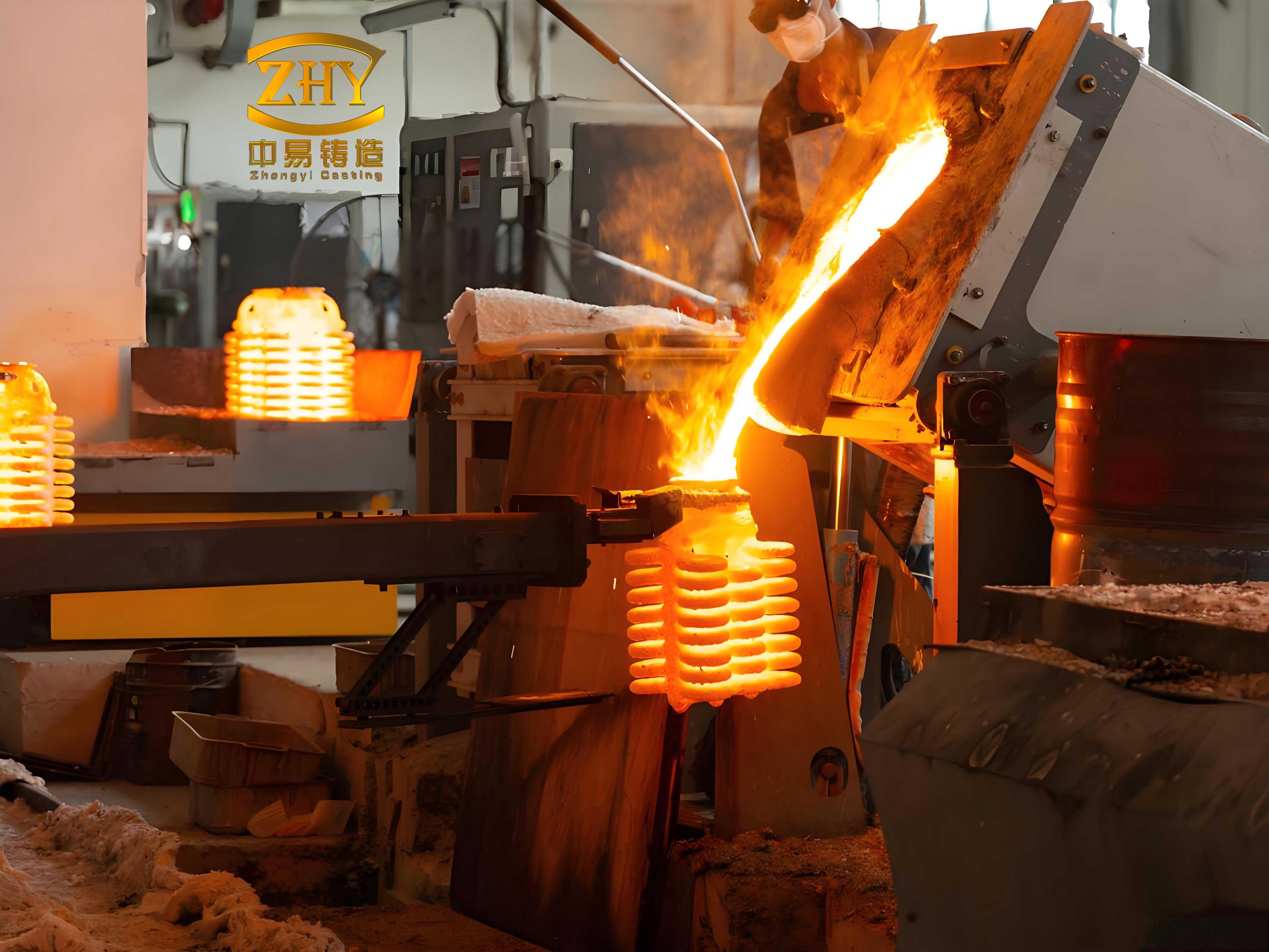
The pouring operation is the culmination of the investment casting process. We used CF8M stainless steel, which has a melting range around 1400–1450°C. To compensate for heat loss and ensure fluidity, the superheat was carefully controlled. The mold was removed from the furnace at a temperature exceeding 1000°C to minimize the thermal gradient. The molten metal was poured at 1620–1630°C. The filling time for the large cavity was approximately 120 seconds to ensure a smooth, turbulence-free fill. Immediately after pouring, within 30 seconds, the riser was topped up with additional hot metal and covered with exothermic insulating powder to prolong its liquid state and enhance feeding. The solidification dynamics in the investment casting process are governed by Chvorinov’s rule, which states that the solidification time \( t_s \) for a casting is proportional to the square of its volume-to-surface area ratio: $$ t_s = B \left( \frac{V}{A} \right)^n $$ where \( B \) and \( n \) are constants dependent on the mold material and metal properties. For our sun wheel, the thick blade roots (high V/A) were potential hot spots with longer \( t_s \), making them prone to shrinkage. To counteract this, we implemented a forced cooling strategy. After pouring, the casting was placed on a dedicated steel frame base, and compressed air was actively blown into the internal passages adjacent to the hot spots. This significantly increased the effective cooling surface area (A) for those sections, reducing their local solidification time and promoting directional solidification towards the riser. The heat extraction rate \( \dot{Q} \) from forced convection can be described by Newton’s law of cooling: $$ \dot{Q} = h A_s (T_s – T_\infty) $$ where \( h \) is the convective heat transfer coefficient, \( A_s \) is the surface area exposed to airflow, \( T_s \) is the surface temperature of the casting, and \( T_\infty \) is the ambient air temperature. By increasing \( h \) and \( A_s \) via forced air, we dramatically increased \( \dot{Q} \), accelerating solidification at the critical zones.
The entire investment casting process, from wax injection to post-pouring cooling, was monitored and controlled. After shakeout and cleaning, the sun wheel castings were thoroughly inspected. The results were highly satisfactory: the blade profiles were free from distortion, and radiographic and visual examination confirmed the absence of shrinkage cavities or porosity at the previously problematic hot spots near the ingate roots. The dimensional tolerances and surface finish met all customer specifications. This success validates the holistic optimization of the investment casting process for complex, heavy-section components.
In reflecting on the investment casting process for the sun wheel, several key factors contributed to our success. First, the adoption of a silica sol shell system provided the necessary strength and stability for large molds. Second, the gating system was designed based on thermal modulus calculations to ensure adequate feeding. Third, the innovative sequential dewaxing technique prevented shell failure. Fourth, optimized firing parameters ensured mold readiness. Fifth, and perhaps most critically, the implementation of controlled pouring coupled with targeted forced cooling directly addressed the root cause of shrinkage defects. The investment casting process is inherently versatile, but its successful application to challenging geometries like the sun wheel requires a deep understanding of heat transfer, fluid flow, and material science. We have demonstrated that through systematic design and process engineering, the investment casting process can reliably produce high-integrity castings for demanding applications. Future work may involve further refining the investment casting process through computational simulation of solidification and stress analysis to pre-optimize gating and cooling strategies for even more complex parts.
To generalize some of the principles, we can formalize the approach to hot spot mitigation in the investment casting process. The thermal condition for avoiding shrinkage in a section is that the local solidification time must be less than or equal to the time available for feeding from the riser. This can be expressed as: $$ t_{s,local} \leq t_{feed} $$ where \( t_{feed} \) is the duration the riser remains fluid. By applying forced cooling, we effectively reduce \( t_{s,local} \). The effectiveness factor \( E \) of forced cooling can be defined as the ratio of solidification times without and with cooling: $$ E = \frac{t_{s,without}}{t_{s,with}} $$ For our process, we aimed for \( E > 1 \) at the hot spots. Furthermore, the design of the gating system in the investment casting process must ensure minimal temperature gradients that favor directional solidification. The temperature gradient \( G \) at the solid-liquid interface should point towards the riser: $$ \nabla T \cdot \hat{r} > 0 $$ where \( \hat{r} \) is the unit vector pointing towards the riser. Our top-gating design naturally promotes a positive gradient from the casting bottom to the riser top.
In conclusion, the investment casting process, when meticulously planned and executed, is capable of producing near-net-shape components with exceptional quality. The sun wheel project served as a testament to this capability. Every step—pattern making, shell building, dewaxing, firing, and pouring—was interlinked and optimized. The repeated emphasis on the investment casting process throughout this article highlights its comprehensive nature. By sharing our experience, we hope to contribute to the broader knowledge base on advanced investment casting process techniques for heavy and intricate castings. The integration of empirical process control with fundamental engineering principles remains the cornerstone of excellence in the investment casting process.