
The manufacture of turbine blades for aerospace engines represents the pinnacle of modern industrial capability. These components, often termed the “jewel in the crown” of industry, are predominantly produced via the precision investment casting process. This method is critical for achieving the complex internal cooling channels and single-crystal metallurgical structures required for high-performance operation. The environmental conditions within the casting facility are not merely for occupant comfort; they are a fundamental process parameter that directly influences dimensional accuracy, surface finish, and ultimately, the yield rate of these high-value components. The heating, ventilation, and air-conditioning (HVAC) system, therefore, transitions from a supporting utility to a core production system. This article analyzes the unique load characteristics of such facilities and evaluates optimal cooling source configurations, drawing from the detailed simulation and design of a typical aero-engine turbine blade production plant.
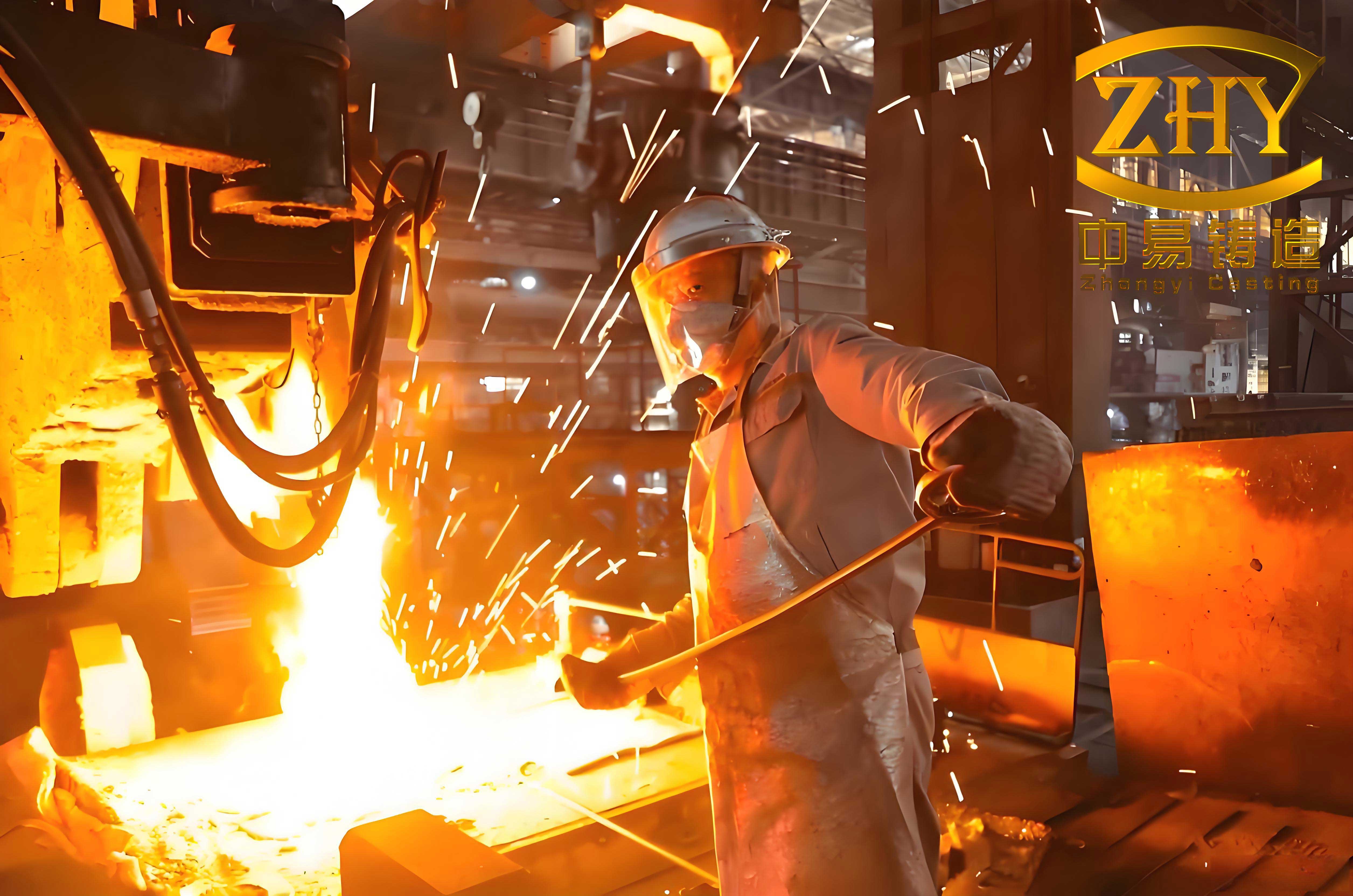
The precision investment casting process for single-crystal turbine blades involves a meticulous sequence: core preparation, wax pattern assembly, ceramic shell building, dewaxing, metal pouring and solidification, followed by an extensive post-casting process chain including shell removal, heat treatment, inspection, and finishing. Each stage imposes specific and often stringent environmental demands. Unlike conventional foundries, the environmental control extends beyond large-volume production halls to include clean, stable rooms for pattern making, shell building, and metrology. The HVAC system must manage significant and diverse internal heat gains from process equipment, handle large and constant exhaust air volumes for safety and quality, and maintain strict temperature and humidity setpoints in critical areas, all while minimizing energy consumption, which can constitute over 50% of a plant’s non-process energy use.
Environmental Requirements by Production Zone
The facility is segmented into zones with distinct environmental mandates, directly dictated by the needs of the investment casting process.
| Production Zone | Key Process | Environmental Requirement | Major Load Characteristics |
|---|---|---|---|
| Wax Pattern Shop | Injection, assembly, and correction of wax patterns. | Temperature: 22 ±1°C. Stable conditions are vital for wax dimensional stability. | High internal heat gain from wax injection machines. Significant local exhaust at workstations for fume removal (e.g., 24,000 m³/h). |
| Ceramic Shell Building | Automated dipping, stuccoing, and drying of ceramic shells on wax clusters. | Temperature: 22 ±1°C, RH: 50% ±5%. Critical for controlling shell drying rates and strength. | Moderate internal heat gain. High sensitivity to latent load variations; requires precise dew point control. |
| Precision Inspection & Metrology | Dimensional, radiographic, and metallurgical inspection of castings. | Temperature: 20 ±2°C, RH: 25-75%. Minimizes thermal drift in measuring equipment. | Moderate internal heat gain from equipment and lighting. High stability requirement. |
| Melting & Pouring / Heat Treatment | Metal melting, pouring, and solution heat treatment. | General ventilation for comfort and safety. No specific precision conditioning. | Very high radiant and convective heat gains. High exhaust requirements for fumes and heat. |
| Machining & Finishing | CNC machining and finishing of cast blades. | Comfort cooling: 18-28°C. | High sensible heat gain from machining centers. Better indoor air quality compared to melting areas. |
HVAC System Design Strategy
The diversity of requirements necessitates a zoned HVAC strategy. For precision zones (Wax, Shell Building, Inspection), a dedicated system is employed: a centralized Fresh Air Handling Unit (FAHU) with deep dehumidification capability, supplying conditioned fresh air to local Primary Air Handling Units (PAHUs). The PAHUs then mix this pre-conditioned outdoor air with room return air and provide final conditioning. This scheme, a variation of a dedicated outdoor air system (DOAS) with parallel sensible cooling, offers significant advantages for the investment casting process:
- Decoupled Latent and Sensible Load Handling: The FAHU manages the entire latent load from outdoor air and room humidity generation, cooling the air to a supply dew point often below 12°C. The PAHUs then need only handle the sensible load, primarily from equipment and lighting. This eliminates the need for, and energy penalty of, simultaneous cooling and reheating common in traditional single-zone systems.
- Improved Humidity Control: By centralizing dehumidification, control is more robust and responsive to changes in outdoor conditions.
- Contaminant Management: In the wax shop, the PAHU return inlets are placed away from fume-generating workstations. A separate 100% outdoor air unit supplements the general exhaust, ensuring negative pressure and preventing fume migration.
The air treatment process can be visualized on a psychrometric chart and is governed by the following energy balance. For the FAHU, the cooling coil load ($Q_{FAHU}$) is:
$$Q_{FAHU} = \dot{m}_{oa} \cdot (h_{oa} – h_{cc,ADP})$$
where $\dot{m}_{oa}$ is the mass flow rate of outdoor air, $h_{oa}$ is its enthalpy, and $h_{cc,ADP}$ is the enthalpy of air at the apparatus dew point (ADP) of the cooling coil. For a PAHU, the cooling coil load ($Q_{PAHU}$) is primarily sensible:
$$Q_{PAHU} \approx \dot{m}_{sup} \cdot c_p \cdot (T_{mix} – T_{sup})$$
where $\dot{m}_{sup}$ is the total supply air mass flow rate, $c_p$ is the specific heat of air, $T_{mix}$ is the temperature of the mixed air (pre-conditioned outdoor air + return air), and $T_{sup}$ is the supply air temperature.
For the high-bay Melting/Pouring area, due to immense heat loads and poor air quality, a 100% outdoor air system with targeted spot cooling for operator stations is most effective. The Machining area, with high sensible loads and better air quality, employs a stratified cooling system with high-velocity diffusers to condition only the occupied lower zone.
Annual Load Profile Analysis
A dynamic annual simulation using DeST software for a facility in Beijing (cold winter, hot summer climate) reveals the distinctive load profile of an investment casting process plant. Key findings are summarized below:
- Precision Interior Zones: Exhibit a nearly flat cooling load profile year-round due to dominant, constant internal heat gains from process equipment. Heating demand is minimal and brief. Crucially, these zones often require cooling even in winter, creating a simultaneous heating and cooling demand.
- Perimeter & Administrative Zones: Show a traditional seasonal profile, with heating demand in winter and cooling in summer, heavily influenced by solar gain and envelope transmission.
- System-Wide Demand: The plant frequently operates in a “four-pipe” mode, with cooling required in interior precision zones while perimeter zones may require heating, especially during swing seasons.
| Load Parameter | Value | Comment |
|---|---|---|
| Peak Cooling Demand | 4,059 kW | Driven by summer outdoor conditions + internal gains. |
| Peak Heating Demand | 2,044 kW | Driven by winter outdoor conditions and makeup air heating. |
| Minimum Simultaneous Cooling (Transition Season) | 559 kW | Cooling required for interior precision zones. |
| Minimum Simultaneous Heating (Transition Season) | 327 kW | Heating required for perimeter zones/air reheating. |
This load characteristic dictates that the chiller plant must be capable of stable, efficient operation at low loads year-round and that the system design should facilitate heat recovery between zones requiring cooling and those requiring heating where possible.
Cooling Source Configuration Analysis
The need to achieve low dew points (often 11-12°C) for dehumidification in the FAHU pushes the required chilled water supply temperature lower than typical comfort cooling (7°C). Three primary chiller plant configurations were analyzed to meet this challenge while optimizing energy use.
| Scheme | Configuration | Rationale & Key Feature |
|---|---|---|
| Scheme 1: Unified Medium-Temp Chillers + DX Boost | 3 x 1,400 kW chillers (7/12°C). FAHU has a direct expansion (DX) refrigerant coil for “deep” dehumidification. | Primary chillers run at efficient 7°C. DX coil acts as a “booster” to sub-cool air to required dew point only when needed, minimizing efficiency penalty. |
| Scheme 2: Unified Low-Temp Chillers | 3 x Chillers (6/11°C). No DX boost. | Lower chilled water temperature (6°C) provides sufficient coil capacity for dehumidification. Simpler plant but lower chiller COP. |
| Scheme 3: Split Plants | Precision Plant: 2 x 750 kW chillers (5/10°C). Comfort Plant: 2 x 1,400 kW chillers (7/12°C). |
Dedicated low-temp plant for precision zones. Dedicated medium/high-temp plant for comfort zones. High design flexibility but complex. |
The core thermodynamic trade-off is between chiller efficiency and coil capability. The coefficient of performance (COP) of a vapor-compression chiller is approximated by:
$$COP \approx \frac{T_{evap}}{T_{cond} – T_{evap}} \cdot \eta_{overall}$$
where $T_{evap}$ and $T_{cond}$ are the evaporating and condensing absolute temperatures, and $\eta_{overall}$ is an overall efficiency factor. Lowering the chilled water temperature (and thus $T_{evap}$) to enable lower coil temperatures directly reduces COP. Schemes 1 and 3 attempt to limit this penalty by isolating the low-temperature demand.
Energy Consumption Simulation & Comparison
A detailed annual simulation was conducted using TRNSYS to model the part-load operation of each scheme’s chillers, pumps, cooling towers, and auxiliary components. The results provide a quantitative comparison of operational energy consumption.
| Energy Consumer | Scheme 1 (kWh) | Scheme 2 (kWh) | Scheme 3 (kWh) | Notes |
|---|---|---|---|---|
| Chillers | 1,250,000 | 1,467,000 (+17.4%) | 1,390,000 (+11.2%) | Scheme 2 suffers from lower COP. Scheme 3 suffers from more part-load operation. |
| Pumps & Cooling Towers | 1,180,000 | 1,220,000 (+3.4%) | 1,670,000 (+41.6%) | Scheme 3 has two separate water loops, doubling auxiliary equipment. |
| FAHU DX Coil (Boost) | 85,000 | 0 | 0 | Energy for deep dehumidification in Scheme 1. |
| Total Annual Consumption | 2,515,000 | 2,687,000 (+6.8%) | 3,060,000 (+21.7%) | Scheme 1 is the most efficient. |
The simulation leads to several critical insights:
- Scheme 1 (Unified + DX Boost) demonstrated the lowest total energy consumption. The efficiency gain from running the main chiller plant at a higher evaporating temperature (7°C vs. 6°C or 5°C) outweighed the energy used by the intermittent DX boost coil for deep dehumidification.
- Auxiliary (Pump & Tower) energy is dominant and decisive. It constitutes nearly 50% of the total plant energy use in all schemes. Scheme 3’s significantly higher auxiliary consumption, due to parallel hydraulic systems, made it the least efficient overall despite having a dedicated high-COP comfort chiller plant.
- Part-Load Performance is Critical. The load profile of an investment casting process facility means chillers operate at partial load for much of the year. Schemes that allow chillers to operate near their design efficiency point (like the unified plant in Scheme 1, which can run fewer chillers at higher load) outperform schemes that force multiple chillers into low part-load operation (like the split system in Scheme 3).
- Reliability Considerations: While not directly quantifiable in energy, Scheme 1 and Scheme 3 offer redundancy. In Scheme 1, if the central chillers fail, the DX coil can provide essential dehumidification. In Scheme 3, failure in one plant does not affect the other.
Conclusion
The HVAC system for an aero-engine turbine blade investment casting process facility is a critical production support system with unique, demanding load characteristics. These include year-round cooling demands in precision interior zones, the need for very low dew point air for dehumidification, significant simultaneous heating and cooling requirements, and high internal heat gains. A successful design employs a zoned strategy, typically utilizing a DOAS-like configuration with pre-conditioned outdoor air for precision areas to decouple latent and sensible load handling.
The analysis of cooling source configurations reveals that for the modeled climate and facility load profile, a unified chiller plant operating at standard medium temperatures (7/12°C), supplemented by a DX booster coil in the fresh air handler for “deep” dehumidification duty, provides the optimal balance of energy efficiency, reliability, and capital cost. Crucially, the energy consumed by pumps and cooling towers is a major, often dominant, component of total plant energy use, emphasizing the importance of optimizing hydraulic design and control strategies alongside chiller selection. The specific optimal solution is dependent on local climate, utility costs, facility size, and the exact parameters of the investment casting process. Therefore, a detailed, climate-specific dynamic load simulation followed by a whole-system energy analysis of proposed schemes is an essential step in designing an efficient and reliable environmental control system for these high-technology manufacturing plants.